What Are the Best Full-Time MBA Colleges in India for Career Advancement?


Career advancement from an MBA standpoint isn't just about securing a higher salary upon graduation. It's the trajectory you unlock in the long run, such as the type of roles you enter, the companies willing to hire you, and an alumni network that compounds value for decades. Most applicants understand this but underestimate how sharply the institution they choose shapes each of these outcomes.
India has over 5,500 B-schools, but only a small number actually deliver on their promises. The difference between a Tier-1 MBA and an average program isn't just a pay gap; it's a trajectory gap. The starting salary difference between them is real, but the bigger divergence lies in the quality of roles students break into, access to senior leadership tracks, and the professional network they build in the program.
And while MBA employability in India rose from 47% in 2021 to 71% in 2024, employability and career advancement aren't the same thing. The institution you choose determines whether your MBA unlocks the careers you want or just leads to a credential with no real value. This article identifies the programs that consistently deliver great outcomes and explains exactly how to evaluate, target, and get into the one that fits your goals.
What Separates a Career-Advancing MBA from Just a Credential
These distinctions sound obvious in theory, but when choosing a program, most applicants still default to only comparing ranks and fees. The real differentiators have little to do with campus facilities or headline numbers. They come down to four factors that determine what kind of career your MBA degree actually enables.
1. Recruiter Quality Sets Your Career Ceiling
Firms like McKinsey, BCG, Bain, Goldman Sachs, JPMorgan, and the strategy divisions of major Indian conglomerates recruit almost exclusively from a defined group of Tier-1 institutions in India. These companies don't just offer higher starting salaries; they lead to senior management roles through early exposure to business problems, cross-industry challenges, and structured leadership acceleration relevant to today's industry. Hence, a more meaningful outcome to look for is how your first role enables and uplifts your entire career trajectory in the years that follow.
2. Placement Rate Is the Wrong Metric; Role Quality Is What Matters
As far as placements are concerned, every top B-school in India guarantees 100% placements, but most of these are self-reported without any external or independent evaluation. Which is why the headline salary figures for these colleges sometimes hide the ground reality of the job and the salary that students receive.
Thus, beyond a 100% placement rate, aspirants should evaluate where students are placed, what roles they perform, and whether recruiters believe in the institution enough to return every year. A placement program that consistently places students into high-growth, digital-first, revenue-focused roles delivers much greater long-term career value than one that simply protects placement statistics.
3. Industry Relevance of the Program
An industry-relevant program isn't just one with a current textbook. It's built around live projects, working professionals as faculty and mentors, and active partnerships with organizations that hire its graduates. Students who complete such programs don't need significant ramp-up time at work because they've already applied concepts in real contexts during the course. This is the difference between learning about business functions and being able to execute within them from day one on the job.
4. Long-Term Growth Trajectory Over First Salary
Going into an MBA without clear career goals is one of the most misleading decisions a student can make. A targeted career direction helps you choose the right program, and the right program puts you in the right first role. The compounding effect of that first role at the right employer is very difficult to replicate through individual effort later. The alumni network of a good MBA program is the engine that sustains this compounding long after graduation, and it's the underrated long-term asset that most applicants don't fully appreciate until they need it most.
Top Full-Time MBA Colleges in India for Career Advancement
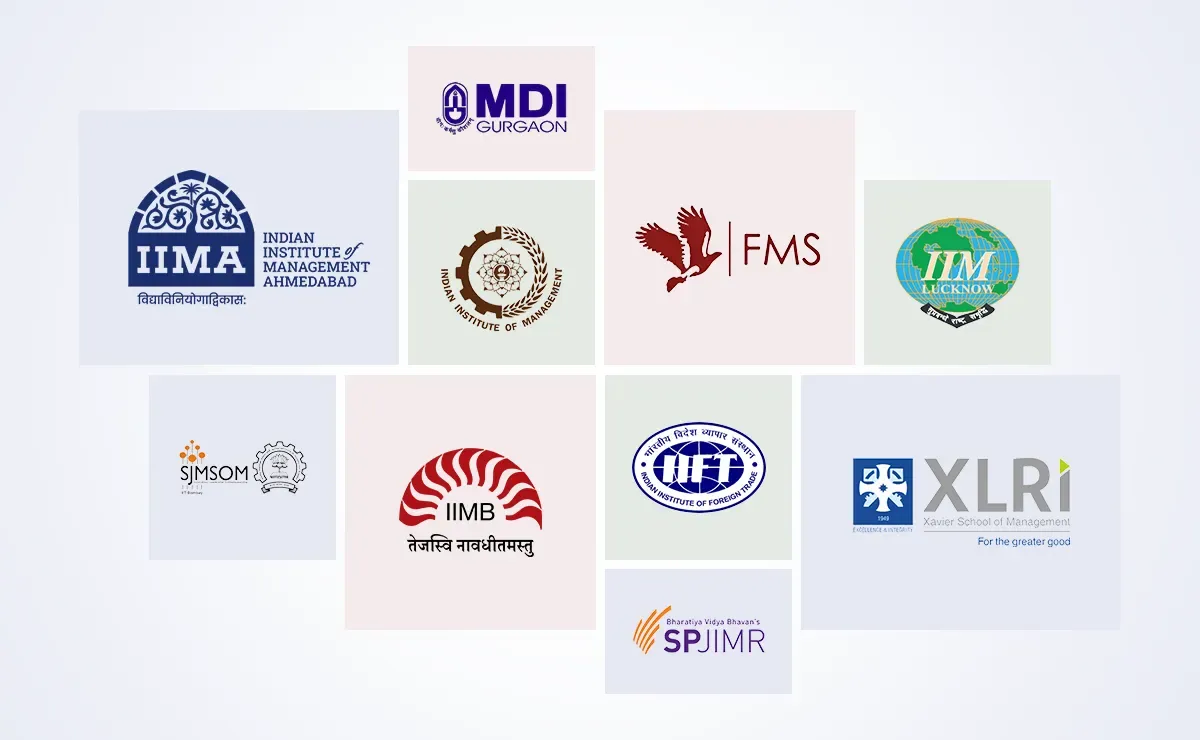
The table below lists some of the most sought-after colleges that offer the most consistent pipeline to leadership-track careers in India. The data below reflects each institution's latest published placement reports. Before making any decisions, verify all figures independently because they are subject to change.
Here is a list of 10 MBA colleges in India that you can consider because they continually receive the largest number of applicants because of their good reputation, competitive placements, and good returns on investment.
Note: The highest salary figure indicates potential but shouldn't be your main decision criterion. Median salary figures are a better indicator of the salaries that most graduates earn. Check all placement information against each institution's independently audited report before making a decision.
Getting In: What These Programs Actually Require
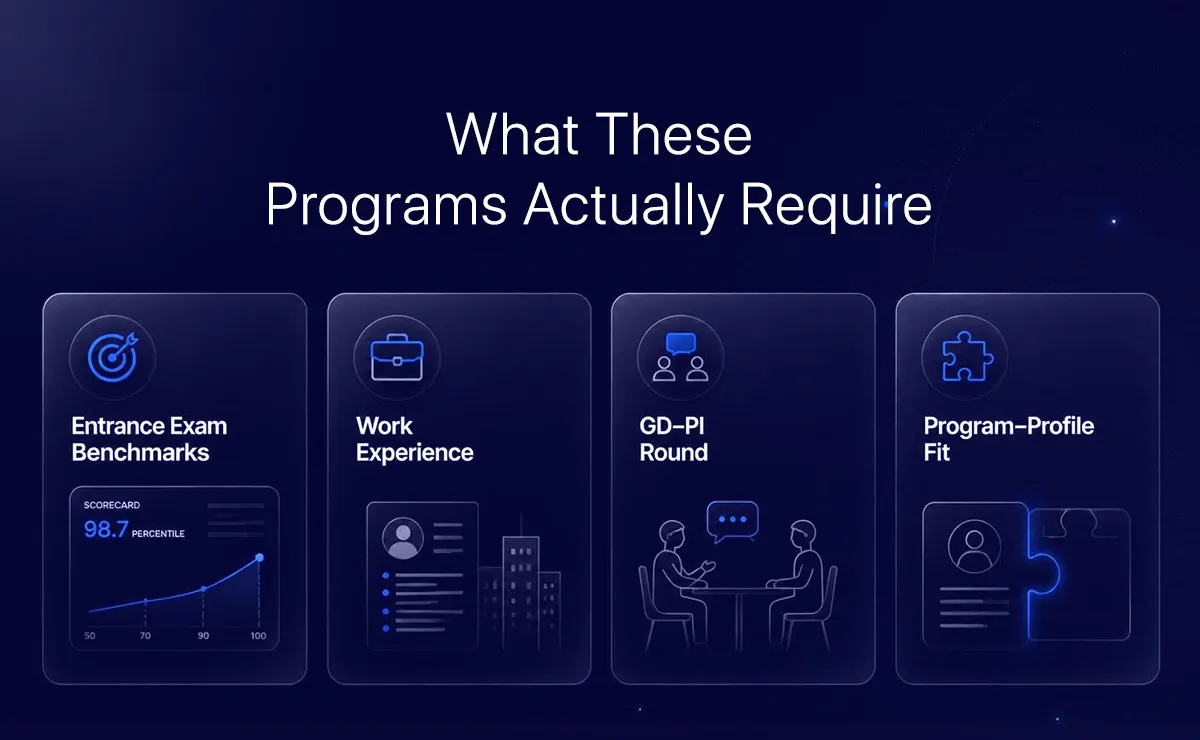
Identifying the right programs to target is the first challenge. The second step is getting in, which consistently demands more preparation than candidates anticipate. Most students who obtain admission to these institutions start earlier and prepare more deliberately than their peers.
Entrance Exam Benchmarks
Most of the programs on this list require a CAT percentile of 97 or higher. The 98th-99th percentile is required for admission to IIM Ahmedabad, IIM Bangalore, IIM Calcutta, and FMS Delhi. Written Ability Test scores are heavily weighted at XLRI, which uses XAT as its primary entrance exam. IIFT conducts its own entrance exam, while IIT Bombay accepts CAT scores but evaluates candidates holistically across subsequent profile rounds. Candidates who are competitive typically begin their preparation 12 to 18 months before the exam.
Work Experience Strengthens Your Application
Work experience isn't a formal eligibility requirement in a traditional 2-year MBA program, but it does help strengthen your application at both the shortlisting and GD-PI stages. Most competitive candidates seeking admission to IIM ABC have 1 to 3 years of experience. But remember, the outcomes and learning from your experience are considerably more important than the duration of your job. Having measurable outcomes, cross-functional responsibilities, or early leadership capabilities in your current role can differentiate you from similar candidates with identical percentile scores.
GD-PI Is Where Admission Is Won or Lost
A strong entrance exam helps open the door to top MBA colleges in the country, but factors like the Written Ability Test, SOPs, and personal interview are what determine whether you receive an offer. Candidates who stand out don't just perform well in isolation; they tell a clear, consistent career story that connects their past experience to their MBA choice and their post-MBA goal in a way that feels specific and targeted to the program they're applying to.
Match Your Application to the Program's Strengths
Each program on this list has genuine, demonstrable strengths in specific career areas. Hence, if a student enters the admissions process with a goal that does not align with the program's USPs or outcomes, it signals a clear mismatch that admissions committees notice. The cleanest way to stand out during GD-PI is to apply to programs whose strengths align directly with your stated career ambitions and to articulate specifically why that program is the right home for the career you want to build.
Conclusion
Deciding to enter a full-time MBA should not be viewed as a quick and easy way to a better paycheck. It's a lifelong investment that adds year after year because of the clarity of your first job, the industries that you pursue, and the network of professionals that you develop. The true value of an MBA is not immediately apparent on the first day of your job. It compounds itself through the potential you show over the long run.
The ten programs on this list differ meaningfully in fees, strengths, and the careers they best serve. IIM Ahmedabad leads in consulting and general management; IIM Calcutta is the finance destination; FMS Delhi delivers unmatched ROI; IIFT offers international business careers, and MDI Gurgaon provides exceptional corporate access in the Delhi-NCR region. Hence, the right choice isn't the program ranked highest on a generic list or forum; it's the one most aligned with the specific goals and career you want to achieve.
Employer demand for management graduates with analytical, cross-functional, and digital capabilities continues to grow across consulting, finance, technology, and FMCG. Hence, evaluate each and every program honestly, apply strategically, and start preparing earlier than you think you need to.