
Are There Any Good MBA Colleges That Accept XAT Scores Below the Top Percentiles?


There's a widely held belief among MBA aspirants that scoring below the 97th percentile in XAT is practically the end of the road. Well, it isn't, and in fact, many highly reputed B-schools across India admit candidates with XAT scores in the 85-95 percentile range. Institutes like XLRI Jamshedpur, MICA Ahmedabad, IMT Ghaziabad, IMI Delhi, Great Lakes Chennai, and FORE School of Management are all on that list.
Here is what aspirants don't realize: entrance exams open the door to top management institutes, but they don't guarantee admissions. Top B-schools evaluate candidates based on their entire profile, right from their academic background, work experience, and statement of purpose to how they carry themselves in the interview.
This is because the institute realizes that they are not just selecting students but building a cohort that will go on to define the next generation of businesses and leaders in the industry. And that requires selecting students based on more than just their test scores.
Hence, beyond performing well on tests, students must also focus on developing their overall profiles. If you have a relevant story to tell and have your priorities straight, like gaining skills, real-world exposure, and targeted employment outcomes, then a slightly lower percentile won't limit your options.
What Strong MBA Programs Really Look for in a Candidate

The 97+ cutoff is the entry bar for a handful of the country's most elite programs. But beyond those colleges, there is also a wide and genuinely strong tier of B-schools that admit students and still deliver stellar career outcomes.
There are many programs that focus less on filtering scores alone and more on choosing candidates based on their overall profiles. The reason is simple. They are not just choosing candidates for a program but also preparing the leaders and managers of the future. And to be a successful leader, you don’t just need academic excellence but also soft skills, presence of mind, the ability to influence, etc., and these cannot be measured by one XAT percentile.
Hence, the factors that move the needle on your career include:
- Curriculum relevance: A program built around current industry demands is far more likely to produce employment-ready graduates.
- Industry alignment: Faculty practitioners who bring in real business insight into the classroom, along with live projects and internship opportunities, make learning better.
- Placement quality: It is important that an MBA program actually offers the roles aligned with your career goals. Find out whether the program you choose is preparing you for the careers you want to break into.
Understanding these levers helps you evaluate B-schools with far more precision than percentile cutoffs alone.
Top MBA Colleges Accepting XAT Scores Below the Top Percentile
The following table covers eight reputed MBA and PGDM programs across India that accept XAT scores below the 97th percentile.
How MBA Colleges Evaluate Candidates Beyond XAT Percentile
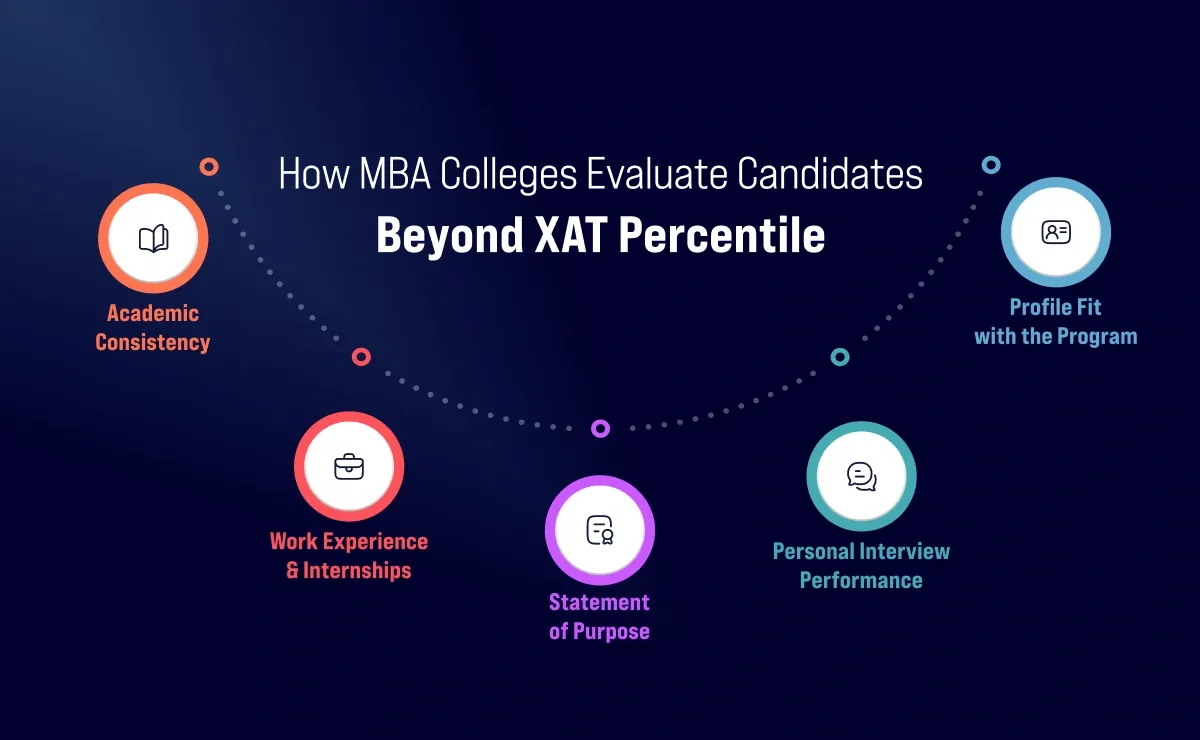
While a good XAT score can help you secure a shortlist, it isn't enough to secure admission on its own merits. There are examples of students who scored near-perfect scores being rejected and others with slightly lower percentiles being accepted. The difference between them lies in the quality of their entire profile, and that is why B-schools take into consideration the following factors:
1) Academic Consistency
If you consistently perform well across classes 10 and 12 and in graduation, it indicates that you have the ability to sustain academic pressure over time. Moreover, a steady upward trajectory in your results each semester shows that you are reliable and have the potential to improve.
On the other hand, even a dip in one of your results with a credible explanation doesn't disqualify you, as the admissions committee understands that external factors sometimes intervene, even for the best performers. So, if you continue to show improvement throughout, that is what will make you stand out.
2) Work Experience and Internships
B-schools in India usually do not require work experience as a prerequisite for admission to the traditional 2-year MBA. But having so does improve your entire profile and enhance your chances of admission.
Professional exposure adds a practical dimension to your application and demonstrates that you can engage in meaningful discussions with your peers and mentors by applying what you have learned so far in the classroom. It also improves the overall quality of education for the entire cohort. This is why B-schools value work experience and view such candidates more positively.
3) Statement of Purpose
The SOP section of your application is one of the most important factors that determine your admission to a top B-school. It gives you the opportunity to explain your motivations, outline your career goals, and connect your past experiences to the program you're applying to.
SOPs help the admissions team evaluate how well you know yourself, your career goals, and your commitment to succeeding in the program. A well-thought-out SOP also helps make up for a slightly lower percentile, but only if it's written honestly, with clearly founded and verified examples from your life.
4) Personal Interview Performance
The interview process is again a very important and decisive stage of your admissions. It helps evaluate a candidate's nuanced capabilities that exam scores or other relevant documents can't capture.
Candidates who can communicate well, articulate their thought process, and handle pressure during the interview demonstrate that they are well-suited to handle the rigor of the program. It also tests your authenticity, confidence, and willingness to get into the program, so preparing well for this stage is very important.
5) Profile Fit with the Program
Ultimately, every program is different, with specific focus areas and offerings that set it apart from other B-schools. So, the admissions teams want candidates whose profiles genuinely align with that direction as well.
If you're applying to a marketing-focused program from a finance background, you'll need to make a compelling case for why that shift makes sense. Institutes are not only looking at your past, but they are also deciding if you will be an asset to the classroom and if you will make the most of the curriculum.
Conclusion
Scoring in the top percentile on the XAT is very important, but so is focusing on other aspects that make your profile attractive. Many high-quality, high-ROI programs across India admit students in the 85–95 percentile range and consistently produce graduates who go on to build impressive careers.
What matters far more than the percentile is whether the program you choose delivers the right combination of curriculum relevance, industry exposure, practical learning, and placement support.
The shift happening across leading B-schools is worth paying attention to as more of them are evaluating candidates by weighing academic consistency, work experience, SOP quality, and interview performance alongside test scores. That's good news for well-rounded candidates who may not have had their best day in the exam hall. Your potential as a manager is more than a number, and the right program will recognize that.
Choose carefully, evaluate honestly, and focus on the outcomes that matter most to your long-term career—not just the name on the degree.