Can a 1-Year MBA Help You Reach a Brand Manager Role Faster?


Brand management is a highly sought-after, competitive, and lucrative career path in modern marketing. A brand manager sits at the intersection of strategy, consumer psychology, creative execution, and business performance. Fresh graduates or management trainees typically start at ₹5-₹7 LPA, but post-MBA entry roles, such as assistant brand managers, immediately jump to ₹12.8–₹14.1 LPA.
This means that an MBA does help you reach brand manager roles more quickly. But is there an even faster route to break into this role, especially for those who are clear about pursuing this path? For them, a more nuanced answer is that a targeted one-year MBA helps you achieve this goal even faster. Let's explore how through this article.
Brand Management Is Not an Entry-Level Marketing Role
Brand management is a highly sought-after, competitive, and lucrative career path in modern-day marketing. A brand manager sits at the intersection of strategy, consumer psychology, creative execution, and business performance. The role covers how a product is perceived, priced, positioned, and grown over time, and to do so, they coordinate across sales, creative, and distribution teams, often simultaneously.
Hence, companies hiring for this role, especially in FMCG, set a high bar at the point of entry. They expect candidates to arrive with a working understanding of the function, which makes it difficult to break into without deliberate, targeted preparation. It is also why the educational path you choose matters so much at this stage.
To understand the preparation you need, it helps to first know what the role involves. Brand managers are responsible for:
- Brand Strategy: Deciding how a product should be positioned, what it stands for, who it is for, and what sets it apart from competitors.
- Advertising and Campaigns: Briefing creative agencies, overseeing shoots, managing messaging, and ensuring consistency across all communication touchpoints.
- Consumer Research: Studying buyer behavior, tracking market trends, and translating data into actionable brand decisions.
- Pricing and Packaging: Understanding how small changes in price point or packaging affect consumer perception and product performance.
- Cross-Functional Coordination: Working across sales, product, and creative teams to ensure alignment between how a product is built and how it is communicated.
Every one of these decisions carries downstream consequences for how a product performs commercially, which is why companies set high standards, as a misaligned brand strategy can do real, measurable damage to market position and revenue.
The Skills That Actually Get You Hired
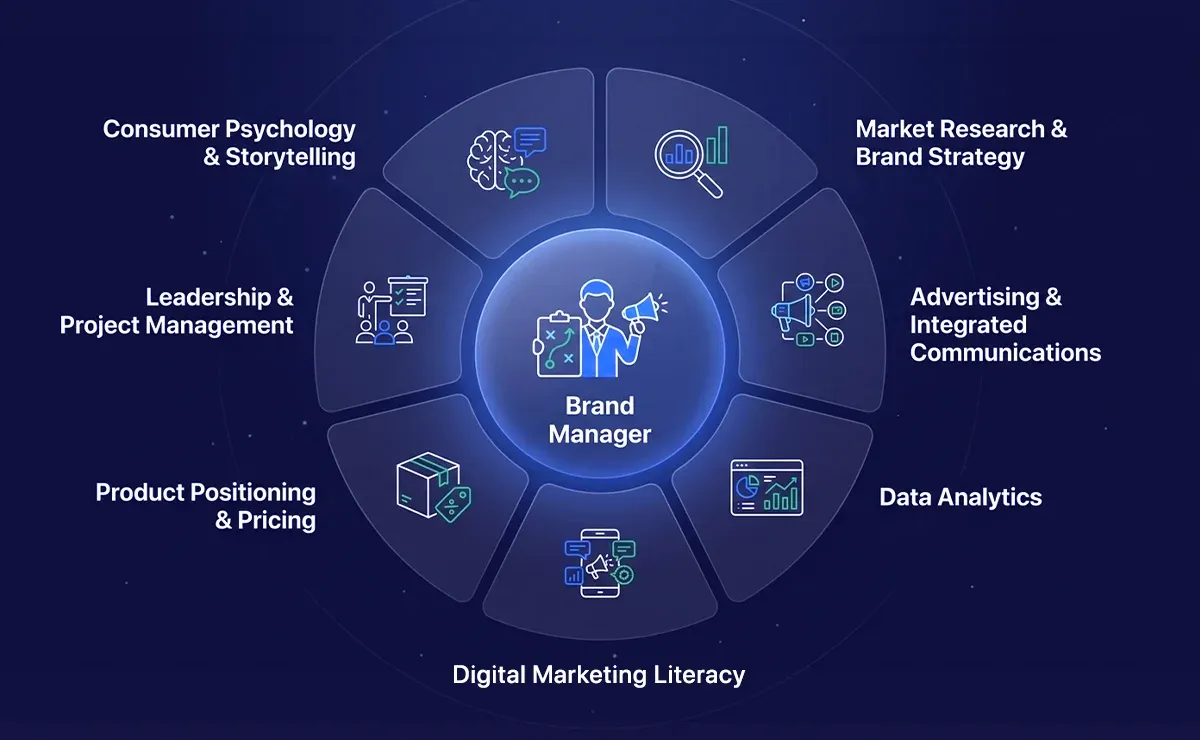
Note that the skills mentioned below are very difficult to develop passively through general work exposure, as they require structured, applied learning.
- Consumer Psychology and Storytelling: Understanding what drives purchase behavior and communicating a brand's narrative in a way that connects emotionally and motivates action.
- Market Research and Brand Strategy: Gathering meaningful consumer and competitor insights and translating them into a clear, defensible strategic direction for the brand.
- Advertising and Integrated Communications: Briefing and managing agencies effectively, reviewing creative work with a trained eye, and overseeing campaigns from brief to execution.
- Data Analytics: Interpreting campaign metrics and market data to evaluate what is working, what is not, and what decisions need to follow.
- Digital Marketing Literacy: Understanding how social media, performance marketing, and SEO function as tools for brand-building in today's environment, not just in theory.
- Product Positioning and Pricing: Identifying where a product fits in the competitive pricing landscape and how to maximize both perception and revenue.
- Leadership and Project Management: Managing timelines, coordinating cross-functional teams, and navigating multiple stakeholders with confidence and clarity.
Developing these skills requires more than intuition and business exposure. It requires a curriculum specifically designed to achieve these outcomes, making a good MBA program definitely the key to success.
Two Roadmaps to Brand Management Role
There are two well-established routes into brand management, and they differ substantially in pace and structure.
Path 1: The MBA Route
Graduation → MBA in Marketing → Management Trainee → Assistant Brand Manager → Brand Manager
This is the faster, more structured path. After completing an MBA, companies hire graduates directly as management trainees. Within a year or two, you step into an assistant brand manager role, and from there, the progression to brand manager is relatively clear. Most people on this path reach the brand manager title within 3 to 5 years of graduating, with starting salaries ranging from ₹18.2 to ₹20.1 LPA.
Path 2: Without an MBA
Graduation → Sales or Marketing Executive → Digital Marketing / Product Marketing → Marketing Manager → Brand Manager
This path is equally real, but it is significantly longer. You gain ground-level sales and marketing experience over many years, gradually gaining consumer insight, campaign exposure, and business acumen to succeed in the role. The timeline typically runs for 6 to 8 years, and entry-level salaries range from ₹3.6 to ₹4.2 LPA.
The Shortcomings of the Traditional 2-Year MBA Route
The 2-year MBA in marketing has long been the default recommendation for brand management aspirants, and at top FMCG companies, this credential still carries weight. However, many traditional MBA programs have not kept pace with how brand management is practiced today.
B-schools continue to teach legacy-brand theory, traditional consumer behavior models, and outdated campaign-planning frameworks. However, a brand manager role today requires candidates to be fluent in digital channels, performance marketing, consumer data interpretation, and integrated marketing execution.
In traditional marketing curricula, these competencies are addressed inconsistently, resulting in graduates who hold the credential but lack the functional depth companies are hiring for.
This structural gap has given rise to a distinct 1-year MBA and PGP programs built specifically around modern marketing and brand management functions. Rather than covering general management in full, these programs focus entirely on marketing, especially how modern marketing functions and what it requires.
How 1-Year MBAs/PGPs Help Reach Brand Management Roles Faster
Here is how a targeted 1-year MBA helps reach brand management roles faster:
- Credentials Open Doors: In industry hiring for senior roles, credentials are often the first filter. Years of strong work experience, however valuable, do not replicate this access in the same timeline. A credible 1-year MBA or PGP gives candidates entry into this pipeline, and that access alone can compress the journey into brand management by several years.
- Concentrated Learning: Building readiness for a brand manager role is challenging through natural progression. Depending on the company, you do gain access to skills with time, but it is scattered and rarely produces comprehensive coverage of the full function. This is where a well-designed 1-year format helps provide structure to the whole process. Students graduate with an end-to-end understanding of the function, rather than fragmented, role-specific exposure that builds slowly.
- Earlier Career Compounding: Entering brand management at 23 or 24 rather than 28 or 30 has significant compounding career implications. Every year spent in this position builds expertise, leadership credibility, and demonstrable business impact. And by starting early, with a strong foundation, one is more likely to achieve senior brand manager and category leadership positions much sooner.
Not All 1-Year MBAs Are Built for Brand Management: Program Fit Matters
1) 1-Year MBAs Are a Serious, Rigorous Format
It is worth noting that a 1-year MBA is not a shortcut version of a 2-year program. At their best, these programs compress the most critical elements of management education into a high-intensity, highly focused year, with the added benefit of producing more targeted, efficient, and closely aligned graduates who can succeed in their intended roles. They represent a maturing category of business education, which is why most 1-year MBA programs in India are executive-level.
2) Most 1-Year MBAs Are Still General Management Programs
The most important nuance of this article is the fact that most 1-year MBAs are still general management programs unless they focus on a specialization. Generic 1-year MBAs still cover finance, operations, strategy, HR, and marketing, giving each function roughly equal coverage throughout the year.
Marketing typically appears either as a module within a broader core curriculum or as an elective available at a later stage of the program. For someone aiming to break into brand management roles, this structure provides a solid business foundation but insufficient functional depth.
3) Choosing Without Checking Program Fit Is Risky
Students sometimes choose 1-year MBA programs based on general reputation or overall rankings, without verifying whether they actually produce marketing-specific role outcomes. A student targeting brand management but enrolling in a well-regarded general management program may graduate with excellent, broad business skills yet find themselves underprepared for the practical demands of the role. You eventually enter the role through the right career choices, but again, it costs time.
What to Actually Look for in a 1-Year Program for Brand Management
Before committing to any program, students targeting brand management should examine four things specifically:
- Curriculum Depth: Is marketing the core of the entire program, or is it one elective track within a broader general management curriculum?
- Faculty Profile: Do practicing brand managers and marketing leaders teach and shape the program, or is it driven primarily by academic faculty?
- Placement Specificity: Do placement outcomes include actual brand management, category management, and growth marketing roles, or are marketing roles bundled into broad, mixed-function placement statistics?
- Project Exposure: Do students work on real-life brand and business problems throughout the program, or only on case studies and textbook exercises?
A program that cannot give specific, role-level answers to these four questions deserves scrutiny before you commit your resources to it.
Altera Institute: A Brand Management Ready 1-Year Program

Within the 1-year MBA/PGP criterion, Altera Institute's PGP in Applied Marketing stands out as one of the clearest examples in India of a 1-year program structured entirely around modern marketing functions, rather than treating marketing as an elective.
It was designed in direct response to what organizations need from marketing graduates today. The coursework covers brand strategy and consumer insight, digital and performance marketing, product marketing and go-to-market strategy, analytics and data-driven decision-making, and revenue-linked thinking.
Its faculty is entirely composed of working professionals and marketing leaders. Students work on live projects with real companies throughout the year, graduating with a portfolio of applied work, exactly what recruiters want.
What makes this model particularly relevant for brand management aspirants is the specificity of its placement outcomes. Graduates land in brand and category management, growth and performance marketing, product marketing, and revenue roles at companies including Amazon, Flipkart, HUL, Godrej, Nykaa, Mamaearth, Blinkit, Wella, and Plum.
The alumni outcomes also reflect this reality. Role distribution for the Class of ‘25 report:
- 35% secured roles in eCommerce
- 24% joined founder’s office or EIR positions
- 12% moved into growth and revenue roles
- 9% entered product management
- 9% were placed in brand management.
- And 11% joined FMCG sales and marketing functions
For students who are still mapping out which direction to take within the broader management education landscape, Altera Institute offers a genuine, structured, and highly targeted pathway to a career in brand management.
Summing Up
In conclusion, yes, a 1-year MBA can help you reach brand management faster, but it depends entirely on whether the program you choose is actually built for that outcome.
A marketing-focused 1-year MBA provides targeted learning, delivers the MBA credential, and provides access to recruiter pipelines that can move a student from graduation to a brand management role in a fraction of the time the non-MBA path requires. For students who are clear about their destination, the format offers a compelling combination of depth, speed, and career ROI.
The decision that matters most is not whether to pursue a 1-year or 2-year program. It is whether the 1-year program you are considering actually prepares you for brand management roles.
For students ready to make that move with intention and clarity, exploring programs like Altera's PGP in Applied Marketing, structured specifically for modern marketing careers, including brand management, is a sensible and well-evidenced next step.