Is Doing a 1-Year MBA Really Worth it for Career Growth?


Management education in India is shifting, with 1-year MBAs, PGDMs, and PGP programs moving from niche alternatives to serious, mainstream choices for professionals seeking quicker career progression.
Globally, accelerated MBA formats have existed for quite some time, and now in India, that momentum has picked up considerably. Programs like ISB, Great Lakes, XLRI, SPJIMR, and a growing number of newer institutions like Altera Institute and Master Union have created their own 1-year formats, as they realize it is quickly becoming a top choice for early and mid-career professionals in the country.
When it comes to investing in education, MBA aspirants today want to make more informed decisions. They take into account the opportunity cost, loan repayment schedules, job quality, and the future relevance of what they will learn and compare it to the time and expense they will spend. This way, they can develop a realistic career growth trajectory and expect outcomes based on a holistic evaluation of a program.
Hence, an accelerated 1-year program that delivers career advancement that is most aligned and realistic for students is becoming popular today. But how do you evaluate whether a program delivers the desired results?
The answer depends on the quality of the curriculum, the depth of the placement ecosystem, the caliber of the faculty, and how clearly a candidate knows where they are headed. This article breaks down each of those factors so that students can evaluate whether a 1-year program is really worth it for career growth.
The Rising Popularity of 1-Year MBA Programs
1-year MBA programs tend to be more rigorous due to their accelerated duration. A traditional two-year MBA requires candidates to step away from work for 2 years straight, which is a significant opportunity cost to forgo for anyone already earning a competitive salary. This is one of the reasons why early and mid-career professionals are choosing the 1-year format:
- Time out of the workforce drops from 2 years to 12-15 months
- Total tuition and living costs are substantially lower
- Career progression and return on investments are achieved faster
- New skills get applied sooner, while they are still current
The demand side of MBA graduates reinforces this strategy as well. Today, recruiters rarely care about the duration of an MBA, as long as candidates can demonstrate job readiness and skills for the roles they are applying to. In this regard, 1-year MBAs are performing well because their graduates arrive with targeted domain knowledge and require less on-the-job training.
The curriculum is another reason why 1-year MBAs are becoming increasingly popular. Many colleges today have shifted their focus towards creating specialist 1-year programs in India. Instead of broad generalist management curricula, these programs focus on providing practical learning and upskilling in targeted domains such as digital business, product management, growth strategy, and analytics.
This is especially beneficial for professionals with clear career goals who want to gain targeted upskilling in the roles and industries they aim for. Ultimately, these specialist 1-year courses do a better job at creating career growth outcomes that are more focused and efficient to attain in the long run.
How Do 1-Year MBA Programs Help with Career Growth?
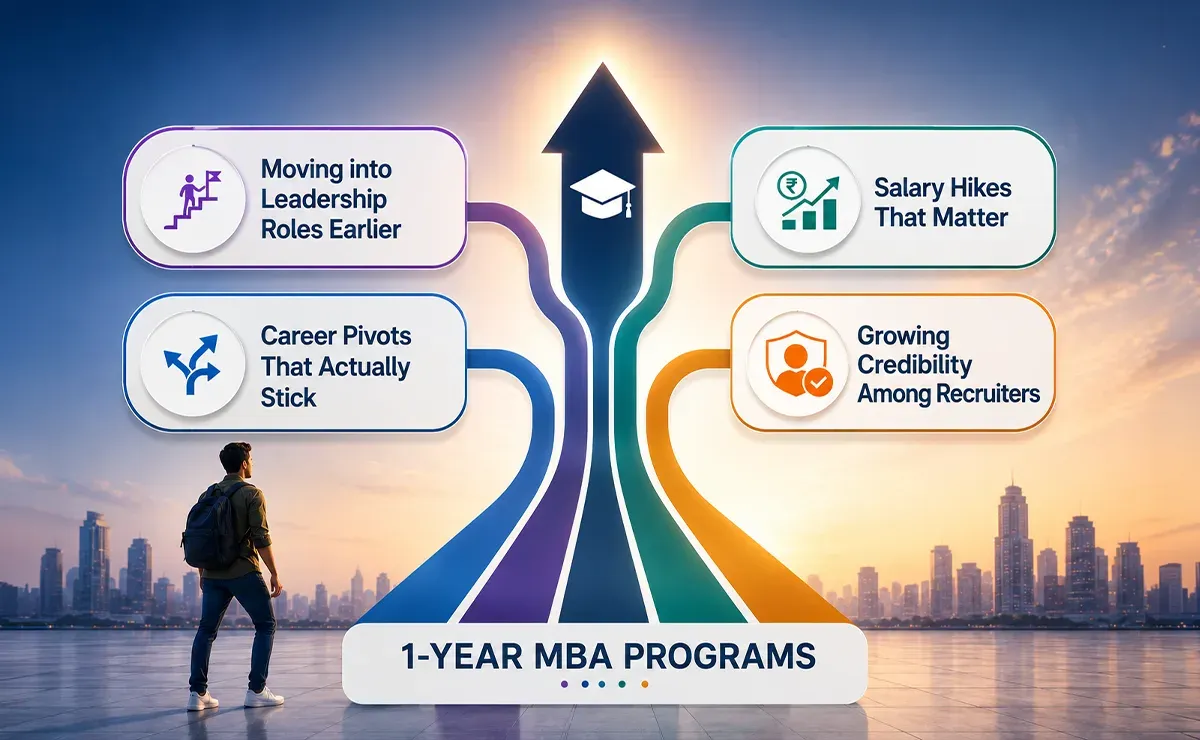
A well-designed 1-year MBA program helps advance careers beyond immediate salary increments. Here are instances where the impact is most consistently visible.
1) Moving into Leadership Roles Earlier
Many professionals tend to hit a ceiling after three to five years of their roles. They possess strong execution skills but lack business vocabulary, cross-functional exposure, and strategic thinking necessary for senior-level roles. In this regard, a 1-year MBA can speed up that transition. The intense, focused learning environment in finance, marketing, operations, analytics, and organizational leadership changes the way candidates approach business issues, making them successful candidates for jobs they may otherwise have taken years to attain.
2) Career Pivots That Actually Stick
Changing industries or functions without a supporting credential is genuinely difficult. A 1-year MBA helps provide the credibility and structured knowledge students need to make that pivot. This way, breaking into strategic skill-driven roles in marketing, product management, growth marketing, and business strategy becomes viable. Candidates who already bring some transferable skills tend to make the most of this situation, while accelerated programs fill in any knowledge gaps.
3) Salary Hikes That Matter
A hike in salary data supports the case for well-chosen accelerated programs. Professionals with relevant experience typically see salary increases of 30-50% after completing a 1-year MBA from a reputable institution. For example, ISB's PGP reports that graduates see an average salary increase of 247% within 3 years of completing the program. Similarly, newer institutes in this space, like the PGP in applied marketing offered by Altera Institute, also reported a 3.2X salary hike for its PGP class of ‘25, signaling clear salary advancement.
4) Growing Credibility Among Recruiters
As mentioned before, recruiters today rarely care about the duration of an MBA program, provided students can demonstrate the skills and competencies they need for the roles they are targeting. This means that skills and experience today clearly outweigh duration, format, and even brand name, making 1-year MBAs truly desirable without the job market questioning their credibility when compared with a traditional 2-year MBA. Reputable 1-year MBA programs also attract top companies and recruiters, making their outcomes comparable to many traditional 2-year MBAs.
Where Do 1-Year MBA Programs Fall Short?
The same intensity that makes a one-year MBA attractive is also what makes it the wrong fit in certain situations. Being clear about these limitations before applying is worth more than discovering them after.
1) No Room for Career Exploration
A 2-year MBA program gives students more time to explore areas where they may have natural talent or interests. This, in turn, helps them make the right choice when selecting a specialization for their second year. But in 1-year MBA programs, students are usually expected to arrive with a clear sense of what they want to achieve through this program. And because 1-year programs directly start with targeted specialization rather than building foundational business knowledge, there is no room for students to change their minds or explore other areas later.
2) Program Quality Differs Significantly
Not all 1-year MBA programs are the same. Some are not as deep or well-organized as they should be in terms of curriculum, faculty credibility, and placement infrastructure to justify the outcomes. Others may simply condense the traditional 2-year MBA pedagogy into a single year, without actually offering any industry relevance, specialized domain expertise, or practical learning formats that define the core of 1-year MBAs in India. Hence, selecting a credible 1-year MBA can be difficult, especially given the widespread disinformation in the market.
3) Career Clarity Is a Prerequisite, not a Bonus
A one-year MBA works best for candidates who already know the industry they want to enter and the roles they are targeting. Without that clarity, even a strong program can produce graduates who are well educated but professionally undirected. The credential does not substitute for knowing what you want to do with it. If you are not sure yet, the more useful first step is to build that clarity before committing to a 1-year program.
What Makes a 1-Year MBA Truly Effective for Career Growth?
Given how widely program quality varies in India, the effectiveness of a one-year MBA depends more on what a specific program is designed to do than on its duration. The programs that consistently produce strong career outcomes tend to share a few specific characteristics.

1) Their curriculum is built around modern business requirements
Recruiters in 2026 are not looking for generalist MBA graduates but specialists who understand digital business models, have relevant domain-specific skills, and are comfortable with AI-integrated workflows. About 36% of Indian employers plan to hire specifically to keep pace with digital change in their organizations, which is why a curriculum that has not kept pace with these realities is preparing candidates for a job market that no longer exists.
2) They have both industry professionals and academicians in their faculty
There is a real difference between learning from someone who has studied a business problem and someone who has actually solved it. In fast-moving domains like marketing, product, and digital business, curricula taught exclusively by career academics tend to lag behind the demands of the real world. Programs that bring in startup founders, growth leaders, former CMOs, and operators as core faculty significantly close this gap.
3) They are known for providing a practical learning environment
There is a significant desirability gap between MBA graduates with extensive theoretical knowledge of strategy and those who can actually execute it in practice. Which is why programs that integrate live projects, real-world assignments, and client-facing work give students something concrete to show to their recruiters. For early-career professionals with limited experience, a portfolio of actual work can make a significant difference in the hiring process, particularly in roles that screen for demonstrated ability to execute.
Conclusion
1-year MBA programs have rightfully earned their growing relevance in India. It is not because they are faster or cheaper to pursue but because they are designed around current market realities expected from fresh graduates today.
Furthermore, a 1-year format only works if the institution is genuinely committed to providing a curriculum that is relevant, offers real-world experiences, and results in placement outcomes that meet quality standards and align with industry. Without meeting these conditions, a 1-year program simply does not cater to today’s industry for which it is designed.
Businesses in India are moving toward digital-first organizations, analytics-driven decision-making, and valuing execution over qualifications. Hence, accelerated management programs built to address these realities are not a lesser version of a traditional business education. They are, increasingly, the version that prepares you for what is destined to come next in the industry.