Why Students Choose Altera Institute Over Traditional MBA Programs

In 2026, does a B-school's brand name matter more than what it actually prepares students for? For decades, the answer was indeed that a strong brand name meant stronger placement outcomes, and the rest of the career was assumed to follow.
And rightly so; that assumption has a real foundation. India's management education dates back to 1953, when the Indian Institute of Social Welfare and Business Management was founded in Calcutta. IIM Calcutta and IIM Ahmedabad followed in 1961, built in partnership with MIT Sloan and Harvard Business School with support from the Ford Foundation.
It was these institutions that trained generations of managers for a business world that looked very different from what it is today:
- Hierarchies remained stable, and functions stayed in their lane
- Campus pipelines and alumni networks were used for hiring
- The same syllabus could remain relevant for years without having to be revised
- AI and digital tools were rarely included in the core curriculum
The world has moved faster than most MBA curricula could keep up. As a result, more and more students compare their options with these shifts in mind, not as one big brand decision, but as a series of specific, comparable questions about the actual process of building a career.
This article doesn't offer a single verdict on Altera Institute versus a traditional MBA; instead, it weighs five specific bets a student makes, one at a time.
Why the Traditional MBA Stopped Being the Safe Bet
Employability figures are the most direct evidence that the old paradigm is dead. In India today, only around 7% of MBA graduates are meeting employer expectations, and wider studies have shown that only half of the management graduates are actually job-ready.
The gap is a mismatch between what's taught and what companies actually need in today's business world. The jobs out there require managers to move effortlessly between product, growth, and analytics. The traditional education model still teaches finance, marketing, and ops as three distinct tracks.
Most MBA curricula still treat AI literacy and digital strategy as electives rather than core skills. A structural mismatch is at play here, and it goes beyond a few weak institutions dragging down the average. Based on the table below, it can be seen where the two models diverge:
The above table therefore explains why the skills gap persists even as the number of students pursuing an MBA YOY keeps increasing. Additionally, MBA program quality varies more than the "MBA" label suggests. Thousands of Indian Institutes offer business education today, but teaching standards and industry exposure differ sharply, and only a fraction of them are globally accredited.
Hence, degrees alone are no longer a reliable indicator of quality. In this regard, the comparison needs to be more specific: not whether Altera Institute is better than a traditional MBA in abstract terms, but where they diverge.
Where Traditional MBAs and Altera Institute Actually Diverge
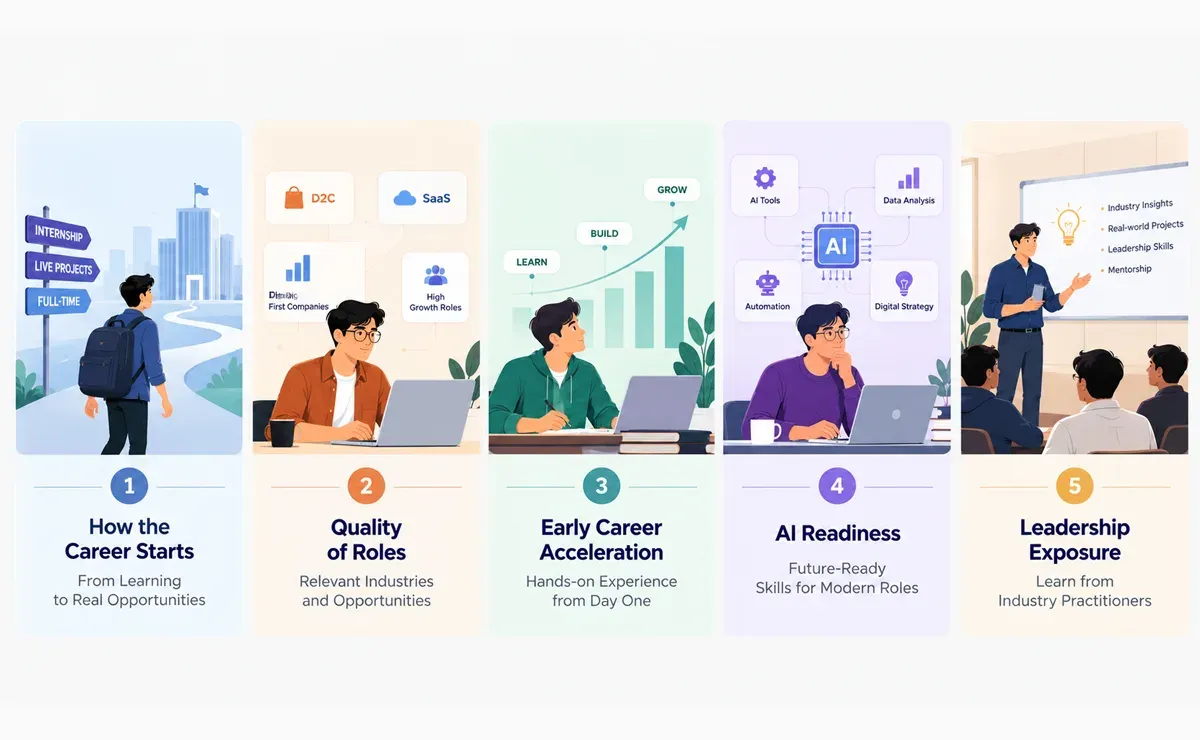
The table below introduces five specific dimensions that decide how a management career actually unfolds.
Let's understand the five dimensions in more detail.
How the Career Starts: Calendar-Bound vs. Portfolio-First
Traditional MBA programs have a structured campus placement season that gives students a fairly predictable route into a role. That route is mapped to alumni outcomes and existing recruitment pipelines.
Altera Institute put the student profile and portfolio first. Students spend 12 months on campus doing live project work with real companies, plus practitioner-led mentorship sessions, followed by a 3-month internship. That gives the candidate a real body of work, which in turn massively improves employability and the chances of an internship becoming a permanent role.
Quality of Roles: Network Size vs. Network Relevance
Traditional MBA programs have the real benefit of established recruiter relationships and alumni networks built over decades, especially in consulting, finance, and other high-growth sectors.
Altera Institute's network, by contrast, targets sectors such as D2C, SaaS, and digital-first companies for marketing-focused roles in product, growth, eCommerce, EIR/Founder's offices, etc., because that's exactly the kind of role Altera Institute prepares students for.
So the comparison here is between network size and network relevance. Altera Institute’s targeted network places students directly into companies such as Honasa, Blinkit, and Nykaa, rather than targeting sectors and roles that the Institute does not prepare students for.
Early Career Acceleration: Conceptual Foundations vs. Practical Exposure
Traditional programs excel at building strong conceptual foundations for their students that support long-term career progression, and that grounding has real value.
Conversely, Alterra Institutes' applied model is designed to shorten the distance between conceptual foundations and real practice. Students work on live client briefs from day one, rather than case studies built around outdated market realities. This mirrors the job it prepares students for, making them valuable to a company right from day 1.
AI Readiness: A Label That Needs Evidence
Both the new age and the traditional MBA programs now use 'AI first' as a marketing ploy in their brochures. On its own, though, without any real results to back it up, that's pretty much meaningless.
Many traditional MBA programs still treat AI literacy, digital strategy, and technological adaptability as electives rather than integrating them into the core of modern leadership. They teach AI readiness only as fast as their curricula are revised, which can take years. That is why Altera Institute makes this claim, with clear outcomes to show.
Kshitij Jain, a student in Altera Institute’s PGP class of '26, went from a BBA fresher to an AI and analytics manager at The Man Company. This reflects a career trajectory built around the exact skills Altera Institute students are prepared for. In fact, 10% of the students placed so far (80% of the batch placed after wave 2) have landed specialist AI roles.
Leadership Exposure: Structured but Distant vs. Direct Exposure
Students in the traditional MBA get their leadership experience through case competitions, clubs, guest speakers, and internships. That does lead to real development, but it's less focused and less direct, and the quality of industry exposure can vary from school to school.
Altera Institute has therefore changed what mentorship looks like day to day. Instead of occasional guest lectures and mentorships, Altera Institute teaches the entire curriculum 100% through industry practitioners who are actively working in the fields they teach. That access builds direct execution skills and strengthens leadership capabilities right from the outset.
Where the Five Dimensions Play Out: Career Outcomes at Altera Institute
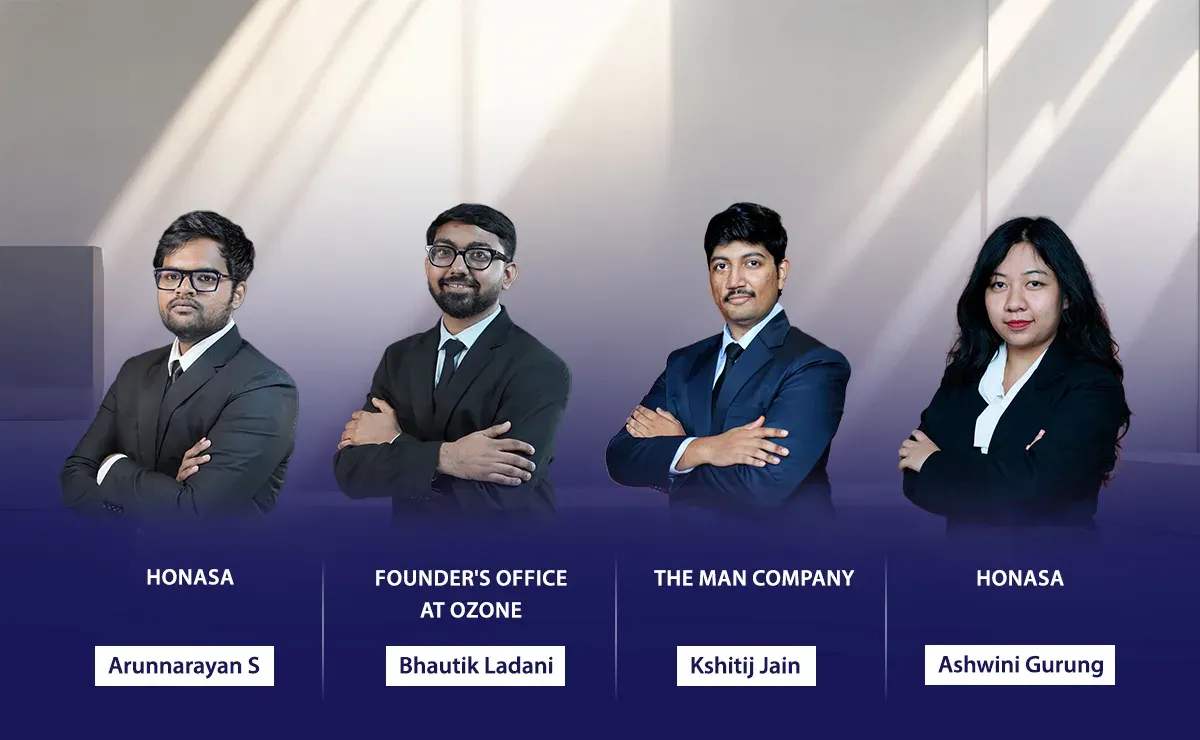
The claims made above are only as good as the evidence behind them, and it is worth being upfront about what that evidence actually is. The outcomes below are actual named examples of our students that illustrate what the applied model makes possible.
- Bhautik Ladani, now in the founder's office at Ozone, is the clearest evidence for leadership exposure. He works as a direct execution partner to leadership, using BI dashboards, financial modeling, and turnaround-time frameworks to resolve operational bottlenecks, which most graduates don't get until years into a traditional-track career.
- Arunnarayan S, a product manager at Honasa, and Lakshita Poddar, who handles ad monetization at Blinkit, both show the relevance and quality of roles Altera Institute prepares students for. Neither moved into a generalist entry-level position common at traditional B-schools.
- As the AI-readiness discussion above noted, Kshitij Jain's move from a BBA straight into an AI and Analytics Manager role at The Man Company remains the strongest evidence on this list, because the job title itself centers on the skill most traditional curricula still treat as an elective.
- Ashwini Gurung gives another take on role quality. She studied sociology at Hindu College before joining Honasa, so she has a non-business academic background. She's in a strategic marketing role without having had to go through a generalist role first.
These outcomes, of course, depend on industry, role, and output quality. Industry sets the ceiling on how quickly a career can grow, as high-growth industries (D2C, e-commerce, B2B SaaS) grow far faster than legacy industries (traditional retail, traditional banking, etc.).
Graduates moving into administrative entry points progress more slowly than those in roles with direct commercial ownership (they're closer to the revenue and strategic decisions). Therefore, rather than competing on tenure, the graduate should compete on quality output, and AI fluency should enhance that quality.
Placement data is the most concrete evidence for this comparison. The Altera Institute PGP Class of '26 had a highest package of ₹32.5 LPA and a median package of ₹17.88 Lakh. That consistency is clear across the cohort.
- 12% of placed students earned ₹10–12 LPA
- 13% earned ₹12–15 LPA
- 48% earned ₹15–20 LPA
- 21% earned ₹20–25 LPA
- 6% earned ₹25 LPA and above
Career growth from here rarely moves in a straight line, but it does tend to follow a recognizable arc.
- Years 0–5 are about building a foundation: a management trainee moving to an area manager role in FMCG, or a growth associate moving to a category manager in D2C.
- Years 5–10 bring functional leadership, where specialists start managing entire departments and generalists in a founder's office take on regional responsibility.
- By the 10–15-year mark, growth is driven by P&L ownership, venture creation, or a move into a CMO, COO, or VP-level role.
Summing Up
In comparing Altera Institute with a traditional MBA, students aren't making one big brand choice. Their bets include how their career begins, what kind of role they get, how quickly they progress, how fast promotions follow, whether they walk in AI-ready, and how much leadership exposure they get in the first year.
This is why the Altera Institute backs up its claims with evidence: role-specific salary data that increases with responsibility rather than tenure; a curriculum developed and delivered by practitioners; and outcomes that show AI readiness leads to job titles rather than just staying on a syllabus line.
For a student making this choice today, the more useful exercise isn't asking which brand has the most weight. It's to run your own personal priorities and your specific target sector against those five dimensions and be honest about which side of each one actually matters for the job you're after.
Altera's counsellors and its free Career Charter tool exist for exactly that exercise: mapping a specific academic and work background against these five dimensions, rather than handing out a generic recommendation.
As applied, industry-aligned programs grow in popularity, the gap between being job-ready and simply holding a degree is likely to widen before it narrows, which favors curricula built to update continuously rather than periodically.
Employer demand is already shifting toward people comfortable with both business judgement and hands-on digital execution, and that shift is why this comparison keeps coming up more often.