Who Should Teach Tomorrow's MBA Students? Rethinking the Role of Faculty in B-Schools

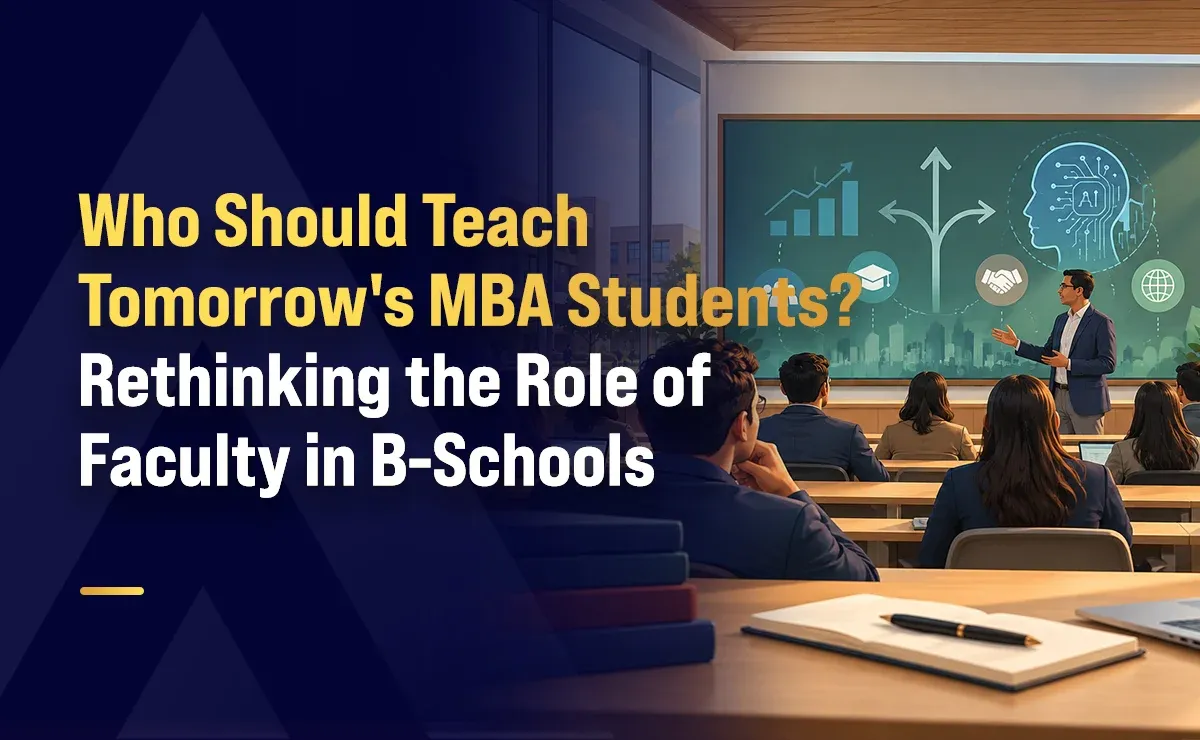
The gap between what MBA graduates know and what they can do on day one in their careers is as much determined by the kind of faculty who teach them as by the content of the curriculum.
AI, technology, and data-analysis skills are becoming more important hiring criteria in 2026, according to GMAC's Corporate Recruiters Survey. Which is why employers have stopped rewarding potential on their own.
What they want now is Day-1 job readiness: the ability to read a dashboard, run a model, and scope a campaign without three months of on-the-job training. The traditional MBA wasn't designed to handle this. The curriculum cannot keep up with the industry's rapid pace of change.
Two factors are further facilitating this shift:
- AI is absorbing the tasks that used to be repetitive. Data pulls, first-draft financial models, and routine research briefs are increasingly automated, raising the bar for what a graduate must bring in on their own.
- Generalist credentials are losing their edge. A broad business degree used to be proof enough; now it barely signals whether someone can walk into a specific industry problem and solve it.
B-school curricula don't update slowly by accident. For a new elective or industry update to reach a classroom, it often has to pass faculty committees, departmental reviews, and administrative approval.
Furthermore, accreditation bodies such as AACSB and India's UGC add to this constraint. They use specific frameworks to define a legitimate master's-level business qualification, which changes far less often than industry standards.
Another deeper issue among these constraints is who teaches the course. This is exactly where the academician-led faculty vs. practitioner-led faculty argument comes into play.
Academician-Led Faculty vs Practitioner-Led Faculty

Academician-led faculty are usually career academics, and their classrooms focus on understanding before application. That approach has real strengths: depth, rigor, and the ability to reason through problems that don't yet have an established solution.
Practitioner-led faculty reverse that order. The person teaching the course is also actively working in the field, which changes what the classroom draws first, as the comparison below shows.
Both models are equally valid. Both build real capability, and a strong MBA program can benefit from both. But current market demand for immediate execution has changed how much weight recruiters place on each, and understanding that shift before choosing a program matters.
How They Shape the Talent They Produce
The clearest way to see this difference is to look at four areas where the two faculty models consistently diverge.
Knowing a framework and knowing when to apply it are two very different skills, but unfortunately, a traditional B-school tests only one.
AI makes this point louder than ever. Because it is already vital to understanding customers, interpreting business data, and automating decisions, treating it as a one-time elective leaves students with real knowledge gaps and feeling underprepared.
What They Look Like in Practice
Imagine a brand observing declines in customer retention. Each faculty model takes two different paths when presented with the same problem.
What Kind of Business Professional Does Each Model Develop?
The difference between these two faculty models isn't just what they teach. It also shapes what kind of thinker and decision-maker walks out of the program.
Why a Practitioner-Led Faculty Cannot Perform Well in Isolation
B-schools must hire industry practitioners as mentors to teach their students today, but that alone isn't enough.
A practitioner who still teaches within an unchanged, theory-first structure will default to the same lecture-and-case fundamentals because the surrounding system rewards it. Practitioner-led teaching works because of the infrastructure around it, which has four parts.
Let's look at these infrastructures in more detail.
Curriculum That Evolves with the Industry
As AI, automation, digital platforms, and new business models continue to change how companies operate and hire, curricula cannot remain static. For example, a marketing student today should learn AI-enabled marketing, digital commerce, and customer analytics, in addition to traditional brand management.
Practical Learning Pedagogy with Live Projects and Industry Exposure
Students grasp concepts more concretely when they use them to solve real business problems. That calls for live projects with real companies, internships, business challenges, client interactions, and site visits spread across the program. A lesson on social media strategy only proves itself once a student has used it to build something real and defend their choices while facing scrutiny.
Recruiter and Industry Engagement
Industry involvement should not start only when placement season does. Regular contact through guest sessions, mentorship, and career guidance throughout the program gives students a current read on what employers actually expect. A single annual recruiting event is already outdated by the time most students graduate.
Continuous Industry Collaboration
Bringing companies to campus isn't the only time industry collaboration is at full swing. Industry feedback should actually influence what is taught and how success is measured. When employers identify AI fluency as a critical skill, that signal should appear in coursework and assessment within a cycle or two, not years in the future.
Together, these four elements keep practitioner-led teaching from becoming a mere brochure line.
The Impact of Practitioner-Led Learning in MBA Studies
Line these four elements up correctly, and the case for practitioner-led teaching over a purely academic model becomes measurable in six specific ways.
- Continuous Real-World Exposure: In practitioner-led learning, industry contact becomes a continuous process rather than an occasional event. It replaces occasional internships with continuous, weekly immersion, where active professionals guide students through live corporate challenges using real-time data.
- Better Commercial Thinking: Students start asking what a decision will cost, how it affects revenue or margins, and what trade-offs the business is willing to accept. It builds students' muscle to make quick decisions under pressure by connecting marketing, finance, strategy, and operations.
- Stronger Problem-Solving Skills: Real business problems rarely have one right answer. Which is why practitioners push students to handle ambiguity by breaking problems into parts, identifying what matters, comparing approaches, questioning assumptions, and adjusting as constraints change with time.
- Immediate Application of Concepts. A lesson on brand positioning becomes an actual brand exercise. A discussion on go-to-market strategy becomes a market-entry problem to solve. Live projects and practical assignments combine learning a concept and applying it into one activity, instead of two separate steps.
- Better Understanding of Industry Expectations: Students get a clearer sense of how recommendations are presented, which metrics different teams actually track, how decisions are communicated to stakeholders, and how work is evaluated in a professional setting—details a syllabus rarely covers.
- Higher Career Readiness: All of this makes the jump from classroom to first job less jarring. Students get repeated practice analyzing problems, making recommendations, taking feedback, and applying frameworks before they ever do it for a paycheck.
None of these replaces academic teaching. Academic learning still builds the foundation. Practitioner experience shows a student how to use that foundation when no textbook answer remains.
How Altera Institute Approaches Practitioner-Led Learning

Altera Institute brings the industry into the classroom through two distinct channels, and the difference between them matters.
Guest interactions are broad and occasional, giving students a short window to explore multiple industries and career paths.
That range means students hear how business decisions look from several sides of the table, rather than from one type of industry experience alone.
Embedded practitioner faculty turn that exposure into depth. These are professionals teaching regular coursework across the PGP rather than making a single appearance.
That continuous involvement carries through case discussions, sprints, and mentoring across the PGP, feeding into an AI-first curriculum built around AI Foundation, Generative AI, and Agentic AI, along with specific applications of AI to marketing and product management, so AI functions as a working tool across courses rather than a single elective.
Altera Institute ties this together through five pillars:
- Practitioner-led faculty
- An AI-first curriculum
- Live business projects
- Mentorship and industry exposure
- Structured career preparation
Students learn a concept, apply it under a practitioner's guidance, execute it on a live project, and reflect on the outcome before moving on.
Conclusion
Although the MBA is still valuable, it is being taught for a market that no longer exists. Employers no longer reward generalist degrees on their own, and the gap between classroom theory and what new hires are expected to do in their first ninety days has widened.
Changing this doesn't just mean updating a syllabus. It's about who the teachers are in the classroom and whether the systems around them let them teach the job as it's done today.
This is why practitioner-led faculty embedded in that kind of structure can produce what a lecture-and-case model cannot: students who have already made real decisions under real constraints before they start their first job.
For anyone evaluating a business school today, the more useful question is not which one has the strongest brand. It is whether the person teaching you is equipped to make you useful from day one or only to make you sound informed.