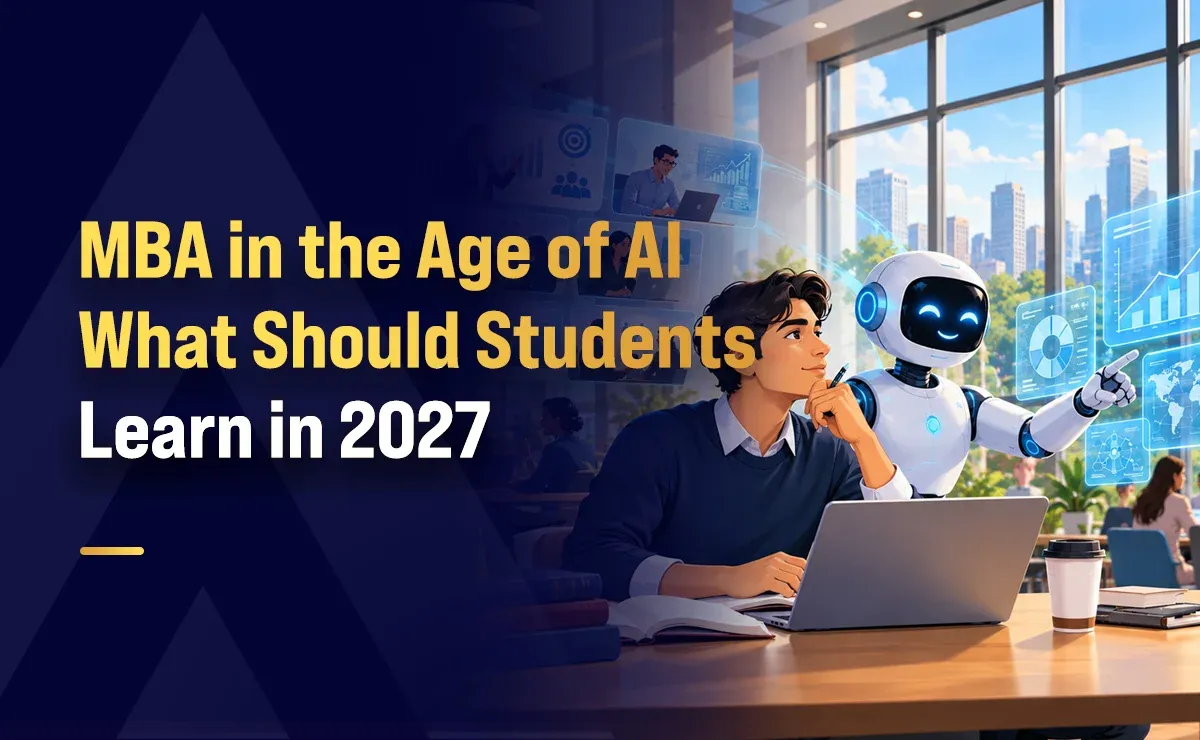
MBA in the Age of AI: What Should Students Learn in 2027?
AI is changing how businesses work, but it is not simply replacing people. AI is taking over repetitive tasks like data entry, invoice processing, and customer support, and it is helping employees work faster. This means managers now need to work alongside AI, use it effectively, and make better decisions based on the information it provides.
Almost every business function is going through this. Marketing uses it to understand customers and build campaigns. Finance uses it for forecasting and analysis. HR uses it to analyze their workforce and to improve the hiring process. Operations uses it to improve processes and forecast demand.
As a result, recruiters are increasingly looking for professionals who understand both business fundamentals and AI. An MBA is still valuable, but what makes it valuable is changing. It is no longer enough to understand how a business works. You also need to understand how technology is changing how business operates.
This article maps what that shift demands for a student preparing for the 2027 admissions cycle.
Why Is the AI Economy Changing MBA Education?
AI is taking over the repetitive middle of most jobs and leaving the judgment calls at either end to the person holding the title. Hence, a manager's job today is to work alongside that layer of automation and to decide what to do with what it hands back.
How Is AI Changing Business Roles?
That shift spans sectors and roles, so don't assume the job requirements of any given function.
- Marketing: AI reads customer behavior, spots audience segments, generates content, and supports campaign optimization. The job is shifting from routine execution to strategy, customer understanding, and data-backed decisions.
- Product: Product managers use AI to sort user feedback, catch patterns early, and speed up research. Humans decide which problems are worth solving and connect customer needs to business goals.
- Finance: AI automates reporting, crunches financial data, and sharpens forecasts. Finance professionals still need the underlying financial knowledge but now also need to interpret what an AI-generated insight actually means.
- Consulting: Artificial intelligence analyzes markets, processes large volumes of information, and generates an initial recommendation in a short amount of time. It speeds problem-solving and turns raw information into something a client can use.
- HR: AI tools are transforming recruitment, employee analytics, and workforce planning. Some aspects of human resources remain beyond the reach of tools, such as culture, employee experience, and leadership calls.
- Operations: AI helps forecast demand, manage supply chains, flag inefficiencies, and automate the repetitive stretches of a process. Operations managers need to understand both the tool and the business process underneath it.
- Sales: Artificial intelligence identifies prospects, analyzes behavior, and personalizes outreach to predict which leads are worth following up. Currently, sales professionals need relationship skills coupled with a working knowledge of data and artificial intelligence.
Alongside these seven areas is a newer, blended role: the AI Generalist. These professionals can work across business, marketing, technology, AI, and operations for businesses and startups that can't yet afford five separate specialists. This means that AI isn't only reshaping functions but also creating new ones. It also means the traditional MBA must expand its curriculum.
What Recruiters Expect from MBA Graduates in 2027

Recruiters evaluating AI talent in 2027 aren't screening for more AI knowledge in the abstract. They're testing specific mixes of technical fluency and human judgment, and the two rarely show up separately.
Technical Skills
Technical skills do not mean becoming technical experts or learning to build AI models. They mean understanding how to put the technology to work inside a business. Skills recruiters increasingly value today include:
- AI Literacy: Being aware of what AI can do, when it should be used, where it adds value, and where its limits lie.
- Data Interpretation: Making decisions based on data analysis, spotting patterns, and applying that insight.
- Automation Tools: Understanding how a tool automates the repetitive stretch of a workflow and improves it.
- Digital Business Understanding: Knowing how technology, digital platforms, and data are reshaping business models and customer behavior.
Human Skills That AI Cannot Replace
Technical fluency must be followed by human judgment, something that recruiters are weighing accordingly in their new hires:
- Critical Thinking: Questioning an AI output instead of taking it at face value.
- Communication: Explaining an idea clearly and working across teams that don't share your background.
- Decision-Making: Weighing data and AI insights against business context and risk.
- Commercial Judgement: Knowing what makes business sense, not just what's technically possible.
- Leadership: Guiding a team, managing change, and owning the outcome.
- Learning Agility: Staying open to new tools and ways of working as things shift.
In the coming years, employees will need to get comfortable formulating the right questions, not just executing tasks toward a conclusion someone else already framed.
AI Skills Recruiters Now Expect from MBA Graduates
Here is how all of the above requirements get tested in an interview:
What Makes an MBA "AI-First"?
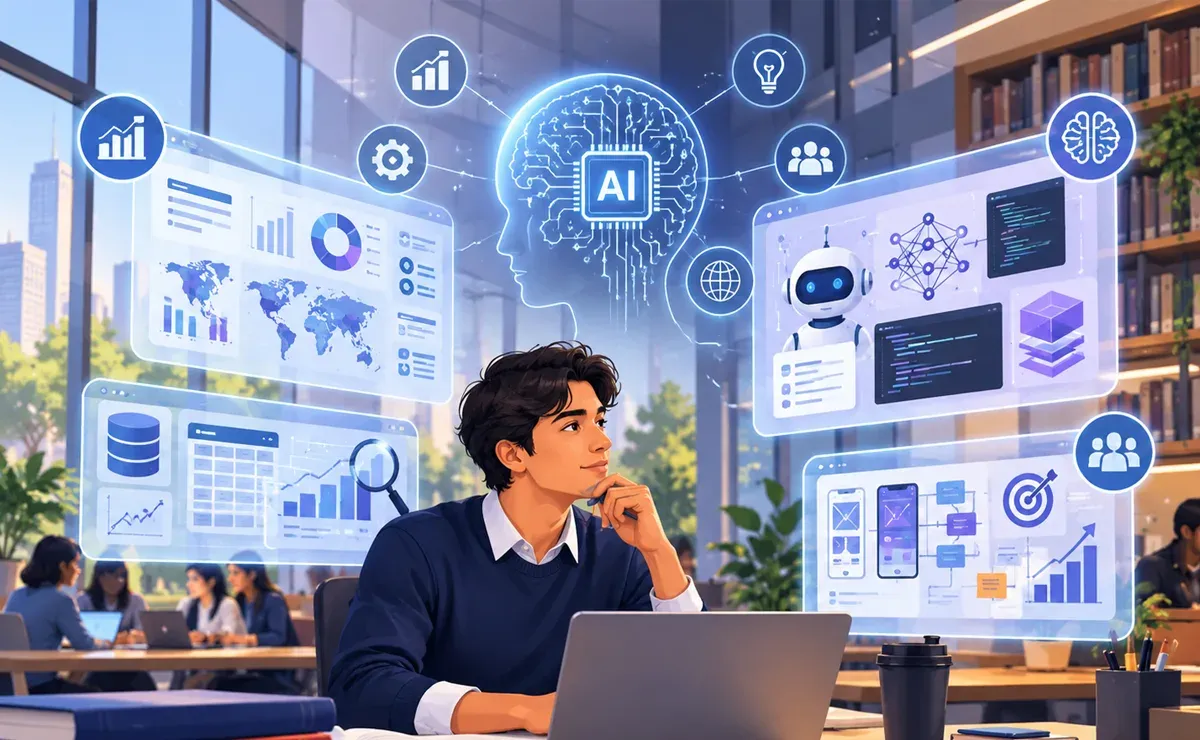
An AI-first MBA isn't a longer syllabus or a single elective bolted onto an otherwise unchanged curriculum. It's a different way of learning, built around how businesses run today rather than how they ran when the syllabus was last approved. A handful of concrete markers separate the two:
- A curriculum that evolves continuously rather than staying fixed for years, with AI, data, and digital business woven into the core rather than appended to it.
- Faculty with current industry experience bringing live business challenges into the classroom instead of teaching purely from theory.
- Applied learning over lecture-only delivery, live projects, simulations, real assignments, and internships built around outcomes.
- Active industry connections, practitioner sessions, mentorship, and exposure to real brands and real problems.
- Career development that outlasts placement day, built around long-term employability rather than a single placement percentage.
- Continuous exposure to emerging tools and technologies, so the toolset taught keeps pace with what businesses are actually using instead of aging in place.
- Interdisciplinary learning that connects business, technology, data, and customer behavior, taught as one connected view of how a business runs rather than as siloed subjects.
How Students Can Evaluate Whether an MBA Is "AI-First"
Indian B-schools operate within the UGC/AICTE framework whereby the curriculum structure is centrally defined and very slow to change. That's why independently designed programs can move faster and why the Altera Institute's PGP in Applied Marketing sits outside that traditional structure.
The Altera Institute’s PGP in Applied Marketing ticks all seven of the above boxes—it's practitioner-led faculty, it's real business projects, and the curriculum is absolutely flexible to add or drop tools as the industry moves on.
Conclusion
AI hasn't undermined the traditional MBA. It's simply shifted the emphasis from technical data analysis to human leadership, strategic judgment, and complex problem-solving. The basics of business are still important, but they no longer set the MBA apart as a qualification, since a tool can now do much of that work for you.
AI fluency without business judgment creates someone who can use a tool but can't judge the value of its output. Judgment without AI fluency results in someone who reasons without having access to the best available evidence.
AI will keep evolving, but human judgment persists. The MBA's broader purpose has shifted with it, from producing generalists to producing job-ready functional specialists, and AI is accelerating that shift rather than creating it from scratch.
The real question for a 2027 applicant isn't whether to do an MBA. It's whether the program you choose will teach you to think or just execute, because AI already does the execution.