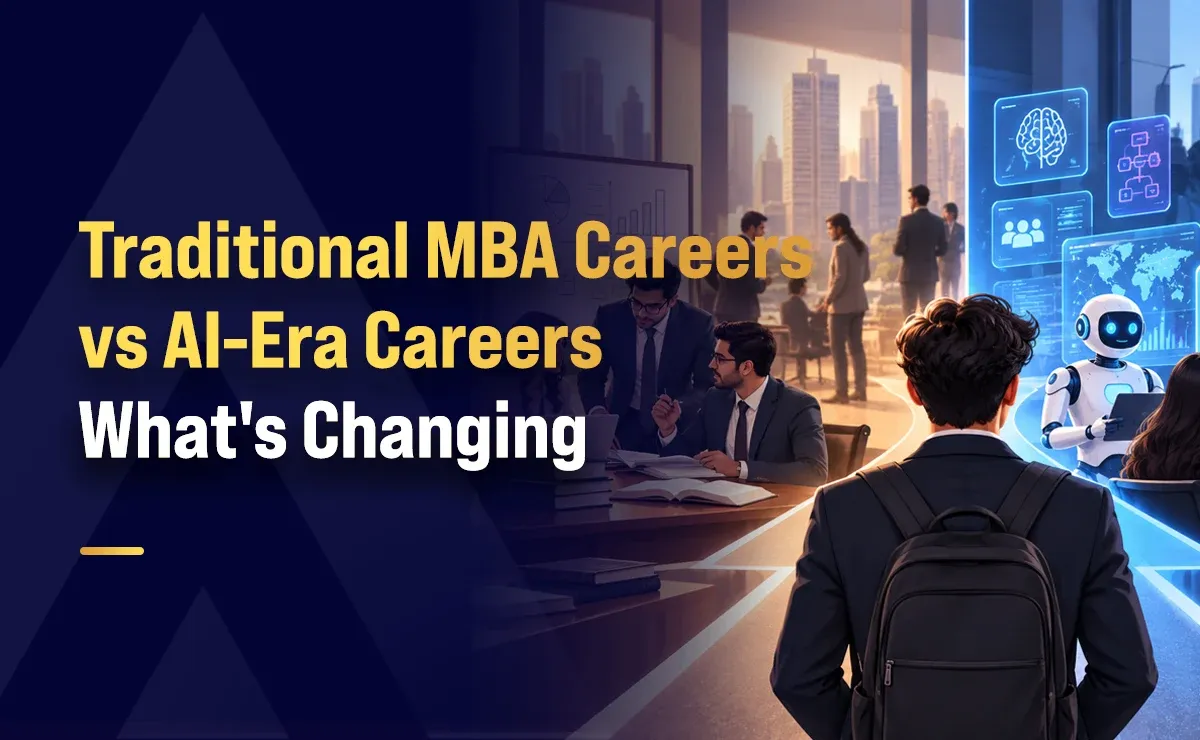
Traditional MBA Careers vs AI-Era Careers: What's Changing?
Step into an interview room today, and the questions sound different than they did even three years ago. Hiring managers spend less time asking which framework a candidate has memorized and more time probing whether that candidate can make a sound call from messy, AI-generated data.
A 2025 McKinsey report found that 88% of companies use at least one AI tool, and LinkedIn's Work Trend Index shows AI adoption at just under 75%. The company-level AI adoption scores have doubled since 2024.
None of that means an MBA has become irrelevant. It simply means the benchmark for job readiness has shifted function by function. This article precisely maps that shift and what you need to know about it, whether you're already in the job or still in the process of interviewing.
The Old Bar vs. the New Bar: What's Actually Being Judged Now
The clearest way to see the shift is to compare them side by side. The table below lines up what used to be the criteria for getting hired and promoted with what recruiters are testing for today, row by row.
The pattern is the same in all six rows. Recruiters are increasingly asking candidates to walk through an AI-assisted workflow that they've actually built. It's no longer about testing knowledge of individual tools or textbook knowledge. The interview format has changed. With 88% of companies already using AI, that shift is no longer the exception; it's rapidly becoming the norm.
What This Shift Changes About Your Day-to-Day Work

This shift is not abstract. Function by function, it changes what you are expected to decide and how early in your career you are expected to start deciding it.
- Marketing: Campaign output used to be something you could count. How many posts, how many variants, and how many assets are shipped in a sprint. With GA4 AI and Meta AI now generating the majority of that output themselves, the thing you're actually going to notice is that you're going to be looking at a campaign on day 3 and seeing it's dying, and you'll kill it. You won't be waiting for the day 14 report to come back and confirm what the dashboard would have already told you.
- Product: Prioritization frameworks such as RICE and ICE have not changed, but the speed of the inputs feeding them has. User interviews now get synthesized into patterns within minutes, pushing the scarce skill downstream to defend a trade-off when two data sources disagree and a stakeholder wants an answer by the end of the day.
- Finance and Analytics: Excel Copilot and the Bloomberg GPT can produce a working forecast in the time it used to take an analyst to go and find the right template. The one thing neither of those tools will pick up on in isolation is a model that is quietly assuming flat customer churn in the very month that a competitor cuts their price by 20%. That kind of gap is very much the sort of thing that would be the actual interview question.
- Consulting and Strategy: Perplexity and Gamma can produce a market sizing slide and a first draft of a deck in a few hours after a client call. The slide itself was never the difficult bit. The hard bit is defending the number in it when a partner asks you where the underlying assumption came from.
In all of these functions, it's compressing the timeline for when you'd expect judgement to be applied. Work that used to be in a mid-career job description now appears in a Year 1 to Year 3 role.
India's e-commerce alone is expected to grow its GMV to over 170-180 bn at over 20% per annum by 2030. At that scale, junior hires will be making judgment calls much earlier than they would have in the past.
A Self-Check: Where Is the Gap in Your Own Skill Set?
Most professionals already agree that AI upskilling matters. Roughly 70% of employees say so. The harder number is that only 39% of graduates report actually using an AI tool at work, and that gap between belief and practice is the real problem.
- Can you name the two or three AI tools specific to your function, not just ChatGPT, and explain what each is actually used for in your role?
- Have you built one complete AI-assisted workflow from start to finish, or have you only used AI for isolated, one-off tasks?
- Could you describe a business judgment call you made that overrode or corrected an AI-generated recommendation?
If the honest answer to most of these is no, that is the specific, addressable gap. Nearly 94% of graduates, MBAs included, are considered unfit for employment because they lack industry-relevant skills, and this self-check is usually where that mismatch lives.
Closing the Gap: Two Different Paths, Depending on Where You Stand
Once you know where the gap is, the next move depends entirely on your situation. This is where the advice has to split: someone already inside a company needs a different first step than someone currently interviewing.
If You Are Already Employed
- Pick two or three tools tied directly to your function and go deep on them, instead of collecting a long list you barely use.
- Build one demonstrable, end-to-end AI-assisted workflow tied to a real task in your current role, not a demo or a one-off experiment.
- Change how you talk about your work in one-on-ones and performance reviews, narrating the judgment calls you made using the AI output, not just the output itself.
- Volunteer for any AI pilot running on your team, or shadow how an adjacent team is using automation.
Judgment that you never narrate in a review doesn't register as a differentiator, no matter how sound the call was. Visibility, in this sense, matters almost as much as the skill itself.
If You Are Job-Hunting
- Build the same kind of end-to-end AI-assisted workflow using a personal project or freelance task if you do not currently have a job to draw on.
- Prepare one specific story for "Walk me through an AI-assisted workflow you built, and where you disagreed with what it produced,” since that is close to a standard interview question now.
- In your resume and portfolio, lead with the decision you made using the AI output, not the name of the tool you used to get there.
The workflow walkthrough has effectively become the interview. Rehearse it as a story with a clear decision at the center, not as a vague line on a resume.
If You're Weighing Further Formal Education: What to Look For in a Program
Some people aren't looking to close the gap in their current role. They're looking at which program to go into next and whether it will actually equip them for this transition.
The checklist below is not predicated on any one institution. It focuses on the difference between a program designed for this decade and one that has simply put AI on top of an existing program.
- Ask to compare this year's core module list with the syllabus from two years ago. If the same case studies and electives are still in the same places, then the curriculum hasn't moved a step, whatever the brochure says.
- Check whether AI appears within the core required courses (e.g., marketing strategy, financial modelling) or only within a stand-alone elective, which a large proportion of the cohort will simply opt not to take.
- Ask what proportion of the final mark in the core courses is derived from a live client project as opposed to a written exam or a case write-up. A program designed for that kind of shift will be up front about that figure.
- Check the faculty list and see how many are actually in industry. A lot of them will have a visiting faculty title, and their last actual job was ten years ago.
Altera Institute's PGP in Applied Marketing is a prime example of this checklist in action. It's a program that teaches AI and business judgment as one skill from day one, via live projects for real companies. 89% of their students ended up in AI and digital-first roles, and over 70% of the 2025 batch are in roles above ₹15 LPA.
Where This Leaves You

The honest answer has never been whether AI will replace MBA jobs. It won't. What's changed is the bar within the job itself, and that bar has moved up earlier in people's careers than most realize until they do the self-assessment.
If you're already employed, then the move is immediate: pick your tools, ship one real workflow, and change the way you talk about your judgement in your reviews. If you're in job-hunting mode, then that very same workflow becomes the story you're going to be rehearsing for the interview, which is already going to be testing that very thing.
If you are still choosing a program, the move is diagnostic. Weigh curriculum, faculty, and assessment model against what is actually being tested now, with Altera Institute's applied approach as one working example.
None of these makes the traditional MBA skill set useless. Framework fluency, financial literacy, and structured thinking still matter, and dedicated AI-first roles such as AI Product Manager and AI Strategy Manager are growing across technology, finance, and retail. What has changed is where that skill set sits: it is now the floor a candidate stands on, not what sets them apart.