
What Matters More Than Your XAT Score During MBA Admissions?


The moment XAT results are declared, students immediately pull up cutoff lists and gauge whether their scores meet the bar at their target B-schools. And while it is the right reaction, it is built on a premise that only helps you in the first stage of admissions, which is securing a shortlist from your target B-school.
XAT is one of India’s most widely accepted MBA entrance exams after the CAT, with over 1.42 lakh registrations in 2026 alone, a record all-time high. This intense competition easily makes entrance exam cutoffs feel like the only variable that matters in MBA admissions. But in reality, it is only one of many criteria that determine your final admissions decision.
Your XAT scores serve as an initial threshold for shortlisting. The next steps involve performing well throughout the admissions process, including in group discussions, written tests, interviews, and other holistic profile evaluations. These are also very real aspects that influence admissions decisions.
Note that this does not mean you should take the XAT exam lightly. A strong percentile remains essential for securing a shortlist. The point this article is trying to make is that students must also focus equally on what comes next: an evaluation of your entire profile, which should be equally strong to secure final conversion.
Your XAT Score Is an Initial Filter, Not a Final Verdict
The XAT assesses quantitative ability, verbal reasoning, and decision-making ability under pressure. While these are important indicators of a student's cognitive abilities, they are just part of the qualities that B-schools look for in their aspirants.
In practice, while entrance scores are vital for initial shortlisting, they are only one of several weighted parameters in a B-school's final multi-stage evaluation process.
For example, XLRI assigns 60% to the XAT score, 25% to GD/PI performance, 10% to academic background, and 5% to work experience and diversity to the final selection weightage. So while a good percentile is absolutely non-negotiable, there is still room for you to outperform candidates who share your XAT percentile.
Hence, in addition to performing well in the XAT, you should also improve other aspects of your profile to more easily convert your target B-schools once shortlisted.
Six Criteria That Determine Your Admission in Top B-Schools
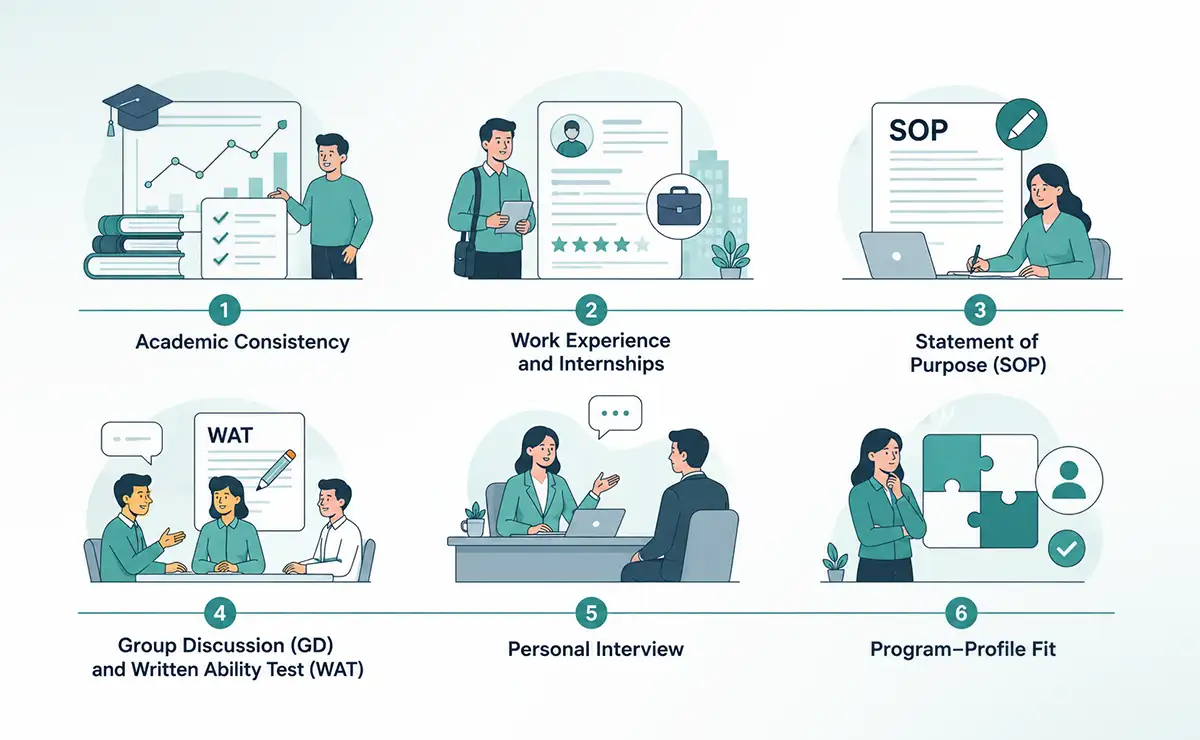
Understanding what B-schools actually evaluate puts you in a better position to compete. The following six criteria carry real weight in virtually every selective MBA admissions process.
1. Academic Consistency
B-schools review your performance from Class 10 to Class 12 and your undergraduate degree. They do so to determine consistency and whether students can handle extended academic pressure. Your overall academic profile is a crucial factor that can make the difference for those with a low percentile.
Although a single poor performance does not necessarily raise concerns, a downward trend across all three exams may, even for candidates with high XAT scores. If you have had genuine disruptions in your academics, you must be able to address them in your SOP with honest context and clear evidence and showcase your growth since then.
2. Work Experience and Internships
Professional exposure adds depth to a candidate's profile. Additionally, B-schools don't just look at how long you've been on the job; they look at clear evidence of tangible business outcomes, which makes it a much more powerful admissions tool than any other key admission metric.
For freshers too, this bar is not zero. Although work experience is not an eligibility requirement for the traditional 2-year MBA degree, relevant internships, project work, entrepreneurial experiences, or leadership in college organizations are all indicators of a solid overall profile.
3. Statement of Purpose (SOP)
An SOP is where you showcase your voice and career clarity. It's also the stage at which students with similar profiles get to differentiate themselves by writing a strong career narrative. It outlines your identity, career goals, and how the program you have chosen will support your career. SOPs are not simply a summary of your CV; they're coherent career narratives that link your past to a well-thought-out future.
Research suggests that SOPs and essays collectively account for roughly 15% of the total weight in admissions at top B-schools. This makes the real differentiator clear. Generic applications that list nonspecific goals can undermine the narrative you are trying to set. Everything you write in your SOP should point towards a direction and must demonstrate program fit.
4. Group Discussion (GD) and Written Ability Test (WAT)
The GD and WAT questions aim to assess communication skills, critical thinking, and composure. An evaluator will not only be listening to what you have to say but also how well you listen, whether or not you can contribute to others' ideas, and if you can lead the discussion without dominating it.
The WAT assesses the ability to structure complex ideas rapidly and convey them in a structured and persuasive manner within the time limit. With regular practice, performance in both rounds can be greatly enhanced, including by keeping up with business news, writing under timed conditions, and engaging in practiced GD sessions.
5. Personal Interview
The personal interview is frequently one of the most intensive and decisive moments in the entire admissions process. With PI carrying 20% to 50% of the final selection weight at top B-schools, treating it as secondary to the entrance exam is one of the costliest mistakes an aspirant can make.
Interviewers are NOT looking for prepared responses, but rather how you think, how you react to pressure, how sincere you are about your objectives, and whether you can lead a real intellectual discussion. A strong interview performance regularly converts final admission offers.
6. Program–Profile Fit
Every program has its own strengths and offers different value offerings to students. Some may have great marketing-focused MBAs, while others may have an acute focus on international business. Hence, a genuine alignment between your background, career goals, and the program’s specialization acts as a real competitive advantage.
If you are changing disciplines or about to make a career pivot, that change must also be communicated clearly to the admissions team. They're looking for assurance that this particular program will have a positive impact on your objectives and not simply add another credential.
How to Build a Stronger Profile Before Applications Open
Your XAT score cannot be changed after results are declared. But most of the other dimensions that determine your final admission outcome are within your control. GD and PI rounds at most B-schools open between February and April, which means aspirants shortlisted after January results need to move immediately.
Below are examples of what targeted preparation looks like in each dimension.
1) Academic Background: If your grades are not consistently good, be prepared to address this in your SOP or during your interview in an objective manner as part of your story instead of an excuse.
2) Work Experience and Internships: If you are a fresher, take on some meaningful internship projects or work experience before applying. Also, remember that the panel is interested in a candidate's initiative and learning, not in their years of service.
3) SOP Preparation: Remember to start early, do thorough research on each program, and draft your SOP according to the requirements of the program in question. A generic SOP that could be applied to any institute is easily identifiable and seldom effective.
4) GD and WAT Preparation:
- Read Economic Times, Mint, or Business Standard every day to develop current affairs awareness and an analytical vocabulary.
- Practice writing on business, public policy, and abstract topics, with a time limit of 15-20 minutes, with a target of 200-400 words per session.
- Engage in peer-led simulated GD groups and record sessions to analyze your listening, body language, and argumentation.
5) Personal Interviews:
- Develop a strong career story that links your past, present, and future and can be communicated in 60-90 seconds.
- Prepare clear and honest responses to near-certain questions. For example, “Why an MBA?” “Why now?” “What is the reason for this program, specifically?”
- Practice with mentors who will give you direct, uncomfortable feedback, not just encouragement.
- Have two or three questions ready to ask your interviewers to demonstrate that you are prepared and interested in the program.
6) Program-Profile Fit: Do more research beyond the ranking of each institute. Know about its pedagogy, recruiting sectors, and the position roles filled by its graduates. Apply to colleges where your experiences and interests fit.
Choosing a Program That Sees Your Complete Potential

There is a meaningful insight embedded in the admissions debate: the way a program evaluates candidates tends to reflect how it develops them. Programs that factor in the consistency of coursework, career exposure, communication skills, and career clarity, in addition to grades, are more likely to foster and produce more complete, career-ready professionals.
Cohort composition is important as well. Enriching peer learning environments are created when programs deliberately integrate freshers with experienced professionals and include a diversity of academic and professional experiences. Learning that takes place outside the classroom often rivals what is taught in the classroom.
The Altera Institute is an example of this approach. It is quite selective, but not just on a percentile basis. Admission processes span a number of dimensions, all of which are equally important to performing well in entrance exams. It accepts CAT (90+), XAT (90+), GMAT (625+), and NMAT (225+), recognizing that different exams surface different strengths.
Finally, the right program for you is not necessarily a familiar brand name or a program at the top of the list. It is the program that is most purposeful in developing you for the career you want and that assesses you across your full range of potential, not on your best day in an exam hall.
Conclusion
While your XAT score is important, it is just the starting point, not the final step in the admission process. Aptitude test scores are just one of many factors b-schools consider when choosing the next generation of business leaders, and a test score alone does not tell the full story of what leadership actually requires.
Your admission is determined by the six criteria outlined in this article, and you have significant control over them. So the biggest change you can make is to cease to take your percentile as your verdict and begin to audit your whole profile on all dimensions.