How to Build a Strong MBA Application for Altera Institute
Altera Institute uses a profile-based shortlisting process to evaluate candidates, and their chances of admission are determined by the overall strength of their profile rather than by a single cutoff percentile.
Like B-schools such as SPJIMR, ISB, BITSOM, etc. Altera Institute also evaluates candidates on multiple aspects, including academic consistency, the quality of professional experience or internships, leadership experience, extracurricular activities, and how clearly they articulate their career vision in the SOP section of the application.
This is why the shortlisting process at Altera Institute seems less linear than a percentile-based one. Hence, it isn’t rare to see a 95th-percentiler not be selected if their profile and SOP responses are weak, while a 90th-percentiler advances to further rounds because they demonstrate impact, purpose, and a convincing profile that aligns with the program.
The difference between a good and a decent application lies in how deliberately a candidate develops and presents themselves throughout the admissions process. It includes academics, test scores, work experience & your SOP, a case interview round, a personal interview, and an interaction with the program director. These are all crucial stages in the final decision.
This article explains the eligibility standards and the evaluation process used by Altera Institute to guide applicants in presenting their applications coherently and purposefully, as the institute expects.
Build a Strong Foundational Profile: Academics, Test Scores & Work Experience
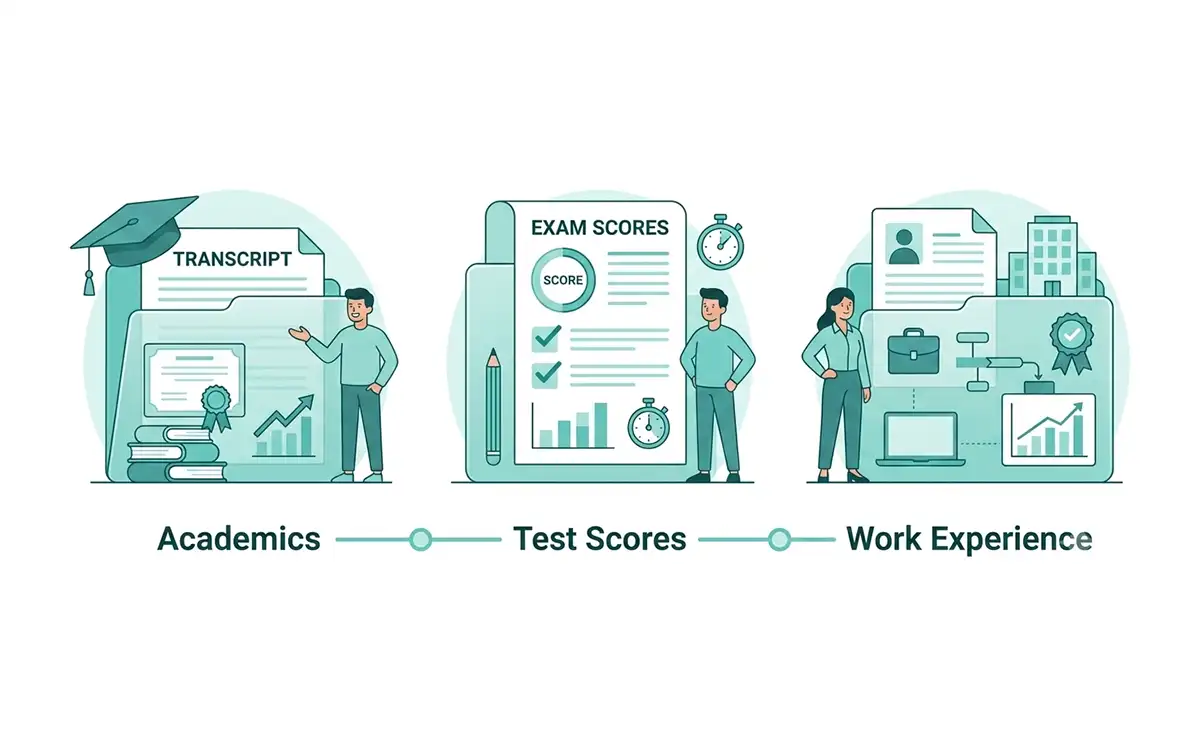
Altera Institute requires a minimum of 50% aggregate at the undergraduate level, although students are generally expected to maintain at least 80% in their X, XII, and UG to be considered strong applicants.
In addition to academic performance, subject depth will also be counted for both marketing and non-marketing background students. For instance, if you're an engineering graduate, your data interpretation skills will be seen as a genuine asset in this evaluation. Similarly, if you studied commerce, strong grades in accounting will be seen favorably. These are directly applicable to the digital & AI-first nature of the PGP, so make sure your CV or SOP actually names these strengths to showcase program-profile fit.
Below are the numbers you can consider as a “safe score” that you should aim for. These are, however, not strict gatekeepers; final decisions are made based on the student's overall profile.
- CAT and XAT: a percentile of 85 or higher is considered a safe score
- NMAT: 220 or higher
- GMAT: 625 or higher, and only the Focus Edition and offline format are accepted
Note that falling slightly short of these numbers doesn't rule you out. A candidate can still get shortlisted if the rest of their profile around academics, work experience, and SOP tells a strong and coherent story.
Candidates who have not appeared for any of these exams also have the option to take the Altera National Aptitude Test (ALNAT). It is a two-hour online assessment designed by the institute to assess suitability for the PGP course. Furthermore, applicants with a strong overall profile who fall slightly short of the accepted cutoffs may also appear for the ALNAT.
Finally, the work experience at Altera Institute is evaluated for depth, not tenure length. The institute's objective is to identify candidates who demonstrate depth, impact, and leadership in their work as well as domain expertise. These are all signs that are far more significant than the length of your job: if you lead a project end-to-end, own key metrics, or step outside of your role to work.
Freshers can demonstrate the same readiness by showcasing internships, leadership roles in college societies, startup stints, and competition wins. But note that internships and extracurricular activities should be listed in the CV or Statement of Purpose (SOP), separate from the work experience section, since mixing the two can muddy the admissions team's reading of your actual professional background.
Write a Statement of Purpose (SOP) That Stands Out
It is common for many applicants to come in with the same percentile and resumes. It is important for them to take the SOP section of the application form seriously, as it acts as a primary differentiator between similar profiles. A well-written SOP gives the admissions committee insight into your thinking and execution, not just your accomplishments, and carries significant weight in the final decision.
The Altera Institute's application form builds this out through three SOP-style questions, each testing a different dimension of your readiness.
1) What is your career ambition?
You're asked to pick up to three motivations from options like brand strategy, entrepreneurship, consulting, analytics, or leadership. The point isn’t to choose whichever options sound the most impressive on paper. It is about picking the ones that actually align with your experience and demonstrate a clear career direction. If your internships were analytics-heavy, don't list entrepreneurship as your primary motivation with nothing to prove that. The panel is looking for direction, not vague ambitions.
2) What is the superpower that sets you apart?
This question isn't asking for a list of generic strengths. Students must write about one or two specific, tangible abilities they bring to the table in every situation, rather than generic traits like “leadership” or “communication,” which describe almost nothing.
For example, leading teams through crisis, multitasking in high-pressure situations, stakeholder management, first-principle thinking, and other such virtues are seen far more favorably, provided you can prove it.
This question is best answered with the STAR model (Situation, Task, Action, Result), with each of the 4 buckets describing the situation, providing evidence for your claims, and explaining the result.
3) Where do you see yourself in five years?
This question enables you to showcase your vision and planning for the future. Your goals can be anything from role-based (brand manager/product manager) to sector-based (e-commerce, consumer tech, BFSI) to entrepreneurial (building a venture later). Whatever your goal, it should be anchored in genuine experiences or insights and backed by a clear rationale. Finally, connect your aspirations with how Altera Institute’s curriculum, live projects, and placement ecosystem will enable you to reach that target.
Please bear in mind that your SOP is not a test of your English skills. This is your opportunity to demonstrate self-understanding, critical thinking, and preparedness for an intensive, outcome-based program. Include specific, concrete, and actual examples to substantiate all the claims and provide context for your achievements and goals.
Prepare for the Case Interview and Personal Interview Rounds

After evaluating your foundational profile, the evaluation process moves to the second phase, which takes place over three rounds. They include the case study round, a personal interview, and a final interaction with the program director. Here's what each round is actually testing and how to walk in ready.
The Case Study Round
The case interview round at Altera Institute is a 30-40 min session in which a candidate is given a short case study (usually a 1- to 2-pager) to review for the first 10 minutes. Then they are asked to consider a solution to the given objective and discuss their recommendations in an interactive manner, while the interviewer also questions them about other aspects of the case.
Past applicants have worked on cases such as designing a premium subscription strategy for BookMyShow as it faced new competition from Zomato's District app and defending Coca-Cola's rural market share against a low-cost challenger called “Thirsty” that had eaten into its base. Neither case requires prior knowledge of ticketing platforms or FMCG pricing. Someone with no understanding of the industry in the case setting could still reason through solutions/recommendations if they think about the fundamentals and approach the problem logically.
A few habits consistently work against candidates in this round:
- Treating it like a viva rather than a discussion
- Focusing too heavily on the final solution rather than the approach
- Failing to explain your thought process clearly
- Staying passive instead of asking questions and engaging with the panelist
Personal Interview and Program Director Round
The Personal Interview puts you face-to-face with a senior leader, and the conversation covers your past experience, the challenges you've navigated, your ambitions, and how well you fit into Altera Institute's digital and AI-first pedagogy. The one thing worth planning for here is consistency: stay aligned with what you wrote in your SOP, since introducing an entirely new narrative at this stage tends to raise more questions than it answers.
The process ends with a final interaction with the program director. The discussion centers on everything you've presented—your grades, SOP, case round, and interview—to assess your potential for success in the program.
Conclusion
There's no single number or round that decides the final conversion at Altera Institute. It all depends on the strength of your overall profile, including academics, test scores, work experience, SOP, and interview performance. They must all point to a coherent career narrative that makes your profile an exact fit for the careers and outcomes Altera Institute prepares you for.
For students who are serious about pursuing careers in eCommerce, growth, or product management, Altera Institute offers a specialist alternative to traditional B-schools, ensuring you are evaluated on real-world skills and your overall profile, not just your entrance test score. It is also one of the only industry-backed 1-year PGP courses in India that is open to both freshers and working professionals.
Hence, an absence of work experience shouldn’t discourage recent graduates from applying. Roughly a third of the class of 26 were freshers, drawn from colleges like Hindu College, Christ Bangalore, NMIMS, KJ Somaiya, and Mumbai University-affiliated colleges, who built their case on academic depth and internships instead. The profile-based process exists precisely so that a well-built application can carry you forward and increase your chances of final conversion.