
What Should You Do If Your NMAT Score Is Lower Than Expected?


You log in to your NMAT dashboard, and your score is somewhere in the low-to-mid 200s. Not the number you hoped for, but it's also not a disqualifying one either.
If you are looking at something between 211 and 222, roughly the 80th to 90th percentile, you are in a genuine middle ground. It is good enough to get real calls but unfortunately not high enough to feel completely safe. Most of the panic around this range comes from treating it as a single verdict. But in reality, your score does not represent a single fixed value; it means something different at every college on your list.
Here is the mechanism worth understanding before you proceed. NMAT does not work like a percentile ladder the way CAT or XAT does. Most institutes that accept NMAT shortlist candidates based on their own raw score cutoffs rather than following a common percentile across institutes. A score of 215 that passes one college might sit on the edge of another.
This article lays out what a score of 209 to 220 gets you, which is roughly the 80th–90th percentile, as per 2026 NMAT results. It also explores where it falls short and what to do about it in the weeks right after results.
NMAT Does Not Run on a Shared Percentile
NMAT by GMAC is a 120-minute test spread across three sections, namely Language Skills, Quantitative Skills, and Logical Reasoning, totaling 108 questions. Unlike CAT, GMAC does not publish a shared percentile. What you receive is a scaled score between 36 and 360, and each college plugs that number directly into its own shortlisting formula.
Score-to-percentile conversions exist and are useful for context, but they are largely estimates layered on top of the mechanism colleges actually use. Here is roughly where recent cycles have placed key score bands that may matter to you.
Somewhere between 70,000 and 75,000 candidates sit for NMAT every year, and the shortlisting cutoffs across the 50-plus institutes that accept it are roughly 190 to 250-plus.
What an 80th to 90th Percentile Score in NMAT Actually Looks Like

The positive news is that NMIMS has gradually decreased its unified shortlisting cut-off to about 209-210 over the last few cycles, with sectional minimums attached, on all its campuses. A score in the range of 209-220 (roughly 80th percentile to 90th percentile, based on the results in 2026) should give you a comfortable margin and get you calls from NMIMS Bangalore, Hyderabad, Indore, Navi Mumbai, Ahmedabad, and most other NMAT-accepting colleges.
Now, the catch is that a call is not a conversion. Historically, the NMIMS final cutoff list, particularly for the Mumbai campus, has rewarded scores well above 222, with conversions more likely for scores above 232. Below that, you will either not be shortlisted or compete hard.
But there are other NMIMS campuses, such as KJ Somaiya, TAPMI Manipal, XIMB, and SDA Bocconi Asia Centre, that sit far more comfortably within this exact shortlist range that you can realistically target.
However, do check your sectional cutoffs before you draw any conclusions from the total. A strong overall score may be cancelled out if any one section (language, quant, or logical reasoning) is below the institute's minimum.
Here is the part that should actually change how you feel about your score. NMIMS has lowered its cutoff in recent cycles precisely because it now leans more heavily on its competency assessment and interview than on the raw NMAT score. If the exam scores were not the best, but the rest of your profile is solid, this is a good moment for that to work in your favor.
Your Immediate Decision: Retake, Recalibrate, or Move Forward
Most NMAT-accepting colleges take your best score across all three attempts. NMIMS, however, is one major exception. It counts only your first valid attempt, no matter how much better your second or third attempt turns out. Hence, a retake can genuinely move the needle at colleges like KJ Somaiya, TAPMI, XIMB, and dozens of others, but it does nothing for an NMIMS seat.
If you want to register for a retake, it is advisable to view your sectional breakdown before you do so, rather than your headline score. If one specific section dragged your score down, a retake aimed at closing that gap is a reasonable, targeted bet for non-NMIMS colleges. On the other hand, if your score is fairly balanced with no obvious weak point, a retake would be a weaker bet. Every attempt costs about ₹3,000, plus tax, and you have to wait at least 15 days before you can try again.
Use the time between results and applications to rebuild your college list into three honest tiers instead of hoping that one name might work out.
- Reach: NMIMS Mumbai and similarly high-bar seats, where 232+ is the safer target.
- Realistic: NMIMS Bangalore, Hyderabad, Indore, and Navi Mumbai, along with KJ Somaiya, TAPMI Manipal, XIMB, SDA Bocconi Asia Centre, and Great Lakes Chennai.
- Safety: Broader ROI-focused institutes among the 50-plus colleges that accept NMAT scores.
Implement this at all 3 levels, concurrently. Please do not delay all other applications for a possible retake. The process from shortlisting to seat confirmation generally takes a few months, but it moves quickly once the interview call is out.
Why Your Profile Matters More from Here
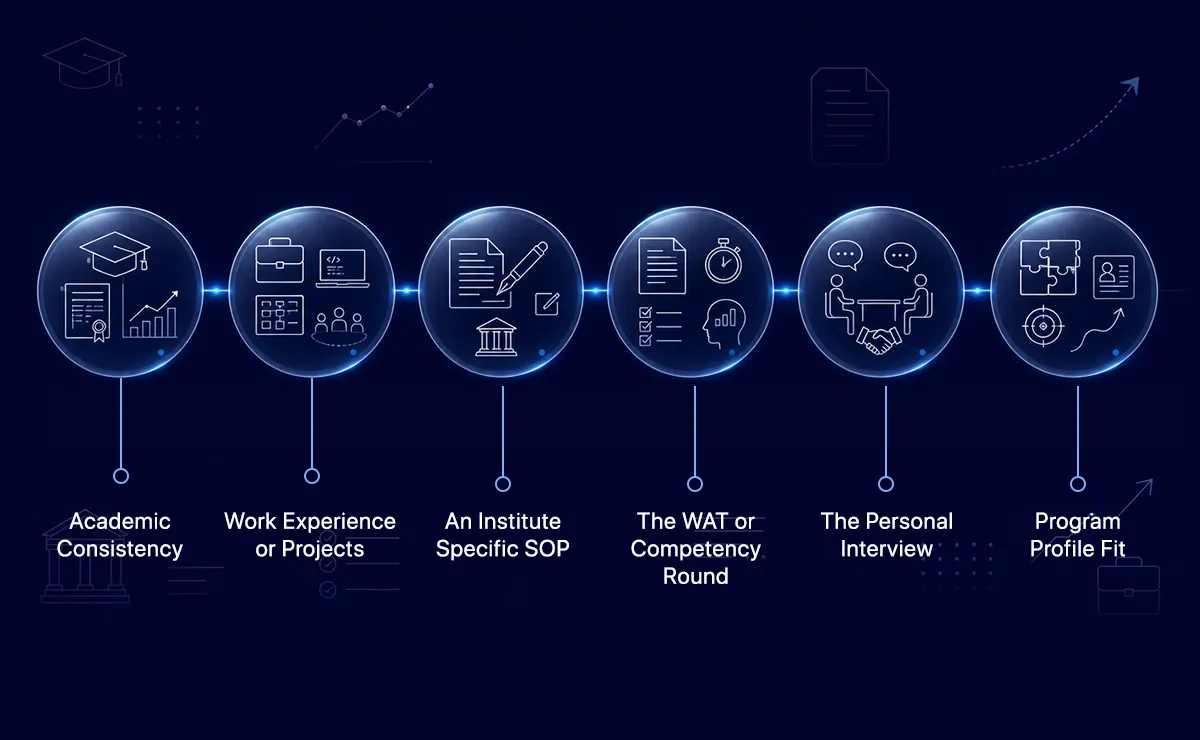
Your NMAT score is just an initial tool colleges use to shortlist students. All subsequent decisions regarding who will receive the seat are made after this, including through the SOPs, the WAT or competency round, group discussions, and the interview process.
Even at exam-led institutes, the NMAT score accounts for only a minority share of the overall weightage, alongside other evaluative aspects such as academics, work experience, GD/PI, and diversity. Hence, a candidate scoring in the 210s with a strong SOP and overall profile has a realistic chance of getting into good colleges.
As you prepare for the NMAT, you should actively work on the following six levers that are entirely within your control:
- Academic Consistency: If your grades dipped at any point, address it head-on in your SOP or interview with concrete context and evidence of recovery, not a vague excuse.
- Work Experience or Projects: The admissions panel is not interested in the number of years you have spent on the job. They are looking for initiative, ownership, and what you actually learned, which freshers can also show just as well through internships or real project work.
- An Institute-Specific SOP: A generic story that could be applied to any college application is easy to spot and actively works against you. Instead, write in context and in accordance with a specific program, while listing clear and realistic goals the program can help you achieve.
- The WAT or Competency Round: This is where NMIMS-style institutes now place their heaviest weight, so treat it as seriously as the exam itself.
- The Personal Interview: Interviewers are not interested in a rehearsed script. They are testing how you think under pressure and how sincere your reasoning actually is.
- Program-Profile Fit: Look past the ranking and brand names. Assess the pedagogy, the pool of recruiters, and the actual positions graduates end up in, then match that to what you are trying to build.
Turn preparation into a routine, as it goes a long way. Read one paper a day, such as the Economic Times, Mint, or Business Standard, which will provide you with the vocabulary and current affairs knowledge on which all WAT and interview paper questions are based. Practice WAT under a strict 15- to 20-minute limit, aiming for 200 to 400 words. Conduct mock GDs with peers, record them, and review your listening and body language, not just your talking points.
Develop a 60-90 second career narrative that links your past, present, and future and rehearse honest answers to the questions. Why do I need an MBA? Why now? And why this program in particular? Come in with two or three well-researched questions; it's one of the quickest ways to show you're really prepared. Even NMIMS, the most exam-led name in this ecosystem, now grades candidates this way.
The Bottom Line
A score of 211 to 222 on the NMAT is not a verdict; it is a starting point. While it may still exclude NMIMS Mumbai from your list, there are many options available to you, including several NMIMS campuses.
The candidates who convert from this band are not the ones refreshing cutoff forums for another month. They are the ones who make one deliberate call on a retake, rebuild their college list around real numbers rather than hope, and put ample focus on the SOP, the competency round, and the interview.
Indian B-school admissions are visibly moving away from a single entrance score toward multi-stage, profile-based evaluation, and NMIMS's own shift is proof of it, making it a genuinely good moment for this to work in your favor.
Note: NMAT cutoffs, weightages, and retake policies shift by admission cycle. Verify current figures on NMAT's official page and each institute's official site before finalizing decisions.