
What Is an IPRS Audited Report, and Why Does It Matter?


When students research programs, the first question they often ask is, “What salary outcome can I expect from a particular B-School?” While understandable, this question rarely captures the true quality and future relevance of an institute's placement outcomes.
There are 5,500-plus B-schools in India, but fewer than 50 have their placement data audited by an outside firm. Furthermore, fewer than 10 of those colleges actually follow the Indian Placement Reporting Standard (IPRS), accounting for less than 0.2% of all B-schools in the country.
This means that an overwhelming majority of B-schools in India still report placement salaries on their own terms (self-audited), with no external check and no shared definition of what "salary breakdown" even includes.
A small number of 31 institutes have opted out of that pattern by adopting the Indian Placement Reporting Standards (IPRS), a framework designed to make placement numbers comparable across schools rather than merely impressive on paper.
This article breaks down what IPRS is, who built it, why an audit alone isn't the same as an IPRS audit, which institutes currently follow it, and how an IPRS report differs from all other reporting standards on the market.
What Is IPRS?
IPRS stands for Indian Placement Reporting Standards, a reporting framework developed by IIM Ahmedabad with input from recruiters, media houses, and other B-schools. In simple terms, it's an agreed format that tells every participating institute exactly how to define, break down, and disclose its placement salaries.
If no common standard is established, it is up to each institute to determine what constitutes a "package." There are all kinds of ways to add up the number that looks larger than students' actual earnings, such as fixed pay, unvested stock, a four-year retention bonus, and a rare international offer. IPRS exists to fill that void and decide what should and should not be in the packages reported prior to publication.
By IPRS norm, institutes have to provide fixed compensation separately from variable compensation and domestic offers separately from international offers. Stock or ESOPs are only counted to the degree that they have vested in year one. Multi-year packages are not aggregated into a single headline number, and only one package per student, counted for year one only, contributes to the overall number.
A third-party auditor then verifies every one of these disclosures before the report goes public.
Who Developed IPRS, and How Has It Evolved?

IPRS didn't arrive as a finished rulebook. It started as a proposal at IIM Ahmedabad's Recruiter Conclave in Mumbai on October 10, 2010, after recruiters and B-schools flagged that most placement reports had become inconsistent.
A committee at IIM Ahmedabad spent November 2010 through January 2011 drafting the first version of the standard. That draft went out for public comment in February 2011 and was circulated among students, recruiters, other B-schools, and the media.
This feedback was used to refine a revised draft at a special conference held at the Indian Institute of Management, Ahmedabad, on June 18, 2011. By September 7, 2011, IIM Ahmedabad had published both the list of institutes that have accepted IPRS and their own first IPRS-compliant final placement report.
IPRS hasn't stood still since; it moved to Revision 2.1 in November 2012, and its most recent update, Revision 2.2, dates to September 2017. Fifteen years after that first conclave, the standard continues to add members; 2025 alone brought its two newest signatories.
Why Does an IPRS Audit Actually Matter?
An external audit, by itself, only confirms that the numbers an institute reported match what recruiters actually told them. It doesn't force every B-school to define "salary" the same way.
A trusted company can audit a report and still have four years of ESOP vesting rolled into a single number, include domestic and international offers, or not reveal what percentage of the batch they place. This is the very issue IPRS was created to address.
The distinction is not one to be taken lightly, as evidenced by a real-life scenario from the IPRS-audited report of the Altera Institute. Take a package valued at ₹13.4 lakh with fixed pay, ₹2.4 lakh with variable pay and ₹20 lakh in ESOPs, with 10% of the ESOPs being vested in the first year. Reported in different ways, that one offer could appear to be three entirely distinct numbers:
- Ignoring vesting entirely, the way many unaudited schools report it: ₹35.8 lakh
- Using a generic, one-size-fits-all vesting assumption instead of the real schedule: ₹20.8 lakh
- Under IPRS, using the actual disclosed vesting schedule: ₹17.8 lakh
That is a gap of almost ₹18 lakh on a single offer, all driven by how it is presented. If the recruiter doesn't provide any information about a vesting schedule at all, IPRS auditors will play it conservatively rather than generously, assigning only 25% of the ESOP value to be vested in year one. The headline number does not include any long-term components like retention bonuses.
This is also why the median and the full salary spread matter more than a single "highest package" figure. IPRS requires institutes to disclose the distribution, not just the peak.
Which Institutes Currently Follow IPRS?
IPRS works as an opt-in registry, administered directly by IIM Ahmedabad. Any B-school can choose to accept the standard, and IIM Ahmedabad maintains a public record of everyone who has done so.
Since 2011, around 31 institutes have formally accepted IPRS, including IIM Ahmedabad itself, IIM Udaipur, IIM Rohtak, IIM Kashipur, SPJIMR Mumbai, Great Lakes Institute of Management, and TAPMI Manipal, among others.
That number comes with an important caveat. It's a cumulative list of everyone who has ever accepted IPRS, not a record of who is actively publishing under it today.
Of those roughly 31 signatories, only 13 currently have downloadable, published reports on IIM Ahmedabad's placement-reports page. That short list includes IIM Ahmedabad, IIM Udaipur, SPJIMR Mumbai, TAPMI Manipal, Kirloskar Institute, XIMB, IIM Rohtak, XLRI, Masters' Union, and Altera Institute. Several older signatories accepted the standard over a decade ago and haven't filed a fresh report since.
The two newest names on the registry, Masters' Union and Altera Institute, accepted IPRS within weeks of each other in late 2025, on November 25 and December 11, respectively. Both are industry-backed, non-traditional B-schools, a sign that adoption is starting to move beyond the legacy IIM ecosystem in which the standard began.
Auditors differ from institute to institute even though the standard itself doesn't change. CRISIL, a Standard & Poor's company, historically audited many of these reports, including IIM Ahmedabad's up to 2016. More recent reports rely on firms such as Brickwork Ratings, B2K Analytics, P.G. Bhagwat & Co., and Sorab S. Engineer & Co. The auditor's name changes, but the disclosure rules they're checking against stay fixed.
How Is an IPRS Report Practically Different From Other Formats
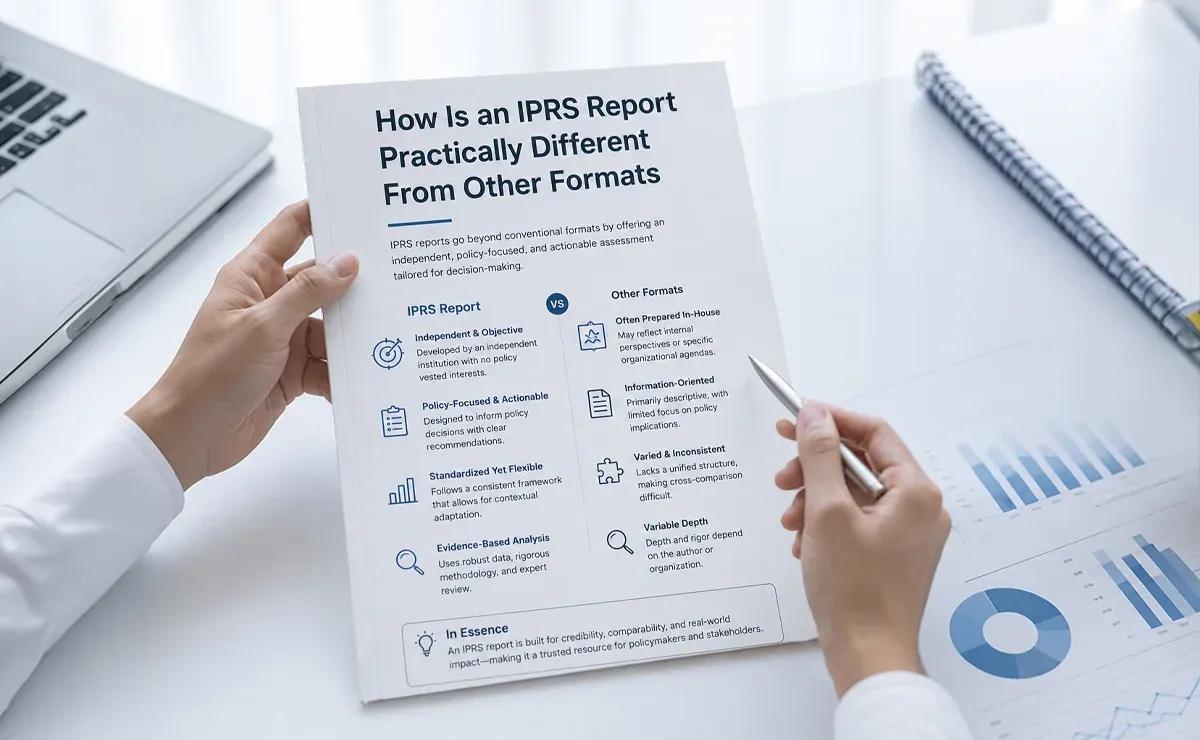
Most placement reports in India fall into one of three categories, and the gap between them is exactly why "audited" and "IPRS-audited" aren't interchangeable terms.
- Self-Reported: No external monitoring of the numbers reported, and no specific definition of what constitutes salary.
- Audited But Not IPRS-Compliant: A third party verifies the accuracy of the figures claimed by the recruiters; however, such numbers are especially susceptible to inflated average packages because they account for one-time bonuses, relocation allowances, or unrealized value of ESOP.
- IPRS-Audited: The same external verification, plus a fixed set of disclosure rules every following institute has to use.
Four specific requirements separate the second category from the third.
- Salary Period: Outside IPRS, even audited reports can combine multiple years of a package or count more than one offer per student. IPRS restricts reporting to year-one salary only and to one offer per student.
- Placement Rate: Neither self-reported nor generically audited formats have to disclose what share of a batch is actually placed or why students left the process. IPRS mandates disclosure of the batch size, the number placed, and the dropout reasons.
- Fixed versus Variable Pay: This is rarely broken out elsewhere but always separated under IPRS.
- Domestic Versus International Offers: Usually blended into one flattering combined number outside IPRS. IPRS, however, requires each item to be reported separately, with its own top, median, and average.
The ESOP example from earlier, ₹35.8 lakh against ₹17.8 lakh for the same offer, is really this list playing out in rupees. Each of those four rules closes off a decision point where an institute could otherwise pick whichever version of the number looks best.
The Bottom Line
The real question a student should be asking isn't "What's the salary?" It's "How was this number actually calculated, and can I verify that independently?"
An audit alone doesn't answer that; only an IPRS audit does, because the disclosure rules are fixed before a single figure is reported.
Before trusting any headline package, check the institute directly against IIM Ahmedabad's official IPRS members list and placement-reports page, and ask the admissions office which standard, if any, its auditor followed.
As more industry-backed, non-traditional B-schools join a registry that has historically been dominated by the IIMs, the verification step is becoming less optional. Transparency is becoming something schools compete on, and the two additions from 2025 suggest that the list is only going to keep growing.