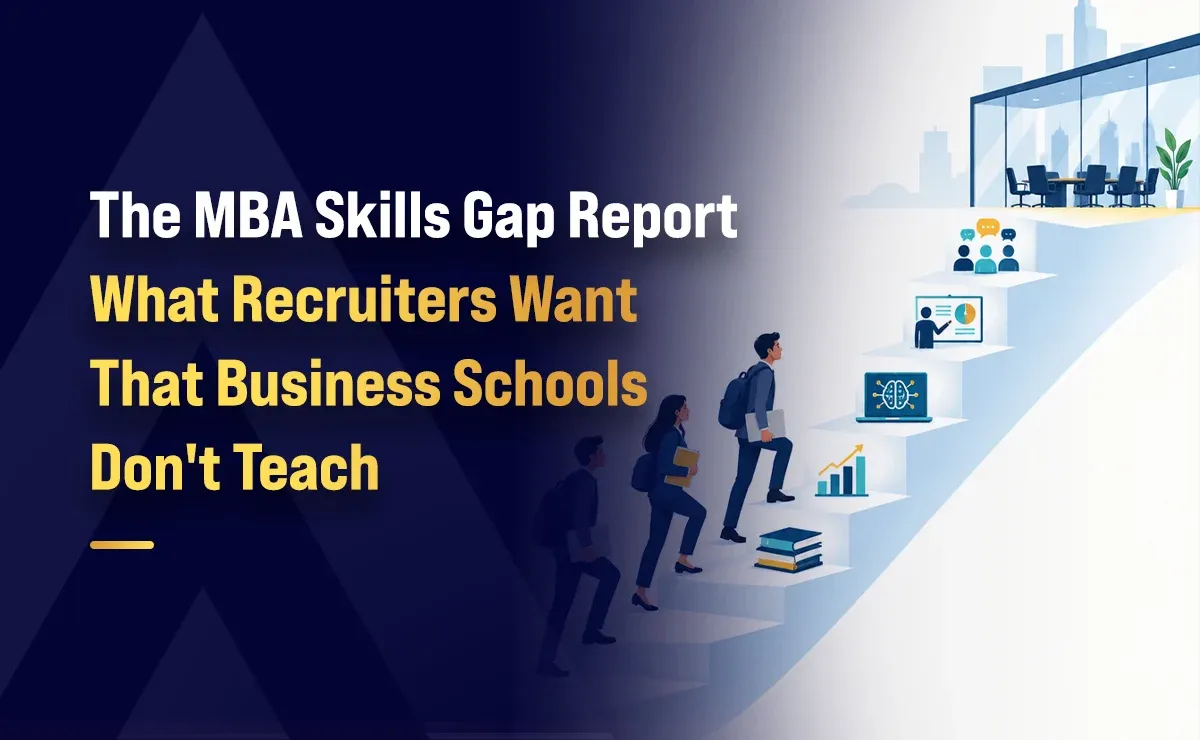
The MBA Skills Gap Report: What Recruiters Want That Business Schools Don't Teach
Hiring expectations across the corporate world have changed faster than traditional MBA curricula have. According to recent LinkedIn India hiring data, nearly 74% of Indian recruiters are finding it hard to find qualified candidates with job-ready capabilities.
Despite high volumes of recruitment across the country, there is a profound mismatch between rote learning of traditional B-schools and the real-time problem-solving skills that are needed by corporates.
Companies are increasingly prioritizing immediate, practical business abilities, like AI integration, commercial analytics, and cross-functional execution, over theoretical knowledge. While traditional institutes rely on outdated frameworks, forward-thinking business schools like Altera Institutes are pioneering programs that are designed to bridge this gap.
This report analyses the disparity between recruiter needs and standard academic offerings.
The MBA Skills Gap at a Glance

The widening skills gap exists because modern workplace needs have changed more rapidly than traditional management education has. As more businesses today are adopting AI, digital transformation, and shorter decision cycles, which means being job-ready now includes execution, adaptability, and data-informed judgement.
Traditional MBA programs, however, still follow a format that values theoretical knowledge more than practical skills. Academic curriculum is about conceptual memorization and classroom exams, resulting in stagnant outcomes for students. This model worked when business environments changed more slowly but is now less effective, as employers need students who can work across teams, use digital tools confidently, and solve problems with commercial context.
This is why recruiters often see a difference between strong academic performance and workplace readiness. A student who understands strategy frameworks well can still struggle to interpret dashboards, lead a cross-functional discussion, or present a decision that resonates with business stakeholders.
Recognizing this industry requirement, Altera Institute has built its curriculum around these industry demands rather than static course curricula. This framework ensures students get immediate applicable capabilities and employability.
What Recruiters Want vs. What Many MBA Programs Teach
The mismatch between an MBA education and industry reality is clear. Recruiters want graduates who can move from analysis to action. This includes using data to support decisions, communicating clearly across teams, and adapting to change quickly.
While traditional programs do not necessarily lack in rigor, they are often slower to update. As a result, students may end up with a stronger conceptual knowledge base but limited hands-on experience with the tools and working styles that matter in modern job roles.
Alterna Institute embeds these capabilities directly into its core curricula. Rather than offering optional modules, it integrates technical proficiency, commercial thinking, and emotional intelligence into its courses.
Why Experiential Learning Matters More Than Ever
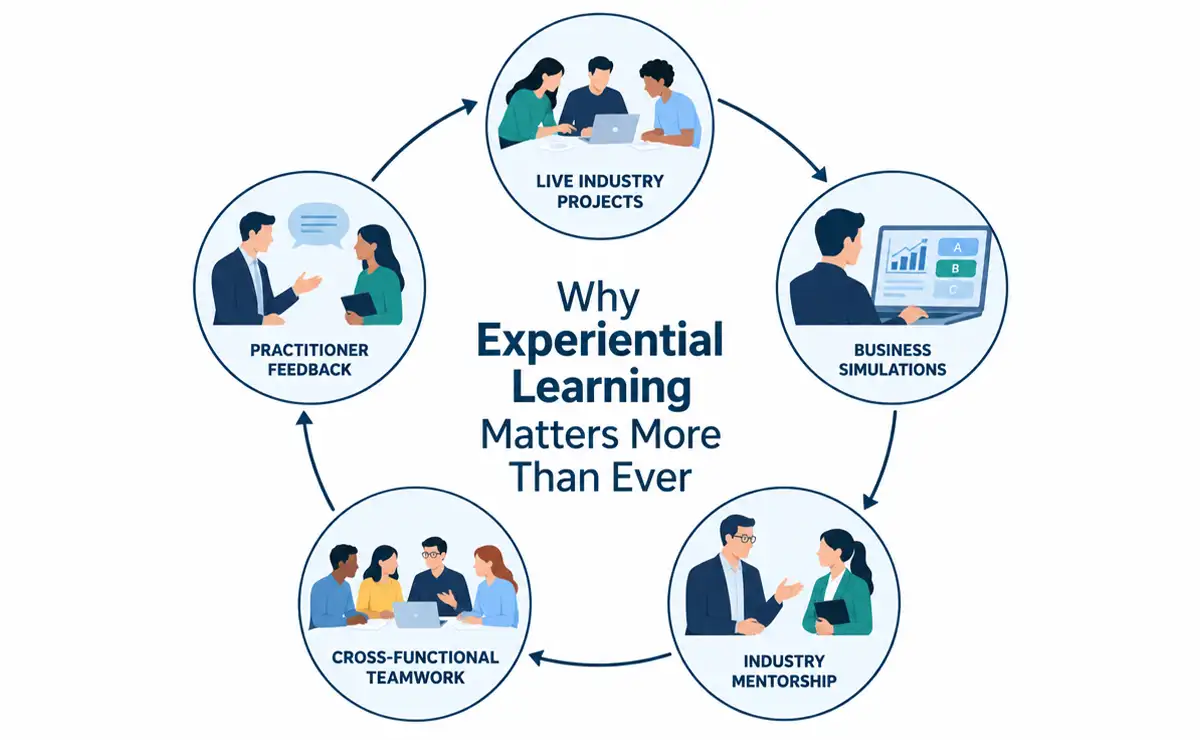
To truly bridge the skills gap, business education must move beyond the classroom. Experiential learning, driven by live industry projects, business simulations, mentorship, cross-functional teamwork, and feedback from active practitioners, develops workplace capabilities more effectively than reading textbooks alone.
These formats matter because workplace skills are difficult to develop through lectures alone. A student who works on live briefs learns how to manage ambiguity, respond to feedback, and build the resilience needed to handle real-world challenges. They also understand how business decisions affect different teams, outcomes, and timelines, which is difficult to replicate in theory-based learning.
This is where curriculum design becomes important. Altera Institute matches the academic rigor of top one-year MBA programs, such as the one offered at ISB. Its program’s learning experience is built to reflect how modern businesses actually work. The curriculum at Altera Institute is positioned on working on live industry projects, mentoring under and learning from industry experts, using AI-enabled tools to support decision-making, and collaborating across business functions.
These skills matter because recruiters hire graduates not only for their knowledge but also for their ability to contribute in environments that demand speed, adaptability, emotional intelligence, and cross-cultural teamwork. A curriculum built around these realities gives students more than a qualification; it gives them context, confidence, and workplace fluency. Altera Institute sits among other recognized names in business schools within the context of modern management education and offers a PGP structure designed to remain closely aligned with industry changes.
Conclusion
The ultimate value of an MBA program no longer depends on the qualification earned but on the tangible capabilities and skills a student develops. As recruiters increasingly look beyond credentials to focus on digital fluency, adaptability, and business execution, students must evaluate programs on how effectively they prepare their graduates for the modern workplace.
For prospective students, the question is no longer which business school has the strongest brand, but which program best includes the state of the industry at the moment. Altera Institute is a prime example of a business school built to meet modern business expectations.
Frequently Asked Questions (FAQs)
Q1. How can MBA students build these skills while they're still studying?
Ans: Students can build skills by taking on internships, freelance consulting projects, earning micro-credentials in AI, and participating in business simulations. Interacting with industry leaders and mentoring under them will also help significantly.
Q2. Do recruiters value certifications alongside an MBA?
Ans: Yes. Recruiters do value certifications, such as CRM platforms, project management, AI tools, and advanced analytics. These provide proof of your hands-on proficiency with these tools and your commitment to learning. However, certifications are considered complementary to your knowledge and skills.
Q3. Are these skills only important for marketing and technology roles?
Ans: No. Skills, such as data-driven decision-making, stakeholder management, and AI literacy, are now considered baseline expectations across many industries. Banking, finance, consultancy, and retail operations, among others, all require their employees to possess these skills.
Q4. How often should an MBA curriculum be updated to remain industry-relevant?
Ans: To remain competitive, management education course curricula should be updated annually, and the process must be continuous. Every few years, there should be a complete review of the curricula and changes to include all major technological and industry upgrades.
Q5. What questions should I ask during an MBA admission counselling session?
Ans: It is good practice to ask about the number of practitioner- or expert-led classes and choice of electives in your MBA program. Additionally, asking how the programs integrate technologies and if you will work on live projects or use standard case studies will help you assess the curriculum.
Q6. Do recruiters prefer a 2-year MBA over a 1-year MBA?
Ans: Historically, recruiters in industries like investment banking or FMCG have preferred a 2-year MBA program, as they pipeline talent through summer internships. However, lately, this has shifted for individuals with prior work experience who want to transition between functions or accelerate their careers without taking a two-year career gap and have a one-year MBA program. At the top level of corporate, both formats are treated as equals, and instead, they prioritize the school’s brand and the individual’s abilities.