
What Are Business Analytics in an MBA Program?

Every major MBA brochure mentions business analytics somewhere in the program overview. But the problem is, what’s behind that phrase varies wildly between institutions. Some programs go deep on applied data tools; others spend half the semester on theories that sound impressive in a classroom but don’t translate into real practical work.
Moreover, if you choose the wrong program or misunderstand what the track actually covers, you’ll graduate with credentials that look good on paper but don’t land job offers. Done right, though, a business analytics track can entirely change your professional profile. It turns a generalist MBA graduate into the kind of talent that companies across BFSI, eCommerce and consulting are actively competing to hire.
This article breaks down what business analytics really means in an MBA program, what it teaches you, where it leads, and what to look for in such a program before you commit.
What Does Business Analytics Actually Mean in an MBA?
The term "business analytics" gets used quite often and loosely, so it’s worth defining it plainly. Business analytics is the discipline of using data to make better business decisions. It’s not about building systems that generate the data. That distinction shapes everything else about the career path students choose.
In the data space, there’s a real divide between professionals who build technical infrastructure (engineers, data scientists, ML developers) and those who use that infrastructure to solve business problems. Business analytics and its study in an MBA program sit firmly on the second side of that line.
The decision-making layer, not the engineering layer
Most organizations don’t need their analysts to code from scratch or build dashboards by hand. They need someone who can read a dashboard correctly, identify what the numbers actually say, and translate that into an action plan the leadership team can use to move forward. That’s the role business analytics trains you for, and it’s precisely why the MBA profile is such a natural fit for this work.
Where domain expertise meets data fluency
What makes a business analytics talent incredibly useful in business across industries isn’t just raw technical skill in isolation. Such graduates can combine domain knowledge with data fluency to make the most precise decisions. Just knowing what a customer retention metric means is very different from understanding why it dropped last quarter and what to do about it. Business analytics education in an MBA program develops this second capability, and it’s exactly the skill that companies are actively paying a premium for.
What Does a Business Analytics MBA Actually Teach You?
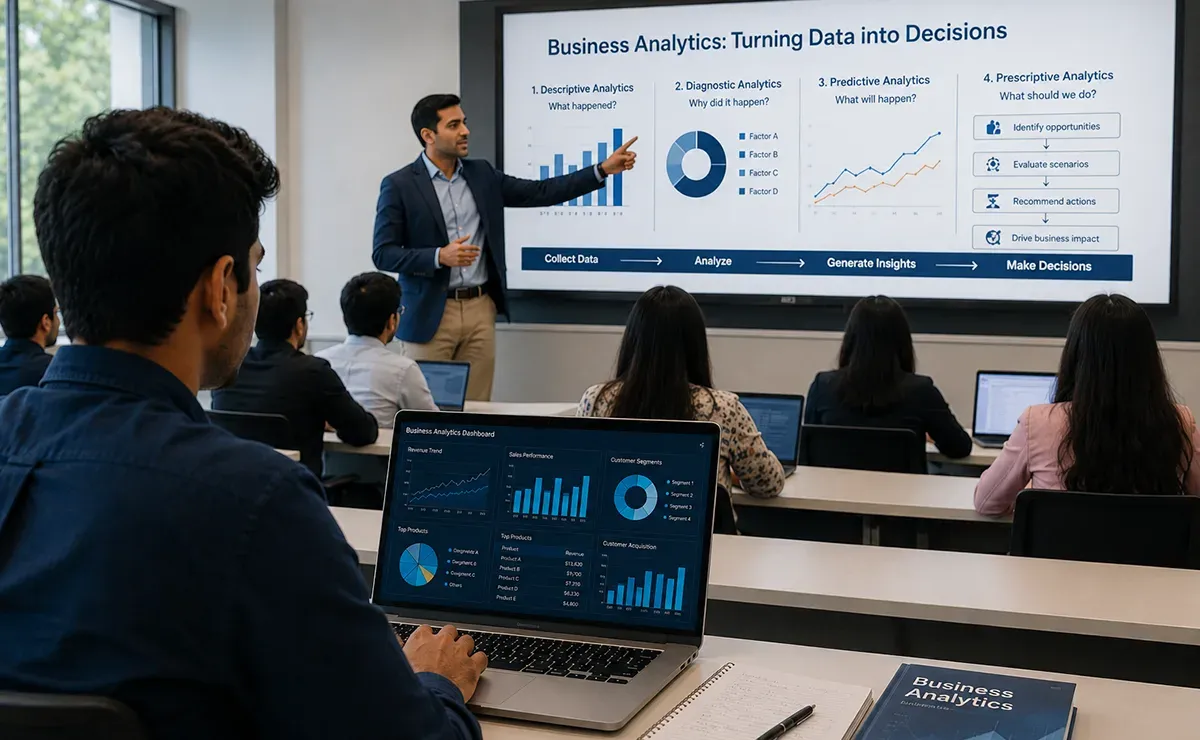
The curriculum for business analytics inside an MBA isn’t a data science program in disguise. It’s built around three distinct capability layers, and understanding what each one develops is how you evaluate whether a program is worth your time and money.
Tools: SQL, Excel, Tableau, Power BI
MBA programs dive deep into business analytics tools, which are integrated into classroom activities to be taught in practice. The tools layer gives you hands-on experience with the platforms that analytics professionals use every day. Here’s what a well-designed program covers:
- Using SQL to query databases and pull structured data without depending on an engineer every time you need a number
- Excel for financial modelling, scenario planning, and decision support frameworks
- Tableau and Power BI for creating visualizations that anyone can read and act upon
- Basic Python or R in stronger programs, at a business-user level rather than a developer level
Quantitative thinking: statistics, forecasting, and performance modelling
Aside from tools, the curriculum develops your ability to think with numbers in a business context. It involves interpreting statistical outputs, constructing forecasts, analyzing demand, and creating frameworks for tracking what matters most within an organization. These aren't just abstract exercises performed at random. They’re applied to real business scenarios, so you leave the program knowing how to measure performance, spot trends early, and model the likely impact of a decision before committing to it.
Communication and stakeholder translation
This is the capability that sets professional analysts apart from report runners. An MBA business analytics track teaches you to take a complex dataset and turn it into a clear, actionable narrative that is easy for a non-technical audience to understand. Whether it’s presenting recommendations to a CFO or writing a product brief for a cross-functional team, this key skill is what makes analysts so important and why they're promoted and trusted. Programs that skip this layer and focus only on tools and theoretical concepts produce graduates who can run reports but can’t think in systems to interpret them.
What Careers Does Business Analytics Prepare You For?
A business analytics MBA doesn’t funnel you into one narrow job title. It opens up a range of roles that exist in high volume across almost every major sector in India, from FMCG and banking to SaaS and consulting.
Business Analyst and Strategy roles: the most common entry points
Business analyst and strategy and operations are among the most straightforward entry-level roles available for MBA graduates. These roles are available throughout FMCG, eCommerce, BFSI, and consulting companies. Unlike more technical tracks, they aren't asking for 2 to 3 years of hands-on technical experience before joining. They can be entered directly after completing a solid postgraduate course.
Product Analytics and BI Manager: mid-level paths with fast progression
Product Analyst and BI Manager positions offer solid mid-level career trajectories for those looking to pursue careers in technology-adjacent companies with comparatively quicker growth than many other MBA careers. Usually, these roles serve as the analytical pillars of a product line or business unit, working directly with product managers, marketers, and senior executives to guide and inform business decisions. Salary acceleration at this level is substantial and faster than in strictly technical jobs.
Consulting and Operations: where MBA judgment adds the most value
The MBA business analytics profile is ideal for consulting positions and operations at D2C brands and scale-up companies. The core job in both scenarios is to interpret information into strategic advice—an area where domain expertise and communication skills are more suited than technical expertise. That combination is exactly what the MBA curriculum builds.
Salaries and Demand in the Indian Market
India has a large analytics industry with an ever-increasing number of professionals, yet it remains under-resourced in high-quality talent. Knowing what to expect in terms of salary helps you make informed decisions and plans accordingly.
Salary bands by role and level
Let's look at the experience level breakdown of salary data collected during hiring for 2025-26:
The learning curve for business analytics professionals is steeper than that of most technical careers. Business-focused career paths have a more direct link to revenue contribution, making it easier to see performance earlier and secure salary increases.
Industries with the highest active demand in India
Analytics hiring in India is currently most concentrated in BFSI, eCommerce, and SaaS, but demand is spreading steadily into FMCG, D2C brands, healthcare, and telecom. India’s data analytics market was valued at approximately USD 2.6 billion in 2024 and is projected to grow at a compound annual growth rate of over 27% through 2033, according to IMARC Group.
Moreover, India saw a 52% rise in analytics job postings from 2021 to 2024, and demand for such positions remains well ahead of the available talent pool of individuals with domain expertise and data proficiency. It's that space where MBA graduates are filling the void with applied training.
Why Do MBA Grads Have a Structural Advantage in Business Analytics?
This is where the MBA profile earns its edge. Business analytics rewards business judgment, not just technical ability. And business judgment is exactly what an MBA trains for.
Business-first thinking as a competitive edge
Engineers who enter data science often don't come with these skills by default: how to handle stakeholders, communicate across functions, and clearly define a business problem before opening any dataset. The problem most MBA graduates face is not an analytical one. It’s the disconnect between what traditional programs teach (theory) and what industry expects (applied, tool-literate thinking). This gap can be filled by selecting the right program. It’s not a structural weakness in the MBA profile. It's a program design issue.
Where the MBA profile outperforms purely technical candidates
Engineers who move into data science positions tend to have strong technical expertise and lack business context and framing, which is required for using analytics at an organizational level. That framing is ingrained in MBA graduates from the outset. The ability to combine domain knowledge and stakeholder communication with analytical thinking is often more important than purely technical ability in jobs that focus on data-driven decision-making.
What to Look for in a Business Analytics Program?

Not all programs deliver what they promise. Here’s how to evaluate whether a program is genuinely built around industry demand or simply marketing itself that way.
The key difference between curriculum and industry alignment
The most crucial question students must ask is whether the program clearly understands the skills companies are hiring for and has been developed around those realities. Live projects and case-based learning always beat lecture-heavy theory courses, as the industry values application of skills, not textbook recall. Search for assessments based on authentic business challenges and tools that are congruent with the job requirements.
Faculty quality and mentorship
Faculty drawn from the industries that actively hire analytics professionals, FMCG, D2C, consumer tech, and consulting, bring a fundamentally different quality of perspective compared to purely academic faculty. When the faculty of a particular program has itself secured the positions that you are interested in, it is a serious indicator that the curriculum is of value to the market.
Duration, format, and outcomes
Usually, more focused 12-15-month programs can yield sharper, more job-ready graduates than diluted two-year generalist MBAs. It's not a duration filter! It is important that the program has an explicit, clear employment outcome and that its curriculum is designed backwards from companies' desired outcomes, not from the appearance of a syllabus.
Conclusion
Business analytics in an MBA does not prepare you to become a data scientist. It prepares you as a professional who can turn data into decisions, the one who reads the dashboard correctly and tells the business what to do next. That’s the role that organizations across every sector are trying to fill right now.
The demand in India is real. The career paths are clearly mapped out. And the MBA graduate, with the right program behind them, has a genuine structural advantage in this space. The analytics hiring wave in India is still in its early stages; professionals who position themselves well now will be the ones managing teams within five years.