Does Any University Offer MBA Programs Suitable for Fresh Graduates?


If you have just completed your undergraduate degree and are considering an MBA, you have probably come across the same concern more than once: Do you need work experience to get in? It is a fair question, and for a long time, it has caused many fresh graduates to delay their plans.
To answer the question, traditional 2-year MBAs and PGDM programs at institutions across India, like IIMs and FMS Delhi, to MDI Gurgaon and XLRI, admit fresh graduates every year as standard practice.
What has changed, however, is the context behind that fact. These programs do not require work experience as a prerequisite, but having so does improve a candidate's profile.
Fresher hiring intent in India rose to 73% in early 2026, and companies are increasingly looking for focused, job-ready candidates. At the same time, MBA enrollment globally has fallen by 6% over five years, while specialized master’s programs have grown by 11%, now accounting for more than half of all master's-level enrollments worldwide.
The market is shifting, and the most useful question for any fresh graduate today is not “Can I apply?” It is “Which program is actually worth applying to?”
What Are the Eligibility Criteria of Fresh Graduates in MBA Programs?
The eligibility criteria for most full-time 2-year MBA and PGDM programs are as follows:
- A bachelor’s degree in any discipline from a recognized university
- A minimum aggregate of 50% (45% for candidates from reserved categories)
- Valid CAT / XAT / GMAT / CMAT / NMAT / Institute Entrance Test score
- Excellent performance in all the group discussion, written ability test, and personal interview rounds
These are the minimum requirements. But what makes candidates jump that bar is another matter altogether and one that freshers should understand beforehand when they begin preparing for the exam.
When there is no professional history on an application, admissions panels do not lower the bar. They redirect their attention to a fundamental question that every admissions team asks, "Is this person a good fit for the program?" They simply look for the answer in these four key areas of focus:
1) Entrance Exam Scores
A good percentile is the most crucial factor for freshers when it comes to getting shortlisted. It's the most objective and direct comparison that is available in the absence of professional experience. Students have to fulfill the cut-off requirement by the institute to be eligible. For instance, FMS Delhi's CAT cutoff is 99.5%, while SJMSOM at IIT Bombay is 98%. It is important to note that the test isn't only a filter—it's the loudest statement your application makes as a fresher.
2) Academic Record and Internships
The admissions team assesses your performance throughout Class 10 and Class 12 and at graduation. If you don't perform well in any one of these, it isn't necessarily a big red flag, but if your grades are steadily declining across them, then it raises questions about your ability to deal with academic stress. Along with your grades, internships, certifications, live academic projects, and extracurricular activities are also considered, as they are proof of your experience, which enhances your profile and increases the likelihood of being selected.
3) Clarity of Career Purpose
Many freshers lose points in the SOP and personal interview round. It is because the panel is looking for genuine authenticity from students. A fresher who can articulate clearly and concisely why he wants this MBA, what he will achieve if he gets it, and why this particular B-school is the best place is more likely to outperform the candidates with higher scores but generic reasons. When you have clarity about your career, then all the other elements of the profile become more authentic.
4) Profile Consistency
A profile should be more than a list of credentials. The panels must be able to read it as a story. With all the elements in a student's profile (academics, internships, and extracurricular choices) aligned and the goals clearly stated, the application comes across as purposeful and strong, even without years of professional experience.
Note: In some institutions, work experience may be included in the selection process even if it is not a requirement. For instance, MDI Gurgaon gives 10% weightage to professional experience. This does not lower the chances of freshers at the eligibility stage, but be aware of programs that take it into account when making a final decision.
Top MBA Programs in India That Welcome Fresh Graduates
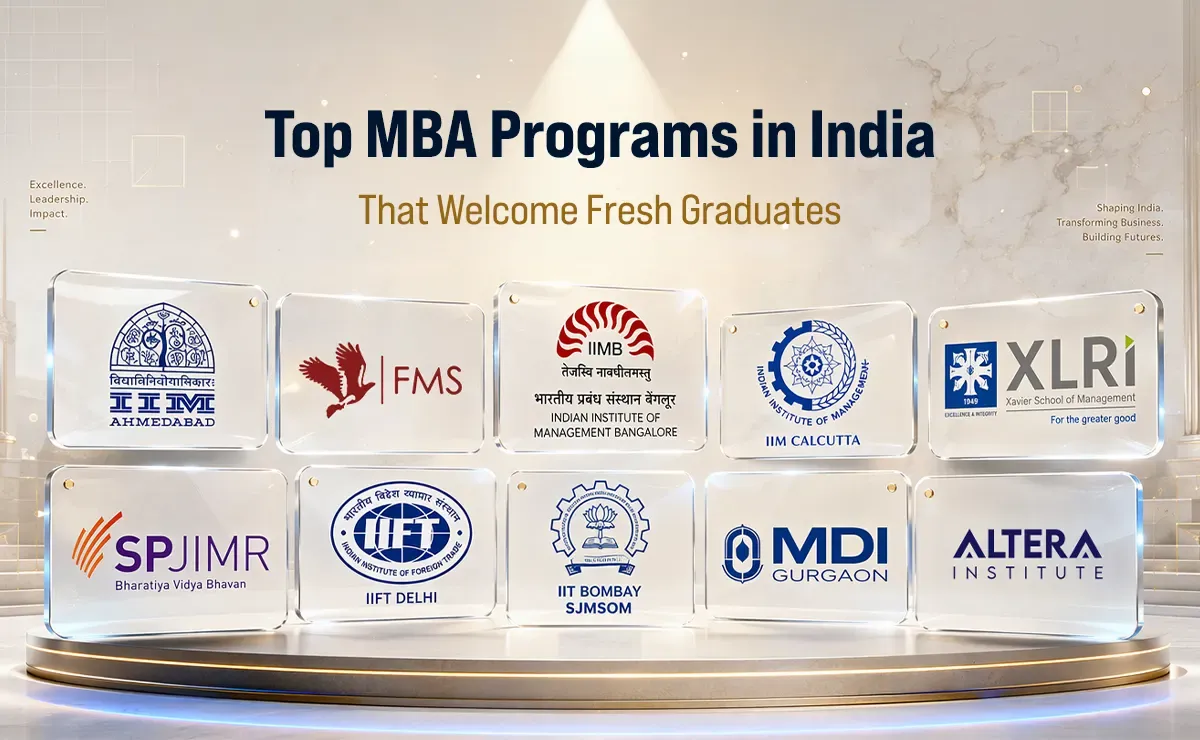
The table below covers ten prominent institutions with key figures a fresh graduate should compare before making a shortlist.
* Represents Interim placement data. Final placement report to be published by the first week of August.
Three conclusions worth drawing from this data before you shortlist:
1) FMS Delhi’s ROI is exceptional
A median salary of ₹29.59 LPA against a fee of just ₹2.43 lakhs is an ROI that no other institution in India comes close to. However, the entry bar is also among the tightest in the country, with a CAT percentile of 99.5+ required for eligibility.
2) The IIM Brand Name
IIM ABC has the highest fees and also the highest median salaries. The table, however, does not reflect what your investment truly represents: continuous access to the best recruiters from consulting firms, banks, and corporations around the world that only hire from a handful of campuses; and an alumni network that grows in value well beyond graduation.
3) The Uniqueness of Altera’s PGP
Altera Institute is the only 1-year program on this list that caters to both freshers and early-career professionals entering digital-first careers. It uses a profile-based shortlisting process to evaluate applicants holistically, making it a distinctive option in this list.
Altera Institute’s PGP: A 15-Month Program Built for Freshers
For most fresh graduates in India, the 2-year MBA has historically been the only realistic pathway into management education. This is because almost every 1-year MBA or PGP program in the country is designed exclusively for working professionals.
For example, IIM Ahmedabad’s PGPX and IIM Bangalore’s EPGP both require at least 5 years of professional experience. IIM Kozhikode’s PGP-BL requires at least 4 years of work experience. ISB’s full-time 1-year PGP, which is not an executive-style program, still requires a minimum of 24 months of relevant work experience at the time of application. For a candidate stepping out of a bachelor’s program, every one of these pathways is closed.
The result is that freshers ultimately default to 2-year MBAs. That is not a problem in itself. But for specific kinds of freshers—those who already know they want to build a career in digital marketing, growth, e-commerce, or product—spending two years in a broad general management curriculum seems like an inefficient route to the destination.
That is the gap Altera Institute’s PGP in Applied Marketing was built to close. It is one of the only 1-year management programs in India that actively admits fresh graduates. The program covers 1,200+ hours of structured learning across 15 months and provides access to live projects from real companies, daily engagement with industry practitioners, and a focused specialization in digital and AI-first marketing roles.
Graduates enter the workforce 9 to 12 months earlier than those from traditional 2-year programs, with a portfolio of real-world experience that employers actively seek.
Altera is the right choice for freshers who:
- Have a clear direction toward digital marketing, growth, eCommerce, and product roles and want to reach these careers faster.
- Want a practical, industry-first learning environment where real projects build the portfolio, not theoretical knowledge.
- Are looking for a program that delivers strong ROI at a lower cost and with an earlier start to earning.
Altera is not the right choice for freshers who:
- Are still undecided about their career direction and need broad exposure across sectors before committing to a path.
- Are targeting careers in consulting or investment banking, where the recruiter networks of IIMs, XLRI, or SPJIMR remain the most effective route.
How to Choose the Right Program as a Fresh Graduate
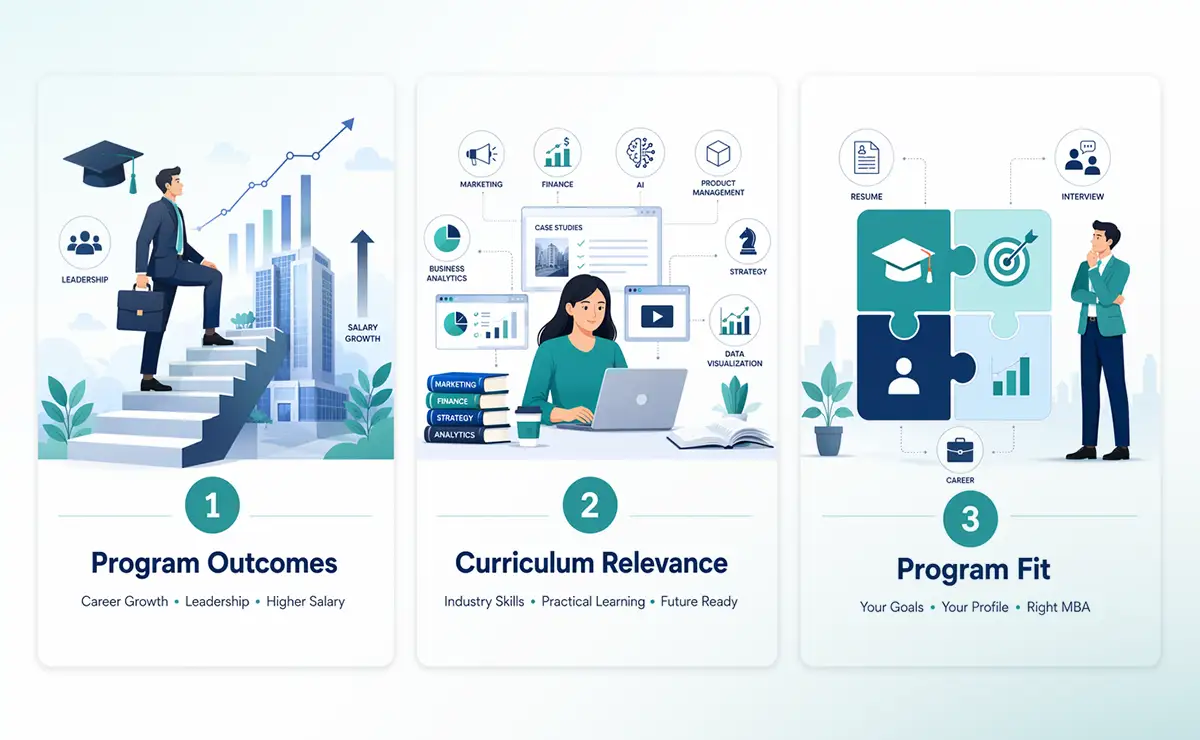
Brand names and rankings are a useful starting point, but they rarely capture the true value of a program, especially for freshers making a significant financial commitment. Three factors deserve careful evaluation before finalizing any shortlist.
1) Program Outcomes
The numbers that most institutions lead with, such as the average and highest salaries, are also the easiest to manipulate. These figures are highly susceptible to a few outstanding offers at the top of the batch and are nearly always self-reported in India without any external verification.
The median income data is therefore more reliable, because it shows the typical income of a student in a cohort, not the top or bottom earners who make a nice headline. Apart from the numbers, also consider whether companies return to your campus year on year and whether graduates are offered positions that promote long-term growth.
2) Curriculum Relevance
The kinds of business operations that MBA degrees train students for have changed significantly over the last decade. Today's industry is very data-driven, AI-integrated, and directly connected with measurable results. Live industry projects, real-life hands-on experience with tools, and learning by practitioners now directly result in more readily usable graduates. This disconnect between what students are learning and what is being taught has real long-term consequences for the new entrants in the workforce.
3) Program Fit
Not all MBA courses are designed for freshers. Some assume real-world experience, making it harder for freshers to connect with classroom discussions. The value add and academic culture of the B-school you select need to be in sync with your career aspirations, learning approach, and readiness levels. The right B-school for you isn't necessarily the one with the best brand name or rankings; it's the one that's right for your individual needs and your future.
Conclusion
The answer to the central question of this article is unambiguously yes. From IIM Ahmedabad, IIM Bangalore, and FMS Delhi to XLRI Jamshedpur, MDI Gurgaon, and IIT Bombay's SJMSOM, management education in India is absolutely accessible to fresh graduates.
For most students, the 2-year MBA or PGDM remains the right choice for freshers who want breadth and time to find their direction. For freshers who already have that direction, specifically those heading into digital marketing, growth, eCommerce, or product, Altera Institute’s PGP offers something no other program in India currently provides: a rigorous, 15-month, industry-built program with no work-experience requirement.