Recruiters at Altera Institute
Who’s hiring, what they’re hiring for, and how the numbers are verified: a closer read of the PGP Class of ’26 Interim Placement Report.
Why the Recruiter List Is the Real Placement Story
When students compare B-schools in India, the recruiter list is usually easy to overlook. They often glance at the headline figures first, such as the average and highest package, recognize a few familiar companies, and then move on to the next brochure. But that only tells part of the story, since it does not say anything about the kind of role the companies offer or whether the numbers are audited and portray the ground reality.
Altera Institute's Interim Placement Report for the PGP Class of '26 goes beyond most. The report identifies all the companies that hired this year, explains what positions they filled, and backs up the salary data with an independent audit. In this article, we delve into what the interim report says about the recruiters and what you need to know if you're considering the Altera Institute.
A Recruiter Base Built Around Four Sectors
At the Altera Institute, some of India’s most respected names in FMCG, eCommerce, consumer tech, and media hire from the campus. This is a deliberate positioning choice, built around sectors where Altera believes the greatest economic value is being created right now, and it expects to keep growing even as AI displaces roles elsewhere.
That positioning shows up in the growth of the recruiter base itself. Forty new recruiters joined the list this year. The cohort also grew in size, but recruiter demand grew faster, which is the more telling number for anyone worried about an oversubscribed placement cycle.
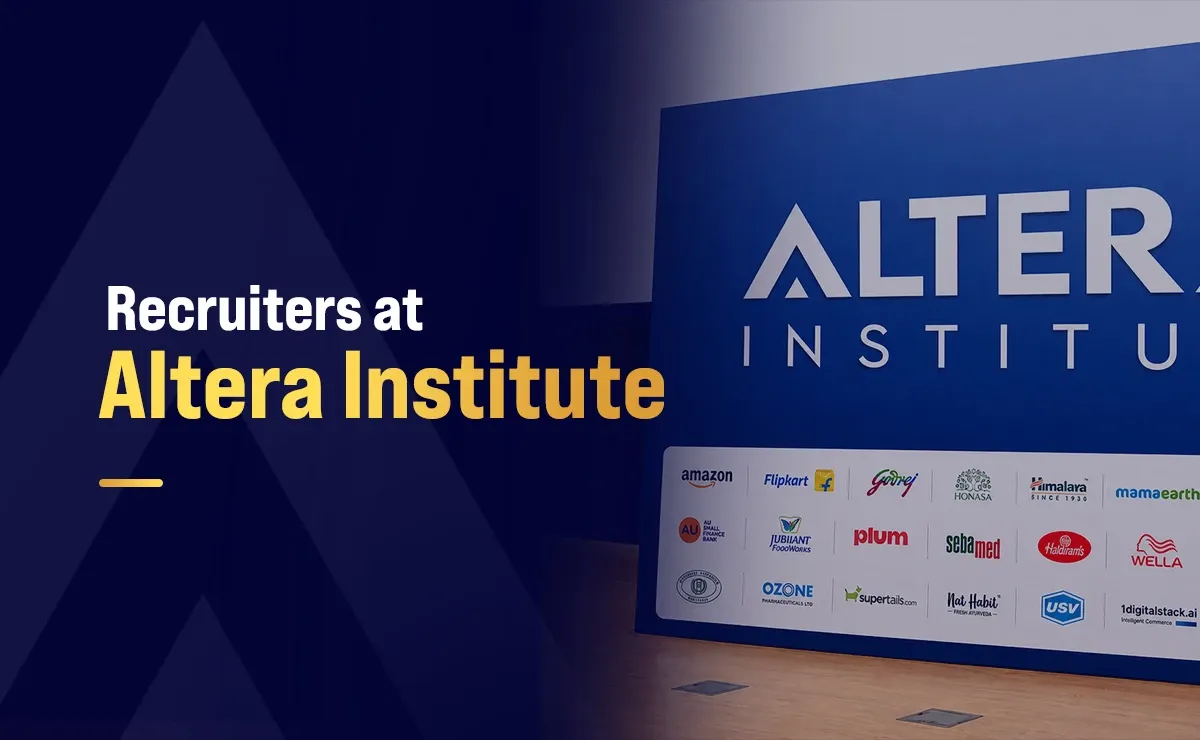
Here is the full list of 30 companies named as recruiters for the Class of ’26:
Some of the names mentioned in the table need no introduction. Hindustan Unilever Limited, Nykaa, Swiggy, Mondelez International, Dabur, and Shiprocket are recognizable across most consumer-facing careers in India. Others, like Slikk, FirstClub, and Whiteboard Capital, are newer and growing fast, and their presence here suggests where hiring in this space is actually headed.
What The Recruiters Are Hiring For
Altera Institute specifically reports the roles recruiters are hiring for.
- More than 90% of students were placed in digital & AI roles, rather than the traditional ITES or BFSI jobs that dominate placement reports elsewhere.
- 10% landed AI jobs, positions centered around building with AI instead of being replaced by it.
- 20% of students were placed into Founder's Office, EIR, or Strategy roles, positions that put students close to core business decisions at a young age.
- The cohort recorded its first-ever placement at a venture capital firm, a rare outcome since VC firms hire infrequently and screen hard when they do.
Within the Digital & AI-first placements specifically, the report breaks down exactly where students landed by function:
Together, growth marketing and revenue roles account for over half of these placements. Recruiters in e-commerce, consumer tech, and D2C brands today need people who can move fast on customer acquisition and revenue growth, instead of just managing existing processes.
Why Companies Choose Altera Over Traditional Tier 1 B-Schools
This is the question every aspirant predominantly asks. If these companies can recruit from any Tier 1 B-school in India, why come to a program that’s under five years old? The report gives three specific reasons, each addressing a different part of a recruiter’s decision.
1. Industry-Leading Instruction and Pedagogy
More than 40 organizations, including Amazon, HUL, ITC, and Nestlé, already use Altera Institute’s programs to upskill their employees. That’s a different kind of endorsement in itself, as recruiters across such legacy companies already know and trust Altera’s pedagogy.
2. Industry-Backed Credentials and Trust
Altera Institute was founded by former HUL leaders and is backed by a group of established CEOs and founders. The PGP in Applied Marketing is run in association with leading industry professionals who serve as mentors, ensuring students are prepared with the skills and competencies that the industry seeks in its hiring talent.
3. Day-1-Ready Talent
The report’s simplest claim is also its most practical one. Students are staffed directly into digital- and AI-first roles without the ramp-up period that recruiters often factor into hiring from more traditional B-schools.
Recruiters in Action: Where Students Actually Landed
Although the report contains statistical information to explain the pattern, it also includes information on individual outcomes that relate to each student's role before and after the program. Here are a few examples of how diverse these transitions actually are:
- Prerna Garg moved from an accounting & finance associate role at NTT into the Founder’s Office at Honasa.
- Vidhi Kalra went from social media marketing at Social Symphony to brand management at Nykaa.
- Vedanta Pai moved from Sales Account Manager at Keka to Cluster Sales Manager at Shiprocket.
- Janis D’Souza went from marketing executive at Asian Paints to community manager at Whiteboard Capital, the venture capital firm behind the cohort’s first VC placement.
- Rishabh Sethi moved from Centre Manager at Career Launcher to Key Account Manager at Mondelez International.
Freshers, students who joined straight after their undergraduate degree, show a similar range. Kshitij Jain came in with a BBA from JECRC University and was placed as an AI & Analytics Manager at The Man Company.
Ashwini Gurung, a sociology graduate from Hindu College, Delhi, was placed into brand management at Honasa. That’s proof that a non-business background isn’t a barrier to these roles.
Recruiter interest doesn’t end at graduation either. The report also tracks alumni from earlier cohorts: a Class of ’24 graduate who started as a key account manager at Honasa now works in ad monetization at Blinkit.
Another Class of ’24 graduate who began in eCommerce at WPP is now a performance marketing manager at Dabur. These moves suggest the relationship between Altera Institute talent and these recruiters continues well past placement day.
Why You Can Trust the Numbers Behind These Placements
Altera Institute doesn’t estimate numbers and makes a point of reporting with total transparency. Recruiters disclose the offer details directly, and that data is then independently audited by B2K Analytics, the same firm that audits placement data for IIM Ahmedabad, under the Indian Placement Reporting Standard (IPRS).
That distinction matters more than it might seem. Of the more than 5,500 B-schools in India, fewer than 50 have audited placement data, and fewer than 10 specifically follow IPRS. That puts Altera Institute among the fewer than 0.2% of Indian B-schools that report to this standard.
The report provides a real-world example of why standardization is important. As an example, let us say a student received an offer with the following breakdown: Rs 13.4 LPA fixed pay, Rs 2.4 LPA variable pay, and Rs 20 lakh in ESOPs vesting over the next four years. Depending on how a school chooses to report that identical offer, it may be presented in three different ways:
- Ignore vesting entirely, and the package reads as ₹35.8 LPA.
- Apply a generic 25% vesting assumption instead of the real schedule, and it reads as ₹20.8 LPA.
- Apply the actual disclosed schedule as dictated by IPRS; it reads ₹17.8 LPA.
Same recruiter, same offer but three different numbers, depending entirely on who’s doing the reporting. That gap is exactly why the audit matters when you compare recruiter data across institutes.
Summing Up
Put together, the current interim numbers give a fairly complete picture of recruiter activity at Altera Institute this year. 75% of placed students landed roles paying more than Rs 15 LPA, with an average salary of Rs 17.4 LPA and the highest offer of Rs 32.5 LPA.
Average compensation growth relative to pre-PGP CTC is at 3.7X. More than half of the cohort placed into MNCs or listed companies, and more than half into eCommerce roles specifically.
This data reflects Wave 2 of a four-wave placement process, with more than 80% of the batch already placed and two waves remaining. If last year’s pattern holds, where final numbers came in ahead of what was forecast at the same stage, recruiter activity is likely to grow rather than plateau before the program closes in October 2026.
For a prospective student, that’s the part worth sitting with. It isn’t just that 30 companies recruited this year. It’s which roles they hired for, how those numbers were verified, and what happened to the people who took those offers.