
Is an MBA Worth Taking a Loan For? A Career ROI Analysis


Pursuing an MBA is a dream for many. But unfortunately, this dream often comes with a huge price tag that pushes students towards an education loan.
This also raises an important question among aspirants, making them wonder if it's really worth taking a loan for your MBA. The answer, however, is not so simple.
It truly depends on the total cost of your MBA against what the course offers to you in the long run. This is also known as the ROI of your MBA. Career-focus institutions like the Altera Institute always encourage students to evaluate an MBA based on long-term outcomes rather than tuition fees alone.
Let’s break it down in more detail to understand if taking a loan for your MBA is truly worth it.
Calculating the True Cost of an MBA
Before deciding whether an MBA is worth taking a loan for, you need to understand what the program will actually cost you. Many students only look at the tuition fees, but that is just one part of the total investment.
When calculating the cost of an MBA, remember to include:
- Tuition fees charged by the business school.
- Living and relocation expenses, including accommodation, food, and travel if you move to a new city.
- Learning expenses, such as a laptop, software, certifications, books, and networking events.
- Opportunity cost, which is the salary you give up while studying instead of working.
- Education loan interest, which increases the total amount you repay over time.
A simple way to estimate your investment is
Don't Judge ROI by Salary Packages Alone

A high salary package may grab headlines, but it does not always reflect the true value of an MBA. To understand the return on your investment, you need to look at the complete picture.
Average Salary vs. Median Salary
Many business schools highlight the average salary of a graduating batch. However, this number can be influenced by a few exceptionally high offers.
The median salary often gives a more realistic view because it represents the middle of the batch. Half the students earn more than the median, while the other half earn less. This makes it a better indicator of what most graduates can expect.
Look Beyond the Highest Package
The highest salary package should never be the only factor when comparing MBA programs. Instead, seek answers to questions such as
- What percentage of the batch gets placed?
- Which companies hire from the program?
- Are students offered roles that match their career goals?
- How many internships convert into pre-placement offers (PPOs)?
- Does the program help students accelerate their careers over the long term?
A program with consistent placements, diverse recruiters, and strong career progression often delivers better ROI than one known for a few exceptional salary offers.
You can often find these details in the placement report of the institute. To ensure complete transparency, Altera Institute publishes an IPRS-audited placement report, which is the same auditing standard implemented by IIM Ahmedabad to ensure the numbers reported are completely honest and transparent.
A Simple MBA ROI Framework
In very simple words, your ROI or return on investment is the return you get from making an investment. Since an MBA is also a huge investment, it is not only natural but also wise to consider its ROI.
You do not need a complex financial model to evaluate an MBA ROI. A simple checklist can also help you make a more informed decision.
Consider these five factors before investing in a program:
- Total investment: Include tuition fees, living expenses, loan interest, and the income you may give up while studying.
- Expected salary growth: Compare your current salary with the average and median salaries offered after graduation.
- Career switching opportunities: Assess whether the MBA can help you move into a new industry, function, or leadership role.
- Alumni and industry network: Look for programs that provide access to active alumni, mentors, and industry professionals.
- Long-term earning potential: Think beyond your first job and consider where the program could take you over the next five to ten years.
Calculate Your Break-Even Period
The break-even period is the time it would take for you to recover your MBA investment cost. A simple way to estimate how long it may take to recover your investment is
Here is an example to understand this.
If your total 1-year MBA investment is ₹20 lakh and your annual salary increases by ₹5 lakh after graduation, your estimated break-even period is 4 years.
This calculation provides a useful benchmark, but it should not be the only factor in your decision. It should be taken into consideration along with all the other factors that we have discussed above.
Which MBA Offers the Best ROI?
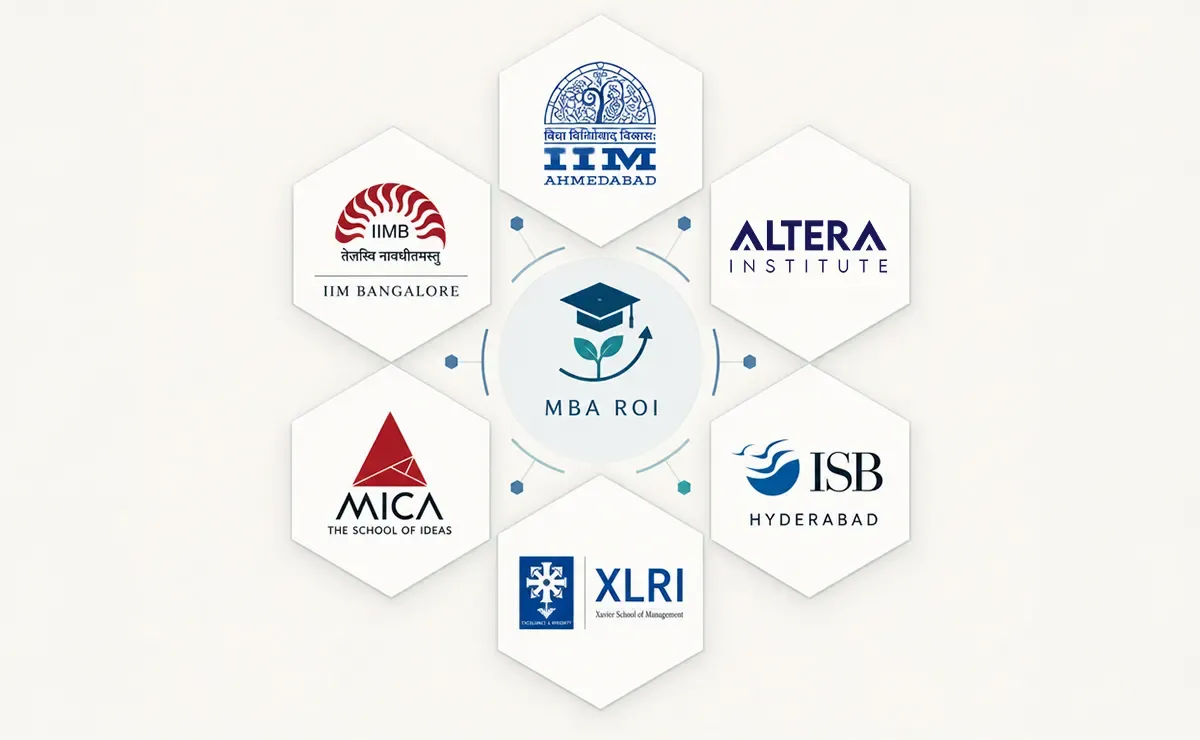
Faculty of Management Studies (FMS)
FMS has one of the highest ROI figures in the country. With its low tuition fee, strong brand value, excellent industry network, and consistent placement record, it offers exceptional value for students seeking high career returns with a relatively low financial investment.
Top IIMs
As you can see, if you choose a top IIM, you will likely make a higher upfront investment, but you also benefit from strong brand value, access to leading recruiters, and faster salary growth. You also gain from an established alumni network and long-term career opportunities. Before making your decision, compare the total cost with your expected career growth to understand whether the ROI works for you.
Specialized Business Schools
If you have a clear career goal, a specialized business school can often deliver stronger ROI than a general management program. Institutes mentioned above focus on specific career paths and align their curriculum with current industry needs.
For example, Altera Institute combines an industry-led curriculum, AI-enabled learning, live projects, and regular employer engagement to prepare students for digital-first business roles through its one-year MBA. It is also one of the few business schools in India to report a +1 ROI, meaning graduates can recover their investment quickly while continuing to benefit from long-term career growth.
If your career goals align with the program's strengths, a specialized MBA can offer better employability and a stronger return on your investment than choosing a program based on brand name alone.
Private Universities
Private business schools such as ISB Hyderabad, XLRI, SPJIMR, and MDI can offer strong ROI, but outcomes vary across programs. Look beyond salary packages and compare placement quality, recruiter diversity, alumni networks, and long-term career growth before making your decision.
When Is Taking an MBA Loan Worth It?
Conclusion: Focus on Lifetime Career Value, Not Just Loan Size
An MBA loan should be viewed as an investment in your future, not simply as a financial liability. The right program can accelerate your career, expand your professional network, and increase your long-term earning potential. Before making a decision, evaluate the total cost of the MBA alongside the quality of placements, industry exposure, alumni network, and career outcomes. Most importantly, compare every program using the same ROI framework. Looking beyond marketing claims and the highest salary packages will help you choose an MBA that delivers real value over the course of your career.
Altera Institute offers a one-year MBA where most students have been able to recover their ROI in less than a year of work post-MBA. This type of ROI is rarely seen with any programs in India. Combined with its industry-led curriculum, small cohort size, vast networking opportunities, and practical learning experience, it is definitely a program worth considering.
Frequently Asked Questions (FAQs)
Q1. Is taking an education loan for an MBA a good financial decision?
Ans. Taking an education loan for an MBA can be a good decision if the program provides a strong ROI. Compare the post-MBA placements, curriculum and pedagogy, peer network, and brand value of the institute to determine your answer.
Q2. How long does it usually take to recover MBA costs in India?
Ans. Depending on the program and your placement post-MBA, it can take anywhere between 1.5 and 7+ years to recover your MBA cost in India.
Q3. Should I compare average salary or median salary before choosing an MBA?
Ans. Median salary is generally considered to be a more realistic figure as compared to average salary because average salary can be significantly influenced by the outliers.
Q4. What factors matter most when calculating MBA ROI?
Ans. Consider the total cost of the program, expected salary growth, placement quality, career switching opportunities, alumni network, and long-term earning potential instead of focusing on salary packages alone.
Q5. Can a specialized MBA offer better ROI than a traditional MBA?
Ans. If it aligns with your career goals and offers strong industry exposure, specialized programs can improve employability and deliver better long-term ROI in specific domains.
Which MBA has the best ROI for working professionals?
Ans. Institutes like FMS and Altera Institute offer a strong ROI>1, which is rarely seen in most MBA programs. That means their students are often able to recover their MBA cost by working for even less than a year.