
Why Is There a Rise of eCommerce Roles in India & Globally?


Five years ago, "working in eCommerce" was a highly operational, execution-focused role that involved managing a product catalog, processing manual orders, handling basic digital storefront maintenance, and coordinating basic customer service and logistics.
Today, eCommerce is characterized by hyper-automation, AI-driven architecture, data orchestration, and deep omnichannel personalization. As a result of quick commerce, D2C brands scaling from Instagram to IPOs, social commerce, and AI-powered retail, India's digital commerce ecosystem has exploded. This has led platforms like Blinkit, Zepto, and Meesho to redefine consumer expectations while also rewriting the career playbook in this space.
Clearly, this isn't a temporary trend. eCommerce is changing the way India—and the world—buys, sells, and builds businesses. By 2030, the market is expected to grow from $65–66 billion to $170–180 billion. CIEL HR reported that the need for talent in the sector has soared by 35% between 2023 and 2025.
Increasingly, these roles are extending beyond customer service and operations. Thus, institutes focused on applied marketing and digital-first business education, such as Altera Institute, are increasingly designing programs to address the emerging realities of digital commerce.
Why is eCommerce Becoming One of the Biggest Career Pathways in 2026?
The factors driving this boom are very much structural. Despite rapid internet penetration, only 30% of Indians currently shop online, compared to 74% in the US and 92% in China. It is one of the largest untapped consumer opportunities in the world. Additionally, UPI adoption in India's Tier-2 and Tier-3 regions, along with falling data costs, is contributing to this growth.
Every quarter, thousands of new jobs are created thanks to AI-driven personalization, a booming marketplace economy, and aggressively scaling D2C brands. For this reason, newer MBA and PGP programs now emphasize applied digital business skills to address the industry's supply-demand gap in relevant talent.
1) India’s Consumer Behavior Has Largely Shifted Online
In recent years, shopping behavior in India has changed significantly. Today's online shoppers aren't just purchasing more; they're purchasing differently. They want one-click checkouts, suggested product recommendations, and almost instant delivery via smartphone apps. For all serious players in this market, omnichannel retail has become a necessary touchpoint in retail strategy, with brands blending offline and online channels.
2) Quick Commerce Is Reshaping Retail Operations
Quick commerce best represents the changes happening in the market today. Blinkit, Zepto, Swiggy Instamart, and Flipkart Minutes have collectively upended what “fast delivery” means in India. According to Kathryn McLay, CEO of Walmart International, quick commerce now accounts for 20% of India’s overall eCommerce market and is growing at 50% annually. Every new dark store these platforms open, and every city they expand into creates a cascade of new jobs across operations, technology, marketing, and supply chain.
3) Global Companies Need Digital Commerce Talent
This growth story isn’t just limited to India. Amazon, Shopify, Walmart, and a wide range of global SaaS commerce platforms are making a big push into their digital functions, analytics, and MarTech capabilities. Professionals with skills in platform management, performance marketing, and commerce analytics are sought after across Southeast Asia, the Middle East, and North America alike. Thus, eCommerce skills are increasingly valuable globally.
Fastest-Growing eCommerce Roles in India Right Now
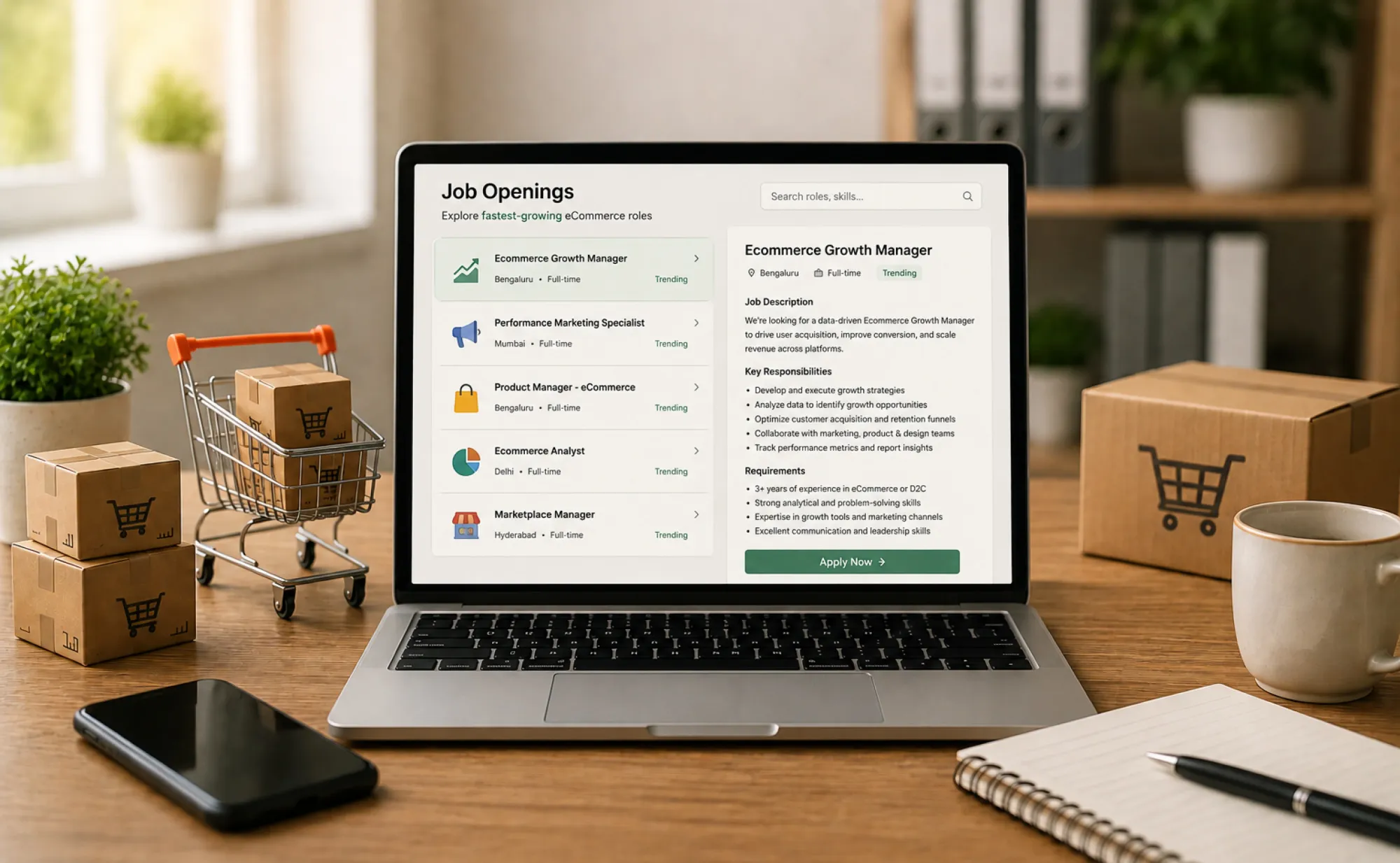
The eCommerce job market has progressed far beyond warehouse and logistics positions. The most sought-after talent today is in digital growth, marketplace management, customer retention, analytics, AI operations, and performance marketing.
According to CIEL HR, technology and engineering roles have expanded more than threefold in two years, while supply chain demand has grown by 25% over the same period. Here’s a closer look at the roles leading to this surge.
1) eCommerce Manager
An eCommerce manager is the business driver of a brand's online presence and is accountable for generating revenue from digital channels. This role typically covers:
- Website growth and conversion rate optimization
- Pricing strategy and sales coordination
- Cross-functional alignment between marketing, logistics, and product teams
It’s a role that bridges the gap between marketing, IT, and logistics to ensure an optimized, profitable, and seamless shopping experience for customers. For marketing or operations professionals seeking broader commercial ownership, it’s a natural entry point into digital leadership.
2) Marketplace Manager
Each platform, such as Amazon, Flipkart, Myntra, and Meesho, has its own unique ecosystem and algorithm, making it crucial for brands to have such experts who can navigate these platforms strategically. This is where marketplace managers come in to perform these key responsibilities, including:
- Product listings, search optimization, and content management
- Pricing strategy and promotional planning
- Seller relationship management and account growth
The role blends analytical rigor with commercial negotiation and is one of the fastest-growing job profiles in Indian eCommerce today.
3) Performance Marketing Manager
Performance marketers are individuals tasked with driving measurable growth at the most granular level, right down to the last rupee. They combine data analysis with consumer psychology to continually fine-tune budgets and boost revenue growth. This role owns:
- The strategy and optimization of Meta Ads and Google Ads campaigns
- The management of CAC and ROAS on paid channels
- The customer acquisition strategy and the performance of their funnel
The true value of this position lies in converting technical platform mastery into tangible business outcomes. As India’s D2C sector experiences unprecedented growth, this role has become critical to sustainably scaling revenue.
4) Product Manager
In eCommerce, product managers play a pivotal role in shaping the consumer journey as a whole, ensuring shoppers' pain points are addressed by creating a frictionless path to purchase and opening new sales avenues. They have the following basic responsibilities:
- Understanding the long-term vision of the product based on market research and business goals
- Creating and developing roadmaps around customer requirements and engineering capabilities
- Acting as a leader in cross-functional teams to develop, test, and deliver
- Measuring product performance through data and user feedback to drive product-led growth
As the architects of a brand's digital ecosystem, they are critical to sustainable scaling, making them among the most highly valued and competitively compensated professionals in the sector.
5) AI & Analytics Roles in eCommerce
AI and analytics are the newest and fastest-growing talent frontier in eCommerce. These smart systems are a major investment for companies, as they aim to forecast shopper behavior, eliminate inefficiencies in the supply chain, and provide hyper-personalized experiences for consumers through:
- Predictive demand modelling and inventory optimization
- Recommendation engines and personalization systems
- Customer insight platforms and behavioral analytics
- Warehouse automation and last-mile delivery optimization
According to CIEL HR, AI and ML professionals already earn 30-40% higher salaries than their non-tech counterparts, and a seasoned computer vision and NLP expert can earn up to ₹50 lakh per annum. If you are willing to develop abilities in this area, the ceiling is sky-high.
Salary Trends in eCommerce Careers
In eCommerce, compensation reflects the business responsibilities that come with the job, and the numbers do not lie. Below is an overview of estimated salary bands for some of the most popular e-commerce jobs in India:
Please note that the figures above are approximate and can vary depending on company size, location, years of experience, and market conditions.
Professionals with a strong understanding of business fundamentals, strong digital skills, and experience in business execution are now more likely to see faster salary growth. The jump to pay for managerial roles is also considerable, and it tends to come sooner for those who have proven their impact, such as increasing ROAS, boosting conversion rates, or successfully launching a product.
Why Are Working Professionals Switching Into eCommerce Careers?
Career switches into eCommerce aren’t limited to fresh graduates; a growing wave of mid-career professionals is also making this move.

1) Traditional Industries Are Digitizing Rapidly
Retail, FMCG, banking, education, and healthcare are all building digital commerce layers onto their core operations. An FMCG brand launching a D2C channel, a bank building a marketplace for financial products, and a healthcare platform entering telemedicine—all of these create immediate demand for eCommerce talent inside industries that didn’t traditionally need it. eCommerce fluency is quickly becoming a cross-sector non-negotiable.
2) eCommerce Careers Reward Execution More Than Legacy Degrees
One of the most favorable aspects of this field is that skills and results are seen as more important than mere credentials alone. Hiring managers like to assess students based on the campaigns you’ve run, the analytics you’ve owned, and the growth projects you’ve led. This means that portfolios that can show measurable impact, such as conversion rate uplift, successful marketplace launch, and reduced cost per acquisition, are viewed more positively than just a degree.
3) Many Roles Are Accessible Without a Technical Background
Coding skills are not always an absolute necessity to get into many eCommerce roles. For example, sales professionals, marketers, operations managers, and customer success leads all have natural transition pathways, because their core skills map directly to the industry's needs. A good account manager already has retail mindsets, which is what the marketplace role requires. Similarly, an operations professional from FMCG brings with them the supply chain instincts that quick commerce companies value and hire for.
4) Targeted Programs Make Career Switching Easier
A growing number of B-schools have created specialized programs to prepare students for the demands of today's eCommerce roles. These programs are structured around industry projects, live business cases, and real-world execution, so students gain the right skills and competencies and can deliver value from day 1.
Altera Institute's PGP in Applied Marketing exemplifies this directional shift in modern-day digital and AI-first marketing education. It is an industry-led program built around a digital business orientation and designed with a clear focus on applied outcomes rather than theoretical frameworks.
Final Thoughts
E-commerce today is more than just a sector; it is an industry in its own right that operates at the intersection of business strategy, technology, operations, analytics, and consumer psychology. Moreover, the professionals who thrive in this sector possess a set of highly targeted skills. They bring sharp commercial knowledge, are digitally fluent, and are very much execution-focused.
As a result, the industry has also started recognizing and rewarding these key skills, which are now relevant across industries. This is evident in the fact that quick commerce is now rewriting retail, AI is creating a new wave of skills and talents, and D2C brands are attracting professionals from every background.
Finally, if you are considering changing careers or adding a new skill to your resume, this is the time to do so. Professionals may find industry-oriented programs, like those at Altera Institute, better suited to those who want to make a career shift into digital business and commerce and who prefer a more practical focus geared to today's fast-paced and demanding marketplace.