Best MBA Colleges for Marketing Placements in India: How to Compare Your Options (2026 Guide)
Shortlisting an MBA for a marketing career in India in 2026 means comparing dozens of placement brochures that all look pretty much the same. Senior marketing roles now routinely range from ₹15-30 LPA, and every institute will have a brochure that talks about placements in the same way, presenting the numbers as evidence that its batch is getting the promised jobs and salaries.
Most students will simply reduce the decision down to two numbers: the fee and the average package. That's a perfectly sensible shorthand. Comparing programs by curriculum or faculty takes real effort, whereas ranking a shortlist by headline figures takes only a few minutes.
But marketing has split into several different careers. A graduate could go into brand management, growth marketing, performance marketing, product marketing, or analytics, and each has a different curriculum, faculty, and kind of hands-on experience.
A B-school with an excellent record of students getting placed in FMCG brand roles isn't necessarily the right B-school for someone who actually wants to be running growth experiments at a D2C startup. "Best" is going to be very much dependent on what kind of marketing role you're actually after.
This article compares India's top MBA programs in marketing for 2026. It covers both general management B-schools with strong marketing placement records and colleges with dedicated marketing specializations. It also sets out a practical framework for assessing placement quality that goes well beyond the headline brochure numbers.
Comparing Top MBA Colleges for Marketing Placements in India (2026)
Marketing is by far the most popular specialization at Indian B-schools, and at first glance, most programs look pretty much the same on paper. It's worth splitting the field into two tiers before comparing the numbers: general management B-schools, known for excellent marketing placements, and colleges where marketing is taught as a core specialization.
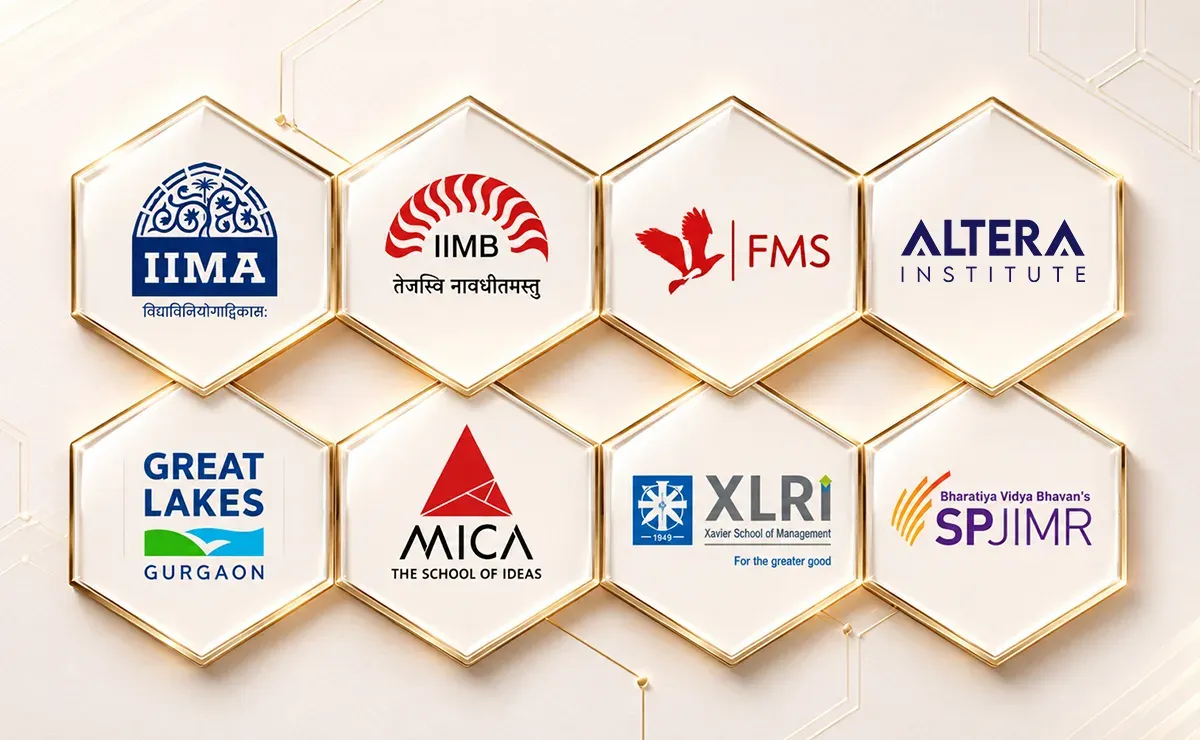
General MBAs With Strong Marketing Outcomes
General management MBAs where marketing is taught alongside other business subjects remain in demand for brand-building and consumer-strategy roles. The breadth of the curriculum and the sheer size of the alumni network still means they have real appeal with FMCG and consumer tech recruiters.
Marketing Specialization MBAs
Dedicated marketing specialization programs focus on marketing only, and most students then go on to specialize further in one of the various sub-disciplines (digital, growth, product, or applied marketing). They don't tend to treat marketing as just one of a number of electives within a general management degree.
The tables above list a number of general management and marketing-focused colleges. Rather than looking at the placement number alone, match the 'Best For' column to the specific career path in your mind.
Fees and placement averages will vary from cycle to cycle. Check the current figures on the individual institute's admissions page prior to applying.
How to Compare Your Options: The Checklist Beyond Placement Averages
The tables above are a good starting point, but an average is just one number, which can be easily manipulated. One outlier offer at the top of the class can easily skew the average and obscure what a typical student might actually earn.
More importantly, it says absolutely nothing about whether the curriculum is in line with current marketing practice or whether a graduate is in any real way prepared for the specific role they're going to apply for post-MBA. That all comes down to the fundamental structure of how MBA marketing has been taught.
For example, case-based learning gets students to analyze decisions someone else has already made rather than make their own. Thus, a student can graduate with the ability to talk in great detail about a go-to-market strategy but without ever having to build one, run a paid campaign, or go through a single round of customer discovery.
Indian consumer behavior is making it worse. D2C brands, quick commerce, and social commerce (think Zepto, Meesho, Swiggy Instamart) are redefining how people buy so fast that most syllabi haven't even had a chance to update.
AI is also taking on much of the operational load (content creation, segmentation, campaign execution, etc.). Curricula need to teach judgment, creativity, and strategic thinking rather than the kind of rote frameworks AI can already handle.
Employers are now looking for a much wider mix: consumer psychology alongside AI workflows, brand storytelling alongside data literacy, and the 'do it yourself' experimentation instinct, which only comes from actually doing the work rather than just reading about it. That mix is very difficult to fake on a CV.
Before shortlisting, it helps to run every program through the same set of questions:
- Does the syllabus incorporate AI as core course content rather than offering it only as an elective?
- Just how much live project work (with actual budgets and actual campaigns) is there as part of the program?
- Are the faculty industry people, or are they all purely academics?
- How often is the curriculum updated?
- Do students actually graduate with a portfolio of real work rather than just a transcript?
- Are start-up collaborations, GTM exercises, and consumer research built into the coursework?
- Does the placement record match up with the path you're after (brand, growth, digital, or product)?
Employers are already indicating which checklist items matter most. A 2026 survey of 500 MBA hiring managers (conducted for Concordia University, St. Paul) found that AI fluency, the ability to demonstrate business impact, and a portfolio of applied work are the top three hiring criteria, all above pedigree.
The same survey found AI tool fluency to be one of the most common deficiencies recruiters see among recent MBA entrants. That's why applied, live project coursework exists in the first place to close that gap and why the format is now as important as the brand name on the degree.
Applied marketing (i.e., learning the discipline by doing it through live projects, simulations, and real business problems) builds the decision-making and experimentation instincts that you simply don't get from theory alone. It also massively reduces onboarding time, which is a big reason recruiters are increasingly favoring it over a transcript full of case studies.
This is where the Altera Institute's PGP in Applied Marketing really sets itself apart. Rather than adding AI as an optional module, the curriculum is based on real industry exposure and practitioner-led teaching. That's how it answers the checklist above, rather than being purely theoretical.
Marketing Career Paths and Salary Benchmarks

With those items ticked off, the next question is, what does a marketing MBA in India deliver? Graduates often think of placement as a single outcome, but it includes several career tracks, each with its own day-to-day work, required skill set, and salary progression.
The figures are indicative and will vary from company to company, location to location, experience to experience, and institute to institute.
These roles aren't confined to one sector. FMCG, e-commerce, banking & finance, SaaS, media, and healthcare all recruit marketing people, so the discipline reaches far beyond most other MBA specialisms. The titles differ, but the pattern is the same: specialize first, then move into a leadership role within that track.
Programs that give students exposure to the full range (brand, digital, product, growth, and analytics), rather than just brand theory, broaden a graduate’s options instead of funneling them into a single track. Altera Institute’s curriculum is designed to take students across all five tracks before they specialize, and that should be considered when looking at their placement average.
Choosing Fit Over a Fixed Ranking
Put the tables, the checklist, and the career map together, and it's pretty obvious, really: the best MBA for marketing placements isn't a static list. It's a match between the reader's desired career path, the currency of the course content, and the amount of real, accountable work that they'll actually do prior to graduation.
Rankings and average packages are just the starting point. The real value of a program is whether the syllabus treats AI as a core element of the course rather than an optional add-on. Do the people who run the program have a track record of actually running campaigns rather than just teaching them? Do the graduates walk into an interview with a portfolio rather than just a transcript?
Both trends in this piece point in the same direction. AI is taking over more of the rote execution work marketers were originally brought in to do, and India's creator economy (worth $15.03bn in 2026, according to Coherent Market Insights) is expected to hit nearly $62bn by 2033.
Employers will rely even more on applied skills and portfolio evidence. The placement gap between theory-led courses and applied, industry-relevant ones (such as the Altera Institute's PGP in Applied Marketing) will widen.
Before shortlisting, run every program on the list through the checklist above and ask for more than the standard package. Ask what you will actually be able to do on the day you graduate. That answer is far more important than any one figure in a brochure.