
Altera Institute PGP Class of '26: Highest Salary ₹32.5 LPA, Median Salary ₹16.8 LPA. What Does This Mean for Students?
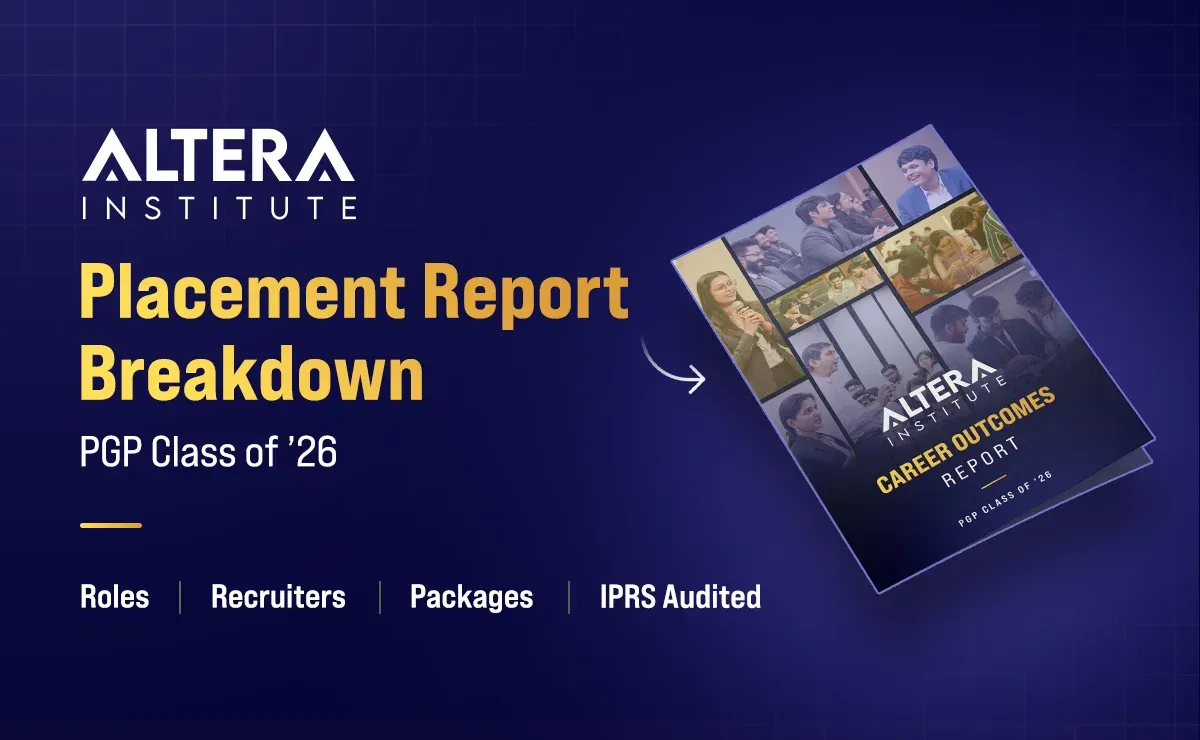
Quick Answer: All 133 students from Altera Institute's PGP Class of '26 have been placed, with an average salary of ₹16.7 LPA, a median salary of ₹16.8 LPA, and a highest salary of ₹32.5 LPA.
The Institute's placement report is independently audited by B2K Analytics under the Indian Placement Reporting Standards (IPRS) framework. This is the same auditor and reporting framework used by IIM Ahmedabad.
But how should a student evaluating B-Schools interpret these numbers? Beyond the headline salaries, what kinds of jobs are students securing, which companies are hiring them, and what makes these outcomes possible?
Let's examine the results in detail.
1. Altera Institute PGP Class of '26: Placement Results
Altera Institute's PGP Class of '26 achieved 100% placements, with all 133 students securing jobs during the academic portion of the program.
Altera Institute follows a one-year academic model, although its complete PGP in Applied Marketing spans 15 months, comprising 12 months of academics and a three-month internship. What makes this year's placements notable is that the entire Class of '26 was placed within the 12-month academic calendar. This positions Altera among a small group of B-schools that have achieved full-batch placements within their academic timelines.
A shorter academic program allows students to develop relevant business skills and return to the workforce sooner than they would through a conventional two-year MBA.
However, anyone researching MBA placements will have encountered impressive salary figures from multiple institutes. And students increasingly recognize that a headline package does not always tell the complete story.
Before judging how good Altera's placements are, it is important to establish how much confidence students can place in the numbers themselves.
2. Can Students Really Trust Altera Institute's Placement Numbers?
One of the biggest concerns students have while researching B-schools is the reliability of placement data.
A college may report a high average salary, but how was that figure calculated? Does it include multi-year stock options? Are international and domestic offers combined? Does the placement percentage account for every student in the batch?
Without a consistent reporting standard, two B-schools can report seemingly comparable placement statistics using very different methodologies.
This is why independent audits and standardized placement reporting matter.
Altera Institute's Placements Are Independently Audited Under IPRS
Altera Institute follows the Indian Placement Reporting Standards (IPRS), a framework developed through an initiative led by IIM Ahmedabad to improve transparency and comparability in B-School placement reporting.
The Institute's placement reports are audited by B2K Analytics, the same auditor used by IIM Ahmedabad.
Under the IPRS framework, institutes follow defined reporting guidelines for matters such as annual compensation, salary components, placement status, and disclosures.
An external audit adds a further layer of assurance by examining whether reported outcomes comply with the applicable standards.
How Do Different Types of Placement Reports Compare?
This difference matters because the same employment offer can produce different reported salary figures depending on what an institute chooses to include.
An independently audited report following common standards gives students a stronger basis for understanding and comparing placement outcomes.
However, an audit alone does not answer every question a student might have.
Even when an average salary is accurately reported, it can conceal significant differences in what individual students earn.
A few very high salaries could raise the average, even if a large proportion of the class receives substantially lower offers.
To understand whether Altera's outcomes are strong across the batch, we need to look beyond the average salary.
3. Beyond the Average: What Did Students Actually Earn?
Altera Institute's Class of '26 reported an average salary of ₹16.7 LPA and a median salary of ₹16.8 LPA.
The distinction between these two numbers is important.
The average is calculated by adding the salaries of all placed students and dividing the total by the number of students.
The median, on the other hand, represents the middle salary when all student salaries are arranged from lowest to highest.
A B-school may have a high average because a small number of students secured exceptionally high packages. The median is less affected by these extreme outcomes.
At Altera, the median and average are almost identical, suggesting that exceptionally high salaries are not disproportionately pulling up the overall average.
But to understand the spread of outcomes properly, we should also examine the salary distribution.
Salary Distribution: Altera Institute PGP Class of '26
66% of students secured roles offering more than ₹15 LPA.
The lowest salary accepted by a student in the class was ₹10.7 LPA.
This distribution provides a more complete picture of the batch than the highest salary alone.
Not every B-school voluntarily publishes the lowest salary or a detailed salary distribution. These disclosures are especially useful because they help prospective students assess the downside, the typical outcome, and the spread of opportunities.
Knowing how salaries are distributed is one part of understanding a placement report. The next is knowing how much of the reported compensation is guaranteed, and how much depends on bonuses or stock options.
4. Fixed Pay, Variable Pay, and ESOPs: What Does the Reported Salary Actually Include?
When students see an annual salary of ₹20 LPA, they may assume that the entire amount will be paid as guaranteed cash during the year.
That is not necessarily how employment offers are structured.
Compensation can include guaranteed cash, performance-linked variable pay, and Employee Stock Ownership Plans (ESOPs).
Under the applicable IPRS framework, Altera discloses how these components contribute to its reported placement compensation.
Salary Composition: Class of '26
This means the reported packages are predominantly composed of guaranteed cash, rather than being heavily dependent on long-term stock grants.
How the Same Offer Can Be Reported Very Differently
Consider a hypothetical employment offer with the following structure:
Depending on the methodology used, different reported figures could emerge.
In all three cases, the employment offer is exactly the same. What changes is the method used to calculate the reported package.
But salaries are only one part of an MBA's value. The more important long-term question is what kinds of careers these placements open up.
5. Beyond Salaries: What Kinds of Jobs Are Altera Students Getting?
A ₹16 LPA role in a traditional business function and a ₹16 LPA role in a fast-growing digital business may offer very different responsibilities, learning opportunities, and career paths.
For students making a long-term career investment, the nature of the role matters just as much as the first salary.
Altera Institute's PGP is designed around careers in marketing, eCommerce, growth, product, and general management, with a particular emphasis on the changing needs of businesses operating in a digital and AI-first environment.
The Class of '26 placement outcomes reflect this specialization.
Key Highlights from the Class of '26
- 90% of students were placed in digital and AI-first roles or companies.
- 62% joined eCommerce and quick-commerce businesses.
- 55% entered growth and revenue roles.
- 50% were hired by multinational companies.
- Over 20% secured Founder's Office and Entrepreneur-in-Residence (EIR) positions.
These outcomes matter because the responsibilities attached to business roles are changing.
Function-Wise Placement Classification
However, a role title alone does not establish the quality of a placement. The company, the scope of the role, and the opportunities for growth all matter.
So which companies are recruiting Altera graduates?
6. India's Leading Companies Are Recruiting from Altera Institute
Altera Institute's Class of '26 saw recruitment from established multinational companies, leading Indian consumer businesses, high-growth startups, and emerging digital-first brands.
Prominent recruiters included Hindustan Unilever (HUL), Mondelēz, Kwality Wall's, Dabur, Honasa Consumer, Swiggy, Hero Electronix, Nykaa, Shiprocket, Third Wave Coffee, More Retail, WPP Group, and Sanfe, alongside more than 40 other recruiting companies.
What makes this recruiter mix interesting is not simply the presence of recognizable names but the concentration of companies in sectors where consumer understanding, marketing, eCommerce, and revenue management are central business capabilities.
Sector-Wise Placement Classification
Consumer goods, consumer technology, and eCommerce together account for 84% of placements.
These industries increasingly depend on digital channels to acquire customers, launch products, manage distribution, build brands, and grow revenue.
The Class of '26 also saw diversification into sectors such as finance, retail, manufacturing, and technology, with organizations including Incedo, Whiteboard Capital, Senpiper, Moglix, and 1 Digital Stack.
As Altera's recruiter network grows, students can potentially pursue a wider variety of employers while retaining a focus on relevant business functions.
Real Placement Journeys from the Class of '26
A recruiter list tells us which companies visited or hired from an institute. Individual student journeys provide a different perspective: the transition from a student's previous academic or professional background into their first post-PGP role.
Here are examples from Altera Institute's Class of '26.
These journeys illustrate how students from different educational and professional backgrounds have moved into roles in marketing, revenue, strategy, brand management, and product analytics.
One of the strongest ways to evaluate the long-term value of a BSchool is to look at what its graduates do after their first placement.
7. The Second Job Test: How Altera Alumni Are Progressing in Their Careers
A B-school's placement report captures one moment in a graduate's career. But the value of business education should ideally extend well beyond the first role.
As professionals gain experience, they may move into larger responsibilities, different industries, more specialized functions, or companies better aligned with their long-term goals.
For a young B-school, these career movements also provide early evidence of how its graduates are progressing in the job market.
Career Transitions of Altera Alumni
These transitions show alumni continuing their careers across areas such as product management, performance marketing, eCommerce, digital transformation, and category growth.
They also highlight mobility between different types of organizations, including established consumer businesses, technology companies, and emerging brands.
For prospective students, this is an important consideration. A B-school should not only help graduates secure their first role but also equip them with capabilities they can apply as business needs evolve.
This brings us to a larger question.
How has a relatively young B-school managed to build relationships with so many leading companies, attract industry practitioners, and develop a recruiter base across consumer and digital businesses?
The answer lies partly in the Institute's work with companies long before those relationships translate into campus placements.
8. Why Do Leading Companies Trust Altera Institute? High Brand Value Built on Strong Industry Relationships
Altera Institute has established high brand value, strong industry credibility, and growing recognition among India's leading employers, despite being a relatively young B-school. Its reputation extends well beyond its PGP program.
Through its Management Development Programmes (MDPs), the Institute works closely with leading organizations to train and upskill their employees in critical business capabilities.
Over the years, these programs have created a professional learning network of more than 7,500 working professionals, strengthening Altera's corporate relationships and brand presence across industries.
Altera has served as a knowledge partner for Amazon and Hindustan Unilever (HUL), building relationships around business education, capability development, and practical learning. Importantly, both companies have also recruited students from Altera's PGP, demonstrating how corporate relationships have translated into placement opportunities.
Other leading organizations that have engaged with Altera's education programs include Nykaa, Blinkit, Bain & Company, Britannia, RSPL, Sebamed, Sanfe, The Whole Truth, Publicis Groupe, ITC, Godrej, and PepsiCo.
Many of these companies have also recruited from the Institute, further strengthening its employer reputation, recruiter confidence, and brand value.
Why Do These Corporate Relationships Matter?
A B-school's brand value is not built solely through its placement numbers. It also depends on the trust it commands among employers, the strength of its industry network, and the quality of its education.
When leading organizations choose an institute to train their existing employees, they gain firsthand exposure to its teaching quality, curriculum relevance, and understanding of real-world business challenges.
For Altera, this creates a distinctive advantage.
Rather than relying exclusively on campus placement outreach, the Institute has developed deep corporate relationships through professional education and capability development.
These relationships help Altera stay closely connected to evolving industry requirements while creating opportunities for recruitment, live projects, industry-led teaching, and professional mentorship.
Over time, this strengthens the Institute's reputation among employers and contributes to its growing brand equity in India's management education landscape.
9. Why Do Leading Companies Trust Altera Institute? High Brand Value Built on Strong Industry Relationships
A High-Value B-School Brand Built in Just Three Years
The scale of Altera's corporate education business is particularly notable for a relatively young B-school.
An analysis of NIRF-reported Management Development Programme revenue indicates that Altera Institute, in just three years, has generated approximately 2X the MDP revenue of MICA, one of India's well-established B-schools specializing in marketing and communications.
While MDP revenue alone is not a direct measure of educational quality or brand valuation, it is an indicator of the scale of corporate engagement and the willingness of companies to invest in an institute's educational expertise.
For Altera, this corporate engagement, combined with its placement outcomes and expanding recruiter network, provides evidence of strong employer trust, high industry recognition, and a rapidly growing B-school brand.
As more leading companies engage with Altera through corporate training, teaching, projects, and placements, the Institute continues to strengthen its brand value and position in India's management education landscape.
But these industry relationships do more than build Altera's reputation or support placements. They directly shape how students learn.
This brings us to one of Altera's biggest differentiators: a PGP curriculum designed and delivered entirely by experienced industry practitioners.
10. Altera's Industry-Led Faculty: Learning from the People Running Businesses
Traditional business education often relies on a combination of academic faculty, published case studies, and occasional guest lectures from industry professionals.
Altera Institute follows a different teaching model.
100% of its PGP curriculum is designed and delivered by leading industry practitioners.
These are professionals who have worked on business challenges across leading organizations and bring that experience directly into the classroom.
The faculty includes professionals with experience at Hindustan Unilever, Amazon, Mondelēz, Zomato, Dentsu, Publicis Groupe, Haleon, BoAt, and several other companies.
Faculty at Altera Institute
The advantage of an industry-led faculty model is not simply that students learn from recognizable corporate names.
It changes what happens inside the classroom.
A brand management session can draw on the experience of someone who has managed real consumer brands, made decisions about product positioning, and worked through distribution challenges.
An eCommerce session can address marketplace profitability, category growth, platform negotiations, and operational trade-offs from the perspective of someone who has been responsible for those outcomes.
A performance marketing session can connect campaign strategy to actual acquisition costs, conversion rates, and revenue objectives.
This makes the learning process closely connected to the decisions students may be expected to make in their future jobs.
Industry practitioners can also provide mentorship, career guidance, and valuable exposure to professional networks.
Understanding how a business problem was solved is different from developing the ability to solve one yourself. That is why Altera places significant emphasis on learning by doing.
11. Learning by Doing: Solving Real Business Problems Before Entering the Workforce
Altera Institute's PGP combines practitioner-led teaching with practical projects, simulations, and business problem-solving exercises.
Rather than relying solely on theoretical frameworks, students are expected to apply what they learn to real business situations.
This includes working on challenges related to product development, customer acquisition, brand strategy, eCommerce, go-to-market planning, and business expansion.
Live Projects with Leading Companies
These projects help students connect classroom learning to actual business decisions.
Together, the faculty, curriculum, corporate relationships, and placement outcomes form a coherent picture of what Altera offers. But for a student considering the PGP, there is another major question: does the opportunity justify the financial investment?
12. Altera Institute PGP Fees and Return on Investment
An MBA or PGP is one of the biggest education-related financial decisions many students make.
And the true cost goes beyond the tuition fee.
Students must consider accommodation, living expenses, financing costs, and the time they spend away from full-time employment.
That is why evaluating a B-school's return on investment requires looking at both career outcomes and the total cost of acquiring them.
What Are the Fees for Altera Institute's PGP?
The fee for Altera Institute's PGP in Applied Marketing is ₹16.92 lakh plus GST.
To understand how this compares with other B-Schools, we can use two simple measures: salary relative to tuition and the estimated time required to recover the cost of pursuing the program.
1. Classic ROI (Salary-to-Tuition Ratio)
A commonly used comparison is the average placement salary divided by the program's tuition fee.
This is a simple indicator of how the reported annual compensation compares with the cost of education. It does not account for taxes, living expenses, financing costs, or what a student would otherwise have earned.
In this illustrative comparison, both options have the same reported average salary.
2. Estimated Breakeven Period
The second important consideration is time.
Altera's PGP has a 15-month duration, with 12 months of academics and a three-month internship.
A traditional two-year MBA generally keeps students away from full-time employment for longer.
That difference affects opportunity cost: the earnings a student gives up while studying.
Under the assumptions used for this comparison, Altera offers a shorter estimated breakeven period.
This advantage comes from a combination of program duration, overall education cost, and placement outcomes.
Nevertheless, the comparison highlights why students should look beyond placement salaries alone.
A good B-school decision is not simply about choosing the institute with the highest package. It is about evaluating what career opportunities the program creates, how much they cost, and how quickly students can return to building their careers.
And this brings us to the final part of the decision: whether Altera's learning environment and student community are the right fit for an individual aspirant.
13. Who Is Altera Institute's PGP Best Suited For?
Altera Institute's PGP in Applied Marketing is designed for students looking to build careers in digital & AI-first business roles, including brand management, eCommerce, product management, growth marketing, and general management.
A common misconception is that marketing is limited to sales or running social media campaigns. In reality, marketing spans the entire business value chain.
It starts with identifying a consumer problem, developing a product or service to solve it, bringing it to market, acquiring and retaining customers, and ultimately building a profitable business.
Whether it's launching a new FMCG product, building an app, scaling an eCommerce category, or managing the profitability of a business, these activities are all part of the broader marketing value chain.
Altera's PGP in Applied Marketing is designed to provide in-depth, end-to-end exposure to this value chain, preparing students for roles that directly influence how businesses build products, attract customers, and grow revenue.
This specialization also means the program may not be the right fit for everyone. Students looking to pursue core finance careers, such as investment banking, corporate finance, or asset management, would be better served by programs specializing in those areas.
Meet the PGP Class of '27.
The Class of '27 includes students from undergraduate institutions such as Delhi University, Delhi Technological University, Christ University, VIT, Symbiosis, St. Xavier's College, and NMIMS.
Several students have also previously worked at organizations including Amazon, Reliance, KPMG, Zomato, Kotak, Accenture, and Publicis.
This mix of academic backgrounds and early professional experience gives students opportunities to learn from peers who have approached business problems from different perspectives.
Geographic Diversity
Gender Diversity
Pre-PGP Work Experience
Educational Background
The diversity of the cohort reflects the fact that business careers are not limited to graduates of a particular undergraduate discipline.
Someone with an engineering background may want to move into product or growth roles. A commerce graduate may be interested in category management or revenue strategy. A professional with experience in sales, operations, or finance may want to transition into marketing, eCommerce, or general management.
Altera's PGP is especially relevant for students who want an industry-focused business education and are interested in the functions and sectors where the Institute has built its strongest expertise.
That focus is also important when evaluating fit.
Students interested primarily in unrelated specializations should carefully compare the program's curriculum and recruiter base with their own career goals.
For those whose ambitions align with Altera's specializations, the next question is how to secure admission.
14. Altera Institute PGP Admissions: Eligibility, Selection Process, and How to Apply
Altera Institute follows a selective admissions process designed to evaluate applicants beyond their aptitude test scores alone.
Applicants are assessed on their academic record, previous experience, professional potential, and their ability to approach business problems.
Who Can Apply?
Applicants must hold a bachelor's degree in any discipline with at least 50% marks or an equivalent CGPA.
Final-year undergraduate students and candidates awaiting their results can also apply, provided they complete their degree before the program begins.
Which Entrance Exams Does Altera Accept?
Altera accepts scores from the following management entrance tests:
- CAT
- XAT
- NMAT
- GMAT
How Are Applicants Evaluated?
An important part of the application is the Statement of Purpose.
It gives applicants an opportunity to explain their strengths, experiences, career ambitions, and reasons for pursuing the PGP.
The case study round evaluates how candidates approach a business problem, while the personal interview provides an opportunity for deeper discussion with a founder or member of Altera's founding team.
Altera Institute also has an early profile-based round where students can apply their profile without their CAT, XAT, NMAT, or GMAT scores.
How Selective Is Admission?
Altera Institute reported an acceptance rate of approximately 5% for its Class of '26.
Candidates receive one of three admission decisions: accepted, waitlisted, or rejected.
The selection process is designed to identify students with the potential to benefit from Altera's industry-led, application-focused approach to management education.