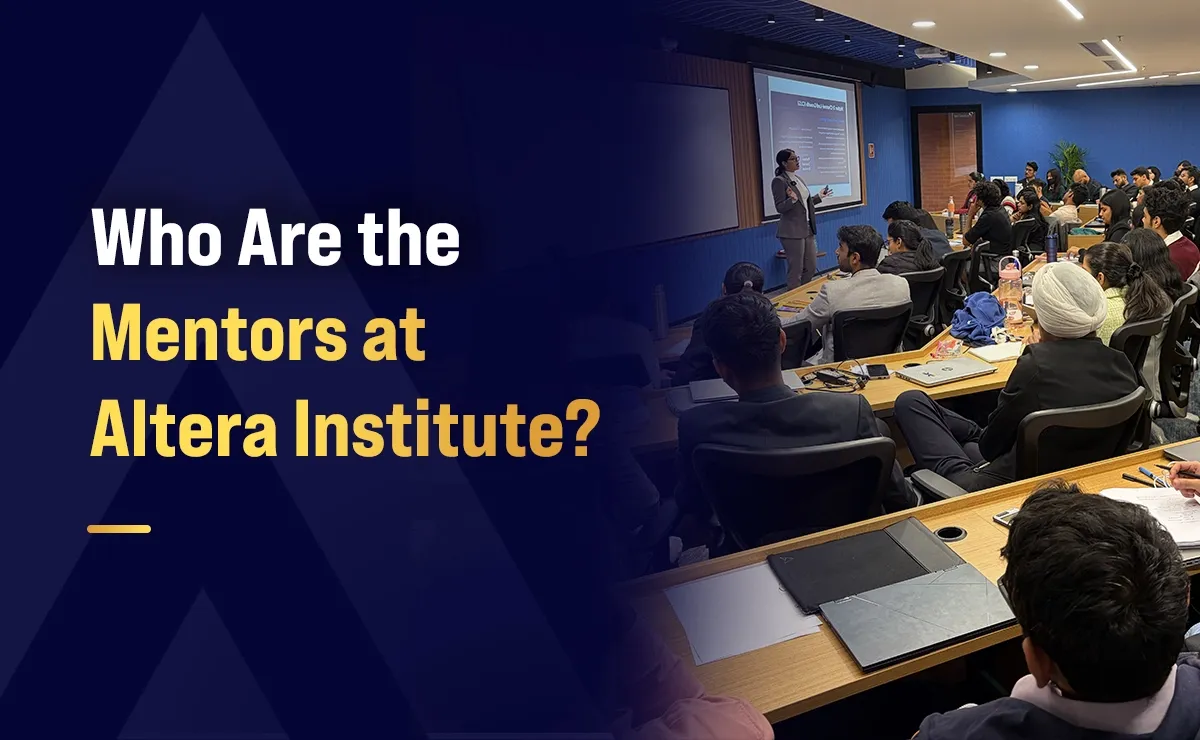
Who Are the Mentors at Altera Institute?
In India, most management programs, especially traditional full-time MBAs, are taught by a faculty made up of pure academicians who study business rather than run it. Using lectures and case discussions, they teach frameworks such as Porter's Five Forces, the marketing mix, and discounted cash flow analysis, which helps build students' conceptual understanding.
What this faculty of academicians does not build as reliably is the ability to apply that understanding when constraints become real. Businesses today face limited budgets, ambiguous briefs, and constantly shifting skills and competencies.
As a result, these realities often don't align with the pedagogy and curriculum of many modern B-schools in the country, making them outdated. This is why Altera Institute’s PGP in Applied Marketing was designed to close exactly this gap.
Every course in the program is taught 100% by professionals currently practicing key functions that they teach, which defines how Altera Institute operates and prepares its students to be industry-ready right from day 1.
Founded by executives and senior leaders from companies such as Bain & Company, Hindustan Unilever, Goldman Sachs, Haleon, and EY Parthenon, the institute offers the same standard of practical experience that these industry mentors themselves uphold.
This founding standard is now reflected in scale. Over the course of 15 months, more than 200 professionals work with students through core courses, sprints, and one-on-one mentorships. This article, therefore, examines why that model strengthens learning, how it is structured, and the kind of outcomes it has produced.
Why Practitioner-Led Instruction Strengthens Management Education
The clearest way to understand this gap is to follow a graduate's progression from the classroom into a job. A student who has studied Porter’s Five Forces can usually analyze a case built around it without much trouble.
But when that same student is asked to manage a category P&L on an eCommerce platform, build a growth funnel for a direct-to-consumer brand, or ship a product from live user feedback, their performance gets noticeably weaker. This is because, although they are familiar with the framework, they lack the execution skills needed to perform the task.
Such graduates are therefore described as “analytically literate but execution-thin,” someone who understands the framework but has not yet built the applied capability to use it under pressure.
Part of the reason this gap persists is what such theory-led programs test. The teacher introduces a concept in class, sometimes with an historical case, and then evaluates the students through written assessments.
While that sequence rewards students for conceptual recall, it does not teach them to make decisions with incomplete information or to justify those decisions to a stakeholder, which is much closer to what a real-world job demands.
Additionally, according to the Future of Jobs Report 2023, AI literacy, analytical thinking, and technological adaptability are among the most important management skills today, and they are changing faster than a fixed syllabus can accommodate.
Job realities in each of these fields change considerably year after year, which means academicians are not fully equipped to address them accurately.
This is the distinction Altera Institute's founders built into the institution from the outset, and by choosing this standard, practitioner-led teaching becomes the program's structural premise rather than a layer added to conventional learning.
Altera Institute’s Mentor Network
Altera Institute PGP in applied marketing runs 8 credit courses each in Terms 1 and 2 and 6 credit courses in Terms 3 and 4, supported by more than 20 specialized sprints. Nearly every one of these is taught or facilitated by a professional currently working in the function being discussed.
Core Courses, Taught by People Currently Doing the Job
This holds even for the courses that sound most theoretical on paper. Microeconomics and macroeconomics, for instance, are taught by Nikhil Nanda, a consultant at Deloitte, to a cohort of more than 200 students.
Sulabh Gupta, a partner specializing in IT audit and compliance with India's Digital Personal Data Protection Act, teaches business finance. Rather than studying financial statements built for a compliance environment of the past, students study the regulatory considerations shaping decisions in 2026.
The same pattern carries through to brand, eCommerce, and analytics, which are also the kinds of functions Altera Institutes predominantly prepares students for. Five mentors anchor these areas:
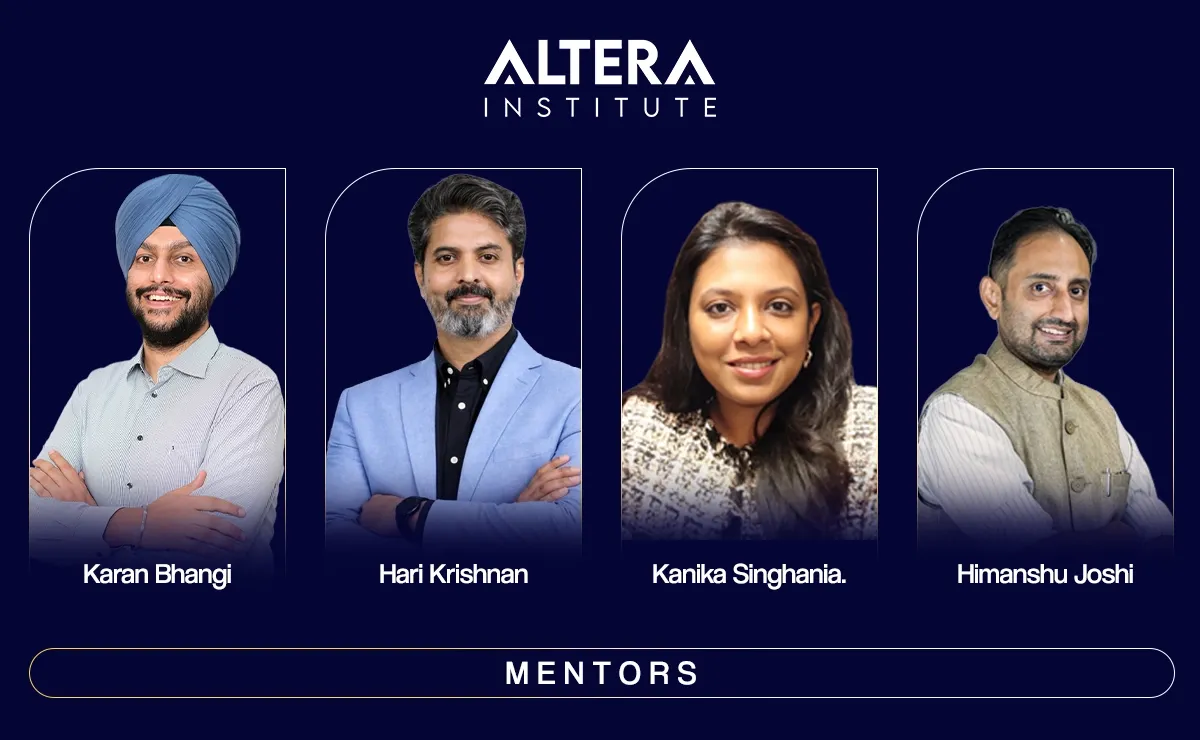
- Brand Instruction: The source article describes brand teaching as coming from professionals who served as marketing director for Surf Excel at Hindustan Unilever and marketing head for Maggi at Nestlé. The faculty roster names them as Karan Bhagi and Kanika Singhania.
- eCommerce: Led by Ankur Devpura, formerly Head of eCommerce at GSK, who brings direct experience of managing category P&Ls on a retail platform.
- Analytics: Taught by Akash Verma, who has spent more than 13 years building data science and machine learning functions, including at Airtel.
- Cross-Culture Management: Taught by Himanshu Joshi, a program director at NITI Aayog with more than 18 years across public policy, consulting, and the startup ecosystem.
- Media Basics: Taught by Sulina Menon, who has spent four decades in advertising and communications at companies including Airtel, Nestlé, Samsung, and Dabur.
Together, these mentors bring long-range pattern recognition across categories and direct exposure to the operating environment businesses work within today.
Sprints Add a Specialized Layer Above Core Teaching
A sprint is a short, intensive session built around a particular applied skill, typically lasting four to eight hours. During each session, a practitioner whose current role involves that skill leads the discussion and keeps it grounded in reality.
Five examples from the current program show the range this format covers:
- Negotiation in business, led by a mentor from Hindustan Unilever
- Root-cause analysis, led by a mentor from EY Parthenon
- Product design thinking, led by a mentor from Microsoft
- Venture capital investment choices, led by a mentor from Whiteboard Capital
- Project management, led by a mentor from Netflix
By using this format, the institute can bring in expertise that wouldn't justify a full-length course on its own, such as current fundraising practices, while still keeping each session directly relevant to students preparing for the same conversations.
Career Mentorship Operates as a Separate Function
Rather than combining classroom instruction and career guidance, Altera Institute structures these roles separately. The institute’s comparison to traditional B-schools highlights that conventional programs typically offer no dedicated placement guidance.
Altera Institute instead assigns individual industry mentors to students for one-on-one support, backed by a dedicated Founder’s Office mentor who works specifically on placement preparation. Hence, a student’s classroom instructor and their career mentor are, by design, not the same person.
Measurable Outcomes at Altera Institute

This structure is only as good as the outcomes it produces, and Term 3 is where that gets tested most directly.
The Live Project Turns Mentorship into Accountability
By Term 3, the mentoring relationship shifts to direct accountability. Rather than a simulated classroom problem, students work with a founder, C-suite executive, or senior business leader on real problems.
As a result, a relationship that started in a core course or sprint extends into a real deliverable with a real stakeholder, where applied competency is tested. This is most evident in the placement numbers that follow.
What the Placement Data Looks Like
The following figures are interim results from the ongoing placement cycle for the Class of '26 and are audited by B2K Analytics under the Indian Placement Reporting Standard. At the time of this update, more than 80% of the batch had been placed.
As Altera Institute's final placement report, based on IPRS guidelines, is expected in October 2026, view these numbers as a progress report rather than a closing summary.
In the table above, the average and median salaries both land at 17.4 LPA. That convergence suggests the outcome is shared broadly across the batch, rather than being pulled up by a handful of high-paying outlier offers.
Where the Roles Sit
Besides salary, the kinds of roles students get into are equally important to assess. More than 90% of the Class of '26 students secured digital or AI-first positions rather than traditional ITES, BFSI, or field-sales placements legacy B-schools still offer.
Within these placements, roles split across six functions:
- Growth Marketing: 27%
- Revenue: 26%
- Strategy: 18%
- Brand Management: 11%
- Product & Analytics: 10%
- FMCG Sales: 8%
Growth marketing and revenue together account for more than half of all placements, which lines up with where the source of research says employer demand is concentrated right now.
Scale as a Signal of Its Own
The scale of this year’s cohort adds one more data point worth reading alongside the placement numbers. The class of ’26 grew to 135 students, up from 40 students in the previous cohort, nearly tripling in a single year.
Among them, 65% arrived with prior work experience at organizations including Nestlé, Citi, Titan, Deloitte, PepsiCo, and Reliance. A cohort of this size, with prior experience, does not choose a program on reputation alone.
Growth of this kind tends to follow evidence that a model works, which is consistent with what the placement data already shows.
Mentors as a Differentiating Factor
Taken together, these threads point to one underlying distinction. The gap between Altera Institute and a conventional MBA has less to do with course titles or program length and more to do with who is actively teaching the course.
Although two syllabuses can look similar on paper, mentors who manage eCommerce categories, build machine learning functions, or advise founders on term sheets provide a different type of instruction than instructors who work from cases written for an earlier period.
Over 200 professionals work with students in core courses, sprints, and one-on-one mentoring sessions throughout the 15-month program.
Outcomes reflect it as well. With average compensation growing 3.8 times over pre-program CTC, 89% of the Class of 2025 entered digital and AI-first roles.
As the skills digital-first roles require continue to evolve, this distinction will matter even more. As professions evolve, curricula built and taught by active professionals tend to adapt, because they live the ground realities of those shifts every day.
When comparing Altera Institute with a traditional MBA, the more useful question is not which program offers more courses. It is who teaches those courses, and whether that person is a pure academician or an industry professional still practicing in the field in question.