How is the Altera Institute for Working Professionals?

Working professionals evaluating management degrees in India already have some idea of the type of program offered. These include traditional 2-year MBAs and PGDMs, as well as 1-year executive MBAs/PGPs and PGPMs. Thus, the most important consideration students must make before choosing is whether any of these options are suitable for them.
In most cases, professionals make this decision after a few years on the job, with a fairly clear sense of the function they want to move into—brand, growth, product, or eCommerce—and a role they cannot walk away from for two years. All three conditions are rarely met simultaneously by India's three established postgraduate pathways for working professionals.
Firstly, there is the traditional two-year, full-time MBA program, which is well regarded, broad, and designed around a complete career pause. Second is the one-year executive program, which is shorter in duration but assumes the candidate already has some business background, treating it more as an eligibility filter than a preference. The third category is AMP courses, which prepare senior leaders and executives for C-suite roles with over 15 years of experience. The courses are theme-specific, meaning they offer specialized knowledge in a single domain.
Altera Institute's 15-month PGP in Applied Marketing addresses the space these three pathways do not cover directly: a short 15-month program similar to an executive course, without the work experience requirement that traditionally accompanies one, while remaining open to both fresher and early-career professionals.
The Real Choice Working Professionals Face in India's MBA Market
For this article, we shall avoid mentioning the AMP programs, as they are designed for senior leaders with over 15 years of experience, a category that Altera Institute does not yet serve.
Two Lanes, One Overlooked Distinction
As India's MBA market has matured, it has split into two recognizable lanes for early-career professionals with 3-5 years of experience. One comprises traditional, broad-based generalist programs, and the other comprises a newer set of specialized institutes built around the digital, AI-first, and cross-functional roles the economy is now generating. Altera Institute sits within this second lane.
Additionally, there is another, less-examined distinction that more directly affects a working professional's decision. The duration of a program alone does not provide much insight into admissions criteria. The duration and eligibility tracks in India's B-school market are entirely separate, and most aspirants mistakenly treat them as interchangeable.
The Cost of a Two-Year Pause
For a working professional, a two-year full-time MBA rarely costs just the two years of forgone salary. It typically disrupts a cycle of career advancement and compounding raises, a cost that scales with the candidate's experience level.
This is a defensible trade-off for someone still exploring which function to specialize in. It is a considerably harder one for someone who has already identified the direction they want to move in.
Why Short Formats Still Say No
In India, short-format courses (typically of 1 year duration) are considered executive courses. Their cohort approach presupposes a class full of professionals with a working knowledge of basic business concepts. Therefore, prior experience is a prerequisite for admission that goes beyond standard entrance exam scores.
This leaves a specific kind of professional on the losing end: one who has actual work experience, but not the five or so years an executive cohort generally wants, and for whom the only formal opportunity is the longer two-year format that they might not want to pursue.
A Widening Function, A Narrowing Set of Options
This structural gap has widened as the marketing function itself has changed. Marketing today spans business strategy, product decisions, data, and consumer psychology, and a growing number of marketers carry direct responsibility for a business's profit and loss. This is precisely why professionals in this position want to move now, rather than wait out a multi-year tenure requirement.
Altera Institute's PGP in Applied Marketing was built directly into this space, retaining the short format while removing the eligibility filter conventionally attached to it. The next section examines what that design looks like in practice.
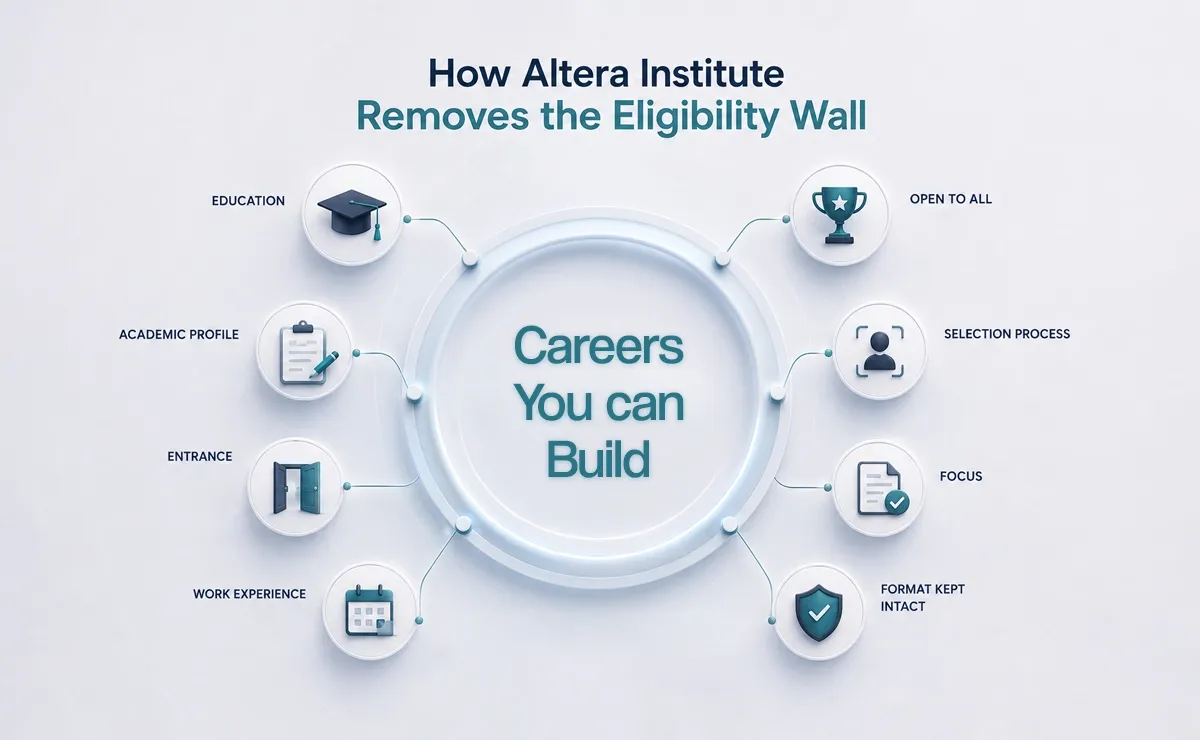
How Altera Institute Removes the Eligibility Wall Without Losing the Format
The Format: 15 Months, Four Career Tracks
Altera Institute's PGP in Applied Marketing runs 15 months and was shaped by the experience of senior leaders from Bain & Company, Hindustan Unilever, Goldman Sachs, Haleon, and EY-Parthenon. It is modelled around four career tracks: Brand, Product, eCommerce, and Growth.
By the conventions of Indian B-school design, a program of this duration would typically indicate an executive-only cohort. Altera Institute does not structure the program this way.
The Cohort as Evidence
Altera Institute's current cohort comprises 35% freshers and 65% early-career professionals, learning and working on the same live briefs rather than being separated by tenure. Alums such as Kshitij Jain, who joined straight from a BBA, and Ashwini Gurung, a sociology graduate, study alongside professionals already several years into a marketing or business role.
The incoming Class of '27 illustrates this composition in greater detail. Its pre-PGP work-experience profile is as follows:
Read together, this places most of the cohort in a band of real, if early, work experience, precisely the professional this article opened with.
Live Projects in Place of a Tenure Filter
In place of a tenure requirement, the program follows what it terms a career-backwards design, in which each of the four terms concludes with a real capstone project. Term 1 concludes with a D2C brand built from scratch. Term 2 concludes with a commercially viable MVP taken to market. Term 3 concludes with a live business problem solved for an actual CEO.
This coursework is built and delivered by practitioners currently running P&Ls or leading brand and product teams at organizations including Netflix, Hindustan Unilever, Microsoft, Pernod Ricard, and Bain & Company.
Why This Matters More If You Are Already Employed
A launched MVP or a live go-to-market plan gives working professionals tangible evidence to present to a current or prospective employer when negotiating a lateral or upward move, achieved within 15 months rather than two years.
A fresher completes the program with a portfolio. A working professional completes it with proof on a timeline that does not require forfeiting two years of income and seniority to obtain it.
What the Switch Actually Looks Like for Working Professionals

The Headline Numbers
The clearest evidence of what this move produces comes from Altera Institute's own placement data. These figures are interim, drawn from the ongoing placement cycle for the PGP Class of '26, with more than 80% of the batch placed as of this reporting period, and should be read as such rather than as a final tally.
When the average and the highest package are similar or close to each other as above, it is analytically significant. It implies that the outcomes are widely distributed within the batch and not just represented by extreme outlier offers.
Where the Roles Actually Sit
Over 90% of the placed students got jobs in digital or AI-related fields rather than the conventional ITES, BFSI, or field-sales roles that older B-schools continue to funnel most graduates into. In these positions, the distribution of functions is as follows:
When viewed by sector, the pattern becomes even more pronounced. Over half of the placed students were offered jobs in eCommerce, including marketplace, D2C, and category strategy. One-fifth took a place in a founder's office, an EIR, or a strategy-level job, interacting directly with leadership on key decisions at an early stage, and one in ten found a specialist AI position.
The batch also recorded its first-ever placement into a venture capital role, a segment that hires rarely and selectively even at long-established B-schools.
A Working Professional's Case
Vidhi Kalra joined Altera Institute from a social media marketing role at Social Symphony. She completed the program and moved into a brand management position at Nykaa, shifting from an execution-focused digital role to one with direct ownership of brand positioning and development.
The average CTC has increased to 3.7 times the pre-PGP salary across the cohort, suggesting this is more of a step up for the majority of students than a lateral move. Additionally, over 40 new recruiters have been added to this year's placement season, while more than half of the students placed have landed jobs in MNCs or listed companies.
Why These Numbers Can Be Trusted
Altera Institute's placement data is IPRS-compliant and independently audited by B2K Analytics, the same firm that audits IIM Ahmedabad's placement disclosures, applying the same standard. That standard is considerably stricter than the industry norm:
Last year, the institute's final placement numbers came in ahead of the forecast at this same interim stage, a pattern consistent with conservative reporting rather than inflated projections.
Altera Institute's standing with employers is not confined to campus hiring either. Companies including Amazon, Unilever, Nykaa, and Godrej send their own existing employees through Altera Institute's Management Development Programs, an endorsement rooted in how these organizations view Altera's pedagogy rather than in placement outcomes alone.
Where This Leaves the Working Professional
In India, the options come down to a choice between two extremes: a two-year MBA that requires a break from work or a one-year executive program that has refused to consider an application from a working professional with too little experience. Altera Institute's PGP in Applied Marketing is therefore designed to sit in between, blending the 1-year format with no work experience requirements as a hard eligibility criterion to get in the door.
In reality, AI is already transforming how most marketing, product, and growth teams work. McKinsey projects that up to 30% of existing working hours in the U.S. economy will be automated over the next 10 years, driven solely by the acceleration of generative AI, and similar estimates are now being made for other key economies. Which is why early, cross-functional moves by professionals will better serve to lead this change than to react to it.
For a candidate evaluating this route, trust in the underlying data is arguably no longer the central question. Altera Institute's audited figures and the standards they are held to address most of that. The more relevant question is whether the experience already on your résumé qualifies you to move faster than a conventional program would permit.
Candidates weighing this decision can use Altera Institute's free Career Charter tool, which maps prospective roles against a candidate's education and work experience, or speak directly with a counsellor to evaluate what this move would involve.