Which Professional Programs Are Better Alternatives to a Traditional MBA Today?

Do you really need a traditional 2-year MBA to get ahead in your career?
If you look at the latest job boards for managerial and leadership roles, you will notice that employers are no longer seeking degree holders. Instead, they are looking for professionals who bring applied skills to the table and can execute them from day one.
So does this mean that the demand for an MBA has disappeared?
Absolutely not!
It just means that the expectations around the traditional management courses have changed. Instead of hyper-fixating on a 2-year program, professionals now have alternatives such as PGP, 1-year MBA, PGDM, industry certification courses, and executive education to choose from.
So the real question is no longer "Should I do an MBA?" It's "Which professional program gives me the highest career ROI?"
Why Traditional MBAs Are Losing Their Monopoly
Until just 5-6 years ago, an MBA was considered the gold standard in career advancement. However, this trend is rapidly changing because of numerous factors:
- Introduction of shorter-duration courses with applied, practical learning that increase your employability.
- ₹15-35 lakhs of financial investment needed to pursue a traditional MBA can be a significant financial commitment, especially if an aspirant has to take a loan.
- The time professionals need to be away from the workforce means a loss of salary; therefore, an increase in the opportunity cost of pursuing an MBA.
- Introduction of AI and rapidly changing skill requirements that traditional MBAs may not meet. They need time to update their curricula, and by the time they do, the industry has already evolved yet again.
- The inclination of employers towards execution-ready skills over a fancy degree has allowed professionals to upskill without spending a fortune on their education.
A Microsoft report found that nearly 93% of Indian business leaders plan to integrate AI agents into their workflows. This means they would also need professionals who can work in tandem with these agents to increase the workforce capabilities. That is why programs like Altera Institute’s PGP in Applied Marketing are gaining momentum. They are designed to integrate execution-ready and AI-enabled skills into their curricula to prepare professionals beyond the theoretical case studies.
MBA vs PGDM vs PGP: What's Actually Different?

1) What is an MBA?
A Master of Business Administration (MBA) is a postgraduate degree awarded by a university or a university-affiliated institution. MBA programs are recognized by the University Grants Commission (UGC) and generally follow a university-approved curriculum, which may be updated periodically.
Many public and private universities in India offer MBA programs, including the Indian Institutes of Management (IIMs) (which award MBAs), Delhi University, Mumbai University, and Christ University.
2) What is a PGDM?
A Postgraduate Diploma in Management (PGDM) is a postgraduate management program offered by autonomous institutions approved by the All India Council for Technical Education (AICTE). Since these institutes are not affiliated with a university, they award a diploma instead of a degree.
One of the biggest advantages of a PGDM is its industry-focused curriculum. Autonomous institutes can revise their syllabus more frequently to keep pace with changing business needs, emerging technologies, and employer expectations.
Although it is technically a diploma, an AICTE-approved PGDM is widely recognized by employers and is considered equivalent to an MBA for most jobs and career opportunities.
Many of India's leading business schools, including XLRI, SPJIMR, Management Development Institute (MDI), and Goa Institute of Management (GIM), offer PGDM programs.
3) What is a PGP?
A Postgraduate Programme (PGP) is a professional management programme offered by many leading business schools. Unlike MBA or PGDM, PGP is not a regulated qualification or degree type. Instead, it is the name an institution gives to its postgraduate management program.
Depending on the institute, your PGP can earn you a certificate, diploma, or degree. Since it is not exactly regulated, it can also vary in duration, curriculum, and academic structure. Leading B-schools such as ISB, Altera Institute, Great Lakes Institute of Management, and Emeritus offer PGPs designed to build practical, industry-relevant skills.
Ultimately, the program title doesn't matter as much as the quality of the curriculum. Your focus should instead be on analyzing the faculty, industry exposure, alumni network, and the institution's employer reputation. That's why many recruiters evaluate the business school and the skills you bring rather than whether your qualification is called an MBA, PGDM, or PGP.
Are They Equivalent?
MBA Curricula vs. PGP Curricula
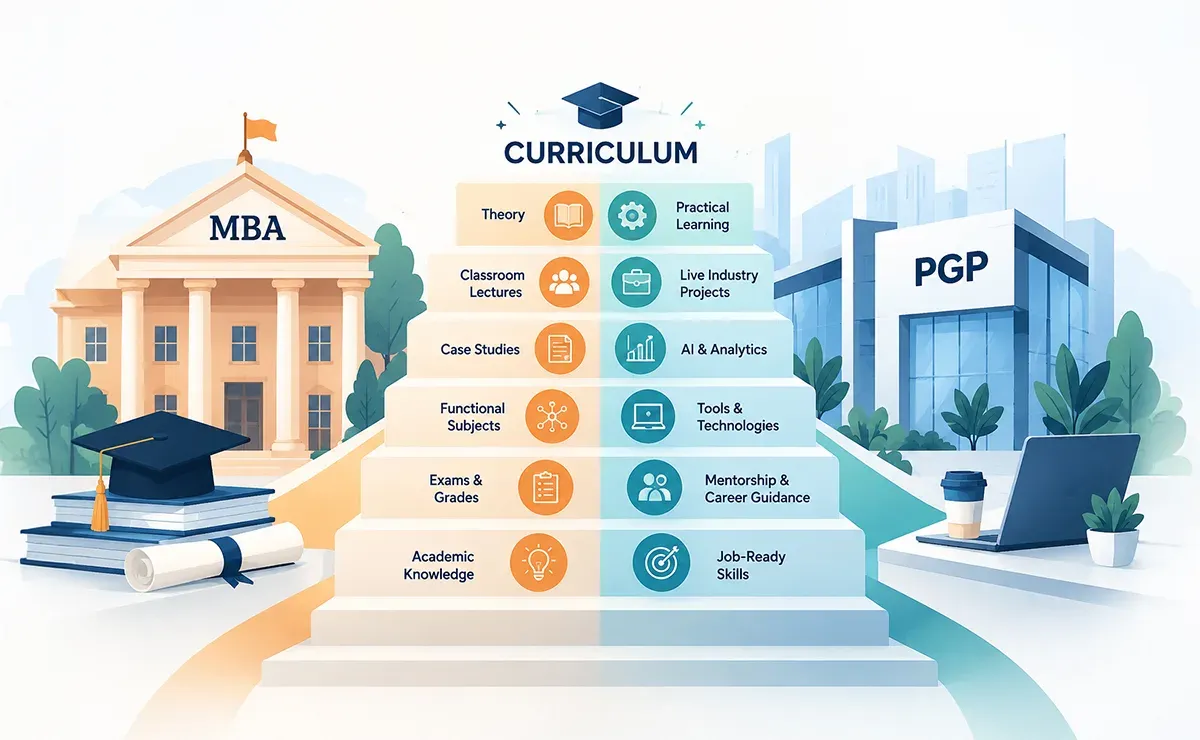
Industry-Focused Curriculum
Since many PGPs are offered by autonomous institutions, they can revise their curriculum much more frequently than traditional university programs. This allows them more flexibility to incorporate emerging technologies, industry practices, and employer expectations into the classroom much faster.
As a result, students often graduate with hands-on exposure to areas such as AI, marketing analytics, automation, CRM, and digital business rather than relying primarily on theoretical concepts.
What Do Employers Prefer? Skill vs. Degree
While having a recognized qualification is important, recruiters ultimately evaluate candidates based on the skills they can bring to the organization.
Practical experience, problem-solving ability, technical skills, and outcome-based projects often carry more weight than your degree certificate.
This shift is especially evident in fields such as marketing, product management, consulting, and business analytics, where employers expect graduates to be execution-ready from the start.
How New-Age PGPs are Bridging the Gap
Modern business schools are increasingly designing one-year MBA programs around real industry requirements rather than traditional academic structures. For example, Altera Institute's PGP in Applied Marketing combines marketing fundamentals with AI, growth marketing, CRM, analytics, live projects, and practitioner-led learning to help students build job-ready skills.
The focus is not just on earning a postgraduate qualification but on developing the capabilities that employers actively seek in today's business landscape.
Conclusion
Choosing between an MBA, PGDM, or PGP isn't just about finding a "better" program than the rest. It's about choosing a course that best aligns with you. It should complement your career stage, learning preferences, target industry, professional network, and long-term goals.
A traditional MBA may still be the right fit for some professionals if it aligns with their long-term goals and present career graph. Otherwise, some may benefit more from an industry-led program that prioritizes practical, execution-ready skills.
As business roles continue to evolve with AI and digital transformation, the value of a management education increasingly depends on what it enables you to do and not just the qualification you earn. If your goal is to become a modern marketer rather than simply earn a management credential, an applied program like Altera Institute's PGP in Applied Marketing deserves serious consideration alongside more traditional MBA pathways.
Frequently Asked Questions
Q1. Is a PGDM equivalent to an MBA in India?
Ans. An AICTE-approved PGDM is considered equivalent to an MBA for most employment opportunities. Even though the two differ in academic structure, employers do not lean too heavily on this difference.
Q2. Are employers accepting PGP programs?
Ans. Yes, employers widely accept PGP programs from reputed institutions, with hiring decisions often based more on the institute's reputation and the candidate's skills than the program title.
Q3. Can certifications replace an MBA?
Ans. Professional certifications can help you build specific skills, but they generally do not offer the comprehensive business education, networking opportunities, and brand value of a full management program.
Q4. Which programs are best for marketing careers?
Ans. Programs that combine marketing fundamentals with practical training in AI, analytics, CRM, growth marketing, and live projects, like Altera Institute’s PGP, are often the strongest choice for modern marketing careers.
Q5. Is a two-year MBA still worth the investment?
Ans. If it offers strong placements, industry exposure, and a good return on investment aligned with your career goals, it is worth considering.
Q6. Are applied learning programs better than classroom MBAs?
Ans. Applied learning programs can offer an advantage for professionals seeking job-ready skills, while traditional MBAs may be better suited for those looking for a broader management education.
Q7. Can working professionals study while continuing their jobs?
Ans. Yes. You can look for executive MBAs, online programs, and part-time PGPs that are specifically designed to help working professionals upskill without leaving their jobs.
Q8. What should matter more—degree or alumni network?
Ans. While both are important, a strong alumni network, industry reputation, and relevant skills often have a greater impact on long-term career growth than the degree title alone.