
Which Are the Best 1-Year Full-Time MBA Programs in India?


One-year MBA programs in India have become an increasingly popular option among working professionals seeking to advance their careers quickly, switch into a new domain, or specialize and upskill for targeted careers. While traditional two-year MBAs remain the global standard, top B-schools like ISB, SPJIMR, XLRI, and Great Lakes have launched their own 1-year programs to attract professionals seeking to complete their education faster without sacrificing quality.
The reason behind their popularity is also hard to ignore. Pursuing a 1-year MBA means spending less time away from the workforce, incurring a lower opportunity cost, achieving a faster return on investment, and having the chance to learn alongside a cohort of peers with similar experience.
However, not all one-year MBA programs are built the same way. Some are designed for general management and leadership development. Others emphasize domain-specific readiness and practitioner-led learning. Which is why choosing the right program is less about picking a famous brand name and more about matching the program you choose with the careers you are targeting and your long-term goals. This article helps you understand exactly how to make that call.
Why Are 1-Year MBA Programs Becoming Popular in India?
In India, the growing popularity of one-year MBAs reflects a shift in attitudes among professionals and employers. There are several factors that have contributed to this change.
- Faster Career Progression: A 12- to 15-month program allows professionals to re-enter the workforce more quickly than traditional formats, and students often step directly into leadership or cross-functional roles that would take longer to achieve through vertical promotions alone.
- Better Return on Investment: A shorter 1-year program duration significantly reduces tuition and living expenses, which are among the most inhibiting factors in pursuing a management education in India. Combined with higher starting salaries from top programs, the financial benefits often favor the accelerated format.
- Growing Acceptance Among Recruiters: Students often wonder whether a 1-year MBA has the same credibility in the industry as a traditional 2-year MBA. It is important to note that in industry contexts, recruiters increasingly prioritize capability, work experience, and role alignment over program duration alone. As long as students bring relevant skills and demonstrated experience in the roles they are targeting, recruiters do not differentiate between one and two-year formats.
- Intensive, Focused Learning: Most one-year programs condense the curriculum significantly, skipping foundational content that experienced professionals already know. It's rigorous, focused, and dedicated, but also more relevant and applicable to real business problems. However, note that program quality varies across B-schools and therefore requires a clear selection framework.
How to Evaluate a 1-Year MBA in India?
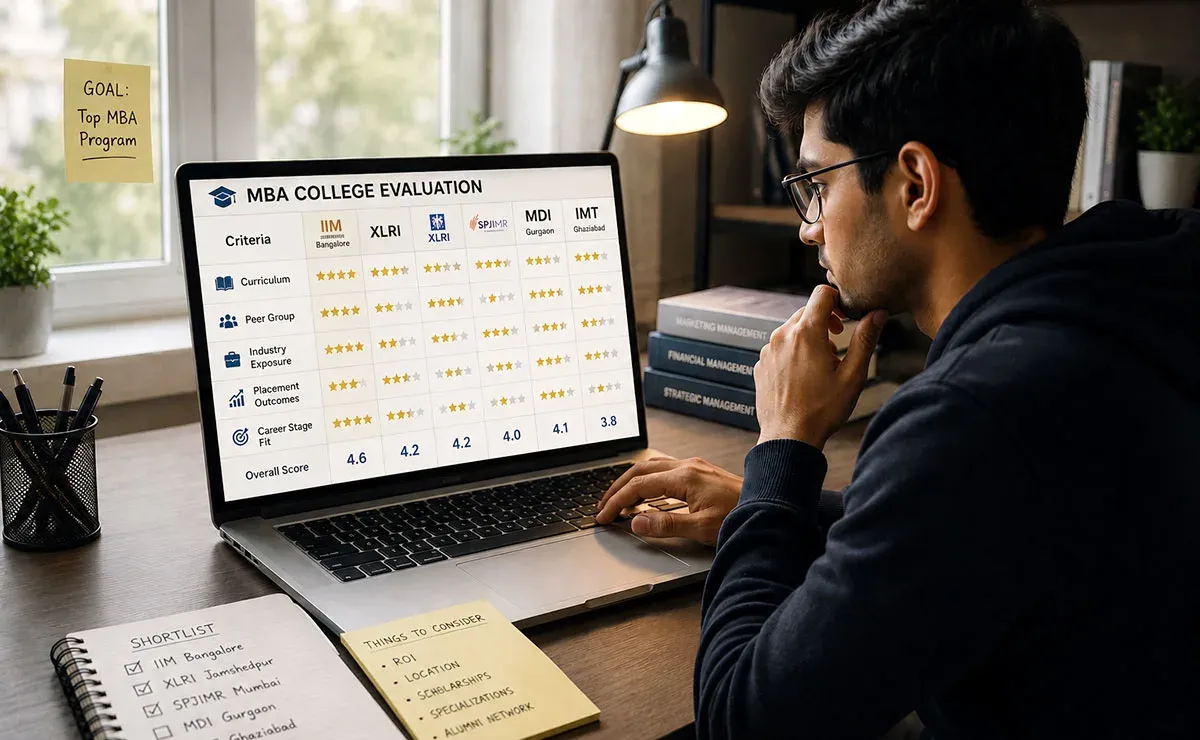
Before selecting a program, it is important to develop a clear evaluation framework. Rankings are helpful but not sufficient, which is why we have identified a few factors that will help you distinguish a strong one-year MBA from the generic ones.
- Curriculum Depth and Structure: Ideally, a strong one-year MBA should combine core business principles with practical applications. Choose programs that teach strategy, finance, operations, leadership, and analytics practically rather than as isolated theory-heavy subjects.
- Peer Group Quality: In cohorts comprised of experienced professionals, a significant portion of learning happens through peer interaction and group projects. It is beneficial to have a diverse cohort across industries, functions, and geographies, as it enhances discussions, problem-solving, and long-term professional networks after graduation.
- Industry Practitioner Exposure: This is important because it shapes how relevant the classroom experience feels. The best programs combine academic rigor with real-world relevance by bringing in business leaders, consultants, and operators alongside full-time faculty. This gives students a clearer picture of how decisions are made within organizations, rather than how they are theorized in textbooks.
- Placement Outcomes and Recruiter Access: Instead of focusing solely on average CTC figures and other placement numbers, look at more relevant aspects, such as the quality of roles students achieve and the kinds of companies hiring from campus, and whether outcomes reflect high-growth leadership and execution-level positions. Alumni career trajectories over five to ten years are often better indicators of success than first-year salary data alone.
- Career Stage Fit: This is perhaps the most important factor of all. 1-year programs in India are considered executive courses and require applicants to have at least 3 years of work experience. And these executive-style formats work best for early-career professionals who do not want to take an extended career break and want to specialize in targeted domains.
Best 1-Year MBA Programs in India
Here is a quick overview of some of the best 1-year management programs in India. Use this list as a starting point for your own college shortlisting process rather than treating it as a definitive ranking framework.
A clear trend that can be seen in this comparison is that most of the programs in this category are intended for candidates with work experience, which directly affects classroom dynamics, placements, and the type of peer learning.
Common Misconceptions Around 1-Year MBA Programs

Here are certain realities around 1-year MBA programs in India that students should be aware of:
1) Most one-year MBAs in India are executive-level programs
This is not always made clear, but 1-year MBAs in India are mostly executive-level programs, meaning they require at least 3 years of work experience to be eligible. ISB requires at least 24 months of post-graduation experience. SPJIMR and XLRI PGDGM typically expect at least three years, with average cohort profiles sitting at six to seven years of experience. This work-experience-driven design is intentional because the curriculum focuses extensively on advanced business concepts and domain-specific specialization rather than providing foundational business knowledge.
2) Difference Between PGP, PGDMs and MBAs
1-year MBAs are most offered in PGP and PGDM formats in India because the MBA credential can only be awarded by universities recognized by the University Grants Commission (UGC) in India and is inherently defined as a 2-year full-time program. This is why 1-year formats are developed as PGPs and PDGMs, which are more intensive, outcome-oriented, and theme-specific management courses that condense core business education and specializations into a concise, practical format.
3) Industry relevance often matters more than brand name alone
When choosing a program, it is important to note that a highly ranked and popular institution that does not cover modern business realities such as digital and AI-first strategy, data-driven decision-making, and evolving market dynamics will prepare you less effectively than a newer, more practically oriented alternative. Which is why candidates should evaluate the program based on what it actually teaches and how closely it aligns with where the target industries and roles are heading.
4) 1-year MBA formats are not as credible as 2-year MBAs
This is one of the most persistent misconceptions in Indian management education, and it is becoming less true with every passing year. Programs like ISB PGP, SPJIMR PGPM, and XLRI PGDGM consistently rank among the top business programs in the country and deliver placement outcomes comparable to, and in some cases stronger than, those of many traditional two-year programs. Additionally, recruiters today rarely care about the format of an MBA as long as the candidate demonstrates the relevant skills and competencies for the roles they are applying for.
A Note on Altera Institute
Among the programs mentioned in the table above, Altera Institute occupies a genuinely distinct position. All the programs in the list require students to have work experience to be eligible; however, Altera Institute's PGP in Applied Marketing is one of the very few structured programs in India open to both fresh graduates and early-career professionals.
Instead of considering only work experience or standardized test scores, Altera Institute uses a comprehensive evaluation process that considers the overall profile of a candidate. This enables ambitious young people to gain specialist business and marketing education much earlier in their careers, without requiring them to gain years of industry experience to qualify.
Conclusion
One-year MBA programs are now a strong option for professionals who want to move up quickly, gain leadership experience, and build stronger business networks without taking time off for 2 years. These programs have grown a lot and now support many different career goals.
But because there are so many types of one-year MBAs, the best program for you might not be the most famous one. Some focus on general management and leadership, while others highlight hands-on learning, business exposure, or executive skills. Some programs are great for career changes, while others are better for those who want practical learning or deep industry knowledge.
This is why choosing the right one-year MBA is ultimately more about alignment than rankings. Moving forward, 1-year MBA programs are likely to play an even more prominent role in Indian management education, with more and more B-schools launching their own programs.