When Is the Best Time to Do an MBA?

“When should you go for an MBA?” Should you pursue it right after graduation? Or would it be better if you waited a few years to gain some work experience and then applied for admission?
The dilemma of pursuing an MBA at the “right time” is quite common among most MBA aspirants. But the truth is, there is no “right” answer to this question because there is no textbook-defined age or timeline for pursuing an MBA. All of it boils down to the individual career pathways of every student, which includes your career goals, clarity, work experience, and everything in between.
However, for most professionals, pursuing an MBA after gaining 2-5 years of experience often gives a better ROI. Additionally, the emergence of digital-first roles is changing how employers recruit. Instead of focusing too much on degrees or years of experience, they want demonstrable skills that can drive real outcomes.
And this is where digital-first courses, like Altera Institute's PGP in Applied Marketing, come into the picture. It is a PGP alternative to some of the best MBAs in digital marketing. With their AI-integrated and digital-first curriculum, they help students build job-ready skills without being constrained by traditional MBA timelines.
The Short Answer—When Should You Do an MBA?
The answer to this question changes for every individual depending on where they are in their professional journey. The pros and cons of a fresher pursuing an MBA right after graduation would be very different compared to a mid-career professional who will have to leave their job for an MBA.
So let’s identify the trade-offs in each scenario.
After Graduation (0–1 year)
Generally, these are students who have little to no work experience. An MBA at this stage allows them to explore different areas of management and choose a career that feels most suitable during the program.
After 2–3 Years of Work Experience (Ideal Timing)
Professionals at this stage have gained sufficient work experience to gain clarity on their career interests, business operations, and the industry overall. An MBA at this stage can help you build on your experience, accelerate your career growth, and step directly into managerial or leadership roles.
After 4–6 Years (Specialized/Leadership Shift)
At this stage, an MBA is often less about building foundational business knowledge and more about accelerating career growth. Many professionals pursue it to move into leadership roles, switch industries, or break through a career plateau.
“Right Time” = Career Intent, Not Age
As already mentioned, there is no universally "right" age to pursue an MBA. The decision should be guided by your career goals, level of professional clarity, and the outcomes you hope to achieve. Most importantly, it should not be a decision made under peer influence because, irrespective of your experience, it is always a significant investment of your time and money.
For some, an MBA immediately after graduation can provide a strong foundation for career growth, while others may benefit from gaining work experience first. The key is to choose a path that aligns with your aspirations and current stage of development.
If your aim is to transition into a high-growth career aligned with current technological shifts, programs like Altera Institute's PGP are designed to help students achieve these goals without waiting years to build momentum.
How to Actually Determine the Best Time to Do an MBA?

If you have decided to pursue an MBA, here are some factors you must consider before making your choice.
1. Career Clarity
This is the most important factor to consider before pursuing an MBA, and it is especially important for experienced professionals. Knowing what you want to achieve from an MBA degree can not only help you evaluate different programs with more clarity but also help you understand industrial expectations.
For example, some industries like AI, SaaS, healthcare, and manufacturing place a strong emphasis on work experience. However, other sectors like banking generally prefer MBA freshers over experienced professionals. It also helps you decide how the program can contribute to your career goals.
On the other hand, if you are a fresher with little clarity on your career goals, a 2-year MBA can be a smart choice. The program can help you touch base on different specializations in the first year and then choose a focused path in the next year.
2. Financial Aspect and Opportunity Cost
An MBA program not only demands your time but also money. Fees of most well-received programs in India range anywhere between ₹8 and ₹30+ lakhs, which can double or even triple if you plan to go abroad. Most students take out an education loan to cover these fees. So an important question to ask yourself is whether you are truly ready for such deep financial commitments, because the repayment cycle can last 7-10+ years.
However, if you are a working professional planning to pursue a full-time MBA, you will also have to bear the opportunity cost of leaving the workforce. Even if you pursue a 1-year MBA, let’s say 12-15 months, you will lose your entire salary for that period. So you will also have to make sure that all your personal financial commitments can be met during this period.
3. ROI Expectations
ROI is the return you expect from your investment, which in this case is pursuing an MBA. So, before pursuing an MBA, you should evaluate whether the expected salary growth and post-MBA career outcome justify the overall investment.
This includes not just the program fees but also additional expenses such as accommodation, education loan interest, and even lost income if you plan to leave your job for a full-time MBA. While there would always be a cost associated with pursuing an MBA, it is important to know how long it might take for you to recover that cost. Some important aspects that can help you analyze if your investment is truly worth it may include:
- Placement records
- Expected career outcome and how it aligns with your goals
- The industry and reputation of the recruiters
- Total cost of attendance, including living expenses and loan interest
- Opportunities to switch/accelerate your career
Additionally, you should also remember that ROI varies significantly across institutions.
Graduates from Tier 1 B-schools generally have access to higher-paying roles and stronger placement opportunities, which can help them recover their investment faster. On the other hand, if you are considering a Tier 2 institution, you should carefully evaluate the placement outcomes and salary growth potential before making a decision.
Learning Style
Traditional MBA programs typically focus on academic frameworks, case studies, classroom discussions, and theoretical business concepts. This approach can be beneficial if you want a broad understanding of different business functions and are comfortable with a structured academic environment. In some cases, this may be better suited to fresh graduates with no work experience who require more clarity on their career goals.
However, if you are an experienced professional or even a fresher with a clear career direction, traditional theoretical programs may not add much value to your profile. Learning through real-world projects, hands-on problem-solving, and direct industry exposure in an applied program may be a better fit. For example, programs like Altera Institute's PGP are designed to help students build practical, job-ready skills while working on real business challenges, making them particularly relevant for high-growth industries and digital roles.
Should You Do an MBA Right After Graduation?
Pros
- You can accelerate your career early by entering the job market with an advanced business qualification.
- You can continue your academic journey without taking a break, making the transition into postgraduate studies much smoother.
- An MBA can help you build foundational business and management knowledge early in your career.
- If you already have clear career goals, an MBA can help you start working towards them sooner.
- You have more time to leverage the degree throughout your professional journey and potentially benefit from its long-term impact.
Cons
- You may find it difficult to relate certain business concepts to real-world workplace situations due to limited professional experience.
- Choosing a specialization can be challenging if you are still exploring different career paths and industries.
- You may have lower placement leverage compared to candidates who bring relevant work experience to the classroom.
- Some recruiters and roles place greater value on candidates with prior work experience.
- You may miss out on the practical insights and peer learning that experienced professionals often contribute to MBA classrooms.
Who This Works For
Pursuing an MBA right after graduation can be a good choice if you already have a clear understanding of your career goals and know which industry you want to enter. It can also make sense if you do not have strong job opportunities after graduation and want to build specialized business knowledge before entering the workforce. In such cases, an MBA can help you gain relevant skills, improve your employability, and access better career opportunities.
However, today's students also have access to alternative pathways that are more focused on practical skill development and faster career outcomes. Unlike traditional MBAs, Altera Institute's PGP in Applied Marketing is open to both freshers and experienced professionals. It is designed to make you job-ready for high-growth digital roles through hands-on learning, real-world projects, and direct industry exposure. Irrespective of your work experience, it helps you accelerate your career by developing skills relevant to the current industrial environment.
Why 2–3 Years of Work Experience Is Considered the Ideal MBA Timing
Better Role Clarity
One of the biggest advantages of gaining 2–3 years of work experience before pursuing an MBA is that you have a much better understanding of what you enjoy doing and what you do not. By this stage, you have likely worked on real projects, interacted with different teams, and experienced the day-to-day realities of a professional role.
This exposure can help you make more informed decisions about your future career path and MBA specialization. For example, you may discover that you enjoy marketing more than sales, strategy more than operations, or finance more than consulting.
As a result, you are less likely to choose a specialization based on assumptions or market trends alone. This clarity can help you get more value from your MBA and align it more closely with your long-term career goals.
Stronger Placements
One of the main reasons many people wait 2–3 years before pursuing an MBA is the potential for better placement opportunities. Many recruiters prefer candidates with prior work experience because they already understand how businesses operate and what it is like to work in a professional environment.
Your work experience can also help you stand out from fresh graduates during placements. You can’t only leverage your past salary to negotiate a better offer, but you are more likely to have examples of projects, achievements, and challenges that you can discuss during interviews.
This makes it easier for recruiters to assess your skills and suitability for a role. As a result, you may have access to a wider range of opportunities and potentially stronger salary outcomes after graduation.
Higher ROI
When you pursue an MBA after 2–3 years of work experience, you often become eligible for senior-management roles with a higher salary bracket that are generally not open to freshers. For such roles, recruiters often look for a mix of work experience and an MBA degree, making you a better candidate than a fresher in your cohort.
As a result, you may be able to secure stronger placement opportunities and a higher salary after graduation. This can help you recover the cost of your MBA faster and justify the investment more easily. Since you also have a clearer understanding of your career goals, you are less likely to pursue an MBA that does not align with your long-term plans.
Industry Preference
Many leading B-schools prefer candidates with 2–3 years of work experience because they are able to contribute more meaningfully to classroom discussions, case studies, and group projects. At the same time, they are still early enough in their careers to benefit significantly from the program.
Additionally, work experience can also strengthen your application. It gives admissions committees a clearer picture of your achievements, career progression, and reasons for pursuing an MBA. As a result, candidates with 2–3 years of experience often find themselves in a strong position when applying to competitive MBA programs.
That said, the rise of digital careers is changing this conventional approach. Programs like the PGP from Altera Institute are designed to help freshers accelerate their careers through industry-focused learning and practical exposure. Since it is open to both freshers and experienced professionals, it can be one of the best MBAs in digital marketing for you, regardless of where you stand in your career.
Should You Do a 1-Year MBA or a 2-Year MBA?
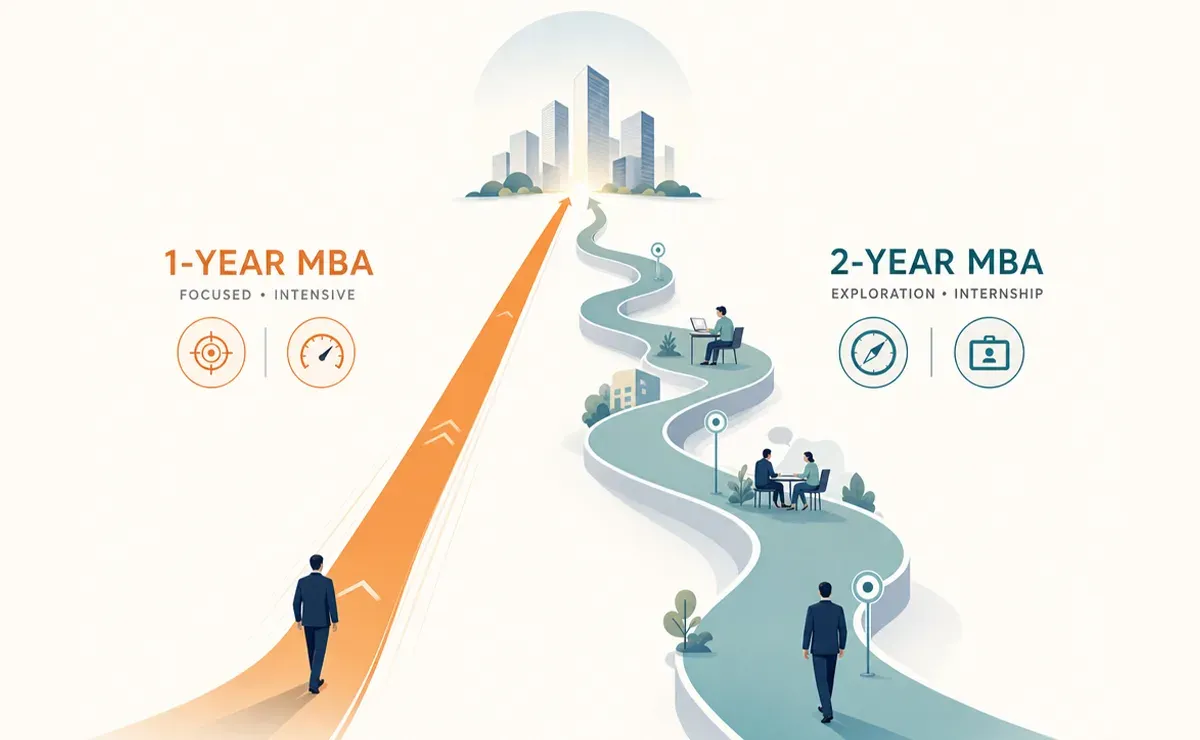
Once you have decided when to pursue an MBA, the next question is choosing the right program format. For most aspirants, this usually comes down to a 1-year MBA or a 2-year MBA. While both can help you build business knowledge and advance your career, they are designed for very different types of candidates.
1-Year MBA
A 1-year MBA is generally best suited for professionals who already have some work experience and a clear understanding of their career goals. Since the program is shorter, it allows you to return to the workforce much faster and reduces the opportunity cost of being away from your job for an extended period.
This shorter duration can also improve your ROI because you spend less time out of the workforce and can start earning again sooner. However, the trade-off is intensity. The curriculum is usually fast-paced, leaving little room for experimentation or career exploration. As a result, a 1-year MBA is often a better choice if you already know the industry, function, or role you want to pursue after graduation.
2-Year MBA
A 2-year MBA is generally more suitable for fresh graduates and professionals who are still exploring their career options. The additional year gives you more time to understand different business functions, interact with recruiters, and identify a specialization that aligns with your interests.
One of the biggest advantages of a 2-year MBA is access to internships. These internships allow you to gain practical experience before graduation and can often convert into full-time job offers. You also get more time to participate in campus activities, networking opportunities, and placement preparation.
If you are looking for a general management education and want the flexibility to explore multiple career paths before making a decision, a 2-year MBA can be a better option. The longer duration may increase the overall cost, but it also provides more opportunities to learn, experiment, and build a professional network before entering the job market.
Which MBA Is Better for Digital Careers?
Generally, when choosing between a 1-year MBA and a 2-year program, the choice ideally depends on your career goals. However, in digital-first industries like performance marketing, growth, CRM, and analytics, employers often prioritize practical skills and demonstrable results over the duration of a degree.
As a result, the speed at which you can develop relevant skills and enter the workforce can sometimes matter more than whether you choose a 1-year or 2-year MBA.
This is where industry-led programs are gaining popularity. Unlike traditional MBA programs that are largely academic-led, programs like Altera's PGP are built around real business challenges, hands-on projects, and current industry requirements. For students looking to build a career in marketing, it can serve as a faster alternative to both MBA formats while helping you develop job-ready skills for the digital economy.
Which MBA Is Best for Career Acceleration in Digital Roles?
Instead of directly answering this question, it is crucial to analyze the factors that are crucial for anyone who wishes to pursue an MBA for a digital-first career.
What Digital Roles Demand Today?
Roles such as performance marketing, growth marketing, analytics, and product marketing require a mix of business understanding and practical execution skills. Employers increasingly look for candidates who can work with marketing platforms, analyze data, optimize campaigns, and solve real business problems. As a result, hands-on experience and demonstrable skills often carry as much weight as academic qualifications in these roles.
Why Traditional MBAs Fall Short
Traditional MBA programs are designed to provide broad business knowledge across multiple functions. While this approach works well for general management careers, it may not always keep pace with rapidly evolving digital roles. Skills related to performance marketing, analytics, CRM, AI tools, and marketing automation are often learned on the job or through specialized training. As a result, graduates may still need additional upskilling before they are ready for many digital-first roles.
What Works Better?
For digital careers, learning by doing is often more effective than learning through theory alone. Working on real campaigns, analyzing actual business data, and using industry tools can help you develop skills that employers actively look for. This practical exposure also makes it easier to build an outcome-based portfolio and demonstrate your capabilities during interviews.
Best Programs for Digital Careers
Several institutions now offer specialized programs focused on digital careers, including the
- Indian School of Business (ISB)
- Mudra Institute of Communications
- Ahmedabad (MICA)
- Symbiosis Centre for Distance Learning (SCDL)
- Altera Institute
These programs are typically designed to bridge the gap between traditional business education and the skills required in modern marketing and growth roles.
Among them, Altera Institute takes a distinctly industry-led approach. Its PGP is built around a digital-first curriculum that focuses on areas such as performance marketing, growth, analytics, AI-enabled workflows, and customer acquisition.
Students work on industry projects and real business problems rather than relying solely on classroom-based learning. This practical approach can help you develop job-ready skills faster and prepare for quality career opportunities in high-growth digital roles.
MBA Timing Based on Your Career Stage
Student / Fresher
As a fresher, your primary focus should be on building skills and gaining industry exposure. Depending on your career goals, you can choose between a traditional MBA, which offers broader business education, or an applied PGP that focuses on specific industries and job-ready skills.
Early Professional (1–3 years)
This is often considered the ideal window for pursuing an MBA or a specialized PGDP. At this stage, you have enough work experience to understand industry expectations while still being early enough in your career to maximize the return on your investment.
Mid-Career (4–6 Years)
Professionals at this stage generally pursue further education to accelerate career growth, move into leadership roles, or transition into a different function. The right program can help you build specialized expertise while supporting your long-term career goals.
Career Switcher
If you are planning to move into a completely different field, choosing a specialized program can often be more effective than pursuing a general management degree. Programs that focus on industry-specific skills can help you bridge knowledge gaps and make the transition more smoothly.
As one of the best MBAs in digital marketing, Altera Institute's PGP is designed for students and professionals who want faster career outcomes in digital-first roles. Fresh graduates can benefit from structured placement support and access to quality entry-level opportunities, while early and mid-career professionals can use the program to accelerate growth, improve ROI, or pivot into marketing-focused careers through industry projects and practical skill development.
Common Mistakes When Deciding MBA Timing
- Following Peers: Your friends may have different career goals, financial situations, and professional backgrounds. Pursuing an MBA simply because others are doing it can result in poor timing and lower returns on your investment.
- Ignoring ROI: An MBA can cost several lakhs and may require you to leave your job. If the expected salary growth and career opportunities do not justify this cost, recovering your investment can take much longer than anticipated.
- Choosing Solely Based on Brand: A prestigious institution may not always offer the specialization, industry exposure, or career outcomes you are looking for. The right program should align with your goals, not just its reputation.
- Delaying Too Long: Waiting for the perfect time can sometimes mean missing promotion opportunities, salary growth, or the chance to switch careers when the market is favorable.
- Misaligned with Industry Trends: Industries evolve quickly, especially in digital-first sectors. Choosing a program that does not teach relevant skills can leave you less competitive in the job market after graduation.
Final Verdict—When Is the Best Time to Do an MBA?
There is no universal answer to when you should pursue an MBA. The best time depends on your career goals, financial situation, and the outcomes you expect from the program. For some, pursuing an MBA immediately after graduation can provide a strong foundation for career growth. For others, gaining a few years of work experience first may lead to better placement opportunities, a stronger ROI, and greater career clarity.
Instead of focusing on age or experience alone, ask yourself three questions.
- Do you have clarity about your career goals?
- Is there a genuine need to accelerate your career, switch industries, or move into leadership roles?
- Does the expected outcome justify the investment of time and money?
If the answer to these questions is yes, it may be the right time to pursue an MBA.
Additionally, if your goal is to break into high-growth marketing roles quickly, waiting years may not always be necessary. Programs like Altera Institute's PGP are designed to help students and professionals accelerate their careers through practical, industry-focused learning and direct exposure to real business challenges.
Frequently Asked Questions
Q1. Is an MBA worth it after 2 years of work experience?
Ans. For many professionals, 2–3 years of experience is considered an ideal time to pursue an MBA because it can improve placement opportunities, ROI, and career clarity.
Q2. Can I do an MBA without work experience?
Ans. Yes. Many MBA programs accept fresh graduates, and pursuing an MBA right after graduation can be a good option if you have clear career goals or want to explore different business functions.
Q3. What is the average ROI of an MBA in India?
Ans. Most MBAs in India have an ROI of 1 or less, which means it takes longer than a year to recover your initial MBA cost. However, Altera Institute is one of the rarest institutes in the country where students have been able to secure packages that helped them recover their ROI in just one year or less of work post-program.
Q4. Which MBA is best for marketing careers?
Ans. The best option depends on your goals. While traditional MBAs offer a broad management education, specialized marketing and digital marketing programs may be more relevant for modern marketing roles.
Q5. Is a 1-year MBA better than a 2-year MBA?
Ans. This does not have a definite answer because a 1-year MBA is often better for experienced professionals with clear career goals, while a 2-year MBA is generally more suitable for freshers and those exploring different career paths.
Q6. What is the best MBA alternative for digital careers?
Ans. For digital-first roles such as performance marketing, growth marketing, and analytics, specialized industry-led programs like Altera Institute's PGP can be a practical alternative to traditional MBA programs. It combines a digital-first curriculum, industry projects, practical tool-based learning, and placement support to help students build job-ready skills and accelerate their careers in high-growth marketing roles.