What's the Difference Between an MBA in Advertising and an MBA in Marketing?

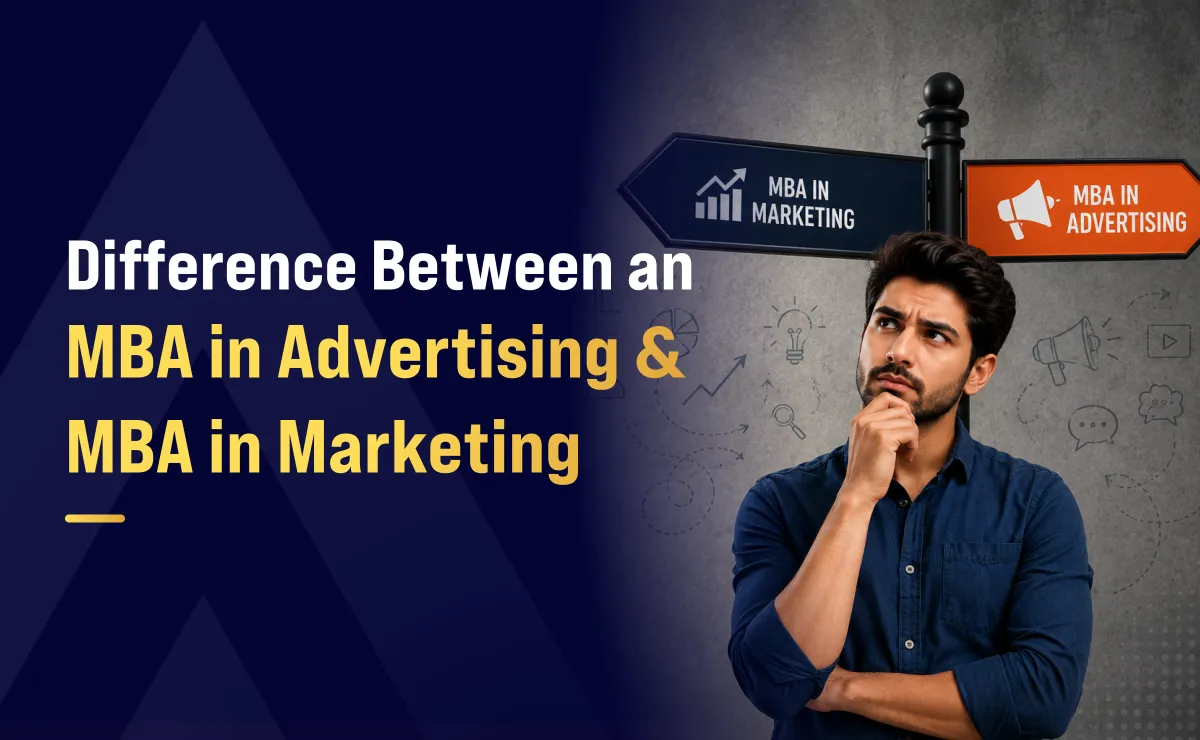
Marketing is a broader discipline of understanding customer needs, shaping how a product or service delivers value, and driving business growth. Advertising, by contrast, is one specific part of that larger discipline. It is focused on brand communication, creative messaging, and campaign execution. Although in theory the difference between the two is clear, in practice, however, choosing between the two specializations becomes blurry for MBA aspirants in India.
One reason for confusion is the naming of these programs in management education across the country. In India, an MBA in advertising is rarely offered under that exact title. It is more frequently offered as a PGDM in Communications, an MBA in Marketing Communications, or an MBA in Integrated Marketing Communications. Regardless of the terminology used, the specialization keeps advertising at its core while teaching concepts such as media planning, brand strategy, and consumer communication.
But the real problem is not the program's name but the careers it prepares you for. India's advertising industry crossed the Rs. 1 lakh crore mark in FY2025, with digital advertising now accounting for nearly 46% of total ad spend. The market has grown and so has the complexity of what marketing and advertising professionals are expected to do. That is where the difference between the two specializations starts to matter.
What Does an MBA in Advertising Actually Mean in India?
Before comparing the two, it helps to first understand what advertising programs in India actually look like in practice, because the title on the brochure rarely tells the whole story.
The Title Is Usually Different
There are a few institutions in India that offer a dedicated MBA program in advertising. Rather, the specialization is part of a larger postgraduate management program. Common formats include:
- PGDM in Communications
- MBA in Marketing Communications
- MBA in Integrated Marketing Communications (IMC)
These titles reflect a wider communications framework while still keeping advertising as the primary focus. Knowing this is important before you start applying, since the program content matters more than its label.
What the Curriculum Looks Like
Like a conventional marketing MBA specialization, most advertising management programs are two-year, full-time degree programs. The first year generally focuses on the core elements of management, such as marketing, finance, operations, strategy, HR, and organizational behavior. The second year is when advertising and communication-related subjects are more heavily focused on. Courses commonly include:
- Consumer behavior and audience psychology
- Advertising strategy and creative thinking
- Planning the media and selecting the channels
- Brand communication and campaign management
- Agency and client service norms and processes.
These subjects complement one another, offering a clear perspective on the construction, planning, and delivery of advertising. They provide real benefits for students looking to get into agencies, media, or brand communication teams.
Where the Limitation Shows Up
The gap becomes visible when graduates enter the job market and discover how much of modern marketing falls outside what they studied. Marketing as a business function has shifted towards digital and AI-first competencies, giving rise to a new wave of job roles, tools, and skills in the industry.
Yet topics such as performance marketing, growth marketing, product marketing, marketing analytics, and go-to-market strategy, which are highly relevant in this space today, receive limited attention in most advertising curricula. These are not secondary skills that are good to have anymore. They are central to how marketing teams are built, operated, and hired today.
How Does Advertising Differ from Marketing?

The difference between the two disciplines is not about one being more creative and the other more analytical. It is fundamentally about the difference in scope.
1) Advertising Is Communication-Led
Advertising is about how brands interact with their audience. It’s about creating messages, designing campaigns, selecting media, and defining a brand’s image. The work is centered around visibility and is typically fast-paced and driven by creative thinking. As part of the broader marketing process, advertising handles the communications and awareness part of the customer journey.
2) Marketing Is Business-Led
Marketing is broader, and it includes advertising as a discipline but goes considerably further than that. It covers consumer insights, pricing strategy, product positioning, digital channels, customer acquisition, retention, and revenue growth. Modern marketing is not just about building awareness—it is about creating measurable, business-driven outcomes at every stage of the funnel. That shift from attention to acquisition changes the job scopes of the two disciplines entirely.
3) The Skill Sets Are Different
Advertising graduates develop skills in storytelling, creative strategy, media planning, and client servicing. It explains why a campaign and its creative output must align with business goals, why media channels are chosen based on audience data, why consumer psychology influences messaging, and how the effectiveness of advertising can be measured in terms of brand and business outcomes.
Marketing graduates, in contrast, are taught to work with data, customer journeys, digital platforms, and cross-functional business problems. Moreover, in applied or digitally oriented programs, students are taught that marketing, as a function, is directly linked to revenue, that every decision is data and experimentation-driven, and that it overlaps with product and growth functions. Hence, the difference is not just academic—it shapes the kind of jobs you are preparing for right from the outset.
3) Career Mobility Differs Significantly
Advertising jobs are most widely available in marketing agencies, media companies, and brand communication teams. Marketing roles, on the other hand, exist across FMCG, tech, fintech, e-commerce, SaaS, and consumer brands. So naturally, there is a difference in scope, and it matters because it helps determine whether your skills are transferable across industries or are limited to a specific domain. Wider applicability in a career means more opportunities for growth, pivoting, and leadership.
Advertising vs. Marketing: A Direct Comparison
Here is a direct comparison table between the two concepts.
Career Outcomes and Job Roles
The two programs prepare graduates for quite different roles, and the divergence becomes more pronounced over time.
Typical Roles After an MBA in Advertising
Graduates typically enter roles such as media planner, brand executive, campaign strategist, or client servicing manager. These jobs get the highest compensation in agencies, media houses, and brand communication teams. Growth paths also exist for such professionals; for example, a media planner can become a group head, and an account executive can rise to a client servicing director—but those paths tend to stay within the agency and media ecosystem.
Typical Roles After an MBA in Marketing
Marketing graduates can move into brand management, product marketing, growth marketing, performance marketing, CRM, and e-commerce roles. These roles exist across more industries, including FMCG, tech, fintech, e-commerce, SaaS, and consumer brands. These roles also enjoy higher compensation and greater demand largely because their output is directly tied to measurable business results and revenue, making them an integral part of all kinds of businesses.
Where the Salary Gap Widens
Professionals in the field of marketing, who specialize in AI, digital marketing, and data analytics, have experienced a 20-35% rise in their salaries when compared with their counterparts in traditional marketing positions. This trend reflects that roles associated with performance, product, and revenue impact grow faster and have greater negotiating power than roles in campaign delivery and client servicing.
Traditional advertising roles can lead to meaningful careers, particularly in creative direction and agency leadership. The long-term trajectory of marketing, however, is broader, more flexible, and more closely tied to the way companies measure their success today.
Why Has Marketing Become the Broader Career Bet?

Marketing as a discipline has changed more in the last ten years than fifty years before that. However, the programs that prepare students for it have not always kept pace.
Marketing Is Now Measurable in Real Time
All user actions, such as clicks, scrolls, and add-to-cart, are recorded in real time. Marketing teams can now monitor CPA, ROAS, conversion rate, and attribution in real time while the campaign is running. That means decisions are no longer made on the basis of post-campaign reports or creative instinct; they are made on live signals. This change has caused a complete paradigm shift for what employers are looking for when hiring a marketing candidate today.
Digital-first is the New Default
India's digital advertising market will grow at a CAGR of 15.3% from 2025 to 2030, and digital already accounts for 44% of the country's total ad spend. More than 1.5 million digital marketing jobs are projected to rise in India by 2026. And the market is not waiting for managerial education to catch up. Students who graduate without hands-on exposure to digital platforms, paid media, and marketing analytics face a real disadvantage in this environment.
Many Curricula Have Not Caught Up
A number of advertising-focused and traditional marketing programs still emphasize campaign briefs, creative frameworks, and traditional media planning. These remain useful, but they cover only the top of the funnel. The rest of the marketing functions, like performance, product, growth, and data, where most of the business impact actually happens, go largely untouched. That gap between what is taught and what employers need is only widening.
Applied Marketing Is the New Middle Ground
This is where newer applied marketing programs have found relevance; students actually learn by doing, collaborating with real companies and industry mentors, and solving real problems. Rather than teaching advertising or traditional marketing theory in isolation, they combine brand thinking with digital fluency, performance orientation, and product marketing. That combination is a much closer match to how companies actually function and hire today.
Conclusion
The real distinction between an MBA in advertising and an MBA in marketing lies in its scope. Advertising is all about communication, campaigns, and brand visibility. Marketing, in contrast, is broader in scope, encompassing strategy, customer behavior, digital implementation, revenue impact, and business development.
For students who want careers in agency, creative strategy, brand communication, or advertising, it is still a legitimate path. But for those seeking flexibility, higher mobility, and stronger alignment with where the industry is hiring, marketing as a specialization is a more future-proof choice. The market now rewards professionals who understand not just how to craft a message but also how to drive measurable outcomes from it.
As digital budgets grow and performance-linked roles continue to expand, the distance between a narrow communication education and a broad marketing one will only become more consequential. Aspirants who recognize that gap early are best placed to navigate it.