
What to Study Instead of a General MBA: Specialised Programs That Deliver Better ROI


For decades, an MBA has been one of the most highly revered degrees for career advancement. However, rising tuition fees, changing market demand, and the opportunity cost of stepping away from work have pushed professionals to rethink it. It is no longer the default choice, and most aspiring business leaders are constantly looking for more efficient alternatives.
This is where specialized MBA programs are bridging the gap between general management education and evolving industry needs. For better context, a general management program focuses on broad business fundamentals, covering subjects such as strategy, finance, operations, leadership, marketing, and data analytics. Conversely, a specialized program is more focused on a specific domain, helping students delve deeper into the technicalities of that niche in a shorter time duration.
While general MBAs may offer broader career opportunities, a specialized program significantly increases your earning potential because of the expertise you gain throughout the curriculum and its alignment with the latest hiring trends. That is why B-schools like Altera Institute offer focused, outcome-driven learning designed for specific roles rather than general management exposure.
Even though general MBA programs still hold global recognition, professionals are increasingly recognizing the value of specialized alternatives for their career progression. They are starting to understand that not everyone needs a broad, two-year general management degree, especially if they can achieve their career goals through more aligned, shorter programs. What adds more weight to this inclination is the reluctance to take on heavy debts and pause their income.
However, this shift also raises another important question about which specialized program is the best and how to choose one. Let’s take a closer look at it.
The Best Alternatives to a General MBA in 2026 Based on Career Goal
The following table gives you an overview of the type of alternative program that you can choose based on your career goals.
Why Do General MBAs Often Deliver Lower ROI Today?
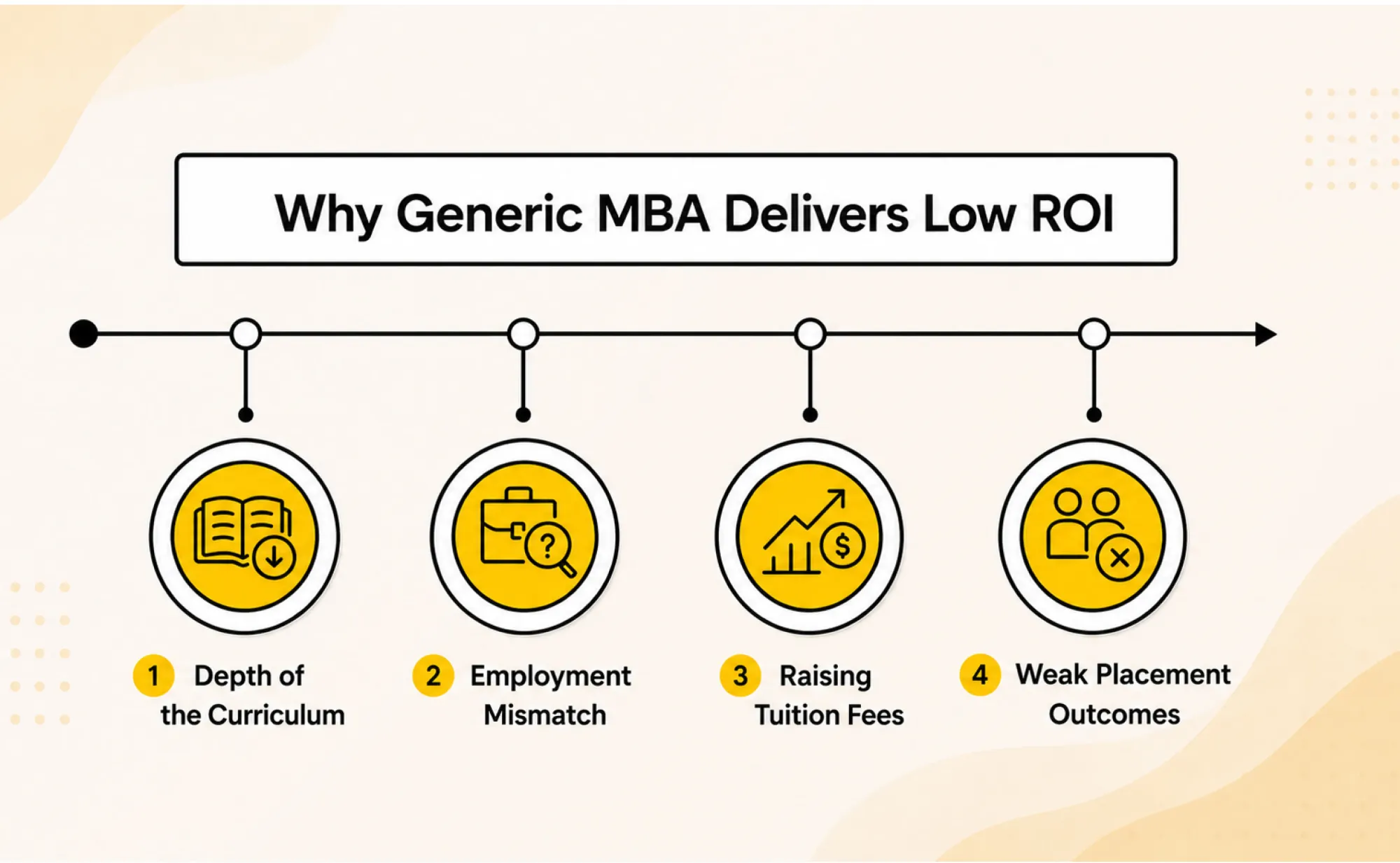
Before we discuss the factors that have reduced the ROI of a general MBA program, let’s quickly understand what ROI means in MBA terms.
It is basically your total investment and cost for pursuing an MBA versus the return you get on it. Most general MBA programs fail to offer a return that is at par with the investment they require. It may include unsatisfactory job roles, lower-grade salary, slow career growth, etc. Here are some factors that primarily affect it.
Depth of the Curriculum
A general MBA is designed to introduce students to multiple domains like marketing, finance, consulting, etc. Since it touches base on multiple industries, it fails to provide in-depth knowledge of any specific industry. As a result, graduates don’t understand how to add value to the unique demands of a specific industry because they lack the relevant expertise. For example, a general MBA program may not introduce you to the analytical skills needed for complex financial modeling.
Employment Mismatch
Most employers, especially in technical industries like AI, finance, and data analytics, look for graduates who possess industry-specific skills. They want employees who understand emerging technologies like AI, cybersecurity, advanced marketing tools, etc. Since these industries are constantly evolving, they need experts who can not only adapt to rapid changes but also thrive in their roles.
Unfortunately, a general MBA usually cannot deliver this level of depth for specific industries due to time and curriculum constraints. This often leaves graduates unable to find high-growth opportunities beyond a certain level.
Rising Tuition Cost
Pursuing an MBA from any tier 1 or tier 2 institute requires significant financial investment. Most students end up taking out education loans that can take almost a decade to repay, making it a significant financial burden.
Combined with a lack of job opportunities with a general MBA, it becomes a high-risk investment with uncertain returns. For many professionals, the return on investment may not justify the time, cost, and opportunities sacrificed to pursue it.
Weak Placement Outcomes
If you set aside top management institutions, most online or low-tier MBA programs have a very weak placement record. There are also speculations of inflated placement reports, which may give false hope to aspirants.
However, at the end, many graduates struggle to secure roles that match their expectations, often ending up with average packages or positions that lack clear growth trajectories. In such cases, the degree fails to translate into meaningful career advancement, making it a low-ROI choice.
Specialised Programs That Often Beat a General MBA on ROI
When it comes to specialized programs, their ROI is better not just because of shorter duration or lower fees but because of how aligned they are with specific job roles. These programs go into the depths of the industrial technicalities, provide practical exposure, and equip you with skills needed for top leadership roles. Here is an overview of some specialized alternatives that you can consider instead of a general MBA.
Marketing, Brand Management and Product Programs
These programs are designed for hybrid roles that sit at the intersection of marketing, technology, and business. Since most marketing roles are now driven by data and technology, these programs are highly relevant for positions such as growth marketing, product marketing, and digital strategy.
With a focused curriculum covering consumer psychology, digital channels, brand strategy, analytics, and performance marketing, students gain practical, execution-driven skills rather than broad theoretical knowledge. This makes them particularly valuable for engineers, analysts, and aspiring product managers looking to pivot into marketing-led roles.
Moreover, employers increasingly prefer execution-ready marketers who can contribute from day one. This direct alignment between skills and job requirements leads to better role fit, stronger career progression, and ultimately, a higher return on investment as compared to a general MBA that may not be able to offer so much.
Career-focused programs like Altera Institute’s PGP are designed for students aiming to build careers in modern marketing, brand, and product management. With a sharp focus on industry-relevant skills and role alignment, Altera stands out as one of the few B-schools where its ROI exceeds 1, making it a financially and professionally compelling choice.
Business Analytics / AI / Data Science Programs
The rising importance of data-driven decision-making has made business analytics, AI, and data science programs some of the most valuable alternatives to a general MBA. As industries increasingly rely on data to drive strategy, the demand for analytics-led business roles is also rising, offering strong long-term career potential.
Unlike a general MBA, these programs are better suited for data-heavy sectors such as fintech, consulting, e-commerce, and healthcare, where technical proficiency is as important as business understanding.
If you choose to pursue this path, you can learn in-demand skills like data analysis, machine learning, statistical modeling, data visualization, and tools such as Python, SQL, and Tableau. This will prepare you for high-demand roles such as Data Analyst, Business Analyst, Product Analyst, AI Specialist, Data-Driven Product Manager, etc.
Top institutes offering such programs include
- The Indian Institute of Management, Ahmedabad
- The Indian School of Business, Hyderabad
- The Indian Institute of Management Calcutta
- The Indian Institute of Management Bangalore
- Narsee Monjee Institute of Management Studies, Mumbai
Finance Certifications / Specialist Finance Programs
Finance certifications and specialist finance programs are ideal for individuals targeting careers in investment banking, equity research, asset management, and corporate finance. Unlike a general MBA, you can opt for a specialized MBA in finance.
Alternatively, you can also pursue courses such as the Chartered Financial Analyst (CFA), the Certified Management Accountant (CMA), or other finance-focused postgraduate programs.
Depending on your choice, you can build strong foundations in financial modelling, valuation, equity research, portfolio management, risk analysis, corporate finance, etc. These skills are critical in high-stakes financial roles and are well-suited for job profiles such as investment banker, equity research analyst, financial analyst, portfolio manager, and corporate finance manager.
Leading institutions offering specialised finance programs include
- The Indian Institute of Management Ahmedabad
- The Indian Institute of Management Calcutta
- XLRI Xavier School of Management
- Faculty Management Studies, Delhi
- Jamnalal Bajaj Institute of Management Studies
Industry-Specific Business Programs
Based on your interests, you can also explore other industry-specific programs in fintech, healthcare, supply chain and logistics, human resources, and luxury and retail. Choosing these programs can offer highly targeted career pathways focused on sector-specific challenges, regulations, and market dynamics.
- Tata Institute of Social Sciences, Mumbai, is a leading name in healthcare management, whereas the Indian Institute of Management, Mumbai, leads in supply chain management.
- For human resource management, you should definitely consider Xavier Labour Relations Institute, Jamshedpur, and Narsee Monjee Institute of Management Studies, Mumbai.
- In niche domains like agribusiness, luxury, or sector-specific management, institutes such as the Indian Institute of Management Ahmedabad and MICA also offer targeted programs that combine domain knowledge with business fundamentals.
Specialized Program vs. General MBA—Which Gives More Depth?
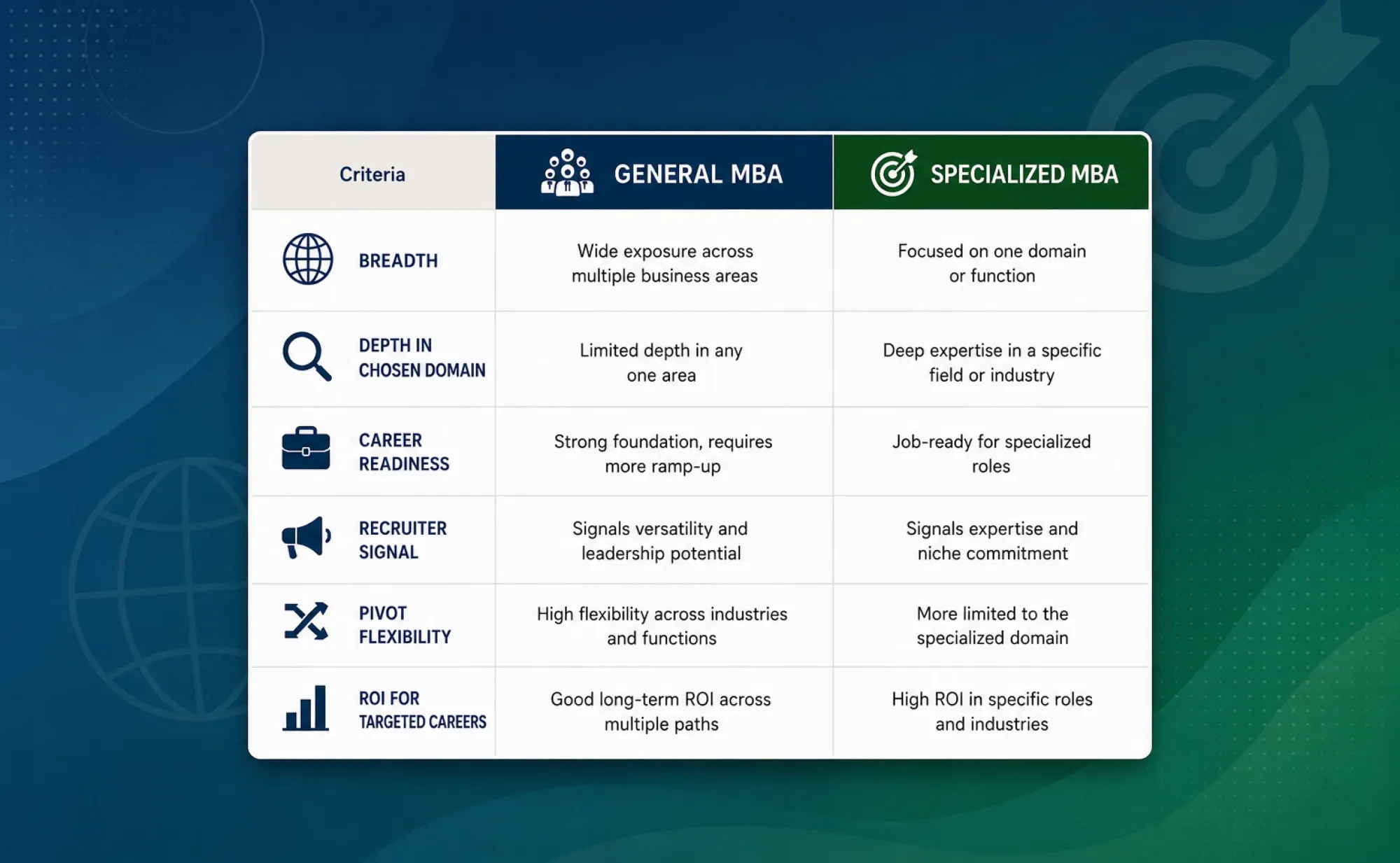
This differentiation clearly highlights how a general MBA is more preferred for its breadth and flexibility, offering students exposure to multiple business functions and the ability to explore different career paths. Conversely, specialized programs focus on depth, equipping students with role-specific skills and practical knowledge from day one. This makes them far more aligned with immediate job requirements and industry expectations.
Are Online MBA Courses Worth It Compared to Full-Time Alternatives?
Online MBA programs can be a practical option, but their value depends heavily on your career goals. Here’s a clearer way to evaluate if they’re the right fit for you:
When to Consider an Online MBA
If you’re a working professional looking to strengthen your credentials, an online MBA can support your growth without requiring a career break. It works well if your goal is internal progression, moving into managerial roles, or formalizing your existing experience. The flexibility in timing and lower opportunity cost make it a practical choice when you want to upskill while continuing to earn.
When an Online MBA May Not Be A Good Fit
If you’re aiming for a career switch, strong placements, or entering the workforce as a fresher, an online MBA may fall short. Without structured placements, industry immersion, or peer-driven learning, it can be harder to break into new roles or industries. In such cases, if your goal is placement and career acceleration, an industry-integrated, specialized full-time program often offers a stronger ROI than an online MBA.
This is especially true for programs like the Altera Institute, which combine a specialized curriculum with industry immersion and career support. It makes sure you get the right environment and exposure to make the major career switch.
How to Choose the Right Alternative to an MBA
With so many new courses emerging every day, it can be difficult to find the right program that aligns with your career goals. Here is a breakdown of how each of these programs can serve you in the long run.
Choose a specialized program if:
Most students who choose a specialized program already have a career roadmap and know the direction they want to take. Whether it's marketing, finance, analytics, or any other industry-specific goal, a specialized program can fast-track your career. It focuses on building depth in a specific domain, making your learning directly relevant to industry needs. Compared to a general MBA, it prioritizes practical application over theory, helping you become job-ready much faster. This makes it a strong choice if your goal is immediate employability and measurable career outcomes. Go for it if you check the following points.
- You prefer a curriculum built around real-world projects and case studies.
- You want direct exposure to industry tools, platforms, and workflows.
- You are aiming for roles with clearly defined skill requirements.
- You value mentorship and guidance within a specific domain.
Choose a general MBA if:
A general MBA is better suited if you’re still exploring different career paths or aiming for leadership-oriented roles. It provides a broad understanding of multiple business functions, helping you build a versatile skill set. It is also helpful for aspirants, especially freshers who are still exploring their options. It allows you to keep your options open before committing to a specific domain.
- You want to build a strong professional network across industries.
- You are interested in long-term leadership or entrepreneurial paths.
- You value exposure to diverse perspectives and peer learning.
- You are comfortable figuring out your specialization later.
Choose an online MBA if:
An online MBA works best if you’re already in the workforce and want to grow without taking a career break. It offers flexibility and helps you strengthen your profile while continuing your job. However, its value depends largely on how your employer perceives the credential. It is most effective when you don’t rely on campus placements for career progression.
- You need a flexible schedule that fits around work or personal commitments.
- You are looking for a cost-effective alternative to full-time programs.
- You are comfortable with self-paced, independent learning.
- You don’t require immersive campus or peer-based experiences.
Why Career-Focused Institutions Like Altera Are Replacing the Traditional MBA Path
Unlike traditional MBAs, which often rely on a rigid curriculum and theoretical learning, we at Altera Institute are more industry-aligned. We have consistently delivered a much better ROI for aspirants (both freshers and experienced professionals alike) seeking industry-specific outcomes in a shorter timeframe.
If you are someone who already knows their career pathway, a specialized program like ours can serve you much better than a general MBA.
Instead of relying solely on theoretical learning, we immerse students in a more agile curriculum that integrates evolving technological and data-driven skills. Not just that, our students also get to learn directly from the industry experts, make field visits, work on real-world projects, solve real problems, and attend workshops that make them job-ready.
Combined with sturdy placement support and relevant skill-building, we prepare our cohort of students to align with modern hiring trends and evolve with them.
Frequently Asked Questions
Q1. Is a specialized program better than an MBA?
Ans. A specialized program can be better than an MBA if you already have a defined career path in a specific industry or domain. It can offer a stronger ROI by building job-ready, role-specific skills and improving employability.
On the other hand, a general MBA is better suited for those who want broad business exposure, flexibility, and access to diverse career paths, especially in consulting or leadership roles.
Q2. Are MBAs and PGPs the same?
Ans. No, MBAs and PGPs are not exactly the same, even if they are quite similar. An MBA (Master of Business Administration) is a formal degree granted by universities or institutions affiliated with universities. In contrast, a PGP (postgraduate program) is usually a certification offered by autonomous institutes.
Q3. What is the best MBA alternative in India?
Ans. Specialized programs are considered the best alternative to an MBA, as they can prepare you for specific roles in a shorter timeframe and accelerate your career growth.
For example, PGP in Applied Marketing by the Altera Institute is a 15-month program that prepares you with practical and job-ready skills in the marketing domain.
Q4. Are online MBA programs respected by employers?
Ans. Online MBA programs are respected by employers in certain contexts, especially for working professionals seeking career progression within their current field. However, they are generally less valued for fresh graduates or career switchers due to limited placements and practical exposure.
Q5. Which specialized courses have the highest ROI?
Ans. With its PGP in applied marketing, Altera Institute has one of the highest ROIs in India. Not only is the program more affordable compared to many other top MBAs, but its excellent placement support and practical skill-building also allow students to recover their fee in less than a year.
Q6. Can I switch careers without an MBA?
Ans. Yes, you can switch careers without an MBA. Many professionals transition by building relevant skills through specialised courses, certifications, and hands-on projects, then leveraging internships, freelancing, or entry-level roles to break in.
However, an MBA can accelerate your career growth by equipping you with the right skill set and opening doors to top positions with much higher salary expectations.