How to Evaluate a Business School Beyond Placements


MBA aspirants often shortlist B-schools by brand name, ranking, and a quick scan of placement reports for headline numbers and placement percentages. But there is no afterthought given to these placement numbers, nor is there any way to cross-check them for authenticity.
Because there are no other clear indicators for evaluating the quality and outcomes of a B-school, transparent placement reporting standards become especially important. And with over 5,500 MBA institutes in India, placement outcomes feel like the clearest filter available.
But here's the problem that colleges fail to address, and students don't realize until it's too late. If a placement report isn't audited or is self-audited, the institute doesn't have to follow any salary-reporting standards, which is important for transparency.
Such colleges do not disclose fixed and variable salary breakdowns or the number of students placed in genuinely verified positions and do not accurately report domestic and international placement packages. Thus, the data you rely on ultimately becomes marketing numbers used even by the most reputable institutions in India.
Placement data is both the most visible metric and the most routinely manipulated one. A high placement rate or a few headline numbers do not really indicate the ground realities of the outcome. They do not say anything about the quality of the roles students secured, the difference between the median and top packages, or the variable and fixed-salary breakdowns for the roles.
Hence, if you're evaluating an unaudited placement report, you are missing out on the bigger picture. Because it is the combination of curriculum quality, industry relevance, post-graduation roles, and cultural fit that determines the ROI of a B-school.
Why Placement Numbers Don't Tell the Full Story
There are more than 5,500 B-schools in India, but only 100-150 consistently report results above 12 LPA. Out of those 150 colleges, fewer than 15% have their placement results externally audited. Others routinely draw criticism in public forums for inflating numbers or reporting metrics that do not reflect reality, such as reporting the top 10% salary average rather than the median salary.
This is why a small group of institutes, including IIM Ahmedabad (IIMA), XLRI, IMT Ghaziabad, SPJIMR, and IIM Udaipur, is held in particular high regard. They follow the Indian Placement Reporting Standards (IPRS), developed and used by IIMA, which is the gold standard of placement evaluation and reporting.
But the unfortunate part is, fewer than 5 B-schools in India join the list and adhere to IPRS year on year, which is less than 0.1% of all B-schools in the country.
The Gap Between Headline CTCs and the Median Salary
Now, if you are reviewing placement reports and don't know whether it was audited, the best indicator of real outcomes is the cohort median package. It is usually included in the headline numbers and is well highlighted, but some colleges report only the highest or average CTC because these figures are easier to manipulate.
Colleges tend to artificially inflate the average salary by including a few high-offer outliers and omitting unplaced students and lower offers from the average. Plus, some may not include whether the highest package they received was international or domestic.
This is why the median salary is the most accurate number to be found in any placement report. It represents the middle of the batch rather than the top, making it far harder to inflate. And it reflects what a typical graduate might expect to earn as opposed to an extreme number that comes from a few outstanding offers.
What Unaudited Placement Data Doesn't Capture
In addition to salary, unaudited reports consistently omit elements that are most important to future career success. It frequently
- Claims a "100% placement rate" by aggressively moving unplaced students into an "opted-out section.
- Omits the quality, domain alignment, and long-term sustainability of the roles accepted.
- Correlates between a student's prior work experience and their final job profile.
- Hides the institution's actual capability to bring recruiters to campus.
It's the quality of the roles graduates take on, the companies that hire them, and how quickly they grow after joining that ultimately matter. None of these is revealed in any headline figure, but they all play a role in the success of your MBA outcomes.
Placement Transparency: Why IPRS Matters

Transparent placement reporting standards are a basic requirement that instantly increases a B-school's credibility. And every institute must follow them because they are asking aspirants to make a huge financial investment decision based on placement outcomes.
IPRS is one of India's most credible frameworks for standardizing B-schools' reporting of salary and placement data. It was developed by IIM Ahmedabad and audited by B2K Analytics. To comply with its guidelines, institutes must distinguish between guaranteed cash and conditional earnings, report ESOPs in accordance with standardized provisions, and clearly report fixed and variable compensation.
Fewer than five B-schools in India join the list and adhere to the IPRS year on year, accounting for less than 0.1% of all institutes. Which is why the ones that do are the ones serious aspirants should pay closest attention to.
Altera Institute, for example, adopted IPRS auditing starting with its second cohort, the Class of 2025. It was audited by B2K Analytics under the same standard as IIM Ahmedabad and had reported a few key audited figures as follows:
- Highest package: ₹26.08 LPA
- Median salary: ₹18.14 LPA
- Top 50% average: ₹20.98 LPA
- Overall batch average: ₹16.85 LPA
- Over 70% of the graduates got jobs that paid more than ₹15 LPA
- 89% of placements in digital and AI-first roles
- Median salary growth of 28.7% from the Class of 2024 to the Class of 2025
These figures place Altera Institute among the top 30 B-schools in India on placement performance alone, a notable achievement for a young institution. More importantly, they are numbers that come with independent verification to back them up.
Factors Beyond Placements That Shape Your Career After Graduation
Once you've confirmed that a B-school reports its placement outcomes transparently, the real evaluation begins. Placements are an outcome, but the five factors below create that outcome, and they deserve equal scrutiny.
1) Quality of Roles Over Headline CTCs
Move beyond the headline numbers and look at the quality of roles students were offered. Get in touch with alumni and ask questions about the ground realities of studying at that college and whether they felt well prepared for the roles and industries they targeted at the time. Also, look at:
- The consistency of old recruiters returning to the campus and new companies joining year after year.
- Whether internships are curriculum-integrated or student-sourced, and the proportion of future-proof roles versus legacy positions in the overall placement distribution.
2) Faculty Quality and Industry Relevance
A program's learning quality and career outcomes are directly influenced by industry relevance and faculty members. A faculty that incorporates both industry practitioners and academic professors to teach students yields outcomes that differ significantly from those of faculties that are composed solely of academic professors. And this gap becomes most evident when judging a graduate's preparedness on day one.
When assessing a B-school, look for:
- Programs that leverage professors with real industry backgrounds, not just academicians
- Programs that have real industry connections that lead to projects with real companies, guest lectures, and mentorships
3) Peer Network and Cohort Quality
The people you study with help shape a huge part of your MBA outcomes. The professional relationships you build play a significant role in your learning and often lead to future referrals, startup collaborations, and job opportunities. Hence, when evaluating a program, consider factors like the following:
- Cohort diversity, including the alumni's average experience bracket and how diverse they are in terms of prior roles and industries
- Batch size dynamics, where smaller cohorts foster more meaningful peer relationships and better placement ratios per student, while larger batches offer broader networking opportunities and greater peer diversity
- Learning culture and whether the B-school fosters peer learning or operates as a zero-sum environment
4) Curriculum and Learning Model
Make sure the program you choose aligns with how modern businesses operate in its curriculum. A curriculum designed for the realities of the past will not be as effective at preparing students for the evolving roles and industries of the future. The industry today is increasingly moving towards AI integration and digital-first business models, and these are precisely where hiring demand is the strongest and growing. Hence, a well-designed program today should integrate:
- Industry collaboration with real companies and practitioners that shapes both what is taught and how it is delivered.
- Projects built around real business problems, not hypothetical simulations.
- Exposure to relevant tools and skills as an active part of the learning model, rather than an add-on.
5) Culture and Program Fit
The B-school you choose based on its community, values, and academic style should align with the student’s future course of action, learning style, and career goals. This is what is known as cultural and program fit. The right B-school isn't necessarily the one that has the best placements; it's the one that's right for you and for your future. Therefore, while evaluating B-schools, consider questions like:
- Does it have a collaborative or a competitive atmosphere?
- Is the mentorship structured or unstructured?
- Do leadership development opportunities exist outside the classroom?
The Right Questions to Ask Before You Commit
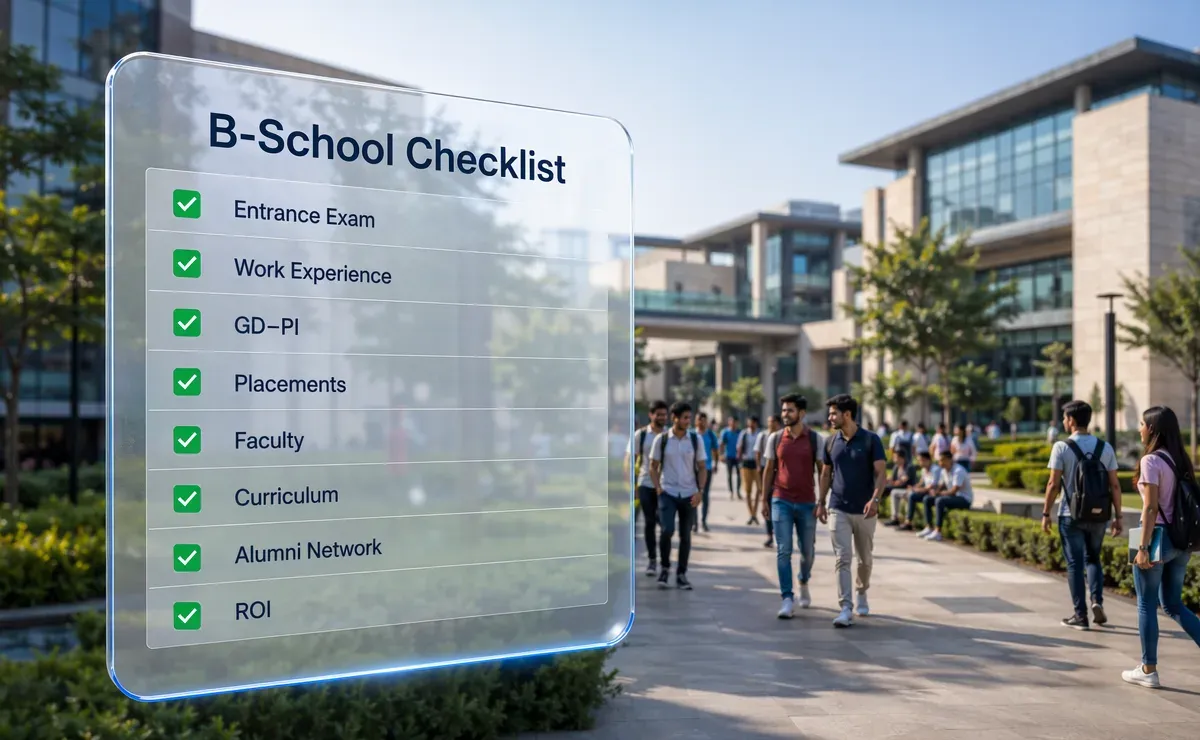
Instead of looking through brochures, use this checklist as a structured evaluation tool for all B-schools you are considering:
- Is placement data externally audited or self-reported?
- What is the median salary?
- What is the faculty-to-practitioner ratio in the program?
- Are internships integrated into the curriculum, or do students have to find their own?
- How big is the cohort, and what kinds of experiences do they have in their roles and industries?
- What roles are graduates entering, and are those roles growing or facing disruption?
- What is your real total cost, including living expenses and opportunity cost?
- How long will it take to fully recover your returns on investments?
Conclusion
There is more to a B-school than a single headline CTC. Placement reports and rankings are retrospective documents. They tell you what an institution has achieved in the past, not if it would be suitable for the career you are developing today.
The right program for you is the one that helps you further your career, has a curriculum focused on what is happening in the real world of business, and offers a community that adds value to you beyond graduation.
Students who evaluate B-schools by prioritizing transparency, faculty quality, cohort strength, and curriculum design aren't just making a smarter choice. They're turning a high-stakes financial decision into a high-confidence investment.
For aspirants seeking a program that puts all of this into practice, the Altera Institute offers a clear example of what outcomes-focused, IPRS-audited, industry-first management education looks like.