What Makes a B-School Truly Industry-Backed? A Framework for Students
“Industry-backed” has become one of the most common claims made by business schools today. But what does it actually mean beyond a line on a marketing brochure?
If you are comparing management programs, the difference can be significant. A school may have corporate partnerships, visiting speakers, or industry certifications, but that does not necessarily mean the industry plays a meaningful role in how you will learn. The real question is whether those connections shape the curriculum, learning experience, and skills students develop.
Institutions like Altera Institute offer an industry-backed MBA where industry involvement extends beyond occasional guest sessions to the way students learn, apply concepts, and engage with real business problems every day in the classroom.
That is why a practical framework is so important in an MBA. Instead of taking “industry-backed” at face value, you should look for measurable signs of genuine industry involvement, from faculty and curriculum design to live projects, mentorship, and career outcomes.
A Framework to Evaluate an Industry-Backed Business School
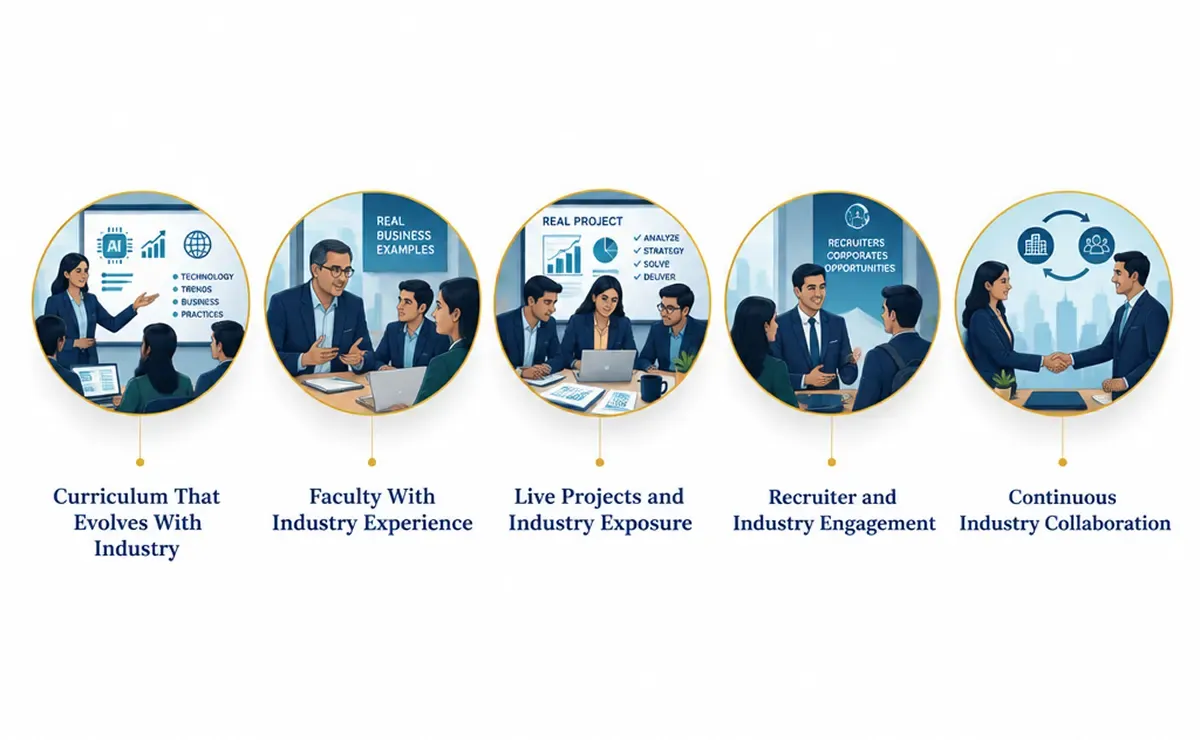
When you compare business schools, it is easy to get distracted by placement numbers, rankings, and lists of corporate partners. But if a school calls itself industry-backed, you should look at what that actually means in practice.
Use this framework as a checklist when researching your options. The goal is to see whether industry involvement genuinely shapes your learning experience or simply appears in the school's marketing.
Altera Institute's PGP in Applied Marketing reflects many of these characteristics through its AI-first curriculum, practitioner-led learning, live projects, and close engagement with industry professionals.
1. Curriculum That Evolves With Industry
A strong business curriculum cannot remain unchanged while the business world around it keeps moving. AI, automation, digital platforms, and new business models are already changing how companies operate and hire.
For example, a marketing student should understand more than traditional brand management. You should also encounter areas such as AI-enabled marketing, digital commerce, customer analytics, and emerging technologies.
When evaluating a program, ask:
- How often is the curriculum updated?
- Does it include AI and emerging technologies?
- Can you choose electives linked to current industry needs?
- Do you get opportunities to apply concepts to business situations?
The strongest programs balance academic theory with practical application instead of treating them separately.
2. Faculty With Industry Experience
The people teaching you can tell you a lot about how a business school approaches industry learning. Look beyond the title of visiting faculty and guest lecturers and understand how involved these professionals actually are.
For example, a senior marketing leader can teach you how a brand decision is made when there are competing business priorities. A technology executive can explain how digital transformation affects teams beyond what a textbook might show.
Look for a mix of:
- Experienced academic faculty who provide conceptual rigor.
- Practitioners who bring current market perspectives
- CXOs and business leaders who can share decision-making experience
Good academic faculty will always be the core of an industry-backed MBA. The strongest schools bring academic depth and practitioner expertise together rather than choosing one over the other.
3. Live Projects and Industry Exposure
You understand a concept differently when you have to use it to solve an actual business problem. That is why practical exposure should be an important part of your evaluation.
Look for programs that offer:
- Live projects with companies
- Internships
- Business challenges and case competitions
- Client interactions
- Company visits
- Industry interactions, etc.
For example, if you learn how brands use social media to reach customers, a live project could involve creating a simple social media plan for a real brand. You get to apply what you learned and see how marketing decisions work in practice, rather than only reading about them.
4. Recruiter and Industry Engagement
Industry engagement should not begin when placements do. You should have opportunities to interact with recruiters and professionals throughout the program.
This can include guest sessions, mentorship, career guidance, networking opportunities, and placement-readiness activities.
The key is consistency. One annual recruitment event does not make a school industry-backed. Regular interactions can give you a clearer understanding of what employers expect and how roles are changing.
5. Continuous Industry Collaboration
The strongest industry relationships go beyond inviting companies to campus. Industry should have a role in shaping what students learn, how they learn it, and how success is measured.
Look for signs such as
- Curriculum feedback from practitioners
- Long-term industry partnerships
- Integration of emerging skills into coursework
For example, if employers identify AI fluency as an important skill, that feedback should eventually influence what students are taught and how they are assessed.
This is what separates a genuinely industry-backed MBA from one that simply uses industry association as a branding exercise. When industry helps shape the learning experience, you graduate with a better understanding of how your knowledge translates into real business decisions.
Altera Institute's PGP in Applied Marketing reflects many of these characteristics through its AI-first curriculum, practitioner-led learning, live projects, and close engagement with industry professionals.
Questions Every Student Should Ask Before Choosing a Business School

When you compare business schools, do not focus only on campus facilities, rankings, or brochures. Look closely at the learning experience you will actually get. The value of an MBA increasingly depends on your exposure to real business decisions, industry networks, and opportunities to solve practical problems.
Use these questions to compare programs:
You can use this framework to evaluate any business school, including Altera Institute. Look at its curriculum, faculty, industry partnerships, and experiential learning opportunities, then consider how closely they align with your long-term career goals.
Remember, you don’t just want to know what the school offers, but what your actual learning and experience would look like during the program.
Conclusion
When a business school claims to be “industry-backed,” it should mean more than having a few corporate logos on their website. It also shouldn't be limited to inviting professionals for occasional guest sessions. Instead, it should describe an educational philosophy in which industry plays a meaningful role in shaping how you learn.
As you compare business schools, look at the full picture. Evaluate how often the curriculum evolves, who teaches you, how many opportunities you get to work on real business problems, whether you can learn from industry mentors, and how recruiters engage with students.
Choosing the right business school is ultimately about choosing the right learning environment. You want one where industry does not sit outside the classroom but actively influences what you learn and how you apply it.
Altera Institute is one example of this approach, integrating industry into curriculum design, classroom learning, and career preparation. You can use the same framework to objectively evaluate Altera Institute—or any other program you are considering.
Frequently Asked Questions
1. What is the difference between an industry-backed MBA and a traditional MBA?
Ans. An industry-backed MBA brings industry professionals, practical projects, and current business practices into the learning experience. A traditional MBA may focus more heavily on academic concepts and classroom-based learning.
2. How important are live projects when choosing a business school?
Ans. Live projects are useful because they help you apply what you learn to real business situations. They can also help you understand how marketing and business decisions are made in practice.
3. Does an industry-backed curriculum improve employability?
Ans. The right industry-backed MBA can improve your employability. When you work on practical problems and interact with industry professionals, you can develop skills such as problem-solving, communication, and business thinking that employers often value.
4. How can students verify whether a business school has genuine industry partnerships?
Ans. Look beyond logos and partnership announcements. Check whether industry professionals regularly teach classes, mentor students, contribute to projects, advise on the curriculum, or interact with students throughout the program.
5. Why should curriculum updates matter when selecting an MBA program?
Ans. Business practices, technology, and workplace expectations change quickly. A regularly updated curriculum helps ensure what you learn stays relevant to the skills and challenges you may encounter after graduation.
6. Can industry-backed learning benefit students without prior work experience?
Ans. Yes, because an industry-backed learning experience can give you early exposure to real business situations. It can help you understand how concepts are applied in the workplace, even if you have not worked in a company before.