
What Jobs Can You Get After a Postgraduate Program in Applied Marketing?

Marketing careers today are shaped less by the degree you hold and more by the relevant skills you have. Employers are no longer satisfied with candidates who understand marketing in theory. They want professionals with practical skills who can run campaigns, analyze performance data, and act on it to make the right decisions. This shift has created a demand-supply gap in marketing roles that traditional marketing education has been unable to address.
Entry-level marketing professionals typically start at ₹4-₹7 LPA, depending on the company, location, role, and prior experience. Graduates of focused, skills-first postgraduate programs, however, often move directly into faster-growing marketing roles with stronger earning potential because these positions place a premium on execution skills.
This is the reality that postgraduate programs in applied marketing are designed to address. This article explains what applied marketing is as a discipline, how a PGP in applied marketing is structured, why employers are prioritizing it over the traditional MBA, and the specific roles graduates move into upon completing the program.
What Is Applied Marketing?
Applied marketing is a learning approach where marketing concepts, frameworks, and strategies are taught through active, real-world application rather than theoretical study alone. Rather than studying the 4Ps or consumer behavior models as abstract concepts, students are taught to use those frameworks to solve live business problems, working with real briefs, real data, and measurable outcomes.
What distinguishes applied marketing from a generic marketing specialization is the integration of three elements: industry relevance, live project work, and mentorship from active professionals. The curriculum is not built around case studies that describe what marketers did five years ago. It is designed around what marketing teams need from professionals right now.
This matters because marketing has fundamentally changed. It is a real-time, measurable, and revenue-owning discipline where every decision is tracked, tested, and optimized, and applied marketing education is built to reflect that reality.
What Does a Postgraduate Program in Applied Marketing Mean?
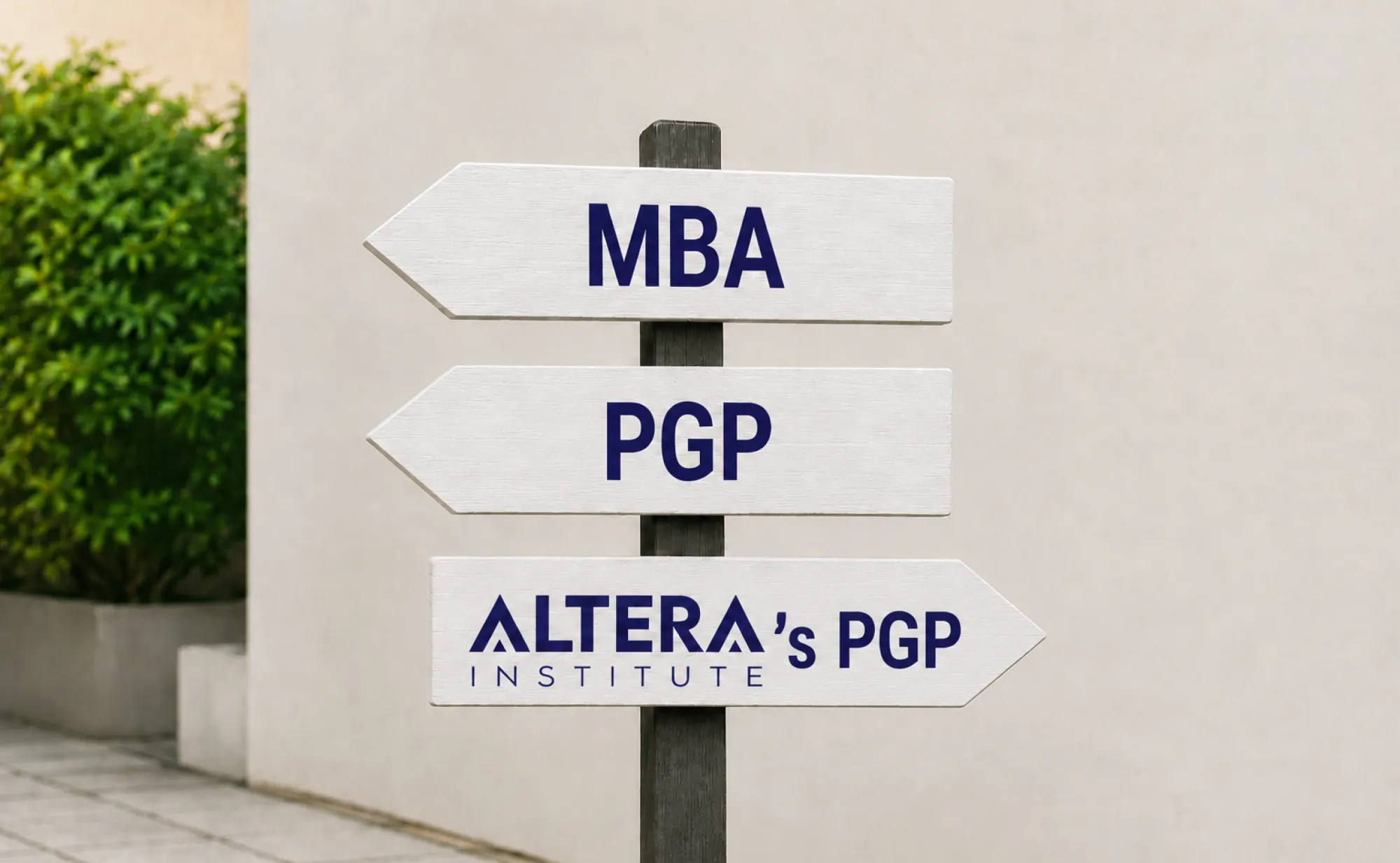
A postgraduate program, or PGP, is structurally distinct from a degree-granting MBA. A traditional MBA spans two years and is regulated by the University Grant Commission (UGC). It is a broad business education program that covers finance, operations, HR, strategy, and marketing in the first year, then shifts its focus to a single chosen specialization from the second year onward.
A PGP, on the other hand, drops the breadth entirely and uses that time to go deep on a single specialization right from the outset. They are highly targeted, industry-backed courses that support curriculum development, mentoring, and the integration of live projects, thereby enhancing the program's overall learning-by-doing approach.
For someone who is certain they want to build a career in marketing rather than explore general management, this trade-off is a significant advantage.
Altera Institute's PGP in Applied Marketing is one example of this format. The program runs for 15 months and stays structured specifically around marketing, eCommerce, and product roles rather than the generalist business curriculum a traditional MBA covers.
How a PGP in Applied Marketing Differs from a Standard MBA in Marketing Specialization
The differences between the two formats go beyond duration and fees. They reflect fundamentally different assumptions about what marketing professionals need to be effective:
Why Many Marketing Aspirants Are Looking Beyond a Traditional MBA
A recent survey found that 80% of employers in India now hire based on practical skills and experience rather than the degree itself. And 42% of hiring managers report difficulty finding candidates who are job-ready, not because candidates lack degrees, but because they lack hands-on execution experience.
A traditional MBA still builds solid business fundamentals, but it often leaves critical gaps for someone entering a marketing role. Common ones include:
- Performance marketing and paid media execution
- CRM, customer retention, and lifecycle marketing
- Marketing analytics and attribution modelling
- SEO, along with emerging practices such as Answer Engine Optimization (AEO) for AI-driven search experiences.
These are not niche skills anymore. They are the baseline requirements for most mid-level marketing roles in high-growth companies today. Institutes like Altera have been designed to address this gap by offering marketing-specific postgraduate programs rather than broad management degrees so that students graduate with the practical skills employers are actively hiring for.
Why Specialized PGPs Are Emerging as the Strongest MBA Alternative for Marketing Careers
Specialized postgraduate programs have a structural advantage for anyone building a marketing career. Rather than spending a year on broader subjects, students spend that time on practical and role-specific skill development in growth marketing, brand strategy, digital execution, and customer acquisition, all of which are in high demand today.
These programs leverage industry-designed curricula to focus on modern tools and AI, providing a high-ROI pathway for early-career professionals to gain practical, hands-on experience.
Ultimately, specialized PGPs bridge the gap between academic learning and modern recruitment needs through intensive, portfolio-driven training. Students graduate with practical experience gained through live campaigns and real-world simulations, providing employers with immediate evidence of their capabilities.
Careers After a Postgraduate Program in Applied Marketing
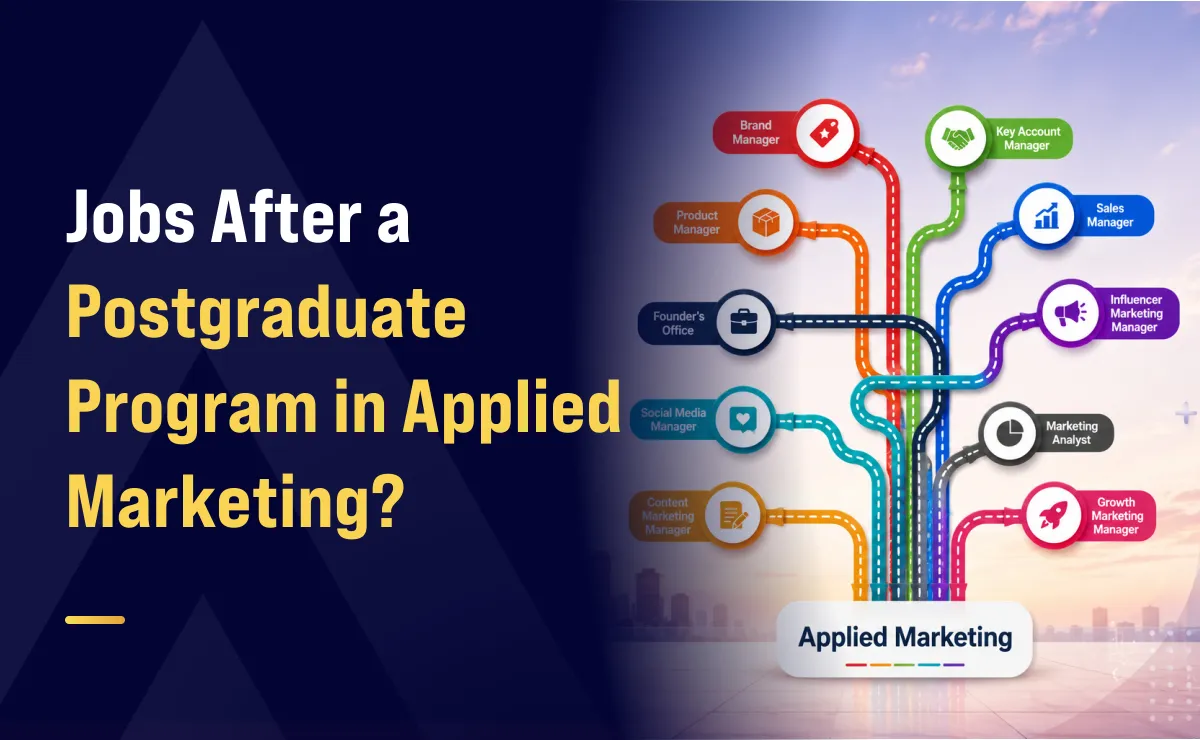
Applied marketing programs are designed with specific roles in mind. Graduates do not land vague "marketing executive" titles. They step into defined functions across brand, product, growth, performance, and commerce. Here is what each role actually involves.
1. Brand Manager
A brand manager's job is to establish and safeguard a brand's perception among its audience. They are responsible for positioning, communication, and running campaigns used to keep the brand relevant and consistent on every touchpoint. It's a job that requires strategy, creativity, and market insight.
Key responsibilities:
- Develop brand strategy and communication frameworks aligned with business objectives.
- Carry out regular consumer research to gauge changes in needs, behavior, and perceptions.
- Plan, execute, and monitor marketing campaigns from concept through performance review.
- Oversee product launches and brand extensions in collaboration with product and sales teams.
Industries hiring for this role: FMCG, retail, pharmaceuticals, consumer electronics, and tech.
2. Product Manager
Many applied marketing graduates also move into adjacent customer-centric roles such as product management, particularly in digital-first businesses where product, growth, and marketing teams work closely together. This role is responsible for the entire lifecycle of a product, from the initial problem definition and concept through development, launch, and ongoing iteration. They sit at the intersection of technology, marketing, and business strategy, coordinating across teams to ensure the product is competitive, well-positioned, and aligned with market needs.
Key responsibilities:
- Define the product roadmap and go-to-market strategy based on user research and competitive analysis.
- Coordinate across technical, design, marketing, and sales teams throughout the product lifecycle.
- Conduct regular competitor analysis to identify product gaps and feature opportunities.
- Track product performance and drive iterative improvements based on user feedback and data.
Industries hiring for this role: IT and SaaS, fintech, eCommerce, edtech, and health tech.
3. Growth Marketing Manager
A growth marketing manager owns the full customer funnel: acquiring new users, activating them, and retaining them over time. The role is defined by constant experimentation, building hypotheses, testing them, reading the data, and scaling what works. It is one of the most analytically demanding roles in marketing and one of the fastest-growing in digital-first businesses.
Key responsibilities:
- Identify and develop scalable growth opportunities across digital acquisition channels.
- Design and run A/B tests across campaigns, creatives, landing pages, and retention flows.
- Drive revenue growth through email marketing, SEO, paid media, and referral programs.
- Build and maintain dashboards to track funnel performance and surface optimization opportunities.
Industries hiring for this role: SaaS, fintech, eCommerce, D2C brands, and digital-first startups.
4. Performance Marketing Manager
A performance marketing manager manages paid campaigns on search, social, and display platforms and has direct visibility on every rupee spent and every dollar earned. This job is all about data and requires accuracy when targeting audiences, testing creatives, budgeting, and optimizing for conversions. The output is a measurable impact on revenue and customer acquisition.
Key responsibilities:
- Plan and manage paid campaigns across platforms, including Google Ads and Meta.
- Monitor and optimize campaign performance against KPIs such as ROI, CPC, and conversion rates.
- Run A/B tests on creatives, audiences, and landing pages to improve results.
- Manage budgets across channels and ensure spend efficiency at scale.
Industries hiring for this role: D2C brands, eCommerce, fintech, edtech, and quick commerce.
5. eCommerce Specialist
An eCommerce specialist manages how a brand shows up and sells across online marketplaces. As quick-commerce platforms like Blinkit and Zepto continue to take share from traditional retail and as Amazon and Flipkart grow more competitive, this role has become increasingly critical for consumer brands. The job is to optimize the brand's digital shelf: ensuring the right products are listed, visible, and converting.
Key responsibilities:
- Optimize and manage product listings on Amazon, Flipkart, Blinkit, etc.
- Track and optimize search results on each platform with algorithm-friendly listing techniques.
- Track conversion rates, ad metrics, and platform-specific KPIs to identify performance gaps.
- Ensure that the supply chain, brand, and performance marketing teams are aligned with inventory and campaign activity.
Industries hiring for this role: FMCG, D2C brands, retail businesses with marketplace presence, and quick commerce platforms.
Why Altera's PGP Is One of the Best MBA Alternatives for Marketing Careers in India
Altera Institute’s PGP in Applied Marketing sits at the intersection of growth, product, and business strategy—the core of modern marketing roles. Instead of repackaging broad management theory as a marketing specialization, its curriculum focuses on how high-growth brands build and scale marketing functions in practice.
To achieve that, the hands-on model becomes the core of the program. Live projects, real client work, and portfolio-building take priority over classroom-heavy instruction, giving students the practical proof of ability that hiring managers value and that is reflected in placement outcomes.
With 50+ recruitment partners across consumer tech, FMCG, eCommerce, and D2C, Altera offers direct industry access instead of passive theoretical exposure. The program prepares students for defined roles, helping graduates enter relevant positions with clear career positioning.
The role distribution across sectors for the Class of ‘25 reflects these outcomes as well:
- 35% of the students were placed in e-commerce roles
- 24% in Founder’s Office or EIR positions
- 12% moved into growth and revenue roles
- 9% entered product management
- 9% placed in Brand Management
- 11% of the students joined FMCG sales and marketing functions.
Summing Up
A postgraduate program in applied marketing prepares students for clearly defined high-demand roles such as brand manager, product manager, growth marketer, performance marketer, and eCommerce specialist. Each path has distinct skill requirements, career growth potential, and salary prospects.
Marketing careers are now shaped by execution, experimentation, and measurable business impact. As companies focus more on growth, customer acquisition, and retention, professionals who can prove these skills gain a clear edge in the job market. Whether you choose a traditional MBA or a specialized postgraduate program, the priority should be a pathway that builds relevant capabilities and prepares you for the role you want to pursue.
Look beyond the brand name and headline salary. Focus on the roles that graduates actually secure and whether those paths align with your goals. That clarity will help you choose a program aligned with your interests and career ambitions.