What Is the Future of Marketing Education in India?

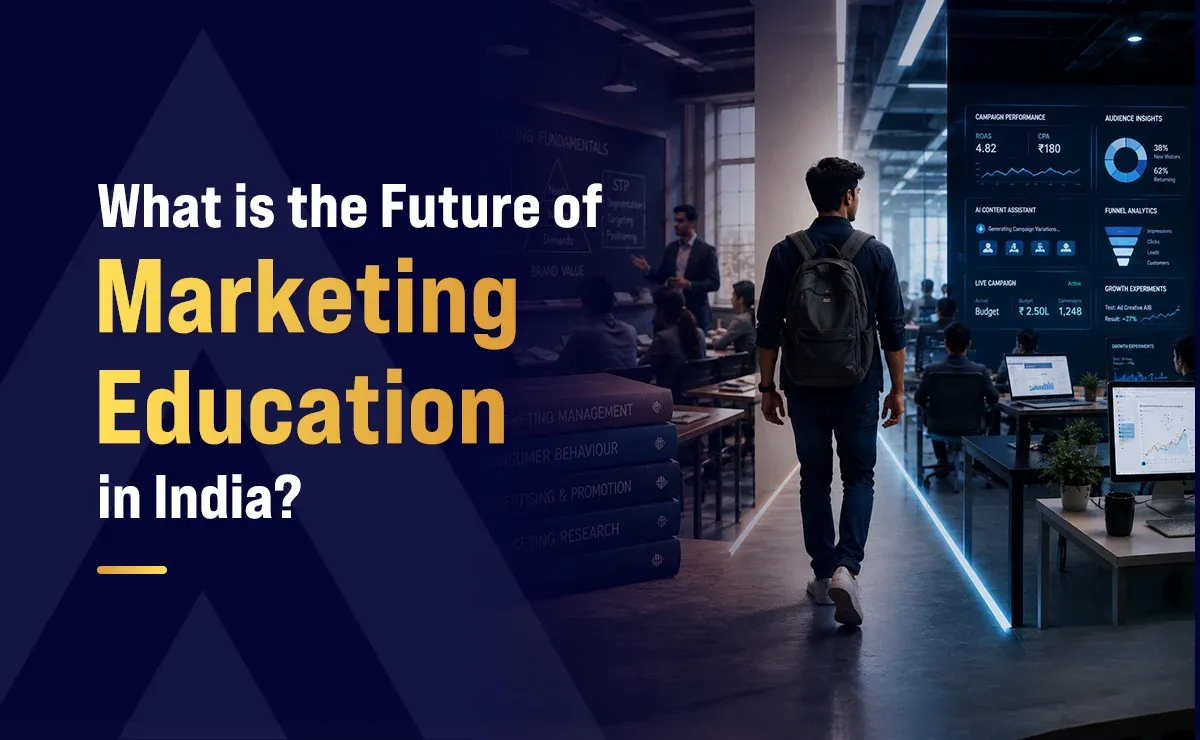
Marketing is no longer just a discipline defined solely by creativity. In 2026, it is defined by AI, data, technology, revenue generation, and measurable execution. A modern marketer today is expected to manage Meta Ads campaigns, pull attribution reports, and present ROI findings to leadership. Yet, the majority of marketing specialization programs in India haven't kept pace with the changes occurring in today’s era.
India's advertising industry crossed the Rs. 111,000 crore mark in FY2025, with digital advertising commanding 44% of that market and growing at 20% year-on-year, according to the ET Brand Equity-Ipsos State of Digital Advertising report. In the meantime, AI-driven marketing opportunities are expanding at a 40% annual rate, and the number of digital marketing positions in India has risen by 30% in the last two years alone. The industry is clearly changing, so why isn't marketing education keeping pace?
Why Is Traditional Marketing Education Becoming Outdated?
Walk into most MBA marketing classrooms in India today, and you will still find Philip Kotler's 4Ps at the center of the curriculum. Product. Price. Place. Promotion. These frameworks emerged from production-oriented business models of the 1960s and 1970s, designed for a world where marketing meant print ads and distributor relationships.
But today, employers are not just hiring generalists who understand brand theory. They are hiring performance marketers who know how to optimize cost-per-acquisition, growth managers who can design and run A/B tests, and analytics professionals who can read a dashboard and make real-time decisions.
1) Curricula Heavy on Theory, Light on Skills
Most marketing courses introduce topics such as brand management and consumer behavior through lectures and case studies. Yet graduates leave without ever having set up a Google Ads campaign, built a lookalike audience on Meta, or tracked a conversion funnel in a live analytics tool. And these aren't just gaps in their resumes—they're the very reasons that freshly minted MBA graduates are spending the first 6 to 12 months on the job trying to pick up the skills they should have learned in the classroom.
2) No Exposure to Real Campaigns
Classroom lectures can only go so far. There is a meaningful difference between theorizing about a go-to-market strategy and actually building one through a live project with real companies and customers. Most traditional programs simply do not offer this, and students graduate without ever having touched a live campaign, managed a real ad spend, or navigated an actual marketing P&L. These are the very things recruiters ask about on day one.
3) An Outdated Approach to Learning
Learning through case-study models does have value, but it also has clear limits. Studying popular case studies from a decade ago does not teach students how to apply them practically in a real business setting. As the business environment changes faster than the academic cycle, theory-heavy programs that lack practical experience will always lag behind what the industry needs. This is why candidates with a portfolio of real work are in greater demand in today's hiring market.
What Does the Future of Marketing Look Like in 2026 and beyond?
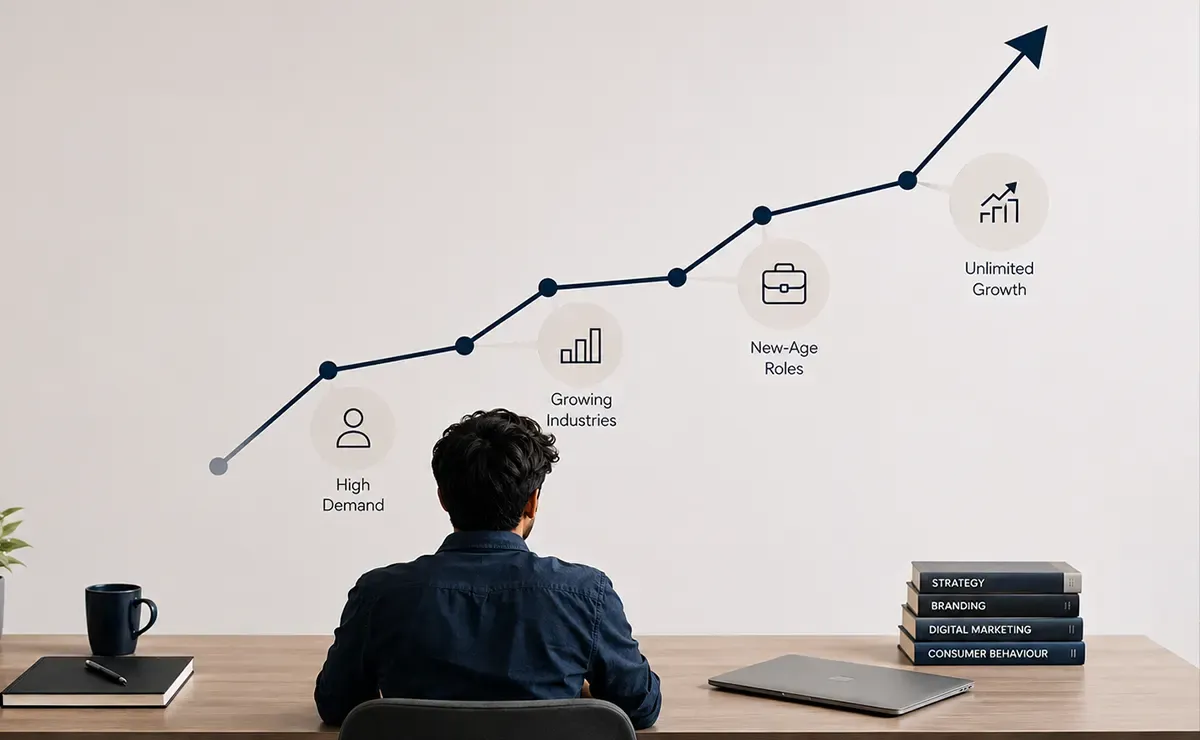
To understand where marketing education needs to go, start by first understanding where marketing itself is heading. The following shifts are not speculative; they are happening right now across FMCG, D2C, eCommerce, B2B SaaS, and nearly every sector in between.
1) AI-Powered Marketing and Automation
AI is no longer a buzzword in marketing; it's now part of the core infrastructure of various industries and domains. Survey data shows that 88% of marketers use AI in their day-to-day roles, and 25% of marketing budgets are allocated to AI tools. AI is not only saving time but also pushing the boundaries of what small teams can do, from automated content creation to campaign optimization and predictive customer segmentation. Hence, those who don't know how to leverage AI tools will be less competitive.
2) Shift to Measurable ROI Roles
Marketing is now directly accountable for revenue, as demonstrated by companies like Nykaa. By increasing marketing spending and focusing on customer acquisition, the company reported a 61% increase in profit. Each and every Rupee you spend on a campaign is supposed to have a constructive effect on sales, customer lifetime value, or market share. This has also shifted the employment landscape, with companies seeking performance marketers, growth managers, and eCommerce specialists rather than broad generalists with extensive theoretical knowledge.
3) Data, Analytics, and Real-Time Decision-Making
A modern marketer relies heavily on user data and metrics, such as CPA, ROAS, and conversion rate, which are tracked in real time to make decisions within hours. Unlike relying on intuition, they base their decisions on evidence. Brands like Swiggy excel at this by closely aligning product changes with marketing campaigns to drive retention and accelerate data cycles. Hence, the ability to take real-time, data-driven actions and scale what works is an essential skill for marketers in 2026.
4) Personalization at Scale
The digital ecosystem in India, powered by over a billion Internet users and affordable data, now enables hyper-personalized marketing at scale. It is predicted that connected TV will have 50 million viewers by 2026, and social media ads will continue to grow in popularity. Getting the right message to the right consumer at the right time is no longer an aspiration but a necessity, and it requires a fine balance of data science and creativity.
Skills That Will Define Future Marketers
Marketing roles for tomorrow will be far more specialized than those of a decade ago. Rather than being generalists across functions, the most in-demand marketers today are deeply skilled in specific domains and understand how those domains directly connect to business outcomes.
1) Performance Marketing
Performance marketing is a function responsible for managing paid acquisition on Google, Meta, and new platforms such as Q-Commerce. It is undoubtedly one of the fastest-growing career options in India, and individuals who can efficiently manage ad spend, reduce customer acquisition cost, and increase ROI on advertising spend are in great demand across the D2C, eCommerce, and startup ecosystems.
2) Marketing Analytics and Dashboards
The ability to work with data is no longer an optional skill for marketers. Understanding cohort analysis, reading attribution models, and learning to use SQL to analyze business metrics are now essential skills for everyone in a marketing position. Brands today rely heavily on professionals who can make data-driven decisions rather than just report it.
3) AI Tools and Automation Proficiency
From creating different versions of ads with AI to automating CRM processes, the ability to use these tools is a real differentiator, whether for producing more content or generating variations. Marketers who can effectively interact with automation platforms, leverage AI to their advantage, and incorporate them into campaign operations will have an edge over those who cannot.
4) Consumer Psychology in Digital Journeys
Consumer psychology sits at the intersection of data and creativity. Understanding what drives someone to click, buy, or return, whether it is a sense of urgency, social proof, or a frictionless checkout, gives marketers a layer of insight that no dashboard can fully capture. Marketers who develop this skill do not just interpret data; they know how to act on it.
The Real Problem: Marketing Degrees vs. Marketing Jobs
There is a clear gap between what colleges teach and the skills companies are hiring for today. About 69% of companies today report struggling to find relevant talent for digital marketing roles, even though universities continue to produce thousands of MBA graduates in marketing each year. This shows that, even though there is a steady supply of MBA graduates, they are far from possessing the competencies required for the roles they apply for.
Many students also end up dedicating more time to earning additional certifications in Google Ads or Meta Blueprint after graduation to demonstrate their hands-on ability to recruiters. This means MBA degrees only end up serving as mere credentials rather than real competency signals.
The hiring reality is direct: India alone is expected to have more than 1.5 million digital marketing jobs by 2026, and the most in-demand roles require hands-on proficiency with specific tools and live campaigns. A program that cannot demonstrate it has prepared students for these specific roles leaves them at a disadvantage before their careers even begin.
What Students Should Look for in a Future-Ready Marketing Program
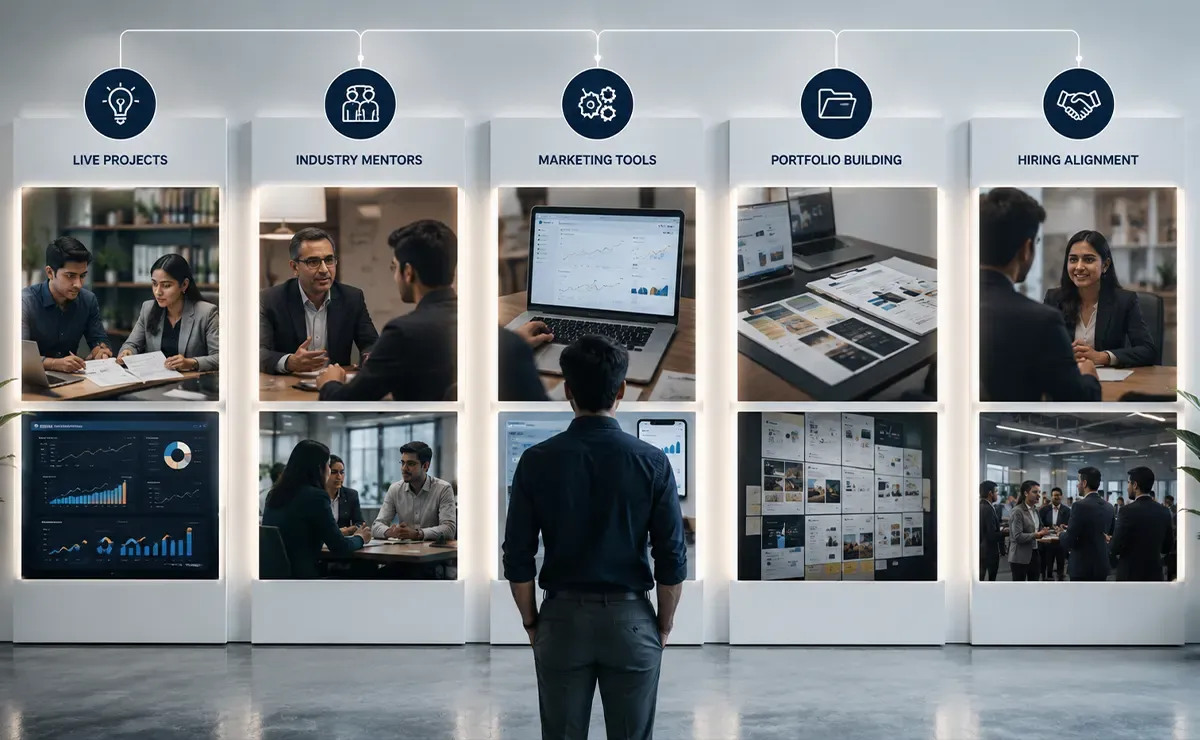
If you are evaluating marketing programs, whether a traditional MBA or a specialized PGP, the right questions to ask are not about rankings or campus size. They are about outcomes and preparation. Here is what a genuinely future-ready program should offer:
- Live projects over classroom lectures: Real work experience that builds a portfolio, not just academic credits.
- Tool training: Hands-on proficiency in ad platforms (Google, Meta, Amazon), analytics dashboards, CRM systems, and AI tools.
- Industry mentors: Access to practitioners who can provide career guidance based on real hiring experience.
- Portfolio-building opportunities: Structured capstones and projects that demonstrate applied marketing skills to employers.
- Hiring alignment: A curriculum explicitly designed around the roles and skills companies are actively recruiting for.
Conclusion
Marketing has already evolved. It is now a discipline of execution, analytics, and technology, and the best marketers in India are not those with the most theoretical knowledge. They are those with the strongest execution instincts and the sharpest data literacy.
The future of marketing education in India must match this reality. It must move beyond legacy frameworks, teach students to work with real tools on real campaigns, and connect learning directly to the roles that the industry is hiring for. Students who receive this kind of preparation will not spend their early careers catching up. They will start ahead.