What Early Placement Data Tells Us About a B-School's Future?


When was the last time you picked up a product brochure before making a significant purchase? As the brochure promised specific features, provided compelling numbers, and painted a picture of value, the product seemed worth considering. An MBA placement report functions in a similar way. It is the first serious document students, investors, and recruiting companies turn to when deciding whether a B-school deserves their trust, and, much like a product brochure, the quality of the information it reveals can tell you more about an institution than just its numbers.
Placement reports are the primary gateway for most MBA aspirants in India when comparing programs. Career outcomes are nearly the sole determinants of the payoff of a postgraduate management degree, and early placement information is one of the most important items of information that a prospective student can review.
Despite this, the current state of the Indian B-school placement data standards is far from transparent. There are more than 5,500 business schools in the country, but fewer than 15% of them actually audit their placement results. This only leads to inflated figures, selective averages, and headline numbers that obscure more than they reveal.
That's why early, transparent reporting is so crucial. When an honest, audited B-school publishes preliminary placement results, it is not merely an indicator of a good hiring season but a sign of something much more important. It informs you whether the curriculum, pedagogy and recruiter relationship in the school are successful in the job market. This article shows a practical lens for reading early data with more judgment and less noise.
What Is Early Placement Data?
Early placement data is released at the beginning of the campus recruitment season. The data includes pre-placement offers secured through internships and the first wave of formal recruiter visits, as well as the distribution of roles offered to final-year students. It is common for this data to be released before the full placement season concludes, giving prospective students a sense of how well a program places its graduates.
The challenge is that early data can be shaped just as easily as any other data. Rather than reporting the total number of students, a school may highlight only the top packages, report a top-decile average as representative, or exclude students who are not participating. It is therefore just as important to understand what the data includes and what it omits as to read the numbers themselves.
What Early Data Can Actually Tell You?

Early placement data should be seen as a directional signal rather than a final verdict. Although it doesn't tell you everything about a program, it gives you enough information to ask better questions. But there are many more important statistics than average salary: median salary, quality of the role, type of recruiter, whether hiring trends are increasing or decreasing year over year, and whether the figures presented align with the outcomes described and the career path the B-school claims to deliver. These indicators show whether an institution produces results across its entire cohort or just for a small number of outliers.
Placement data speaks differently to different audiences, and understanding those differences makes it easier to read.
- Whether an MBA program delivers for the whole cohort or only for a subset of high performers can be determined by median salary data and the quality of the role provided. The quality of a role determines whether graduates enter careers with real growth potential or end up working in jobs that are increasingly automated or commoditized.
- Early placement results provide recruiters with the opportunity to assess a talent pool and determine whether it is worth their time. The stability of the quality of roles across cohorts results in confidence among recruiting organizations, which translates into repeat visits and better job offers.
- To investors and the industry in general, audited placement data represents institutional credibility, which cannot be taken for granted. B-schools with honest early outcomes accrue long-term brand equity, rather than short-term marketing impressions.
Transparency Is the First Signal
The most important question to ask when evaluating any specific number in a placement report is whether the data has been independently audited. To address the opacity of reporting standards in India, the IIMs created the Indian Placement Reporting Standards (IPRS).
The IPRS offers a transparent model of what is counted, how compensation is disaggregated, and how variable compensation, such as ESOPs and performance bonuses are reported separately from guaranteed cash compensation. These differences are of paramount importance when comparing institutional performance.
It is estimated that fewer than 5 B-schools in India adopt the IPRS framework year on year. This represents less than 0.1% of all management programs in the country. B-schools that have their reports audited by recognized firms demonstrate a level of institutional seriousness that extends beyond numbers. Some of the most respected institutions adhere to this standard, including IIM Ahmedabad, XLRI, SPJIMR, and IIM Udaipur.
When an institute reports transparently and complies with a recognized standard, it is a strong indication that accountability is part of its culture. In the case of Altera Institute, a report with its early cohorts audited by the IPRS is a calculated investment in establishing that standard in an environment where the traditional model has historically been the norm. It is among a very limited number of programs to have its Class of 2025 report audited by B2K Analytics.
Role Quality and Sector Mix Tell the Real Story
It is important for placement reports to clearly specify the types of roles graduates are entering, rather than just listing salary packages. An attractive headline salary for a role that entails significant variables and a weak career trajectory is significantly different from an attractive guaranteed package for a position that places graduates at the centre of company decision-making. This distinguishes institutions that genuinely prepare students from those that present data selectively.
This distinction has never been more important in a fast-moving, AI-driven digital economy. Technologies have transformed entire categories of work, with eCommerce, growth marketing, product management, and business strategy now among the fastest-growing segments of talent demand.
Businesses today are built and run differently from years ago, which is why institutes that prepare students for these roles are responding to that change rather than just following trends. The Altera Institute was created to bridge the gap between management education and the digital-first roles that modern companies struggle to fill.
Altera Institute's Class of 2025 audited data illustrate examples of what quality of roles looks like in practice:
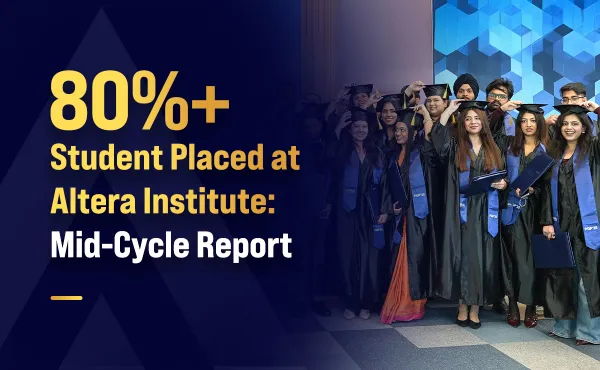
- More than 80% of graduates are placed in digital and AI-centric roles (eCommerce and growth, product management, brand strategy), not classic sales/field roles.
- 35% joined eCommerce roles, including marketplace development, direct-to-consumer performance, and category commerce strategy, functions that sit directly adjacent to company revenue and customer insight.
- 24% entered Founders' Office and Entrepreneur-in-Residence positions, roles that place graduates at the center of strategic decision-making from the very first day of their careers.
- The rest is divided into growth, revenue, product management, and brand/digital strategy roles that drive innovation and strategic growth.
Another indicator worth paying attention to is the number of companies returning to recruit from the same program or college. Repeating hiring patterns indicate there is a genuine fit between what management programs teach and what businesses need. When recruiters return year after year for the same kinds of roles, that consistency is one of the strongest signals a placement report can offer about a B-school's direction.
What to Look for Over Time?

A good batch performance is promising in placements, whereas a steady trend among various cohorts is more convincing. The future of a B-school is clear only when initial data improve year after year. The median salaries of the Altera Institute Class of 2024 to Class of 2025 have increased by 28.7%, the top 50th percentile salaries have increased by 25.6%, and the highest package has increased by 28.7%. These are no coincidental improvements; they are part of a paradigm that finds a better fit in the market as the program matures.
In the early career success of any B-school, the infrastructure that it offers is just as important as the data. A successful placement data cannot be maintained over cohorts without a rigorous curriculum, experienced faculty, and live projects. Rather than estimating the prospects of a new institute on the basis of its initial salaries, ask yourself whether the academic design of the new institute is in a position to support those salaries.
The Altera Institute provides over 300 hours of specialized career support, which includes resume development, structured interviewing, and direct access to a recruiter network that encompasses more than 50 organizations.
When comparing B-schools, students can use this investigative checklist when reading any early placement report:
- Audit and Standards Compliance: Was the report independently verified against a recognized framework, such as IPRS, or was it self-reported without external verification?
- Median and Quartile Visibility: Does the report include median and quartile figures, or does it rely solely on top averages and headline packages?
- Role and Sector Alignment: Do students receive jobs in areas that support the career focus stated in the program, or in areas that are not related and low-growth jobs?
- Cohort Coverage: Are placements spread across the entire batch or concentrated in a small, high-performing group?
- Recruiter Consistency: Do the same companies come around each year, and do they offer better-quality jobs as trust increases?
With these questions, the conversation can move from hype toward the kind of accountability that every student should demand, and every institution should strive to meet.
A Compass, not a Verdict
Use early placement data as a compass. It gives you an idea of where a B-school is headed and presents a meaningful sense of direction, but does not reveal its destination. Numbers that are transparent, audited, and aligned with the institute’s academic design and recruiter demand are much more credible than self-reported numbers made up of cherry-picked metrics disassociated from the program’s real content.
Publishing early outcomes honestly is not a claim to perfection for the Altera Institute. The goal is to provide students with the information they need to make an informed decision about one of their most important investments.
In an environment where inflated placement reports and opaque disclosures remain common, the weight of that commitment goes well beyond any single number. This standard is more than a data point; it is the foundation for a more accountable B-school ecosystem, and every institution, young or established, should strive to achieve and sustain it.