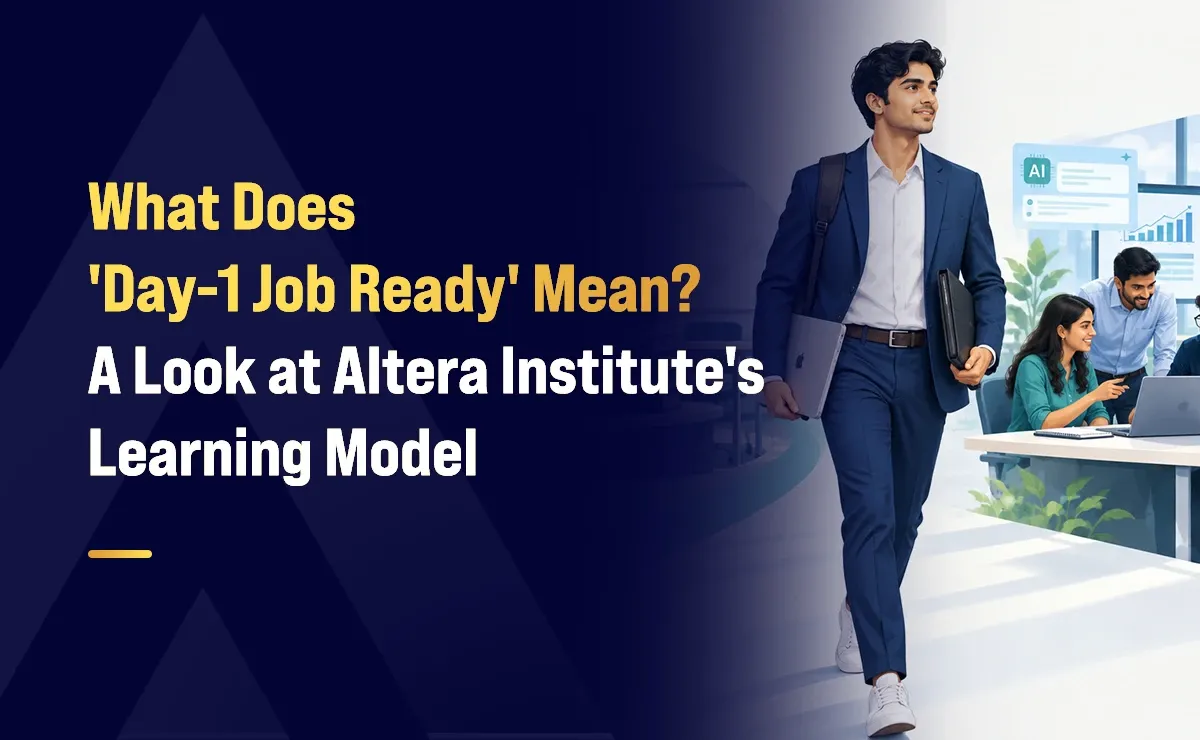
What Does 'Day-1 Job Ready' Mean? A Look at Altera Institute's Learning Model
Initially, management education was designed to connect academic theory with corporate practice. It allowed companies to recruit graduates without investing months training them in basic tasks. Businesses today have changed significantly due to growth in quick commerce and the spread of AI. However, traditional businesses have struggled to keep up.
As a result, several B-schools struggle to place graduates because they are trained on frameworks tailored for pre-2013 corporate environments, not the modern digital ecosystem. Securing a job offer is not the same as being prepared to perform well in it.
Today, employers expect to hire candidates who can contribute meaningfully from the first day. Day-1 job readiness is a measurable combination of applied business knowledge, technical capability, and professional maturity, which is able to generate value and not just complete assigned tasks.
Institutions like Altera Institute have designed their programs specifically around this principle. The PGP combines practitioner-led instruction, integrates AI tools, and live corporate assignments to build workplace capabilities before students are placed in a job.
What Does Day-1 Job Readiness Actually Mean?
Employability is more than earning a degree or memorizing theoretical concepts. Day-1 job readiness defines a candidate’s capacity to translate classroom concepts into workplace execution without requiring extensive training or onboarding.
Beyond Academic Readiness
Academic readiness measures how a student is able to grasp theoretical concepts, solve exam questions, and analyze historical case studies. Day-1 job readiness measures how quickly graduates can work with an enterprise dashboard, analyze real-time data, track costs, or draft operational plans under market conditions.
Creating Business Value from Day One
A day-one-ready graduate is someone who is able to reduce their employer’s burden, not add to it. They understand the brief, ask the right questions, use the tools, and work without needing constant supervision. This may mean they can build reports, analyze consumer trends, and contribute to campaign discussions.
Why Employers Care About Day-1 Readiness
There is a difference between candidates with the right qualifications and those who can start working right away. When new hires understand the work expectations quickly, they don’t need as much guidance from managers. This is beneficial in positions where quick decision-making is essential, and teams work across functions.
The Hard and Soft Skills That Make You Job-Ready
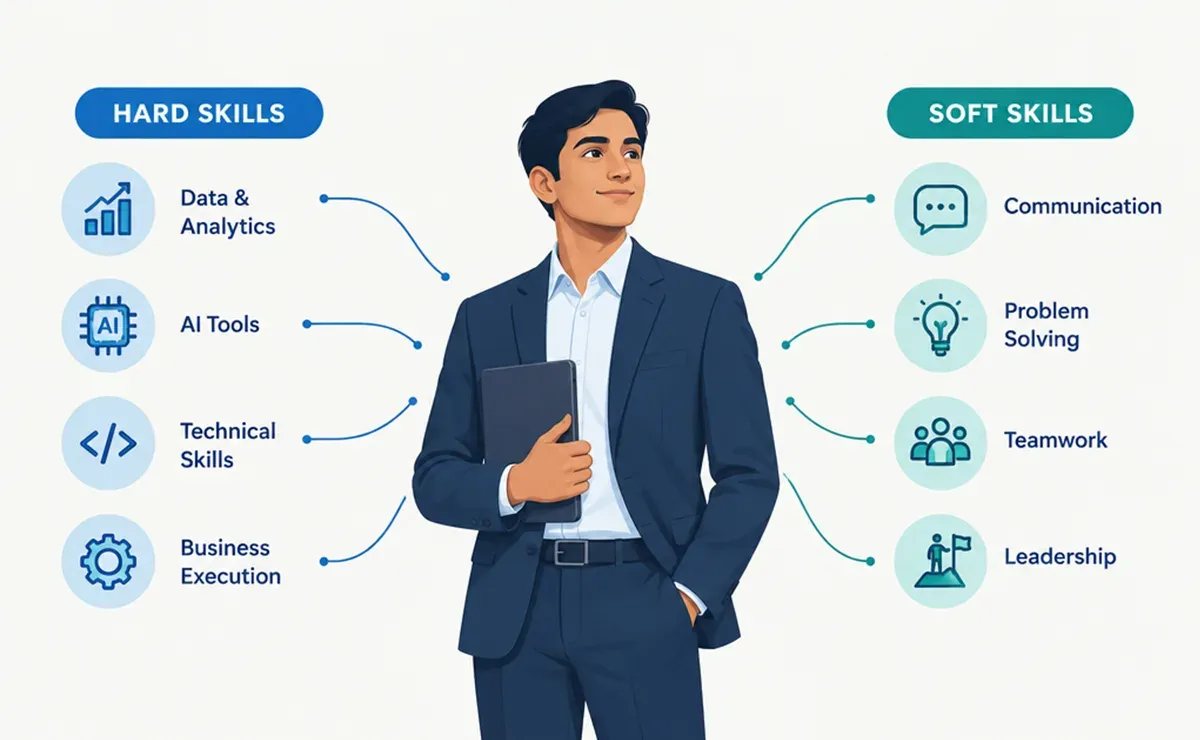
True workplace readiness requires balancing soft skills with execution-focused hard skills.
Soft Skills
Traditional business schools focus on core soft skills, such as structured thinking, spoken and written communication, teamwork, and leadership dynamics. These interpersonal capabilities are essential; without clear communication and structured problem-solving, even the strongest technical work will not have any organizational impact.
Hard Skills
Employers today also expect practical hard skills from day one, especially in fast-moving functions like marketing, growth, and product. Marketers, for instance, are no longer limited to offline campaigns or one communication channel. It now spans omnichannel strategy, e-commerce, AI-enabled workflows, analytics, and full-funnel execution.
Altera Institute prepares its students by focusing on teaching soft skills and modern hard skills that reflect how work is actually done in modern businesses.
The table below outlines how hard skill requirements have changed in businesses today.
How Altera Institute Builds Day-1 Job Readiness
Altera Institute’s program is designed around the idea that job readiness is built through application, repetition, and exposure to real-world business problems. It has designed its learning model to systematically develop immediate execution capabilities across five aspects:
Practitioner-Led Faculty
Learning from active industry professionals helps students understand what business problems look like in practice. Practitioners as faculty bring current examples, operating context, and decision-making habits to the classroom. This makes learning more relevant, and students learn how classroom concepts are used in real roles.
AI-First Curriculum
AI is today a part of everyday business workflow and not a separate subject. By integrating AI into the classroom, Altera Institute students get comfortable with tools and workflows that are used in modern execution. This builds familiarity with automation, faster analysis, and decision-making, as expected in modern roles.
Live Business Projects
Live projects force students to work with ambiguity, deadlines, and business constraints. Instead of only studying cases, they solve real problems for actual businesses, which develops both judgement and execution skills. This also helps the students build a portfolio of work they can speak about in interviews.
Mentorship and Industry Exposure
Regular feedback from practitioners helps students refine their thinking and delivery. Industry exposure provides students with the opportunity to work in a professional setting and get real-time feedback on their output, allowing them to modify and make corrections. This builds feedback and sharper business awareness.
Career Preparation
Career preparation is not limited to just preparing for interviews. It also includes communication and presentation skills, business storytelling, and the ability to make decisions quickly. Altera Institute’s model supports these by providing repeated opportunities to practice them before the graduates enter the workplace.
How Recruiters Assess Day-1 Job Readiness
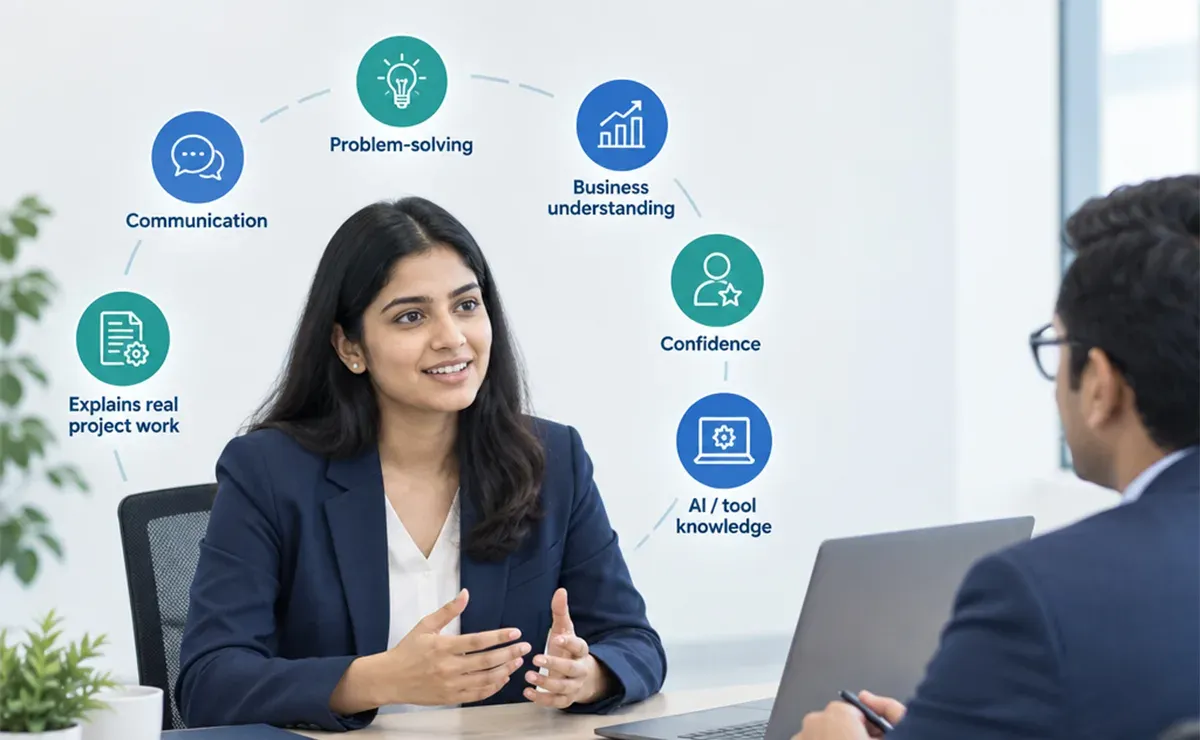
Recruiters assess job readiness in two stages: during interviews and the first few months on the job.
During Interviews
Recruiters look beyond test scores and resumes in interviews when it comes to solving real-world problems. Graduates are judged on their communication, business knowledge, awareness, and clarity of thought in live projects and real-world problem statements. Being able to explain what they worked on, why they took a certain approach, and what they learned signals job readiness more than memorized concepts.
During the First 90 Days on the Job
While interviews check potential, the initial months on the job reveal job readiness. Employers focus on how new hires adapt, learn, and behave professionally after a candidate is hired. New hires are anticipated to settle in quickly, work with others effectively, and add value without delay.
How Students Can Improve Their Day-1 Readiness
Developing immediate workplace readiness is a habit built through consistency with formal education. Here is how the habit can be built:
- Build communication skills through concise writing and structured speaking.
- Learn AI tools used in your field, especially those used in research, analysis, and automation.
- Work on live projects to learn how to deal with feedback, constraints, and outcomes.
- Get feedback to improve the quality of your work and behavior.
- Develop presentation skills by learning how to speak clearly and confidently and to answer questions.
- Understand business metrics to be able to connect work with performance, growth, and impact.
- Read industry news to stay aware of changes in roles, tools, and priorities.
- Build a portfolio of work with projects, reports, presentations, and case studies to discuss in interviews.
Altera Institute’s learning model is designed to create repeated opportunities for students to practice these workplace capabilities. Through repetition, Altera Institute graduates are more job-ready and durable than those with a traditional MBA.
Conclusion
Day-1 job readiness is fundamentally about creating value immediately upon entering the workplace, rather than spending months learning the basics of operational mechanics. As employers raise the bar on adaptability, digital fluency, and practical execution, students need to judge business schools by how well they prepare them to meet these demands.
Continuous learning, tool adaptability, and speed of execution will define long-term career growth. Altera Institute’s PGP combines both knowledge and application with its practitioner-led, AI-integrated, and live project-based curriculum.
Frequently Asked Questions
Q1. What is the difference between employability and Day-1 job readiness?
Ans: Employability means a candidate has the baseline qualifications and knowledge to get hired, but day-1 job readiness is possessing the skills, tools, and professional maturity to contribute effectively immediately once they start work.
Q2. Why do employers value Day-1 readiness in MBA graduates?
Ans: Employers value day-1 readiness because modern digital markets move quickly and cannot afford to have long onboarding and training processes. Hiring graduates who are able to manage campaigns, analyze data, and run an AI-assisted workplace to reduce team burden and contribute to business value.
Q3. Which skills contribute most to Day-1 job readiness?
Ans: The most impactful job readiness comes from combining soft skills, like communication, leadership, and problem-solving, with technical capabilities such as workflows, omnichannel strategy, and performance analytics.
Q4. How can students assess their own workplace readiness before graduation?
Ans: Students can assess their job readiness through live projects, presentations, feedback cycles, mock interviews, and portfolio reviews. Getting feedback from mentors is also vital to identify gaps and make changes.
Q5. Does AI proficiency improve Day-1 employability?
Yes. Proficiency in AI tools is a baseline expectation in many roles. It allows new graduates to conduct research and analysis faster and automate tasks. This makes them more productive than others who work manually.
Q6. Can live business projects improve workplace readiness more than classroom assignments?
Yes. Live corporate projects expose students to real-world situations, like changing consumer behavior, budget limits, and team dynamics. This helps them build practical workplace skills, which traditional classroom teaching cannot provide.