
What Does Being Industry-Led Mean in MBA Institutes?


The MBA has long been a standard pathway to management education in India. For decades, it has carried the promise of career acceleration, access to leadership, and dramatically improved earning potential among graduates. But something has shifted with time. Digital transformation, AI adoption, and rapidly evolving job roles have fundamentally changed what employers expect from business graduates today, and many traditional programs are struggling to keep pace with these realities.
This key shift in business operations and recruitment has given rise to the term “industry-led,” which B-schools increasingly use to signal relevance. But what does it actually mean to be industry-led? And more importantly, how can an aspiring student tell the difference between a B-school that genuinely operates this way and one that uses the term purely as a marketing strategy?
Today, employers are actively looking for candidates who can hit the ground running, not graduates who need months of on-the-job training to catch up. Understanding what industry-led education truly means and how to evaluate it has therefore become one of the most important metrics that MBA aspirants should consider.
Why Does the Term “Industry-Led” Exist?
The conversation around industry-led education did not emerge in a vacuum. It is a direct response to a growing, well-documented gap between the talents that traditional business schools produce and what recruiters actually want.
A recently released Unstop Talent Report 2026 highlights that while 88% of employers are actively hiring, 74% of B-school graduates remain unemployed. The problem is not a shortage of opportunities but a shortage of job-ready candidates. The World Economic Forum’s Future of Jobs Report 2025 reinforces this urgency, projecting that 39% of core job skills will change by 2030, placing enormous pressure on business education to evolve in real time.
Traditional MBA programs were built for a different era of the business world. They were designed around classroom instruction, standardized testing, and well-established theoretical frameworks. For decades, that model worked because the business environment changed gradually enough for academic curricula to remain relevant.
It's no longer the case today with the advent of AI integration, digital-first functioning, and cross-functional workflows, making it a requirement for many jobs to be practically fluent in digital skills. However, the majority of traditional programs continue to offer students the same courses taught years ago and have students learn frameworks rather than apply them in a real business context.
Industry-led education is, hence, a direct response to that gap. It is not a trend or just a branding upgrade. It's a structural rethinking of business education because the job market needs execution skills, not just theoretical knowledge.
What Does Industry-Led Actually Mean?

The term is used broadly, but in practice it refers to a specific set of structural differences that define how a program is designed, delivered, and assessed. Here is what each of those differences looks like in real terms.
- Learning is built around real work, not just case studies. Traditional case studies are drawn from historical scenarios that may no longer reflect the complexities of business today. In contrast, an industry-led program integrates live projects, workshops, brand interactions, and startup immersions into the core curriculum. Students do not just study what happens in a business; they actively work on current problems and produce tangible outputs.
- Curriculum co-created with industry practitioners. When a curriculum is co-designed with industry partners, it stays highly relevant and responds quickly to the shifts in market demand. In an industry-led program, skills such as AI fluency, data analysis, and digital strategy can be integrated far more quickly than traditional academic structures allow, without waiting for lengthy accreditation cycles.
- Practitioners as instructors. One of the most obvious indicators of an industry-led program is its faculty. Such B-schools actively recruit industry professionals who have led businesses, managed teams, and navigated real market pressures. This difference matters because practitioners can not only explain what the theory says but also how decisions are made in the real-world setting. For example, Altera Institute has built its faculty on the backs of former CEOs and CXOs of leading FMCG, D2C, and consumer-tech companies.
- Assessment based on outcomes, not exams. In an industry-led model, students are evaluated based on measurable business outcomes, live project performance, and a portfolio, in addition to written exams. The key is not the extent to which a student can recall a framework under stress, but how well they can actually use it in a real situation.
- Integrated exposure to real business environments. A truly industry-led program exposes its students to real business settings through activities like market visits, founder interactions, brand collaborations, and startup immersions. They serve as the core of the learning processes for such institutes.
How Do Industry-Led MBAs Change the Learning Experience?
The difference between a theory-led and an industry-led MBA is not just structural; it is experiential. Students from such B-schools learn and think differently and come out of the program with a fundamentally different level of job readiness.
In a traditional MBA program, learning tends to follow a linear path: read the theory, attend the lecture, and write the exam. The student understands what happened in a given business situation but may lack the instincts to respond to a new one in real time. In an industry-led program, learning occurs through practical engagement with a given task. Students are placed in situations where they must solve real problems, engage with real stakeholders, and deliver measurable results.
This has a compounding effect on skill development. Because students work on current business tasks throughout their program, they build a portfolio of relevant, demonstrable experience long before graduation. By the time they sit in a job interview, they have more to show and talk about than a transcript or a mere GPA could portray.
This model is particularly crucial for AI-first and digital-first roles, where tools and workflows are constantly evolving. A student who has been given the chance to learn how to think adaptively, work across functions, and use current tools is much better prepared to contribute from the get-go than the student who has only been tested on static knowledge.
Institutes that have adopted such practices also dedicate substantial resources to career readiness as an integral component of learning, rather than an add-on. This includes helping students prepare for interviews, the creation of CVs, and mentoring from senior professionals, which are all integrated into the program right from the beginning.
What Students Should Look For?
Not every B-school that claims to be industry-led truly is one. The term has become popular enough that institutions still operating largely traditional models tend to use it loosely. Here is a practical checklist to help evaluate whether a program’s claims hold up:
- Depth of industry integration: Are there any formal industry relationships or partnerships with employers that have an ongoing or long-term impact on the B-school, or is it just limited to occasional guest lectures? Genuine integration is not about having a logo on a website; it's about co-creating content, having regular curriculum input from industry stakeholders, and establishing live project partnerships.
- Real work experience during the program: Look for B-schools known for steering students toward challenge-based internships and integrating live brand projects and startup immersions into the program that go beyond desk work and observation. The quality of the work experience matters as much as its presence on the program outline.
- Faculty with genuine industry backgrounds: Check whether the B-school has instructors who have actually worked in the roles and industries they teach. Academic theory and practitioners' insight differ in depth, and students benefit enormously from the latter.
- Transparent outcomes data: A truly confident program will have no problem disclosing the types of roles its graduates land, the companies they join, and the career paths available to them, rather than just mentioning the headline salary numbers in its placement report.
- Alignment with roles that are actually in demand: Perhaps one of the most important factors in selecting a program is carefully evaluating whether it prepares students for high-growth roles that are relevant today. This is particularly important for AI-adjacent, digital marketing, and analytics-heavy roles, rather than positions that were popular a decade ago.
Why Do Industry-Led Models Matter Today?
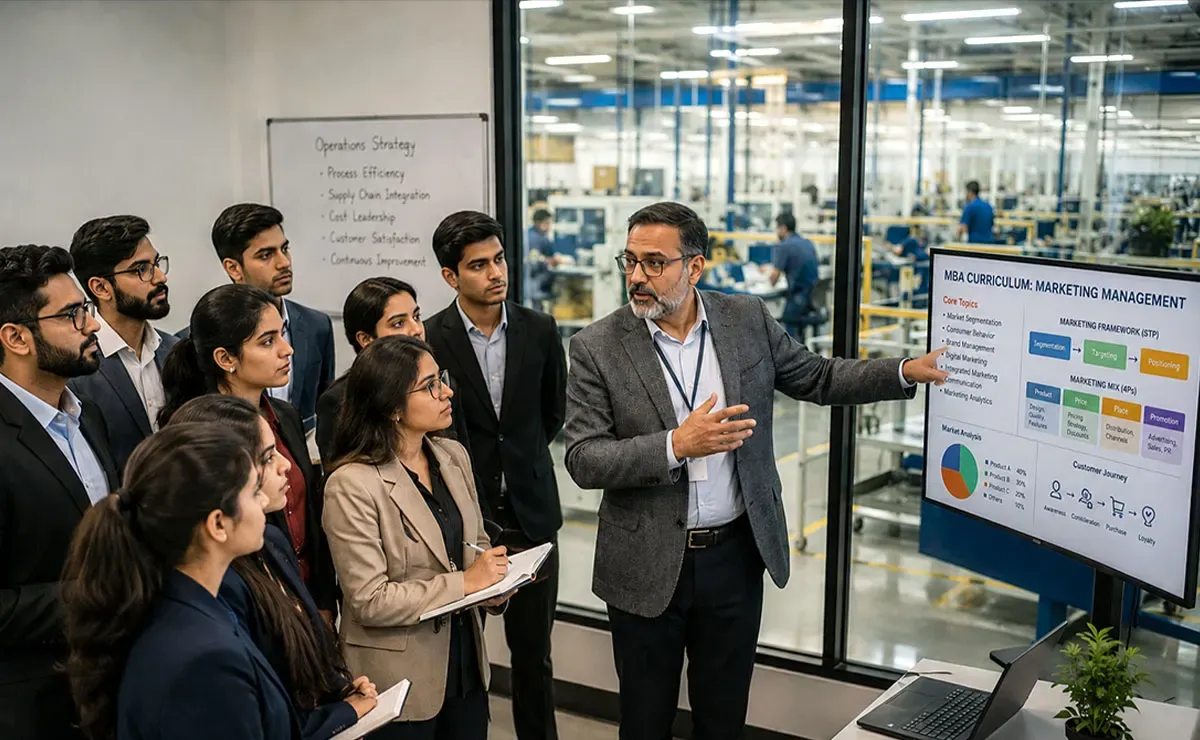
Industry-led models in management education matter because technologies such as AI and the proliferation of digital-first organizations are changing the types of jobs faster than most management learning programs can keep up with. Likewise, employers are increasingly deciding to hire based on these changes rather than just academic qualifications.
Hiring managers now look for portfolios, live work samples, and evidence of problem-solving in real environments. The traditional degree, on its own, is no longer sufficient proof of job readiness. Employers want evidence, and industry-led programs are built to generate exactly that.
Unless they evolve, traditional MBA schools will continue to produce graduates with the same employability issues as reflected in the data. As digital transformation continues, there will be even greater gaps between what is taught and what is required. From here on, the question is not one of curriculum design but rather of institutional relevance.
The commitment toward industry-led models in B-schools is evidence of what can be achieved when curriculum, faculty, and practice are truly aligned. For example, Altera Institute, in its placement report, demonstrates that 89% of its students were able to break into digital and AI-first roles relevant today. And this is no coincidence, but the result of a system designed from the beginning to address employers' needs.
Conclusion
If you read that an institute is "industry-led," it should be more than just a badge on a brochure. It should provide a detailed description of how current business realities and employers' expectations have influenced the institution's curriculum, faculty, projects, and assessment.
The best indicators of an industry-led program for students are whether it integrates live projects, whether practitioners teach in the classroom, and whether there is sufficient industry input into the curriculum. Placement transparency is another factor that should be considered, and these are much more telling than rankings on a list or brand names in a prospectus.
In a continuously evolving job market, graduating with theoretical knowledge alone is no longer a competitive advantage. Which is why programs built around real work, real feedback, and real careers are quickly becoming a standard in management education. As soon as students realize this and learn to identify them, they will be better prepared for the future.