What Do CEOs Expect from B-School Graduates Today? Inside Altera Institute's Industry-Backed Digital & AI-First Curriculum

Business has changed faster than business education ever could. AI is reshaping every industry. Automation is taking over routine tasks. Changing customer expectations and competition are forcing companies to move faster and make better decisions with little room for error.
This change has not only created an education gap but also a gap in hiring, especially for management graduates. Lately, many CEOs have expressed that they don’t just want candidates with a shining degree but people who know how to solve real business problems.
So, if CEOs could redesign business education to fill this hiring gap, what would they prioritize?
The answer may not be about replacing the traditional MBA model but about expanding what business education prepares you for. Beyond concepts and case studies, today’s businesses need graduates who can work with AI, understand data, think across functions, adapt quickly, and connect strategy with execution.
Altera Institute is one example of a business school responding to this shift by bringing the industry closer to the classroom. Its digital and AI-first curriculum is designed around the realities of modern business, with industry practitioners playing a central role in how students learn.
So, what does this model look like in practice? Does it truly align with what CEOs are increasingly looking for when they hire business school graduates?
Where Do Traditional MBA Programs Often Fall Short?
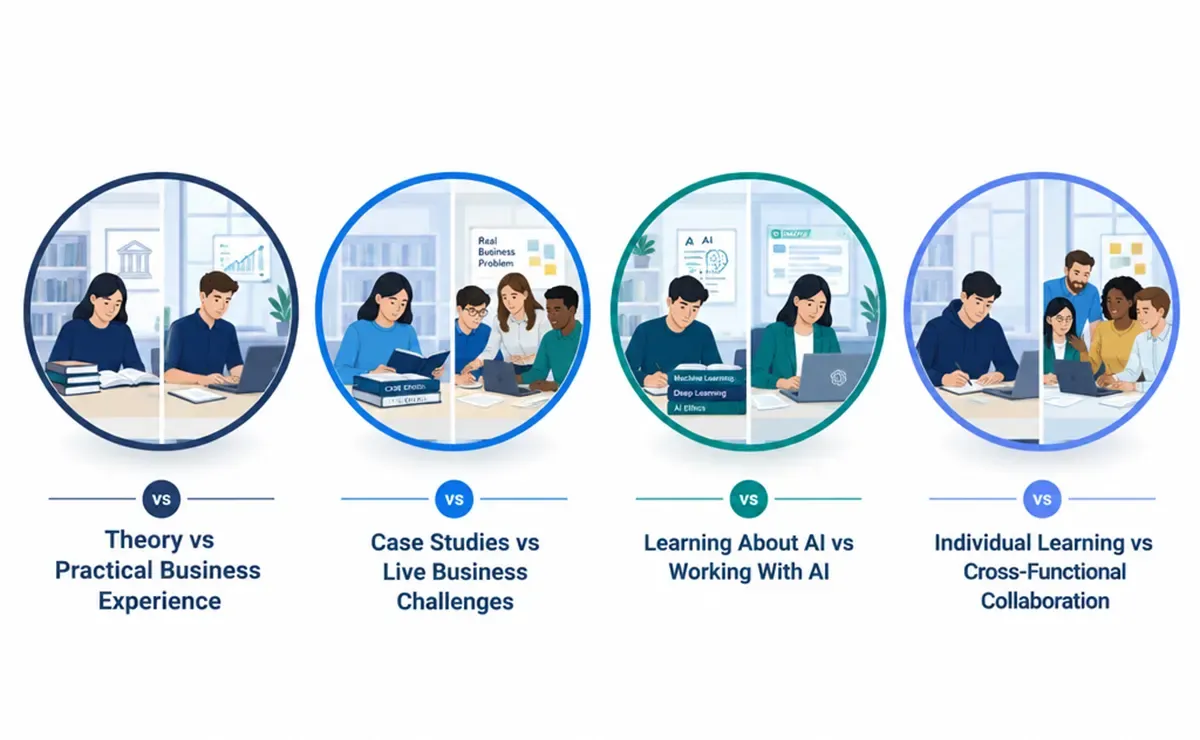
If one had to explain the shortcomings in traditional MBA education in two words, it would be “execution opportunities.” Most traditional programs rely on theory and case studies, which, while important, are not future-oriented. Therefore, they cannot prepare students for a forward-moving industry.
This breakdown will help you understand it in more depth.
Theory vs. Practical Business Experience
Knowing a business concept is one thing. Knowing when and how to apply it is another. Students may understand frameworks for pricing, marketing, or strategy, but real businesses rarely present problems in a neat textbook format. Practical projects and industry exposure help you understand how decisions are actually made when there are competing priorities, limited resources, and uncertain outcomes.
Case Studies vs. Live Business Challenges
Case studies help you analyze how businesses responded to problems in the past. Live business challenges require you to figure out what should happen next. The latter introduces ambiguity, incomplete information, and changing variables. These are the same conditions you are likely to encounter at work. This makes solving ongoing business problems a valuable part of management education.
Learning About AI vs. Working With AI
AI cannot remain a topic you study once and move on from. It is becoming an integral part of how businesses analyze data, understand customers, create content, automate processes, and make decisions. Business education therefore needs to give you opportunities to work with AI as part of everyday problem-solving, rather than treating it as a standalone technology elective.
Individual Learning vs. Cross-Functional Collaboration
Business decisions rarely sit within one department. A marketing decision can affect revenue. A product decision can affect operations. A pricing decision can affect both customers and margins. As a result, you should be comfortable working across functions and understanding how different teams contribute to the same business goal. Cross-functional projects can help build this perspective before you enter the workplace.
If CEOs Designed an MBA Today, What Would It Include?
If CEOs were given the opportunity to redesign an MBA, the biggest changes would likely be visible in the learning experience. The classroom would become more connected to industry, assessments would test decision-making rather than recall, and students would spend more time working through problems that resemble those they will face on the job.
Ultimately, these changes reflect a shift in what businesses need from management graduates. A strong academic foundation still matters, but it becomes more valuable when you can apply it to ambiguous problems, work with different teams, and make informed decisions in real time. For CEOs hiring fresh talent, the ability to move from knowing to doing can make all the difference.
How Does Altera Institute's Learning Model Reflect These CEO Expectations?
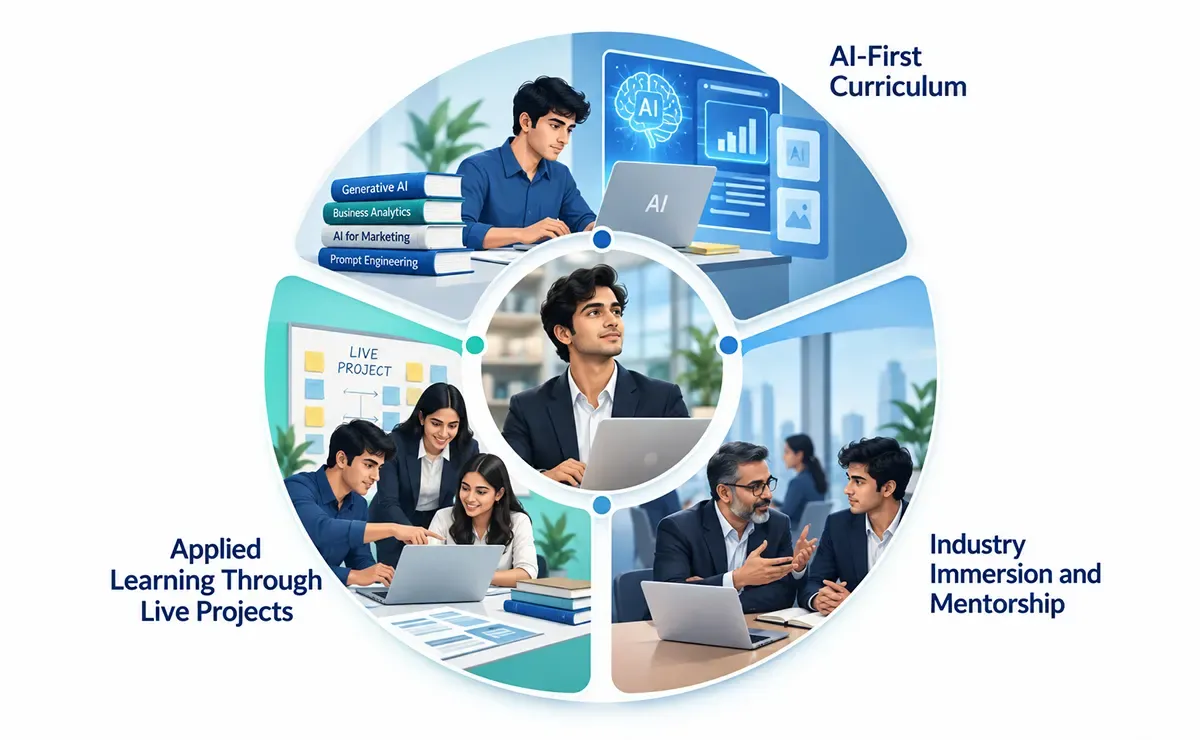
The expectations of today's business leaders are changing what meaningful business education looks like. It is no longer only about what you learn but also where that learning comes from and how often you get to apply it. Altera Institute’s learning model reflects this shift through a combination of practitioner-led teaching, AI-first learning, live business projects, and sustained industry exposure.
AI-First Curriculum
AI is integrated into Altera Institute’s curriculum rather than positioned as a standalone topic. The program includes AI Foundation, Generative AI, and Agentic AI, alongside applications of AI in areas such as marketing and product management. Students also work with digital and AI-first tools as part of their learning.
Applied Learning Through Live Projects
Altera Institute incorporates application into the curriculum through capstone projects, simulations, and live business projects. Students work on real-world challenges with companies and industry professionals, applying classroom learning to problems involving areas such as brand building, go-to-market, and product. This gives students an opportunity to experience the difference between solving a structured academic problem and working through an actual business challenge.
Industry Immersion and Mentorship
Industry exposure is built into the program through immersions, practitioner-led sprints, and mentorship. Altera Institute states that its industry immersions involve solving real-world business challenges alongside industry professionals, while students also receive one-to-one mentorship from industry leaders during the program.
For a graduate, this kind of exposure can provide a clearer understanding of how different functions work together, how decisions are evaluated, and what the transition into a business role actually involves.
How to Evaluate Whether a Business School Is Future-Ready?
Conclusion
Business leadership is evolving, and business education needs to evolve with it. When choosing a business school, look beyond legacy reputation. Consider how the curriculum is designed, how you learn, and how much exposure you get to real businesses and industry professionals.
Altera Institute is one example of a business school built around these changing expectations, with practitioner-led teaching, AI-integrated learning, and applied business education. Whether it is the right fit for you ultimately depends on your career goals and the kind of learning experience you are looking for.
Frequently Asked Questions (FAQs)
Q1. Why are CEOs placing greater importance on AI literacy in management roles?
Ans. AI is becoming part of everyday business decision-making, task automation, data analysis, and understanding customers. CEOs therefore increasingly expect managers to be able to work with AI for faster and more efficient task execution.
Q2. How does practitioner-led teaching differ from traditional classroom instruction?
Ans. Practitioner-led teaching brings professionals with real industry experience into the learning process. Instead of learning concepts only through textbooks and lectures, students can understand how those concepts are applied when making decisions and solving business challenges.
Q3. What skills do employers value most in MBA graduates today?
Ans. Employers increasingly value problem-solving, adaptability, AI and data literacy, communication, and cross-functional collaboration. The ability to apply business knowledge and turn strategy into execution is equally important.
Q4. How can students identify whether an MBA curriculum is industry relevant?
Ans. Look for practitioner-led classes, live business projects, industry mentorship, and exposure to current tools and technologies. A relevant curriculum should also reflect how businesses are changing rather than relying only on established frameworks.
Q5. Why are live business projects becoming more important in MBA programs?
Ans. Live projects allow students to apply classroom concepts to real business challenges, often with incomplete information and practical constraints. This helps develop decision-making, problem-solving, and execution skills before entering the workplace.
Q6. What should students compare before choosing a future-ready business school?
Ans. Look at the curriculum, teaching model, AI integration, industry exposure, live projects, practitioner involvement, mentorship, and career outcomes to understand how well the program prepares you for modern business roles.