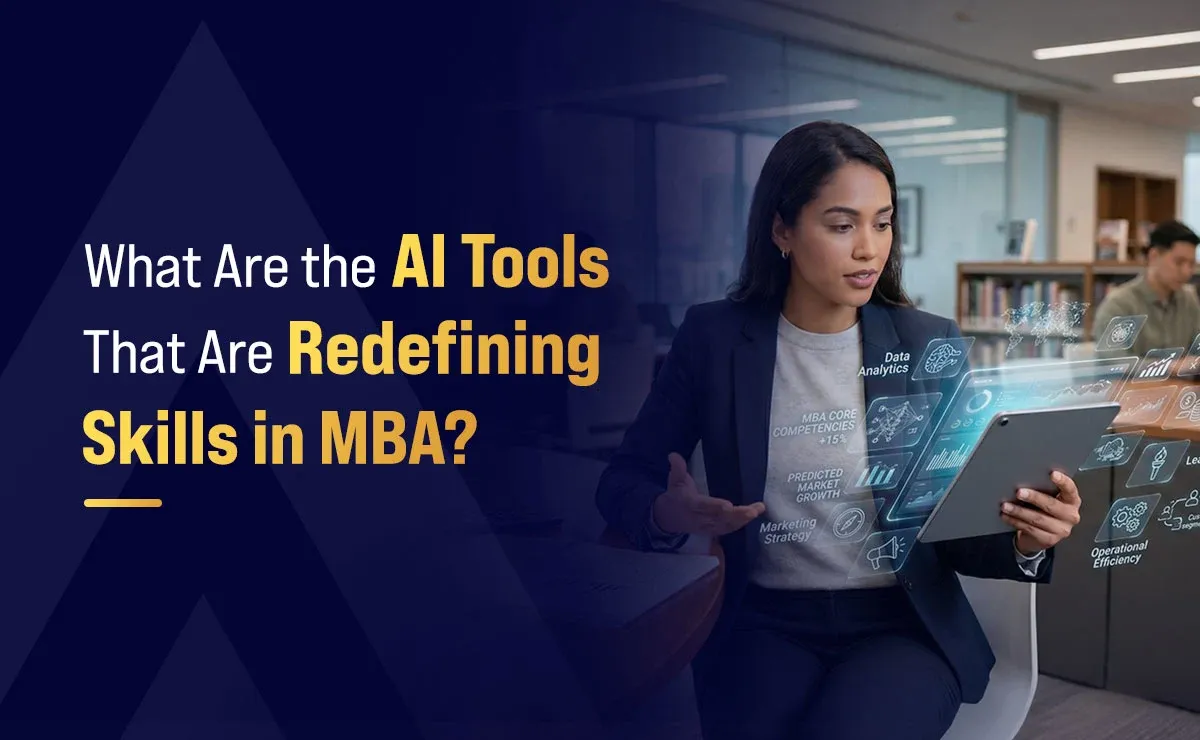
What Are the AI Tools That Are Redefining Skills in MBA?
The business world today moves faster than ever, and AI is now the single biggest force widening the gap between traditional management education and market realities. This is evident in a 2025 McKinsey report, which found that 88% of companies today use at least one AI tool in their regular operations, up from 55% in 2023.
For MBA students, this does not mean AI is replacing them; rather, it is fundamentally raising the bar for the skills they are expected to have today. Tools that once catered to engineering and data science departments are now used across various other functions, helping professionals drive marketing decisions, shape financial models, automate redundant tasks, and inform growth strategy.
Hence, it is very important for MBA grads to understand and work with AI by having relevant skills around the tools that matter, how those tools map to core business functions, and how to build the judgment that makes AI fluency genuinely useful.
This article, therefore, explores the tools transforming disciplines across MBA programs, highlights the distinction between what AI can and cannot do, and reveals the key role a well-designed program can play in building AI capability that employers actually care about and evaluate today.
Why Do AI Tools Matter in MBAs Right Now?
The skills and competencies that employers expect from MBA grads today have shifted significantly. According to a 2025 GMAC Corporate Recruiters Survey, familiarity with AI tools now ranks as the single most important skill employers expect to value over the next five years. A separate survey of 500 hiring managers found that AI fluency was the top hiring priority for 2026, cited by 35% of respondents, ahead of the ability to quantify business impact (31%) and a portfolio of applied work (25%).
What justifies this shift in hiring patterns is not just that AI is creating new job categories, but also that it is redefining what "good" looks like in existing ones. For example, a strategy analyst who uses AI for competitor research now produces more comprehensive, faster output than one who does not. Similarly, marketers who automate content production cycles with AI tools can now run more campaigns at a lower cost.
Hence, the core shift here is towards AI-assisted judgment, with professions moving away from manual execution. This is why it is important for them to know how to prompt these systems effectively, interpret their outputs critically, verify their accuracy, and apply the results in a real business context. That combination, speed plus judgment, is what hiring managers are now looking for from MBA graduates.
What Are Some AI Tools Redefining MBA Skills?
AI's influence on business education is not uniform; it manifests differently across every key MBA discipline. Understanding which tools apply to which functions is the first step toward building practical fluency.
1) Strategy and Decision-Making
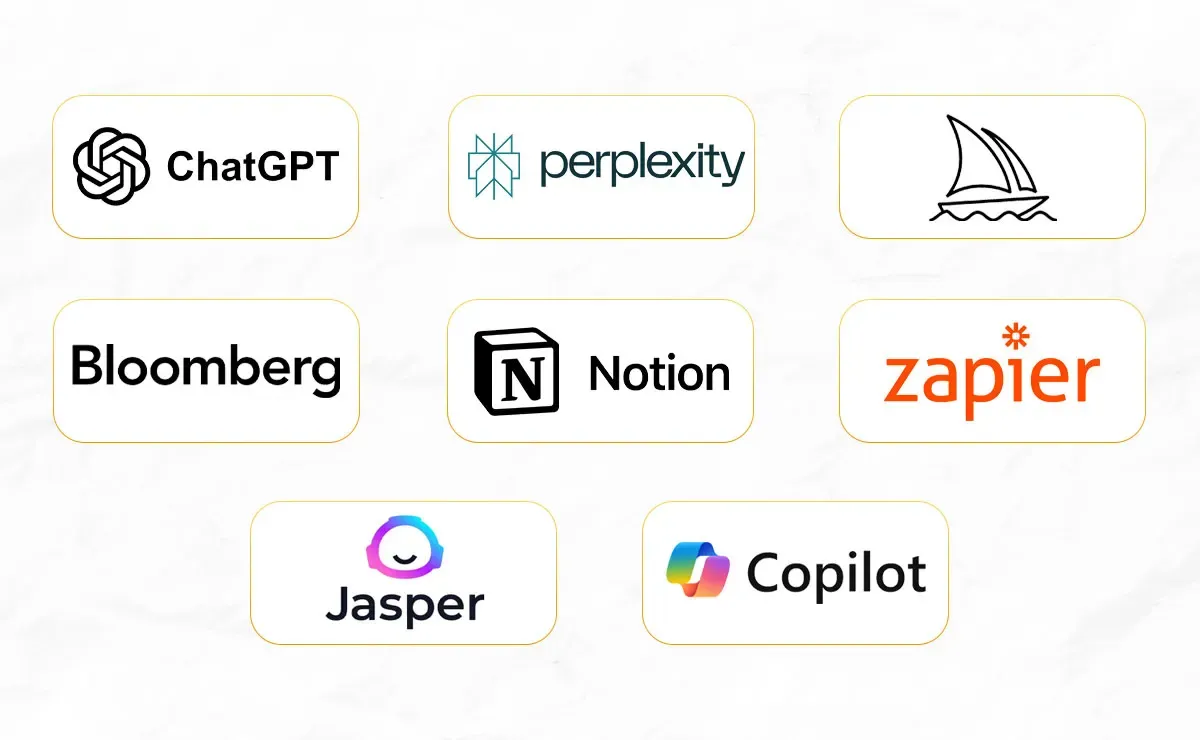
Today, strategists use tools like ChatGPT and Perplexity, which have transformed how they do their everyday work. Market research that previously took several days now takes hours. Competitor analysis, scenario planning, and executive briefings are now faster, more data-rich, and focused. The ability here is not simply to know how to operate these models but to ask the right questions, knowing when the output is strategically sound and when the model is operating outside its reliable range.
2) Marketing and Growth
In the last three years, tools like Jasper and Midjourney have shortened content creation and ideation cycles in ways that weren't commercially viable before. With tools such as GA4's AI-powered performance insights, marketers can save time and effort when ideating, publishing, and optimizing campaigns without logging in and out of separate systems. Now, marketing skills are not only about creating more content in less time but also about aligning content with business metrics such as funnel movement, engagement, and revenue contribution.
3) Finance and Analytics
The introduction of BloombergGPT and Excel Copilot has transformed financial modeling and risk assessment. Now analysts can validate, stress-test, and iterate models faster and more easily, without manually building them from scratch. This is why finance professionals today with an MBA degree are expected to validate the logic behind AI-generated models, not merely take them at their word, which demands a sharper understanding of the underlying business assumptions than ever before.
4) Operations and Productivity
Notion AI and Zapier are among the tools that eliminate the administrative drag that has long slowed organizations down. Workflow automation has moved firmly out of IT departments and into the hands of business managers. This means that operations-focused MBA graduates now need a practical understanding of how automation tools work, where they break down, and how to apply them responsibly within a broader business system.
What AI Can Do vs. What Still Needs Human Judgment?
AI is genuinely excellent at a number of tasks that used to consume significant portions of a professional's workday. Data synthesis, content drafting, pattern recognition in large datasets, and repetitive analysis are all tasks that today's AI tools handle faster and at a greater scale than most individuals working manually. That productivity gain has real value, and understanding it is part of being a capable business professional in 2026.
But there are also clear boundaries, such as identifying the right problem to solve in the first place, applying contextual knowledge that does not appear in any dataset, and navigating ethical trade-offs, that still remain unequivocally human responsibilities. Hence, tomorrow's professionals need to be skilled at formulating the right questions rather than simply executing tasks to reach conclusions.
The true advantage of a well-designed MBA today is knowing when to deploy AI, when to override it, and how to interpret its output in ways that serve actual business goals. And this is not based on instinct; rather, it is a capability that needs to be deliberately practiced to master.
How to Build AI Fluency as an MBA Student?

Building genuine AI fluency is not about knowing every tool on the market. It is about identifying the ones that matter most across business functions and learning to use them with clarity and intent. The following stack of tools is quickly becoming standard for MBA graduates spanning strategy, marketing, finance, and operations roles.
Knowing these tools is the first layer. The second, and more important, layer is a mindset shift in how you engage with them. The professionals who really stand out today are those who design their own prompts, stress-test the responses they receive, and use clear judgment before taking any action based on AI output.
Concretely, this means students learn to
- Prompt with precision, providing context, constraints, and a clear output format
- Validate outputs against known data, business logic, and stakeholder reality
- Leverage AI tools to speed up processes without compromising the outcomes of the decision-making process
- Recognize when a task needs human context that the model does not have access to
This is the competency level that hiring managers evaluate when they say they want AI-fluent candidates. They are not looking for tool familiarity alone; they are looking for professionals who can produce better work, faster, with the judgment to know the difference.
How Does Program Design Shape AI Capability?
AI skills are not equally developed across all MBA programs, and the gap is almost always between application and theory. A program that exposes students to AI tools through case studies and lectures raises awareness. But the program that introduces those tools through real projects, sprints, and discussions equips students with the skills they are actually required to have. This is the distinction that separates job-ready candidates from those who only have theoretical knowledge of how some of these AI tools work.
The strongest AI-ready careers are created in settings where students engage in real-world problems with real consequences using AI. This involves automation, developing functional websites and content systems, scaling output production with AI pipelines, and creating agentic solutions rather than merely being a spectator.
Using AI tools should also be integrated with real commercial outcomes. That means embedding it into brand and growth modules, pricing, and portfolio strategy, and teaching students how AI output affects business outcomes and how to assess those outcomes accordingly.
The right AI-integrated MBA programs ensure that their students work with the same AI systems their future recruiters use. They should graduate with a portfolio of applied work demonstrating they can combine tool literacy with business judgment, not just a transcript listing AI as a course they attended. With 88% of organizations already using AI in at least one business function, the demand for graduates who can hit the ground running has never been more concrete.
Summing Up
AI fluency is now a foundational expectation, not a differentiator anymore. The future is no longer neutral for MBA graduates who lack AI skills, as almost one in four employers now requires students to have AI proficiency as a minimum for any job after an MBA. The market is quite concrete in its valuation of AI skills, with workers verified to have AI skills earning a 56% wage premium over peers in the same role.
The most sought-after MBA graduates in the years to come will be those who can combine genuine AI capability with sharp strategic thinking and sound decision-making. One without the other is not enough. Just like tools without judgment produce mistakes faster, judgment without tool fluency produces slower results.
For students serious about building a career where AI becomes a sustained professional advantage, that integration is where the real preparation begins.