
The Traditional MBA Is Outdated: Why It's Time to Rethink Business Education in India

For decades now, pursuing an MBA has been a safe bet. The education provided by this certification sets you on track for leadership roles. MBA credentials told employers you were ready to run teams and build companies. However, the growth trajectory of the current job market has redefined the value attributed to MBAs.
In an economy shaped by AI, digital tools, and fast-moving startups, your practical skills are more valuable than your education. In this setup, the conventional MBA model is struggling to keep up.
While there are thousands of B-schools in India, only a small fraction are globally accredited. Moreover, some industry studies have suggested that employability among MBA graduates remains a significant concern, with one widely cited report estimating that only around 7% met employer expectations. Even programs advertised as top marketing MBAs now face hard questions.
This is where new-age business schools step in. Altera Institute, for instance, is industry-backed. The program is designed and taught by professionals and built around the digital-first skills that are in demand in the current market.
How the Traditional MBA Model Was Designed for a Different Era
A traditional MBA is not equipped to handle the pace and progress of today’s economy. It was for a slower and more structured corporate world that no longer exists.
The Origins of Management Education in India
India’s journey with management education began in 1953 with the Indian Institute of Social Welfare and Business Management in Calcutta. Then, IIM Calcutta and IIM Ahmedabad were launched in collaboration with MIT Sloan and Harvard Business School in 1961, with the assistance of the Ford Foundation.
Why the Traditional MBA Structure Made Sense
About twenty to thirty years ago, business was more predictable. Large companies ran on stable hierarchies and functional silos: finance, marketing, and operations. This model was mirrored in an MBA education that would train specialists in every function through analytical frameworks and classroom case studies.
This worked well because large and slow-moving companies were in need of managers with deep expertise in one domain, and the MBA delivered exactly that.
However, as businesses became more dynamic and technology-driven, educators have argued that the conventional model of an MBA has become inadequate. This gap in learning and the working world prompted new-age schools like Altera Institute to experiment with alternative formats.
The Skills Gap: Why Many MBA Graduates Struggle in the Job Market

There is an increasing gap between what a student learns in an MBA course and the skills that are expected by employers. Astonishingly, industry reports claim that only about 7% of MBA graduates in the country are deemed employable, and broader studies place the share of genuinely job-ready management graduates well below half.
The Rise of MBA Colleges Without Industry Alignment
India’s MBA boom translated to thousands of colleges offering this certification, but quality matters more than quantity. Teaching standards are vastly different across institutions, the syllabus is outdated, and there is little industry exposure. With the rush, countless MBA marketing online courses cropped up, promising fast results, but there was still a gap between theoretical learning and real-world knowledge.
What Employers Actually Want from Graduates
Employers don’t care about textbook frameworks. They are looking for graduates who can use data, run digital campaigns, work across functions, and contribute to the job from day one. If an MBA cannot offer that, the degree loses its value, and the graduates are left to face a tough market.
The Business World Has Changed Faster Than Business Schools
It has barely been a decade since the definition of business changed, and yet, most MBA programs will teach as though little has changed.
From Functional Managers to Digital Leaders
The leaders today are expected to make decisions reliant on data, think like product builders, and move fluidly across teams. With the growth of AI, startups, and digital-first businesses, the previous job roles have become blurry. Despite this, most MBAs continue to treat AI literacy, digital strategy, and technological adaptability as electives instead of integrating them into the core of modern leadership.
Why Business Education Needs to Become More Interdisciplinary
The market is already witnessing a transformation. Across the world, specialized master’s courses have gone up by 11% even as MBA enrollment declined. This is an indication of how learners are expecting focused and blended skills instead of generalized degrees.
The future of business is interdisciplinary, with a combination of strategy, technology, and design rather than separating them into isolated subjects.
Altera Institute: What Modern Business Education Should Look Like
If the traditional MBA was structured for a job market we have outgrown, what would be a suitable replacement? One thoughtfully curated answer is Altera Institute, which has redefined what top marketing MBAs should deliver for a digital-first economy.
Learning by Doing, Not Just Case Studies
Instead of referring to aged case studies, students have the opportunity to work on real company projects right from the start. This industry-integrated method means learning happens by understanding actual business problems instead of hypothetical ones, so freshers arrive job-ready instead of just having theoretical knowledge.
Industry-Led Curriculum Design
The coursework of Aletra is both curated and delivered by industry experts from domains such as FMCG, consulting, and e-commerce. The syllabus is deliberately cross-disciplinary, blending marketing, growth, product, and data so students build cross-functional thinking and understand how modern businesses operate.
Smaller Cohorts and Stronger Networks
Smaller cohorts have the advantage of personalized mentorship and genuine relationships instead of the anonymity of lecture halls. Instead of one placement week in college, students get the benefit of continued career guidance while graduating into a tight-knit community of peers and industry mentors.
The result is education that is much closer to real business practice, which is verifiable with outcomes: Altera Institute's recent cohort reported a median salary of ₹17.88 lakh.
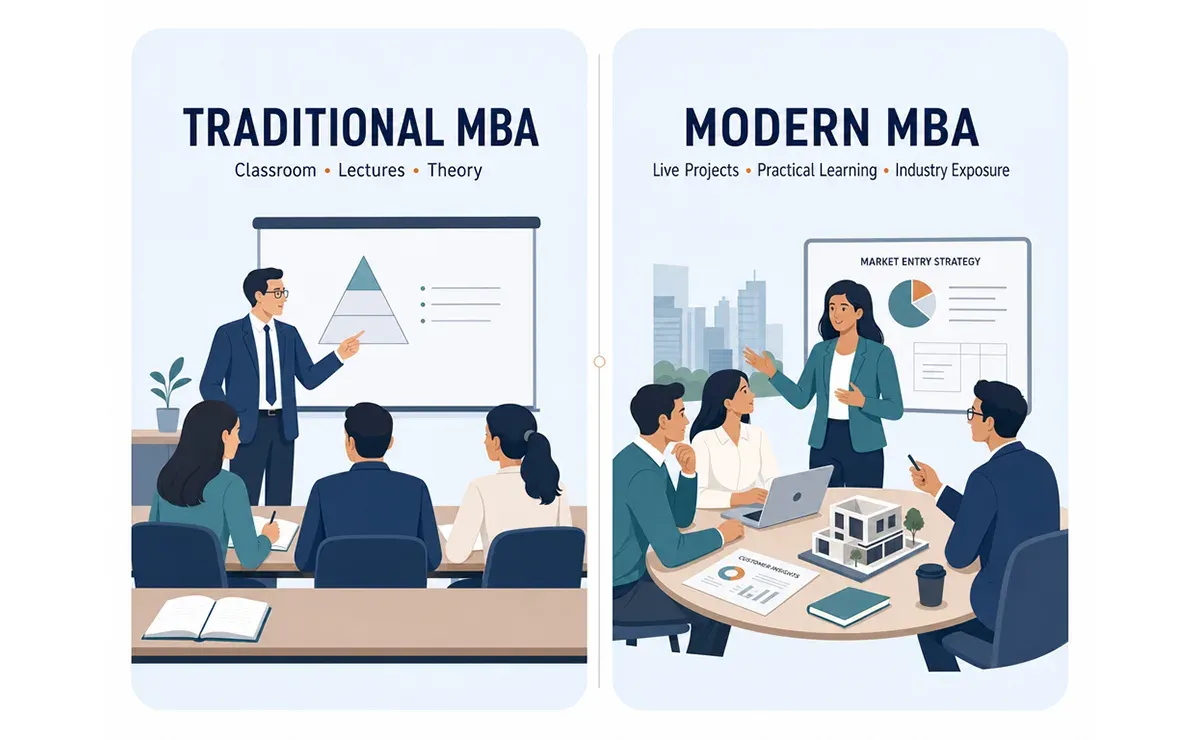
Quick Comparison of Modern vs. Traditional MBA
Conclusion
A traditional MBA course is not useless; it has made generations of capable leaders and still offers valuable fundamentals. Yet, in the economic setting of today, the structure of a traditional MBA course seems incomplete. The current pace of the industry requires learning that is faster, more practical, and genuinely interdisciplinary.
Education is now expected to prepare students for digital, cross-functional, fast-moving roles. The lecture halls of the past are unable to keep up with the new future of management, and a better advantage is associated with smaller cohorts, industry-integrated programs, and a sharp focus on real, job-ready skills.
As the economy of India witnesses a staggering growth, programs such as those curated by the Altera Institute play a pivotal role in redefining the trajectory of business education for the next generation.


