
The Rise of Revenue-Focused Marketing Roles


When you work a marketing job today, you will notice that one question follows every campaign: What did it actually earn? While creativity is a critical element of marketing, proving its value in revenue has become the real measure of success.
A report by Gartner found that marketers are now responsible for five business areas—customer experience, product strategy, and direct sales—and that this number is expected to reach eight in a few years.
There were also more than 376,200 marketing job postings in 2025, and most employers preferred professionals who could link their work to growth. Acknowledging this transition, modern MBA marketing courses now train students to think in terms of revenue rather than just ideas.
What is revenue marketing?
Revenue marketing is a strategic approach that links every marketing activity to measurable revenue instead of just considering softer goals such as brand awareness or lead volume. In the current job context, the marketing and sales teams work together to ensure deals are closed and the company’s income grows.
Here’s where sales and marketing are aligned. The two functions plan together, share data, and agree on what qualifies as a quality lead. In other words, they stop working in separate silos. This arrangement bridges the long-standing sales gap where marketing would generate the leads and pass them on to sales, considering their job done. Organizations that have displayed a strong alignment between sales and marketing have reported up to 38% higher win rates.
It is this connection that is owned by a revenue marketing manager. They design campaigns that are geared towards revenue, track performance against sales outcomes, and use data to fine-tune and streamline what works, thereby ensuring that the efforts of marketing can be clearly seen on the bottom line.
Revenue Marketing vs. Traditional Marketing
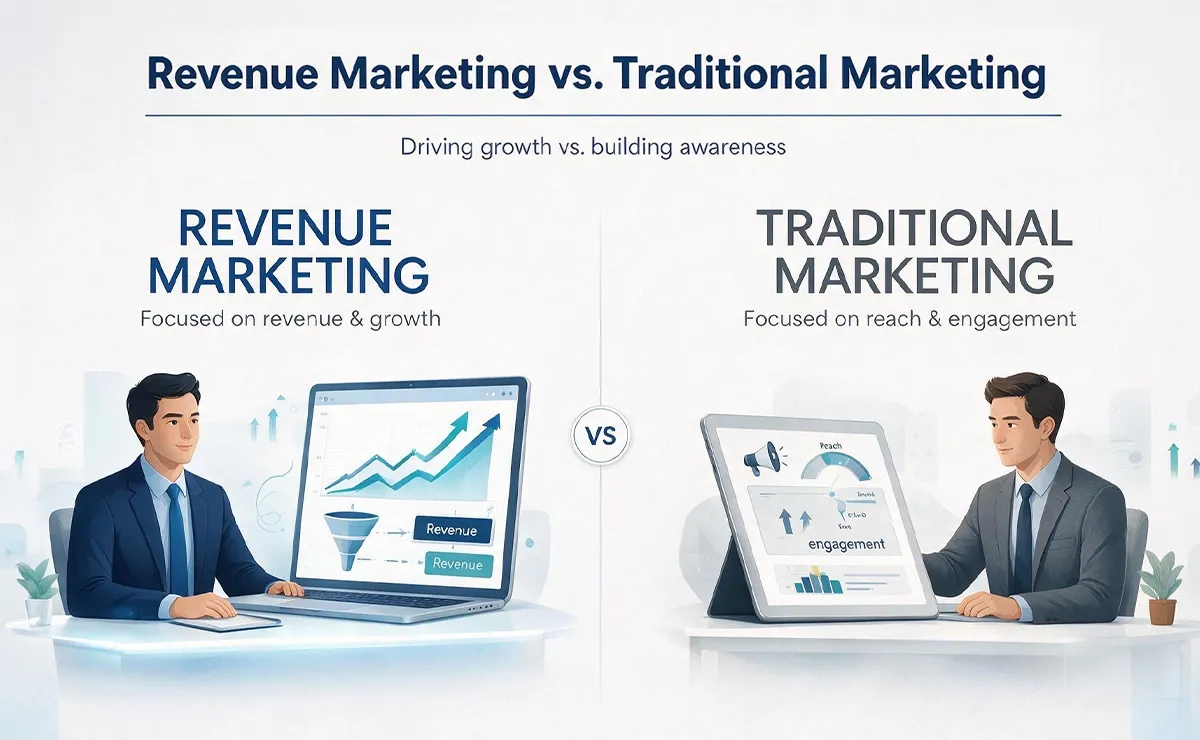
Traditionally, marketing measured effort with metrics such as reach and engagement. Revenue marketing, on the other hand, measures the impact on actual customers and sales. Here’s how the two compare:
Benefits of Revenue Marketing
- Higher quality leads and conversion
As campaigns target buyers who are most likely to engage with the brand, the leads arrive further along the purchase journey and require less convincing. Companies that have a strong sales and marketing alignment have reported higher win rates, which means more of those leads actually convert into customers.
- Greater alignment between sales and marketing
As both teams have unified goals with shared access to data and the same definition of a quality lead, there is no blame transfer for weak or ignored leads. With both functions operating as a single revenue team, more deals could be closed faster.
- Easier attribution and ROI measurement
There is a clear understanding of which marketing effort has actually led to a sale, not just which one earned clicks or views. This makes it that much easier to identify platforms and tactics that earn money and invest more in those. This subsequently proves how marketing delivers real results.
- Focus on long-term relationships and customer lifetime value
Revenue marketing goes beyond a single sale to ensure growth and retention across the customer lifecycle. By focusing on building lasting relationships, it improves the customer lifetime value and creates more predictable growth. Getting command over these skills is the core focus of an MBA in marketing management.
Skills Required For Revenue Strategy Jobs
- Analytics
Revenue roles are fueled by data. Professionals are expected to understand marketing analytics, track campaign performance, and turn raw numbers into actual decisions. They should be comfortable with CRMs, marketing automation platforms, and data visualization tools such as Tableau. Additionally, critical thinking is essential to identify what drives growth.
- Communication
Marketers are expected to be able to translate complex analysis into actionable functions that can be acted upon by leaders and sales teams. Clear communication is a critical skill in these roles, as insight is only valuable if it is understandable and trusted.
- Leadership
As one climbs up the ladder and gains more responsibility, they guide teams and coordinate across sales, product, and finance. Employers expect potential employees who can display the ability to work well with these teams, who understand how marketing drives revenue, and who bring everyone toward the same goals.
- Negotiation Skills
Revenue work involves securing the budget, aligning goals with the sales team, and negotiating with vendors and partners. The skill to negotiate for resources with other department heads helps you get the budget to proceed with things that are actually working and show how the market pays off.
How Altera Institute Prepares Students for Revenue-Focused Marketing Careers

When students enroll at the Altera Institute, they don’t just study marketing theory. The university coursework is thoughtfully curated around a revenue-first curriculum. This means that from the first day, you learn how every campaign is connected with real business growth instead of just clicks and impressions.
What sets the syllabus apart is the focus on hands-on work. Doing live projects ensures students get direct exposure to real business problems and learn to build and optimize actual acquisition funnels while managing real campaign budgets. This ensures that freshers graduate having actually done the job instead of just having read about it.
Altera Institute’s PGP in Applied Marketing is for students who understand that real value lies beyond just a certification. It is an investment that enables you to fast-track your career by giving you practical and revenue-focused skills that hiring managers are actively seeking. By the time you complete your degree, you can step into a revenue strategy role with the readiness to prove your value from day one.
Conclusion
Over the years, the role of a marketer has witnessed an important change, and there is no going back. Employers are not impressed anymore with just reach and engagement; they want to see results that can be reflected in revenue.
For anyone entering the field, this can feel daunting; however, it is also an incredible opportunity. Marketers who are able to showcase how their work is connected with real business growth are the ones who are sought by companies, promoted, and trusted with bigger budgets.
This is where Altera Institute makes a difference. Its industry-led course structure is designed around the outcomes that organizations value most, and its real-world projects let you prove those skills before you graduate. In other words, freshers are equipped with the ability to not just become a part of the market but also to gradually lead it.