The 2026 MBA Readiness Test: Are You Choosing a Business School Built for the AI Economy?
The MBA you choose today should prepare you for the jobs you will enter in 2028 and beyond, not the business world of 2020.
Yet, many students still evaluate business schools mainly through rankings, placements, and brand names. These factors matter, but they do not tell you whether a school is keeping pace with how businesses are changing.
AI is already reshaping marketing, finance, operations, consulting, and other business functions. As these changes accelerate, the relevance of your curriculum can directly affect how prepared you are for the workplace.
So instead of trying to find the “best business school,” based on online listicles, your goal should be to find a school that will make you future-ready in this AI world. It should prepare you for the economy that you will be working in, and AI has already become a huge part of it.
This is where newer business schools such as Altera Institute are challenging the traditional MBA approach by building their programs around the skills, tools, and ways of working that modern businesses actually demand.
Why Is the AI Economy Changing MBA Education?
AI is changing how businesses work, but it is not simply replacing people. In many roles, AI is taking over repetitive tasks and helping employees work faster. This means managers now need to know how to work alongside AI, use it effectively, and make better decisions with the information it provides.
This shift is happening across almost every business function. Marketing teams use AI for customer insights and campaign creation. Finance teams use it for forecasting and analysis. HR teams use it to understand workforce data and improve hiring. Operations teams use it to improve processes and predict demand.
As a result, recruiters are increasingly looking for professionals who understand both business fundamentals and AI. An MBA is still valuable, but what makes it valuable is changing. It is no longer enough to understand how a business works. You also need to understand how technology is changing the way that business operates.
How Is AI Changing Business Roles?
Here is a glance at how AI is changing roles across domains to better understand why B-schools also need to adapt to it.
- Marketing: AI can analyze customer behavior, identify audience segments, generate content, and support campaign optimization. Marketers therefore need to focus less on routine execution and more on strategy, customer understanding, and data-driven decision-making.
- Product: Product managers can use AI to analyze user feedback, identify patterns, and speed up research. Their role is increasingly about deciding what problems are worth solving, prioritizing features, and connecting customer needs with business goals.
- Finance: AI can automate reporting, analyze financial data, and improve forecasting. Finance professionals still need strong financial knowledge, but they also need to understand how to interpret AI-generated insights and use them for business decisions.
- Consulting: Consultants can use AI to research markets, analyze large amounts of information, and build initial recommendations faster. This puts greater value on problem-solving, strategic thinking, and the ability to turn information into useful business recommendations.
- HR: AI is changing recruitment, employee analytics, and workforce planning. HR professionals need to understand how to use these tools while also managing areas that require human judgment, such as employee experience, culture, and leadership.
- Operations: AI can help businesses forecast demand, manage supply chains, identify inefficiencies, and automate repetitive processes. Operations managers need to understand both the technology and the business processes they are trying to improve.
- Sales: AI can help sales teams identify prospects, analyze customer behavior, personalize communication, and predict which leads are more likely to convert. Sales professionals therefore need to combine relationship-building skills with data and AI literacy.
The value of an MBA is not declining because of AI. Instead, the skills that make an MBA valuable are expanding. Business knowledge still gives you the foundation, but AI literacy helps you apply that knowledge in the way modern businesses increasingly operate.
What Recruiters Expect from MBA Graduates in 2026?

The skills recruiters expect from MBA graduates are changing with the workplace. Knowing business fundamentals is still important, but employers now also want to see whether you can work effectively with technology and make sound decisions in an AI-driven environment.
Technical Skills
You do not need to become a technical expert or learn how to build AI models. But you should understand how technology can be used in business.
Some of the skills recruiters increasingly value include
- AI literacy: Knowing what AI can do, where it can add value, and where its limitations lie.
- Data interpretation: Being able to read data, identify patterns, and use insights to support business decisions.
- Automation tools: Understanding how tools can automate repetitive tasks and improve workflows.
- Digital business understanding: Knowing how technology, digital platforms, and data are changing business models and customer behavior.
Human Skills That AI Cannot Replace
Technical skills alone are not enough. As AI is taking over more routine tasks, human judgment has become even more important.
Recruiters now place even more value on skills such as
- Critical thinking: Questioning information instead of accepting every AI-generated answer.
- Communication: Explaining ideas clearly and working effectively with different teams.
- Decision-making: Using data and AI insights while considering business context and potential risks.
- Commercial judgement: Understanding what makes business sense, not just what is technically possible.
- Leadership: Guiding teams, managing change, and taking responsibility for outcomes.
- Learning agility: Staying open to new tools, skills, and ways of working as the workplace evolves.
Why Do Both Skill Sets Matter?
A future manager will not have to choose between AI skills and human skills but will possess both.
For example, AI may help you analyze customer data, but you still need to understand what the numbers mean for the business. It may generate several solutions to a problem, but you need to decide which one is practical and worth pursuing. It can automate a process, but you need to understand whether changing that process will actually improve the customer or employee experience.
This is why recruiters are increasingly looking for professionals who can combine AI capability with business judgment. The real advantage comes from knowing how to use technology without losing sight of the people, customers, and business goals behind the decision.
What Does an AI-Ready Business School Look like it?
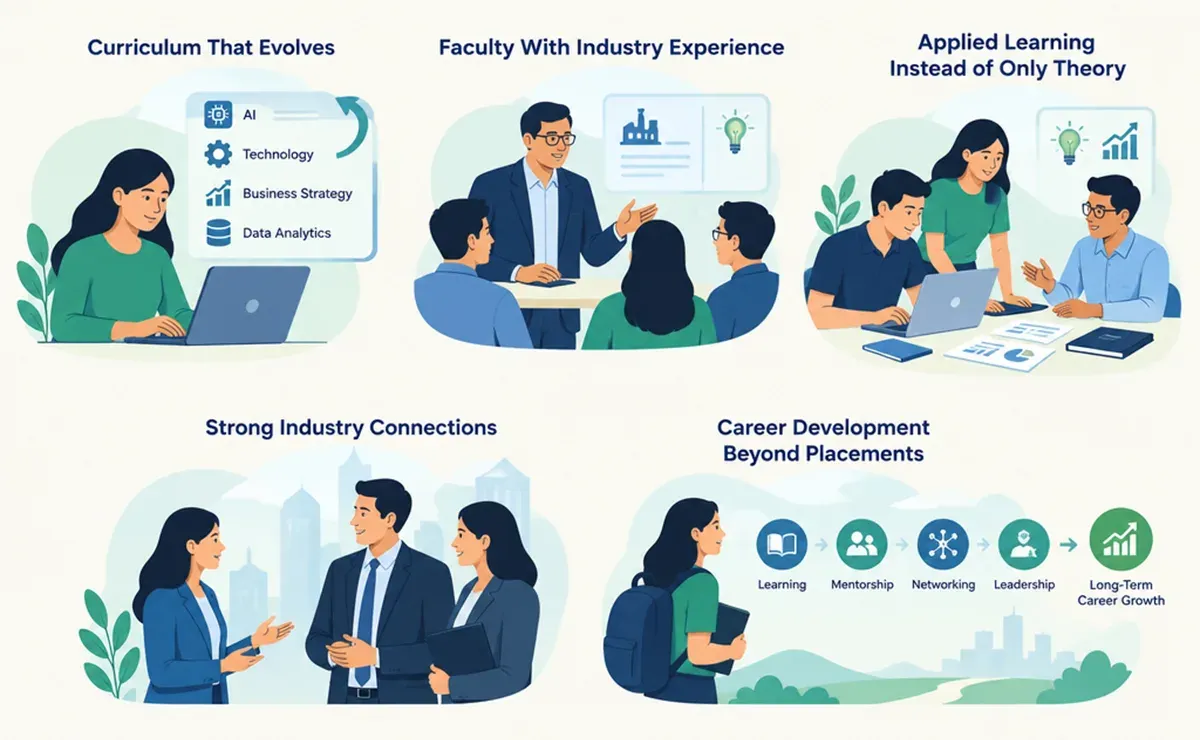
Choosing an AI-ready business school means looking beyond rankings and placement figures. You need to understand whether the school is preparing you for the way businesses will actually operate when you graduate.
Curriculum That Evolves
An AI-ready curriculum should not stay unchanged for years. It should evolve with new technologies, business models, customer behavior, and industry needs. Look for programs that include AI, data, digital business, and emerging technologies alongside core business concepts.
Faculty With Industry Experience
What you learn becomes more relevant when it is connected to current business practices. Faculty with industry experience can bring real business challenges, examples, and insights into the classroom. This can help you understand how concepts are applied beyond textbooks.
Applied Learning Instead of Only Theory
An AI-ready MBA should give you opportunities to apply what you learn. Case studies, simulations, live projects, and practical assignments can help you develop the ability to analyze problems and make decisions in real business situations.
Strong Industry Connections
Industry exposure can help you understand what businesses expect from MBA graduates. Look for schools that offer interactions with industry leaders, practitioner sessions, mentorship, and live business projects.
Career Development Beyond Placements
Your MBA should not only prepare you for your first job. It should also help you build skills that remain useful as roles change. Career development should therefore focus on industry exposure, practical skills, mentorship, and long-term employability.
This is the approach Altera Institute has taken with its PGP in Applied Marketing. Instead of treating AI as an additional topic within a traditional MBA curriculum, Altera Institute has built AI into the way students learn and apply business concepts. Its practitioner-led faculty, live business projects, and industry-integrated pedagogy are designed around the realities of modern business, giving students exposure to the tools, problems, and decision-making they are likely to encounter in the workplace.
Signs a Business School May Not Be Future Ready
Here are some signs you must look out for if your aim is to become an MBA graduate with the right AI skills.
- The school’s curriculum rarely changes, making it difficult to keep pace with new technologies and business needs.
- It has limited AI integration, with AI treated as an additional topic rather than part of the learning experience.
- Classrooms are mostly lecture-based, with very little practical application.
- Few live industry projects that expose students to real business problems.
- Weak recruiter diversity across industries and business functions.
- Limited involvement from industry practitioners.
- Little exposure to emerging business tools and technologies.
- Minimal interdisciplinary learning across business, technology, data, and consumer behavior.
Most B-Schools operate within UGC/AICTE frameworks, where curriculum structures are centrally defined, making it harder to update programs quickly. Altera Institute has intentionally chosen not to follow this conventional model so that it could retain the flexibility to design and update its PGP in Applied Marketing based on changing industry needs.
Conclusion
AI will continue to reshape how business education works and what employers expect from MBA graduates. This makes future readiness just as important as a school’s legacy, rankings, and reputation. Instead of relying on rankings alone, use a structured framework to assess the curriculum, industry exposure, faculty, learning model, and career opportunities.
Altera Institute is one example of a business school built around this changing reality, with an AI-first curriculum, practitioner-led faculty, and applied learning at the core of its PGP in Applied Marketing. It is therefore worth evaluating alongside traditional MBA programs when choosing a business school for the AI economy.
Frequently Asked Questions (FAQs)
Q1. Will AI reduce the value of an MBA degree?
Ans. AI will not reduce the value of an MBA, but it will change what employers expect from MBA graduates. AI literacy, business judgement, and adaptability will become increasingly important.
Q2. How can students identify whether an MBA curriculum is regularly updated?
Ans. Check the program structure, course updates, and subjects being taught. Look for AI, emerging technologies, digital business, data, and current industry practices being integrated into the curriculum.
Q3. Are AI-focused MBA programs suitable for students without a technical background?
Ans. AI-focused MBA programs can be suitable for students from any background because the focus is on applying AI to business problems, not on building AI systems or writing complex code.
Q4. How important are practitioner-led classes compared to traditional faculty?
Ans. Practitioner-led classes add real-world context by bringing current industry challenges and experiences into the classroom. Traditional faculty remain important for building strong conceptual and academic foundations.
Q5. Can an AI-ready MBA improve long-term career growth even if starting salaries are similar?
Ans. An AI-ready MBA can support stronger long-term career growth by helping you build skills that remain relevant as technology, roles, and business requirements change.
Q6. What role do industry projects play in preparing students for AI-driven workplaces?
Ans. Industry projects help you apply concepts to real business problems, work with practical constraints, and understand how AI and other technologies are being used to solve problems in actual organizations.