Should Working Professionals Do an MBA?


An MBA can unlock new career opportunities and accelerate growth, but for most professionals, the real question is whether it is worth the time, the money, and the risk.
The dilemma is understandable. On one side sits the fear of career stagnation, staying in a role that has stopped stretching you. On the other sits the risk of quitting a stable job for eighteen to twenty-four months of study. Flexible MBA and PGP formats, part-time, online, and executive, have changed this equation without simplifying it.
This blog examines the true value of an MBA, analyses what the data reveals, and explains how professionals can determine if it is the right move for their career goals.
Is an MBA Worth It for Working Professionals?
What “Worth It” Actually Means
An MBA’s value is not defined by one outcome alone, but it lies in the combination of opportunities it creates throughout a professional’s career. These benefits typically appear across four areas: increased earning potential, the ability to switch careers or functions, greater access to leadership opportunities, and the credibility and connections gained through a strong alumni network.
What the Data Says
Online and hybrid MBA programs in India typically deliver a salary increase of 30% to 60%, with some graduates reporting hikes up to 100% in one to two years and average post-programme salaries of ₹4 to ₹15 lakh.
At the higher end, ISB's PGP Class of 2025 earned an average salary of around ₹37.29 lakh, 156% higher than pre-MBA pay, with close to 67% switching industries. Meanwhile, IIM Ahmedabad's audited 2025 report recorded a mean above ₹30 lakh.
Demand has not slowed: 90% of corporate recruiters planned to hire MBA graduates in 2024, up from 86% the year before.
So, an MBA is worth it only when tied to a clear outcome: a career switch, a growth trajectory, or a shift into a new domain. MBA courses for working professionals and programs offered by Altera Institute position themselves around outcome-driven ROI, focusing on placements and role transitions rather than the degree credential alone.
When an MBA Makes Sense for Working Professionals
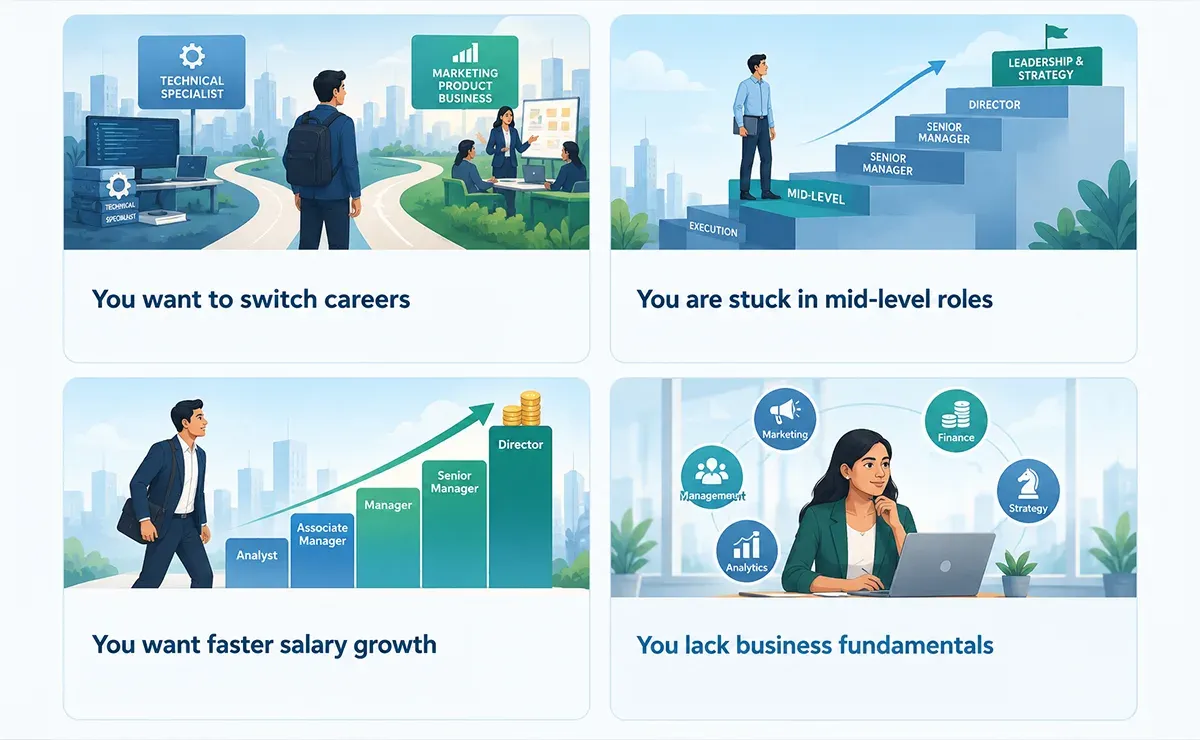
- You want to switch careers: Moving from a technical role into marketing, or from sales into product management, is difficult without a structured transition pathway, which an MBA provides through curriculum, network, and recruiter access built for career changers.
- You are stuck in mid-level roles: Many professionals plateau not from a lack of technical skill but a lack of management exposure. An MBA builds strategic thinking and cross-functional decision-making, the toolkit needed to move from execution to strategy.
- You want faster salary growth: A professional’s earnings often rise steadily with experience. Adding management education to that foundation can create a step change and open pathways to more valuable positions.
- You lack business fundamentals: Engineers, analysts, designers, and other specialists frequently move into business-facing positions without formal training in marketing, finance, or strategy.
This is where new-age, industry-focused programs are gaining ground. Altera Institute's PGP program positions itself as a career-switch accelerator for digital roles such as marketing, growth, and analytics, built for professionals who need business fundamentals without years of theory.
When an MBA May Not Be Worth It
- You are doing it "just because: An MBA taken without a specific goal, a role change, a sector move, or a skills gap tends to deliver a weaker return; the degree does not create the outcome, the intent behind it does.
- You choose the wrong format: A full-time MBA carries the high opportunity cost of eighteen to twenty-four months of lost income, while a low-quality or unrecognized online MBA may offer little placement support. Both risks can be avoided with thorough research upfront.
- You expect an instant salary jump: An MBA creates opportunities, but career growth depends on how effectively skills are applied. The ability to lead teams, manage change, and deliver results defines long-term career advancement.
At Altera Institute, outcome-focused programs are designed around real job roles, industry needs, and practical learning. The program builds readiness, while long-term success comes from workplace performance and continuous growth.
Best MBA Options for Working Professionals
MBAs Where You Would Typically Quit Your Job
1) Full-time MBAs
These programs generally offer the strongest career outcomes because they provide immersive learning, internships, campus placements, and access to powerful alumni networks.
Best for: Professionals willing to take a career break.
2) New-age PGPs
These one-year, industry-focused programs suit professionals wanting a faster route back into the job market, typically in marketing, product, or analytics roles. Being shorter than a two-year MBA, the opportunity cost is lower while outcomes remain strong.
Worth considering:
- ISB PGP, one of India's most established one-year programs, known for its recruiter base and salary outcomes.
- Altera Institute's PGP, an industry-led program built around digital-first careers such as marketing, product, and analytics.
- IIM Calcutta PGPEX
- IIM Bangalore PGP pro
- XLRI PGDM (General Management)
Best for: Professionals seeking faster ROI and industry-focused learning.
3) Executive MBA (Ex-MBA)
Best suited to professionals with five to fifteen years' experience wanting concentrated leadership training, via formats such as IIM Ahmedabad's PGPX, ISB's PGP, and XLRI's executive programs.
Best for: 5-15 years of experience.
MBAs You Do Not Need to Quit Your Job For
These formats suit flexibility over speed and are less recommended for a significant career shift.
1) Online or hybrid MBA
No need to leave your job, and rising credibility as UGC-DEB-approved options expand, with providers including NMIMS Global Access, Amity Online, and Chandigarh University.
Best for: Maximum flexibility.
2) Part-time MBA
Delivered largely through weekend classes, this format is limited but useful for incremental upskilling; Welingkar and NMIMS are common choices.
Best for: Professionals who can attend weekend classes.
ROI Breakdown: MBA for Working Professionals in India

The return on investment (ROI) of an MBA depends on far more than the course fee. While tuition is an important consideration, the overall value of an MBA is influenced by your career goals, work experience, and the opportunities the program creates after graduation.
There are two types of costs to consider:
- Direct costs include tuition fees, study materials, and other academic expenses. In India, MBA fees can range from around ₹1 lakh to ₹25 lakh, while many online MBA programmes typically cost between ₹1 lakh and ₹3 lakh.
- Indirect costs include the salary you lost during a career break, slower career progression, and missed networking or professional opportunities.
Opportunity Cost and Long-Term Career Returns
Professionals who pursue an MBA while continuing to work avoid the immediate loss of income associated with a full-time program. This often results in better short-term financial ROI because they continue earning while studying.
However, a lower opportunity cost does not necessarily make an MBA a better long-term investment. Its true value should be assessed through broader career outcomes, including salary growth, promotions, leadership opportunities, career transitions, and access to a strong professional network.
Flexible MBA programs can drive meaningful career advancement, but prestigious full-time programs often justify their higher fees with stronger alumni networks, greater employer recognition, and better campus recruitment opportunities as well.
Choosing the Right MBA for Your Career Goals
The best MBA programs for working professionals are the ones that align with your career stage, financial situation, and long-term objectives. For professionals who want to upskill without taking a career break, Altera Institute offers a shorter, industry-focused program that emphasizes practical, job-relevant learning for career growth and role transitions.
How to Decide: Should You Do an MBA?
Ask yourself these questions: Do I want to switch roles or industries? Am I stuck in career growth? Can I realistically commit time alongside a full-time job? Do I need structured learning, or would targeted skill courses be enough?
The decision rule is simple: if your answer points towards acceleration or a switch, an MBA is likely worth exploring; if you are still exploring without real clarity on the outcome, it may be worth waiting.
For professionals aiming to transition into digital roles or accelerate their career growth, outcome-focused programs offered by Altera Institute are worth considering.
Conclusion
An MBA is no longer a default next step in a career; it is a strategic move, best suited to career switchers, mid-career professionals, and anyone focused on genuine growth over a credential for its own sake.
As the market shifts towards shorter, outcome-driven formats, Altera Institute gives working professionals a modern alternative beyond the traditional two-year MBA, with learning built around real career progression.
Frequently Asked Questions
Q1. Can I do an MBA while working full-time in India?
Ans: Yes, online, hybrid, and part-time formats are built for this, though the trade-off is a longer as well as less immersive experience than full-time study.
Q2. Is an online MBA respected in India?
Ans: Recognized online MBAs approved under the UGC-DEB framework are increasingly accepted by employers, though institute reputation still matters significantly.
Q3. How many years of experience is ideal for an MBA?
Ans: For a traditional full-time MBA, 2-5 years of experience is common. Executive MBAs are usually better suited to professionals with 5-15 years of experience.
Q4. Which MBA is best for career switchers?
Ans: Full-time MBAs generally offer the strongest switching opportunities because of campus placements and internships. Industry-focused PGPs can also be effective for targeted transitions into digital, marketing, product, or analytics roles.
Q5. Do I need to quit my job for an MBA?
Ans: Not necessarily. Online, hybrid, executive, and part-time formats allow professionals to continue working, although the long-term career impact may differ from that of a top full-time MBA program.