Retention Marketing & CRM Strategy Roles

The importance of retaining your existing customers cannot be overstated. Acquiring a new customer is almost 6-7x more expensive than retaining an existing one.
But is it all just about avoiding the expenses of acquiring a new customer? – Not really!
A newer customer might buy something from your brand once or maybe twice. However, a brand-loyal customer will not only make repeat purchases for themselves but also encourage people around them to buy from you.
A McKinsey report states that in order to make up for the loss of one existing customer, a company needs to acquire at least three new customers. And that is exactly why the importance of retention marketing and CRM strategy roles cannot be undermined.
So what is retention marketing?
Retention marketing is the practice of keeping your existing customers engaged to encourage repeat purchases and strengthen brand loyalty. Brands do this through personalized engagement and loyalty programs across the lifecycle of the customer. CRM strategies also play a key role in determining the success of retention campaigns by analyzing customer data to identify their needs and deliver a more personalized experience.
What Do Retention Marketing & CRM Strategy Roles Do
Core Responsibilities in Retention Marketing and CRM Strategy
Retention marketing and CRM strategy professionals focus on building long-term customer relationships and maximizing customer lifetime value. Their core work goes beyond customer acquisition to ensure existing customers remain engaged, satisfied, and loyal to the brand.
If you choose a career in retention marketing or CRM strategy, you will primarily work on:
- Creating and automating email, SMS, and push notification campaigns.
- Segmenting customers based on their behavior to personalize communication and improve engagement.
- Designing loyalty and reward programs.
- Analyzing customer behavior and churn rate.
- Tracking how different customers interact with the brand.
- Monitoring customer engagement trends, etc.
All of this is essentially done by identifying a customer’s stage of retention. For example, the early stages of customer retention focus on successful onboarding and helping them become familiar with the product. The aim is to subconsciously inculcate a habit of using the product by letting them experience its value.
On the contrary, mid-cycle is all about deepening engagement through personalized communication, whereas the late stages focus on analyzing churn risk and encouraging re-engagement so the customers do not shift to another brand.
You can better understand this through an overview of different types of job roles in this sector.
Different Job Roles in Retention Marketing and CRM Strategy
CRM Manager: A customer retention manager is responsible for the company's customer relationship strategy across channels such as email, SMS, push notifications, WhatsApp, and in-app messaging. They manage customer segmentation, campaign planning, personalization, and CRM platforms like Salesforce, HubSpot, Zoho CRM, etc.
Retention Marketing Manager: Their primary aim is to boost the customer lifetime value by minimizing customer churn and maximizing repeat purchases. They create and optimize retention campaigns, loyalty initiatives, and win-back programs across multiple channels while tracking metrics.
Lifecycle Marketing Lead: A lifecycle marketing lead designs customer journeys from acquisition and onboarding to engagement, retention, and reactivation. They build automated workflows, behavioral triggers, and nurture campaigns using different marketing automation platforms.
Loyalty Program Manager: They develop rewards programs, referral campaigns, and member-exclusive experiences that encourage long-term customer relationships. They work closely with CRM, product, and marketing teams to improve customer engagement and brand loyalty.
CRM Analyst: A CRM analyst uses customer data to evaluate campaign performance and identify growth opportunities. Their work includes cohort analysis, churn prediction, customer segmentation, dashboard creation, etc.
Marketing Automation Specialist: This role sits at the intersection of marketing strategy and technical execution. These specialists build and maintain automated customer journeys across channels to streamline operations, scale campaigns, and improve overall customer retention rate.
Industries Hiring for Retention Marketing and CRM Roles
Core Skills Required for Retention Marketing & CRM Roles
Technical Skills
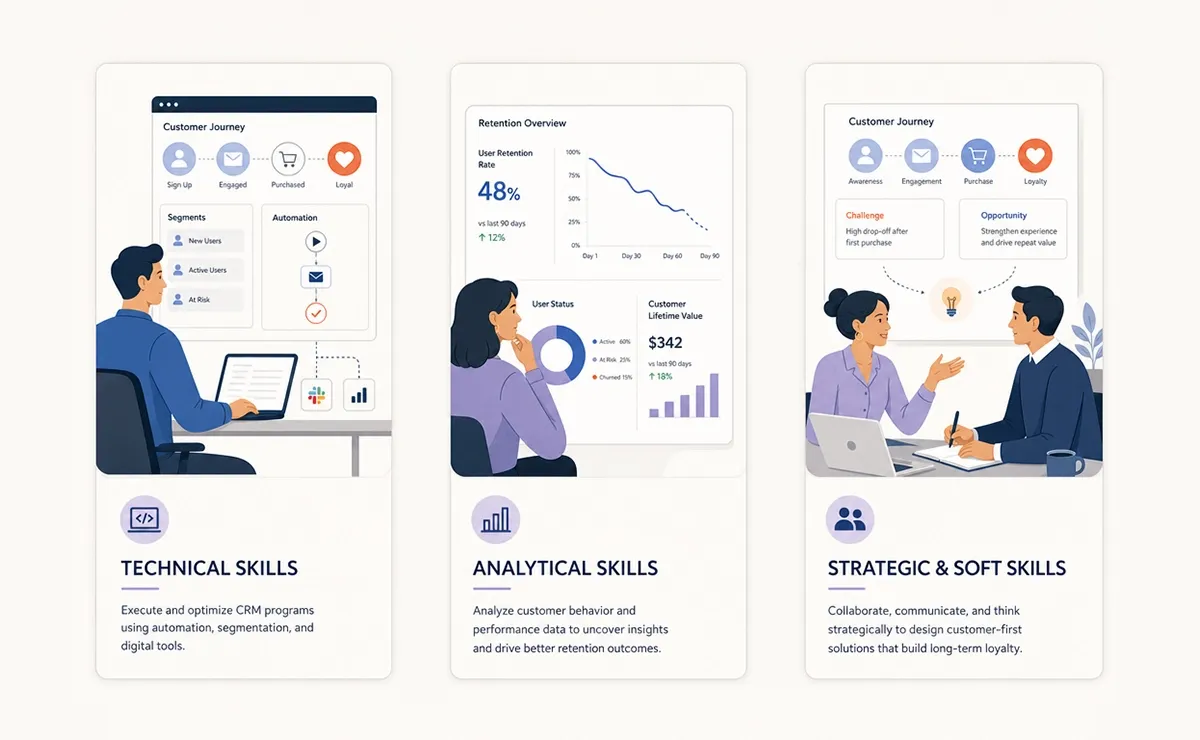
Technical skills sit at the core of any retention marketing role because these professionals heavily rely on tools and platforms for their daily tasks. From customer communication to campaign automation, minimizing churn rates, and delivering a personalized experience at scale, all of it requires a strong understanding of CRM systems and marketing technology. Some of the core technical skills include
- CRM platforms like Salesforce, HubSpot, Zoho CRM, Klaviyo, MoEngage, etc.
- Marketing automation and workflow creation.
- Marketing tools for email, SMS, push notifications, and WhatsApp marketing.
- Customer segmentation and audience-building logic.
- A/B testing and campaign optimization.
- Data management and CRM database handling.
Analytical Skills
To be able to analyze customer behavior, measure campaign performance, identify churn risks, and uncover opportunities, a professional in this field must know how to analyze data. It helps them design strategies and campaigns that can improve engagement and customer lifetime value. The core analytical skills needed may include:
- Cohort analysis
- Churn modeling and churn prediction
- Customer Lifetime Value (LTV) calculation
- Retention rate and repeat purchase tracking
- Campaign performance analysis
- Customer behavior and engagement analysis
Strategic and Soft Skills
To be able to build genuine long-term customer relationships, a retention marketing professional heavily relies on their soft skills. It helps them understand the “why” behind a particular consumer behavior. Not just that, it is also essential to collaborate with cross-functional teams. Some of it may include:
- Active listening to monitor trends, understand customer feedback, and identify gaps.
- Empathy to understand the pain point of the customers.
- Structured problem-solving and decision-making.
- Loyalty and reward program designing that feels truly meaningful.
Here is also a list of important KPIs for a CRM manager role.
- Customer Lifetime Value (CLV): Measures the total revenue a customer is expected to generate throughout their relationship with a business. CRM managers aim to increase CLV by improving customer engagement and loyalty.
- Retention Rate: Indicates the percentage of customers who continue to do business with a company over a given period. A higher retention rate reflects effective customer relationship strategies.
- Repeat Purchase Rate: Tracks how many customers make more than one purchase. It helps CRM managers assess the success of retention and loyalty initiatives.
- Churn Rate: Measures the percentage of customers who stop buying from or engaging with a business. Reducing churn is one of the primary goals of CRM campaigns.
- Average Order Value (AOV): Calculates the average amount spent by customers per order. CRM managers use personalized recommendations and promotions to encourage higher-value purchases.
- Purchase Frequency: Shows how often customers make purchases within a specific timeframe. Increasing purchase frequency helps improve customer lifetime value and overall revenue.
While these are essential skills for every professional in retention marketing and CRM strategy roles, most generalized MBA programs do not include them in their curricula. In the end, students lack fluency with CRM tools and are not adept at understanding lifecycle logic or LTV-linked thinking.
However, Altera’s PGP in Applied Marketing addresses many of these gaps by giving students exposure to CRM platforms, customer analytics, and practical marketing challenges. Its focus on solving real business problems, working with data, and developing collaboration and communication skills helps students build a solid foundation for careers in retention marketing and CRM roles.
What Do Retention Marketing & CRM Roles Pay?
Disclaimer: These numbers are indicative and may vary.
How to Build a Career in Retention Marketing & CRM
A retention marketing and CRM role should not be confused with general sales or marketing, because the primary goal here is to retain customers that the brand has already acquired. And that is exactly what your career path should reflect.
Educational Route to Retention Marketing
Courses that focus on marketing, business administration, consumer behavior, and data analytics can be a good entry point into the field. However, some courses can only get you to entry-level roles, especially if you are a fresher or you have only completed your bachelor’s degree. If you want a more leadership-oriented role, a specialized program like Altera’s PGP in Applied Marketing can be a better choice.
Common Entry Routes for Retention Marketing
If you are already a working professional who wants to switch your career to CRM strategy and retention marketing roles, here are some common entry routes you can consider.
- From email or performance marketing roles to retention marketing
Why does this work?
You are already equipped with foundational skills to run campaigns and optimize open rates. For a smooth transition, learn CRM tools, customer segmentation, lifecycle campaigns, and how to set up automated SMS and push notifications.
- From data analytics or similar roles to CRM strategy
Why does this work?
The analytical background can be leveraged to segment customers and make data-driven decisions as a CRM strategist. However, you will need to go beyond what the data looks like to how it can be used by the business. You will also need to learn CRM tools, lead nurturing, and omnichannel marketing.
- Direct MBA placement into lifecycle roles at D2C or SaaS companies
Why does this work?
This can be one of the most effective transitions if you pick the right course. A specialized MBA course can get you hands-on exposure to CRM tools, data analytics and interpretation, real-world problem-solving experience through internships and workshops, etc. While it may require some time to complete the course, the skills you will learn can be worth the ROI.
What Hiring Managers Look For in Retention Marketers and CRM Strategists
Hiring managers are looking for candidates who can demonstrate measurable impact, not just campaign execution. They want proof that you can analyze customer behavior, segment audiences, run experiments, and use data to improve retention and customer lifetime value. Here are some key skills and responsibilities most job descriptions for similar roles may have:
- Ability to create, optimize, and evolve retention strategies.
- Creation, development, and execution of retention campaigns.
- Ability to collaborate with cross-functional teams to develop key messaging points and direct response creative across mediums.
- Ability to analyze marketing campaign performance, including email metrics, conversion, and retention, to understand effectiveness and ROI.
- Familiarity with CRM and marketing automation tools such as Braze, WebEngage, HubSpot, Klaviyo, MoEngage, or similar platforms.
- Knowledge of A/B testing and experimentation to improve engagement, conversions, and retention rates.
- Understanding of key business metrics, including customer lifetime value (LTV), churn rate, repeat purchase rate, and customer retention.
- Strong problem-solving and critical thinking skills to identify growth opportunities and improve customer experiences.
- Excellent communication and stakeholder management skills to translate data and insights into actionable business recommendations.
Tools to Know Before You Apply
While you don’t need to know all of these tools, a deeper understanding of some of these can help you find a better-paying job in this field.
Where Does a CRM & Retention Career Take You?
This is what your career transition in CRM and retention can look like.
As you move up the ladder, the focus shifts from executing campaigns to owning budgets, shaping customer-centric revenue strategies, and influencing business growth. It is a high-ownership, data-driven career path that is gaining importance as brands increasingly prioritize customer lifetime value and retention over acquisition alone.
How Altera Trains Students for a Data-Driven Marketing Career
Altera’s PGP in Applied Marketing is a blend of AI-driven marketing management, industry immersion, commercial acumen, exposure to CRM tools, applied analytics, and a lot more.
As the course progresses, students learn core skills like
- Retention Marketing
- B2B Sales
- Brand Management
- Category Management
- Omnichannel Management
When combined in a systematic curriculum, these subjects help Altera’s students gain relevant skills and develop a strong understanding of customer behavior, lifecycle marketing, brand growth, and business strategy.
The program goes beyond theoretical learning. Students build their own D2C brand and create a product prototype to address a real market need. Through this process, they gain hands-on experience in consumer research, pricing, go-to-market strategy, and growth.
This end-to-end exposure helps students learn how to solve real business problems, make data-driven decisions, and think from a customer-centric perspective. When looked at from a more focused perspective, these are all skills that are highly valued in CRM and retention marketing roles.
Altera Alumni Who’ve Secured Roles in Retention Marketing & CRM Strategy

- Yuvika Gupta
PGP Class of ‘26
Before Altera: Marketing Manager at Cult URE
After Altera’s PGP: CRM & Social Media Manager at Ten x You
- Vedanta Pai
PGP Class of ‘26
Before Altera: Sales Account Manager at Keka
After Altera’s PGP: Cluster Sales Manager at Shiprocket
Conclusion
Retention is no longer just a support function. It has become a key driver of growth, helping brands increase customer loyalty, maximize customer lifetime value, and build sustainable revenue streams. Businesses that understand that acquisition can be much more expensive than retention continue to place greater emphasis on CRM, lifecycle marketing, and customer retention strategies.
Programs such as Altera’s PGP in Applied Marketing are designed around these modern marketing realities, giving students exposure to data-driven decision-making, industry tools, real-world projects, and customer-centric growth thinking. If you want to build a career in one of marketing's fastest-growing areas, explore Altera Institute and see how it can help you prepare for the future of marketing.

![Is a 1-Year MBA Worth It for Fresh Graduates? Honest Assessment [2026]](/blog/content/images/size/w600/2026/09/Is-a-1-Year-MBA-Worth-It-for-Fresh-Graduates-Honest-Assessment--2026-.webp)