
MBA in Marketing vs MBA in Finance: Which Should You Choose in 2026?


The dilemma of choosing between an MBA in marketing and an MBA in finance is a common yet pivotal decision for most MBA aspirants. While both are celebrated specializations, they carve very different career directions for you.
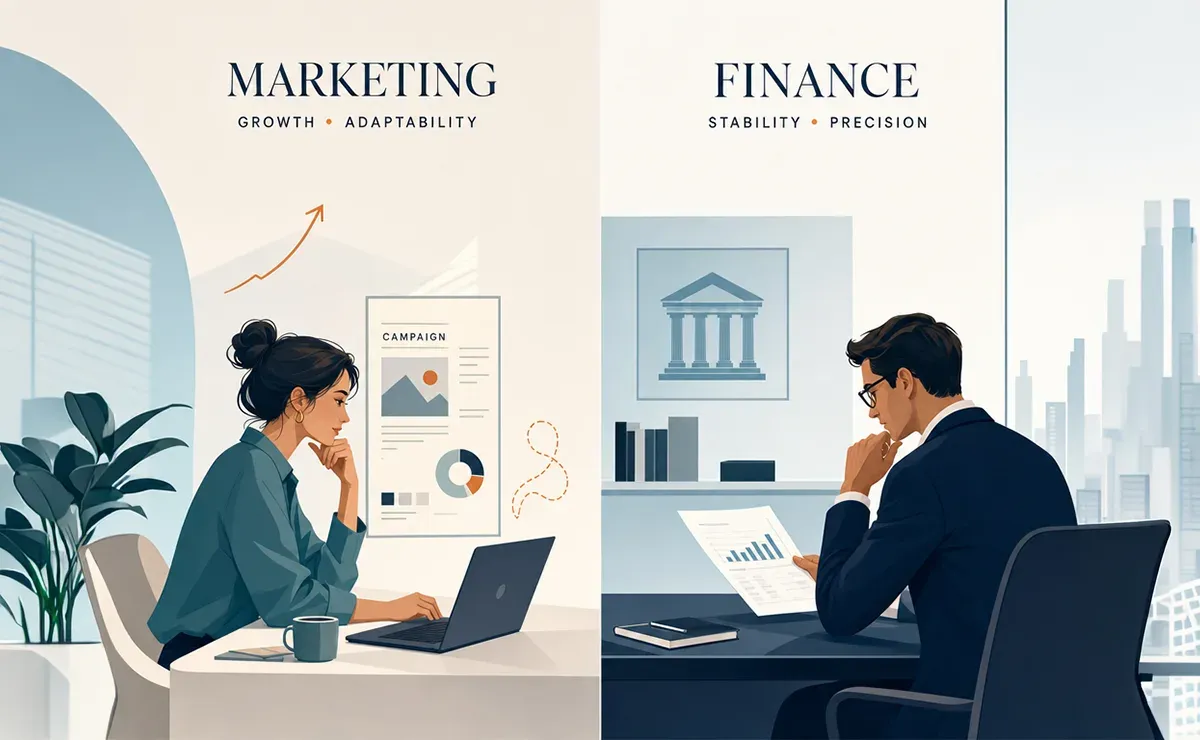
Finance is said to be the lifeblood of any business, and it involves a lot of numbers, financial decision-making, investment strategy, budgeting, etc. The commonly taught subjects include corporate finance, money management, financial modelling, risk management, and more. It is often a good choice for students who are more analytically driven and prefer stable growth.
Marketing, on the other hand, fuels business growth and is responsible for customer loyalty and brand persona. While analytical, it primarily leans towards the creative side, is often more dynamic, and can lead to high growth in your career. Common subjects that you can expect to learn are brand management, advertising, consumer behavior, product management and pricing, etc.
While most traditional MBA marketing courses are often limited to these subjects, Altera Institute takes it a notch higher with its digital-first and tech-aligned marketing PGP. Students don’t just learn the core concepts and theory of marketing but also build practical skills relevant to today’s changing industrial needs. From data analytics to agentic AI, you learn everything that is important for a digital-first marketing career.
That said, here is a breakdown of how you can choose between an MBA in finance vs. an MBA in marketing and what would be a better choice for you.
MBA in Marketing vs. MBA in Finance: Key Differences at a Glance
What is an MBA in Marketing?
An MBA in Marketing teaches you how to attract, engage, and retain customers while driving business growth. Throughout the program, you learn to understand consumer behavior, sell products and services, and build brand image across multiple channels. The course also develops your ability to analyze markets, identify growth opportunities, and make strategic marketing decisions.
Core Subjects
- Consumer Behavior: Helps you understand how your target consumer makes purchasing decisions, what influences their choices, and why they prefer certain brands over others.
- Brand Management: You learn how to build, position, and grow a brand in the market. It focuses on creating a strong brand image that attracts and retains customers.
- Market Research: Teaches you how to collect and analyze customer and market information. The insights help businesses understand demand and identify growth opportunities.
- Advertising and Promotion: You learn how businesses communicate with customers through advertising campaigns, promotions, public relations, and other marketing activities.
- Sales and Distribution Management: Focuses on how products and services reach customers through areas such as logistics and supply chain management.
- Digital Marketing: You learn how to market products and services through online channels such as search engines, social media, email, and websites.
- Marketing Analytics: Teaches the use of data to measure campaign performance, understand customer behavior, and improve marketing decisions.
- Product Management: Explores how products are developed, launched, positioned, and improved to meet customer needs and business goals.
- Artificial Intelligence: Many modern MBA programs integrate artificial intelligence to teach you how to fast-track and automate repetitive marketing processes, build agents, and scale your growth.
Skills required
- Innovation and creativity to brainstorm new ideas.
- Building and executing market strategy and running campaigns.
- Branding to build and manage the brand persona across channels.
- Consumer behavior analysis to identify consumer psychology and the factors that drive them.
- Communication and leadership to influence teams and consumers.
Career Outcomes
After pursuing an MBA marketing course, here are some of the career options that become accessible to you.
Top Colleges for MBA in Marketing
What is an MBA in Finance? (Scope, Skills, Careers)
An MBA in finance prepares students to learn how businesses manage money, investments, risks, and financial planning to achieve long-term growth. Throughout the program, you learn to analyze financial performance, evaluate investment opportunities, manage budgets, and make informed business decisions. You build skills to understand financial markets, assess risks, and create strategies that support profitability and sustainable business growth.
Core subjects
- Financial Management: You understand how businesses plan their finances, control spending, and use money to achieve their goals.
- Investment Management: This subject introduces you to different ways of investing money and helps you assess which opportunities are worth pursuing.
- Corporate Finance: You explore how companies fund their operations, expand their business, and make major financial decisions.
- Financial Markets: You'll get familiar with stock markets, including trading, futures, options, long-term stock investments, etc.
- Risk Management: Every business faces uncertainty. This subject shows you how to identify potential risks and reduce their financial impact before any major losses.
- Banking and Financial Services: You gain an understanding of how banks operate and the financial products and services they offer to customers and businesses.
- Financial Analysis: Focuses on teaching you how to read, analyze, and interpret financial reports and use them to make informed decisions.
- Business Economics: This subject helps you see how changes in prices, demand, and economic conditions can affect businesses and consumers.
Skills required
- Analytical thinking to evaluate financial information and make informed decisions.
- Budgeting and financial planning to manage resources and support business goals.
- Risk assessment to identify potential challenges and minimize financial losses.
- Problem-solving skills to find practical solutions to business and financial issues.
- Attention to detail for interpreting financial reports and spotting trends or discrepancies.
- Understanding of financial markets and investments to assess opportunities and make sound recommendations.
Career Outcomes
An MBA in finance can open multiple doors for you. Here are some leading profiles that are in high demand.
Top Colleges for MBA in Finance
MBA in Marketing vs. Finance—Salary Comparison in India (2026)
Key Insight to Note: Salary in finance is often higher for freshers because of the technical skills and certification requirements. However, a career in marketing often picks up pace with experience and choice of sector. As you learn to integrate AI and other relevant tools into your workflow, you can surpass salaries in finance. The highest growth in the marketing niche is seen in digital marketing sectors.
Another key factor to note is that finance is generally considered a more stable career choice with steady growth. It is, however, considered to be more difficult to enter because professionals must possess deep technical knowledge. Marketing, on the other hand, has lower entry barriers, which makes it easier to enter but more difficult to stay relevant.
To overcome this hurdle, you can choose modern marketing programs like the PGP in Applied Marketing by Altera Institute. With its focus on high-growth digital roles, it prepares you for the modern industry trends and evolving technological landscape with hands-on practical experience of different marketing tools and real-world learning.
Advantages and Challenges of a Career in Marketing vs. Finance
Advantages of Choosing a Career in Marketing
- Marketing professionals are in high demand across industries because marketing is needed in every sector.
- With relevant experience and strategic thinking, you can transition to respected and high-paying leadership roles like VP of Marketing, Chief Marketing Officer, etc.
- Since these roles involve brand reputation, professionals often get to work with senior management even at early stages of their careers.
- Best-suited for individuals who can combine creativity with analytical thinking.
- The field offers a wide range of career paths with a different balance of strategy, creativity, and technical skills.
Challenges of Choosing a Career in Marketing
- Since most roles are linked to targets and measurable outcomes, it can be a very pressurising field to work in.
- You need to rapidly upskill to stay relevant because the field is continuously evolving.
- Results are often affected by market sentiments and consumer behavior, which may not align with the predicted outcome.
Advantages of Choosing a Career in Finance
- Finance is the lifeblood of any business, which makes it a career with strong, long-term demand across organizations.
- Your work directly influences business decisions, investments, and long-term growth strategies.
- The profession offers opportunities to work with senior leadership and contribute to key business decisions.
- As your experience grows, you get the opportunity to partner with businesses and increase your earning potential through profit sharing.
Challenges of Choosing a Career in Finance
- It has a steep learning curve with many roles requiring strong numerical and analytical skills.
- Most roles may offer less creative freedom compared to careers in marketing, design, or product development.
- Financial decisions often involve high levels of responsibility and accountability.
- You may be required to work long hours under high pressure.
An Overview of Top Career Opportunities After an MBA in Marketing vs. Finance
Top Roles in Marketing
- Brand Manager: A brand manager is responsible for shaping how customers perceive a brand. They develop marketing campaigns, oversee brand communication, and ensure consistency across all customer touchpoints.
- Digital Marketing Manager: This role focuses on promoting products and services through digital channels such as search engines, social media, email, and websites. They manage campaigns, track performance, and optimize marketing efforts to generate leads and sales.
- Growth Manager: A growth manager identifies opportunities to increase customer acquisition, engagement, and retention. They work across marketing, product, and sales teams to drive business growth using data and experimentation.
- Product Marketing Manager: Product Marketing Managers bridge the gap between product development and customers. They position products in the market, communicate their value, and create strategies to support successful launches and adoption.
Top Roles in Finance
- Financial Analyst: Financial analysts evaluate financial data to help businesses make informed decisions. They prepare reports, assess performance, and provide insights on budgets, investments, and growth opportunities.
- Investment Banker: They help companies raise capital and manage major financial transactions such as mergers and acquisitions. The role involves financial analysis, deal execution, and advising clients on strategic decisions.
- Risk Manager: Risk managers identify potential financial and operational risks that could impact a business. They develop strategies and controls to minimize losses and improve financial stability.
- Corporate Finance Manager: This role involves overseeing budgeting, financial planning, and funding decisions within an organization. Their goal is to ensure the company uses its financial resources effectively to support growth and profitability.
Which MBA is Best for Marketing in India?
There is no single "best" MBA for marketing in India. The right choice depends on your career goals, learning preferences, and the type of marketing role you want to pursue.
Traditional MBA programs from institutes such as IIMs and FMS continue to be highly respected and offer strong management foundations. However, as marketing becomes increasingly digital and technology-driven, many students are exploring specialized programs that focus on practical skills and industry relevance.
Institutes such as ISB, MICA, Great Lakes, and Altera Institute offer marketing-focused programs that go beyond traditional classroom learning. These programs typically place greater emphasis on digital marketing, analytics, CRM, AI, brand strategy, and real-world business projects.
For professionals looking for faster career outcomes, the PGP in Applied Marketing by Altera Institute is a compelling option. The program is designed around industry needs and provides hands-on learning through live projects and workshops. This allows learners to build job-ready skills and transition into high-growth marketing roles without spending two years in a traditional MBA program.
MBA Marketing vs. Finance: Which One Should You Choose?
Choosing a career between marketing and finance is a very subjective decision. While both fields offer lucrative growth opportunities and earning potential, the final decision should be aligned with your long-term career goals, strengths, and weaknesses.
Choose Marketing If:
This is a better career choice for individuals who enjoy a mix of creativity and strategy in their work. The field often involves working with lots of people, ideas, and problem-solving.
Marketing is a good fit if you like understanding why customers buy certain products, spotting trends, and finding creative ways to grow a business.
The work often involves collaborating with different teams, experimenting with new approaches, and adapting to changing market conditions. If you enjoy variety and don't mind ambiguity, marketing can be a rewarding career path.
Choose Finance If:
An MBA in Finance may be a better choice if you prefer structured work and analytical thinking. Finance requires attention to detail, comfort with numbers, and an interest in understanding how businesses make and manage money.
The work is often more process-driven and focused on evaluating information before making decisions. If you enjoy solving quantitative problems and working with data, finance may be a better fit.
Ultimately, choose marketing if you are energized by customers, communication, and business growth. Choose Finance if you are more interested in numbers, investments, and financial decision-making. The best choice is the one that aligns with how you naturally like to think and work.
Why New-Age Marketing Programs Like Altera Are Replacing Traditional MBAs

The marketing industry is evolving rapidly. The businesses are investing more in digital channels, customer retention, marketing automation, analytics, and AI-driven decision-making than in traditional advertising alone. Hence, most of the roles in this niche now require knowledge of different AI tools and platforms, fluency with marketing channels, and execution of modern marketing strategies, which is often not taught in most traditional MBA programs.
This has led to a broader division of specialized MBA programs into traditional MBA marketing programs vs. modern MBA marketing programs. While the traditional institutes still rely on case studies and theoretical knowledge, modern curricula are designed according to the needs of the industry.
Employers in today’s job market expect MBA graduates to go beyond traditional knowledge and join the workforce with practical skills and the ability to execute marketing strategies, use modern tools, and deliver measurable business outcomes from the start. This gap is particularly more noticeable in fast-growing industries like B2B SaaS, healthtech, and edtech.
Institutes like Altera design their curricula to meet industry standards, ensuring students learn the necessary marketing skills before graduating. Not just that, the entire curriculum is taught by industry professionals like CMOs and brand leads who actually bring practical insight to the classroom.
With one of the highest ROI programs in the country, Altera Institute is reshaping modern marketing education, making sure every graduate not only gets placed but also remains relevant to the industry in their long-term career graph.
Frequently Asked Questions (FAQs)
Q1. What companies hire MBA marketing graduates in India?
Ans. Companies that hire for marketing roles after an MBA include Amazon, Google, Flipkart, HUL, Deloitte, Accenture, etc.
Q2. Which MBA has a higher salary: marketing or finance?
Ans. Generally, the starting salary in finance is higher than in marketing. However, as you progress in your marketing career, you can also increase your earning potential and maybe even surpass salaries in finance.
Q3. Is an MBA in marketing good in India?
Ans. Yes, an MBA in marketing can be an excellent choice in India, especially if you opt for a specialized marketing MBA that is oriented towards digital marketing and practical learning experience.
Q4. Which companies hire MBA marketing graduates?
Ans. MBA marketing graduates are needed across all industries. They are hired by tech giants, FMCG companies, retail and D2C brands, health tech and fintech companies, etc.
Q5. Is finance harder than marketing?
Ans. Finance may be harder than marketing for some people who are not very good with numbers, logic, quantitative aptitude, and accounting. However, neither is inherently harder, and it all depends on your skill set.
Q5. Can I switch from marketing to finance later?
Ans. You can switch from marketing to finance, but it may be a lot harder when you are at the mid- or senior level of your career. Since both fields require different skill sets, you will have to upskill rigorously and plan strategically.