
MBA for Digital Marketing Careers in India


India's digital marketing sector has gone from being a fast-growing niche to the centerpiece of the country's advertising economy. According to the Dentsu Digital Advertising Report 2026, digital advertising grew 19% in 2025 to ₹71,621 crore, accounting for 59% of total ad spend, and is set to grow at a 17% CAGR through 2027.
Moreover, IBEF estimates that the digital advertising market will nearly double to around ₹20.47 lakh crore (~US$22 billion) by 2030. This has also led to increased demand for qualified digital marketers. This growth raises an interesting question: Is an MBA the right gateway for digital marketing careers in India, or do skills and certifications suffice?
Frankly, it depends on whether you're currently trying to get into digital marketing or you want to lead it. Getting in depends on relevant skills acquired through certifications and a portfolio of work experience, whereas growing into strategy, team ownership, and revenue accountability depend on more targeted business education.
This article explains where an MBA fits into that journey, how it shapes salaries, which roles it opens up, and which kind of MBA matters in an AI-dominated, performance-driven market.
How Digital Marketing Careers in India Start: Skills First, Degree Second!
To cut to the chase, no, an MBA is not required to begin a digital marketing career in India, especially for entry-level roles. Recruiters don't just look at where a candidate went to school; they examine what he or she can do. Typically, you can expect to get your first job with knowledge of Google Ads, Meta Ads Manager, GA4, basic SEO, content creation, and some campaign experience.
Most fresher hiring occurs within a predictable range of entry-level jobs. The most popular ones are:
- SEO Executive, Social Media Executive, Content Marketer, Performance Marketing Executive, and Email/CRM Marketing Executive.
There are three main ways to get into these positions: acquiring certifications from Google, Meta, HubSpot, and other programs; participating in internships at agencies, direct-to-consumer brands, or in-house marketing departments; and having websites, blogs, or campaigns that you've managed. A Tier 1 college name is a plus, but not the most important factor.
The salaries in this layer are modest but rising. Glassdoor India data from early 2026 places the average salary for a digital marketing fresher at around 2.4-3.5 LPA. For the first two to three years, hiring and salary are driven almost entirely by what a candidate has shipped; for example, campaigns run, channels handled, and numbers moved, and credentials come second in this aspect.
Where Does an MBA Change the Game?

An MBA makes sense when the bigger picture changes, and a professional wants to own results rather than just run campaigns. It is precisely here that people without formal business education most often stall.
In marketing, execution rewards crafts like unique creatives, cleaner funnels, and tighter targeting. But when it comes to leadership in marketing, it rewards qualities such as strategic thinking, revenue linkage, cross-functional fluency, and the ability to translate marketing activity into clear business metrics. This is what differentiates entry-level roles from well-established roles.
Roles such as Digital Marketing Manager, Growth Marketing Manager, Brand Manager, Product Marketing Manager, and Marketing Analytics Lead sits squarely on this side of the line.
This is where pursuing a marketing-focused MBA or a postgraduate program genuinely helps. A well-designed program helps students build expertise in strategy frameworks, analytics, unit economics, consumer insight, product thinking, and leadership practice. These are skills that work experience alone cannot develop, and they also force candidates to operate outside their comfort zones to ultimately build stronger portfolios.
The salary jump from entry-level to specialist roles in marketing is also well documented. Glassdoor India's 2026 data shows that a digital marketing manager in India earns an average base salary of around ₹8 LPA, with senior managers earning more. Roles such as growth marketing managers, brand managers, and product marketing managers also command a premium. Hence, the gap between execution pay and strategy pay is often 3 to 5 times higher, and it only widens with time.
This is where B-schools like the Altera Institute also come into the picture. Its PGP in Applied Marketing is built to accelerate this transition, moving candidates from "doing marketing" to "leading marketing" by emphasizing strategy, analytics, and revenue ownership rather than generic management theory.
MBA Tier and Specialization: Why Does the Program Design Matter More Than the Label?
When evaluating B-schools to break into a digital marketing career in India, the institute's tier does matter, but perhaps less than it once did.
Tier-1 MBA colleges still offer the strongest placement. It is evident from placement reports of top colleges such as IIM Ahmedabad, which report an average CTC of 35.22 LPA and a median of 34.53 LPA. Similarly, IIM Bangalore reports an average of 34.88 LPA, and SPJIMR Mumbai's Class of 2025 closed with an average of 24.40 LPA. MICA Ahmedabad, which is widely considered the gold standard of marketing education in India, has also reported the highest package of ₹40.91 LPA for the 2024–25 batch.
Tier 2 programs perform noticeably worse in this aspect, but they are not out of the game. IMT Ghaziabad's PGDM 2023–25 reported an average of ₹16.25 LPA and a highest of ₹41.55 LPA. Well-run Tier 2 programs often offer an average salary of 10–18 LPAs, which is still a significant improvement over early-career compensation.
But what separates useful MBAs from generic ones is not the college tier but factors such as curriculum relevance, faculty with operating experience, and the quality of industry integration.
Generic management curricula may not prepare students for growth, performance, and lifecycle roles. This is why programs that are AI-first, analytics-heavy, and taught by working practitioners align more closely with today's hiring demands. MICA, SPJIMR, IMT Ghaziabad, and newer specialized entrants like Altera Institute are a few examples of such focused programs.
Career Paths After an MBA in Digital Marketing
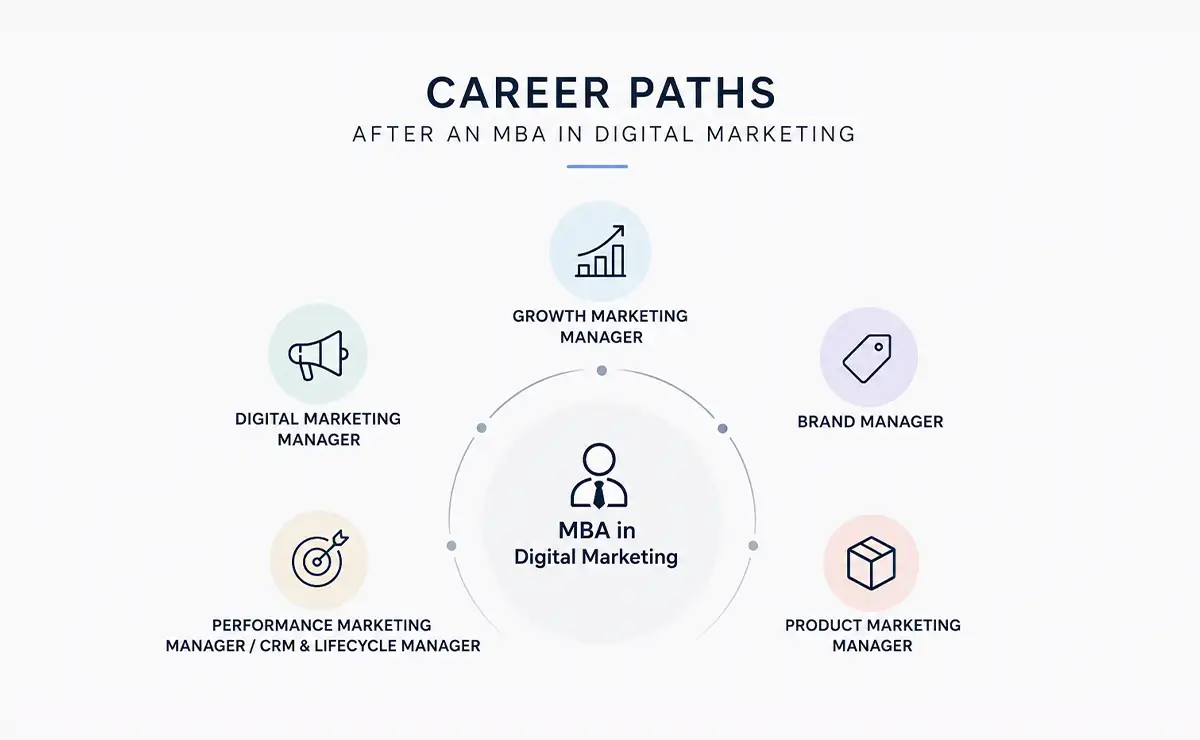
An MBA in marketing in India today unlocks a mix of strategy and execution roles, nearly all of which are on the revenue side. These are some of the most common post-MBA titles in marketing:
- Digital Marketing Manager (owns channels, budgets and campaign teams)
- Growth Marketing Manager (acquisition, activation, retention, experimentation)
- Brand Manager (positioning, communication, equity)
- Product Marketing Manager (GTM, messaging, launches)
- Performance Marketing Manager / CRM & Lifecycle Manager (paid media ROI and customer LTV)
These roles are less about owning a single channel and more about owning an outcome—pipeline, revenue, retention, or category share. That requires judgement, cross-functional collaboration with product, sales, and finance, and the ability to connect daily decisions to a P&L. These are exactly the muscles that structured business education is designed to build and that years of execution alone rarely develop.
Altera's PGP in Applied Marketing is designed for this precise career layer—digital-first, growth-oriented, and built around real projects across brand, performance, and product marketing rather than a generalist MBA template.
How to Decide If an MBA is Right, and When?
The decision framework is simpler than it appears. Candidates who want to remain deep specialists—in SEO, paid media, or creative strategy—should continue their training, earn certifications, and keep building their portfolios. The market pays well for rare technical depth.
If the goal is to lead teams, own budgets, influence product, and eventually sit in a senior marketing or growth seat, an MBA meaningfully shortens the path and raises the ceiling. Both outcomes are valid; they are just different pathways.
Timing matters almost as much as the decision itself. Going directly after undergraduate study is viable at top Tier 1 programs, but most strong digital marketing careers benefit from two to three years of work experience first. That experience gives context as students arrive knowing what a funnel actually breaks like, not just how it looks on a slide, and it translates directly into better placements.
One-year MBAs and specialized marketing PGPs can be excellent choices, but they require closer scrutiny. The questions worth asking are not about rankings; they are about industry connections, curriculum relevance, faculty profile, and the transparency of placement outcomes. Programs that dodge these questions usually have a reason to.
Conclusion
An MBA is not mandatory to build a digital marketing career in India—the entry-level ecosystem remains open to anyone with skills, a portfolio, and hustle. But for professionals targeting leadership, strategy, or general management seats in a market projected to exceed ₹20 lakh crore in digital ad spend by 2030, structured business education is a genuine accelerator, not a mere formality.
Hence, skills get you in; business education helps you lead and scale. The challenge is not whether to pursue an MBA but whether your goal is to gain specialist depth in marketing or to develop leadership skills in a targeted domain.
In a market growing this fast, a generic label matters less than choosing something digital-first, industry-aligned, and honest about outcomes. Altera Institute's PGP in Applied Marketing was built from the ground up for exactly that track: leadership-ready, digital-first marketing roles in the Indian economy as it actually looks in 2026.