
What is the MBA Age Limit?


Among MBA aspirants in India, one of the most common concerns is whether their age will affect their application to a B-school. The short answer is that there is no upper age limit for most programs. However, to give a more specific answer, you would need to consider the format of management education and the entrance exam you will be taking. In addition, you would need to consider whether the program is in India or abroad.
In this article, we clarify the age requirements relevant to each MBA format, entrance exam, and international program category in order to enable you to plan your application based on accurate information, as opposed to making assumptions.
Is There Any Age Limit for an MBA?
No upper age limit has been set by either the University Grants Commission or the All-India Council for Technical Education for MBA and PGDM programs in India. As such, from a regulatory standpoint, there is no age above which a candidate cannot pursue a management degree.
The minimum age requirement for most programs is 20, which corresponds to the completion of an undergraduate degree. Beyond this minimum, admission decisions are based on entrance exam performance, academic credentials, work experience, interview, and group discussion assessments.
There is, however, a significant difference between program formats in terms of the practical age range. A twenty-two-year-old fresh graduate applying to a full-time MBA program targets a different program than a forty-year-old senior executive applying to an Advanced Management Program. Understanding which format is appropriate for your career stage is a more useful question than asking whether an age limit exists.
MBA Formats and Their Age Considerations
MBA, PGP, and PGDM Programs
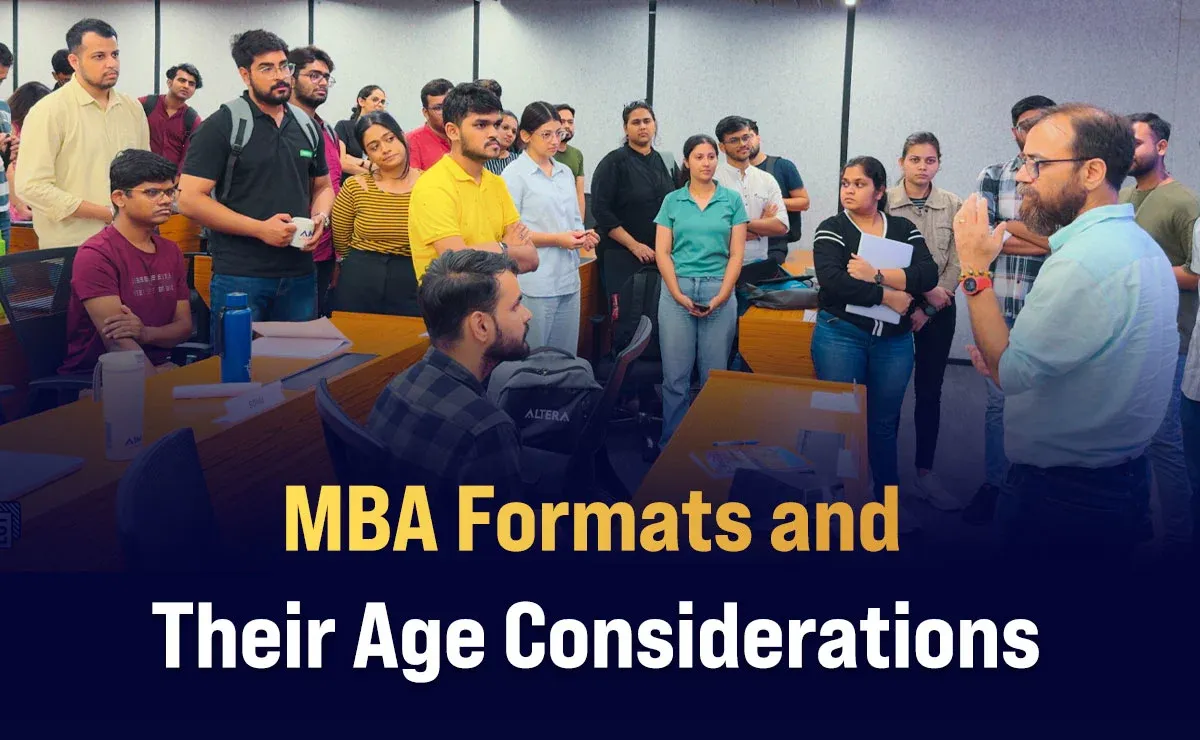
The full-time residential MBA, PGP, and PGDM programs are aimed primarily at recent graduates and early-career professionals. Most institutions offering these programs do not have an official upper age limit. However, a typical applicant profile is between 22 and 28 years old.
For instance, the IIMs do not impose any upper age limit on their flagship programs. In institutions like ISB, which require 2 years of work experience for their 1-year PGP program, applicants are typically 24 to 30 years old. A new-age program like Altera Institute's PGP in Applied Marketing welcomes both freshers and early-career professionals, and the current Class of 2026 includes individuals with diverse academic backgrounds and professional experience.
Executive MBA Programs
Executive MBA programs are designed for mid-career professionals with five to twelve years of professional experience. A typical EMBA candidate in India is between 28 and 40 years old. Programs like IIM Calcutta's PGPEX, IIM Bangalore's EMBA, and XLRI's Executive Management Program all specify work experience requirements rather than age limits as their primary eligibility criteria.
Because EMBA programs are designed to run alongside full-time employment, often in weekend or modular formats, the age and experience of participants are viewed as assets rather than constraints. Candidates in their mid to late thirties are among the most common and most competitive applicants to Executive MBA programs.
Advanced Management Programs
Designed for executives with at least 15 years of professional experience, Advanced Management Programs are the most senior category of management education programs. For example, the ISB Advanced Management Program and IIM Ahmedabad's AMP target C-suite aspirants and senior executives in their 40s. Age is not a barrier to admission, and in many cases, a person's seniority and experience enhance rather than detract from their candidacy.
Participants in these intensive, theme-specific programs are expected to have a strong foundation in general management. Rather than age, the quality and seniority of professional experience are assessed to determine eligibility.
Age Limit for MBA Entrance Exams in India

There is no upper age limit for candidates taking any of India's major MBA entrance exams. All primary tests follow this policy, so age doesn't matter if you are attempting an entrance exam for an MBA degree program.
- The Common Admission Test (CAT) has no minimum or maximum age requirement. Any candidate who holds a recognized bachelor's degree or is in their final year of an undergraduate program is eligible to apply. Scores from the CAT are accepted by most top-ranked programs in the country, as well as the IIMs.
- XAT (Xavier Aptitude Test) similarly imposes no age restrictions. Candidates must hold a bachelor's degree from a recognized university. XAT is required for XLRI and accepted by over 150 institutions, including several that offer programs suited to experienced professionals.
- The GMAT (Graduate Management Admission Test) requires candidates to be at least eighteen years of age but sets no upper limit. It is accepted by the ISB, Altera Institute, and several international programs. GMAT scores are valid for five years, making the exam a practical option for working professionals who may apply to programs at different career stages.
- NMAT, MAT, SNAP, and CMAT follow the same policy. None of these examinations have an upper age restriction. Eligibility is determined by educational qualification and, where specified, minimum work experience, not by the age of the applicant.
Minimum Age Limit for an MBA Abroad
Leading international business schools also impose no upper age limit, though the average age of students in full-time MBA programs at schools like Harvard Business School, Wharton, London Business School, and INSEAD typically ranges from twenty-seven to thirty-two years. This reflects the work experience requirements these programs set rather than any formal age restriction.
Most top international programs require 2 to 5 years of professional experience, which means the youngest students entering are typically around 24 or 25. Some programs, such as INSEAD's one-year MBA, attract a slightly older cohort with an average age closer to thirty, given the depth of experience they seek.
For candidates in their late thirties or forties, many international schools offer Executive MBA formats that run alongside employment. There are a number of EMBA programs available for experienced professionals, such as those offered by INSEAD, Kellogg, and London Business School, which routinely admit candidates in their forties and beyond. With strong professional experience, age is a significant advantage in these applications rather than a disadvantage.
FAQs
Q1. What is the maximum age limit for an MBA?
Ans: MBA programs in India and abroad do not have a maximum age limit. There is no upper age limit set by regulatory bodies, including UGC and AICTE. Rather than being based on age, individual institutions determine eligibility criteria based on educational qualifications and work experience.
Q2. Can a 35-year-old do an MBA?
Ans: Absolutely. A 35-year-old is a strong candidate for both Executive MBA programs and one-year PGP programs designed for experienced professionals. With ten or more years of work experience, such a candidate would be among the more experienced members of a standard MBA cohort and would bring significant value to class discussions and peer learning. Programs like ISB's PGP, XLRI's EMBA, and IIM's executive programs are all well-suited to professionals at this career stage.
Conclusion
Studying for an MBA in India or abroad is not restricted by age. It is the quality of your profile, the clarity of your career goals, and how well the program you choose is designed for someone at your career stage that determines your eligibility and likelihood of success.
The more useful question is not whether you are too old for an MBA, but which format is the right fit for where you are today. A recent graduate and a forty-year-old executive both have strong program options available to them. Choosing the one that aligns with your experience, your goals, and the roles you are working toward is the decision that will actually determine the quality of your outcome.