A Unique Pedagogy: Combining Learning by Doing with an Industry-Backed Curriculum
For more than half a century, the Master of Business Administration has served as the most recognized credential for preparing managers and business leaders. Built on the pillars of finance, marketing, operations, and human resources, the traditional MBA was designed to produce capable generalists for a world of relatively stable hierarchies and predictable competitive environments. That world has fundamentally changed.
Several factors will shape the business environment in 2026 and beyond, including AI, digital commerce, platform business models, and real-time data-driven decision-making. Today, leaders are expected to operate simultaneously at the intersection of strategy, technology, and execution. In addition to leadership skills, the World Economic Forum's Future of Jobs Report 2023 names AI literacy, analytical thinking, and technological adaptability as among the most important management skills for the next 10 years.
The challenge is not that the MBA has lost its value. It is that the pedagogy underpinning most traditional programs was not built for this environment. Teaching frameworks and case studies in lecture halls does not produce the kind of applied fluency that modern digital-first roles demand. This is precisely the gap that a new-age model of management education, such as Altera Institute's PGP in Applied Marketing, is designed to close.
Why Do Traditional Pedagogies in MBAs Fall Short Today?
The standard MBA is effective in teaching frameworks. Students gain an understanding of how to assess a competitive landscape using Porter's Five Forces, analyze financial statements, and build a go-to-market argument. These are very helpful functions. The constraint arises when a graduate enters their first job and is tasked with running the P&L for a category on Amazon, building a growth funnel for a D2C brand, or creating an MVP in response to user feedback. They are familiar with the frameworks but not with the "how to do" part of the task.
Traditional management education predominantly has a lecture-driven, theory-driven approach. The concepts are introduced to students in the classroom and sometimes with historical examples and tested through either exams or written assignments. While students absorb the ideas, they rarely apply them in real-life business situations. The result is graduates who are analytically literate but execution-thin in the specific roles that India’s digital economy is now creating at scale.
Today, recruiters are increasingly recognizing this problem firsthand. Both digitally native and growing companies like HUL, Amazon, Nykaa, Blinkit, etc., are struggling to find skilled talent for roles in brand management, eCommerce, growth marketing, and product management, not because these roles are obscure, but because traditional management programs are producing graduates with inadequate preparation for them.
This is why Altera Institute was founded by leaders from Bain and Company, Hindustan Unilever Limited, Goldman Sachs, Haleon, and EY Parthenon to close this gap with a fundamentally different approach. Let's understand how it is done.
Three Pillars That Redefine How Management Is Taught
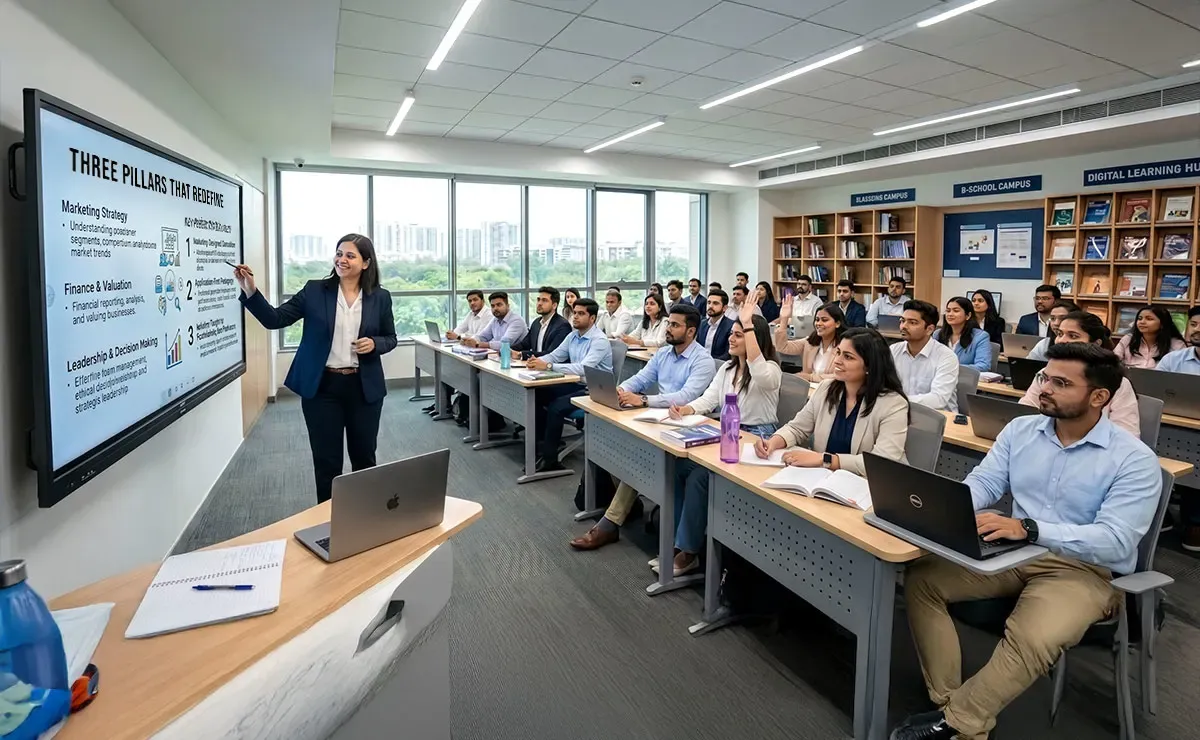
Altera Institute's PGP in Applied Marketing has three interwoven goals that address the various shortcomings of the traditional MBA program. They combine into a coherent pedagogy, not an alternative to traditional pedagogy, but a structural upgrade to it.
1) Industry-Designed Curriculum
Every course in the PGP is designed by active industry practitioners from organizations such as HUL, Amazon, Bain & Company, Goldman Sachs, GSK, GroupM, and many others. This is not a case of industry advisory panels providing occasional input to academics who then develop the syllabus. The curriculum is built by the people currently solving the business problems graduates will need to solve on day one.
The practical consequence of this is that even foundational courses like Managerial Economics or Business Finance are taught with a commercial and decision-making orientation rather than a theoretical one. Students learn financial statements in the context of making business decisions that maximize commercial outcomes, not in the context of passing an accounting examination. The content reflects how leading organizations actually think and operate, not how textbooks from a previous decade described them.
2) Application-First Pedagogy
The second pillar is the principle that business is best learned through practical experience rather than through theoretical study. The entire program is designed so that each concept in the course is supported by an actual or near-actual business application immediately following its discussion. This is done through three types of formats: live projects, simulations, and hackathons, as well as capstone deliverables at the end of each term.
At the end of each of the four terms, students complete a capstone project. This project brings together everything they’ve learned and applies it to a real business challenge.
- The Term 1 capstone requires students to build a D2C brand from scratch. They identify a market need, develop the product and marketing mix, design the go-to-market strategy, and produce the communication assets required to take the brand to consumers. This end-to-end experience of building a business from concept to launch in a single term produces a depth of applied understanding that no case study analysis can replicate.
- In the Term 2 project, students develop a minimum viable product to address a targeted market need. From market research and user feedback to product prototyping, go-to-market strategy design, pricing, and positioning. Students use the commercial and digital skills they have developed in Terms 1 and 2 to complete a product challenge in a realistic environment with realistic time and resource limitations to simulate professional conditions.
- Term 3 capstone is a live project with a founder, CXO, or senior leader from a real company, working on a genuine business problem across brand building, go-to-market strategy, or product development. This is the moment when the application muscle built in earlier terms is tested in the actual conditions of business decision-making, not in simulation. Projects include designing go-to-market strategies, redesigning digital experiences, and developing YouTube content strategies for consumer brands.
- In the Term 4 capstone, students must conduct original research on a topic with practical business applications. This brings students from execution into inquiry, developing students' ability for systematic individual thinking, which is called for by leadership positions.
3) Industry-Taught by Practitioners, Not Professors
All sessions in the PGP are delivered or facilitated by a professional with extensive industry experience. The logic is simple—if the intent is to create graduates who can execute in high-level business positions, they should learn from individuals who have been in those roles and have developed the skills over extended periods of time and accountability.
The faculty is not a group of academic specialists with industry advisory roles. They are operating professionals who have led real businesses at scale.
- Brand and marketing are taught by professionals who served as marketing director for Surf Excel at HUL and marketing head for Maggi at Nestlé. Students learn about brand-building decisions from people who have made them for brands with revenue of thousands of crores.
- eCommerce and digital commerce are covered by leaders who manage eCommerce businesses at companies including GSK and Reckitt, as well as professionals from Amazon's side, category management. The practical knowledge of how platform algorithms, pricing strategy, and category P&L actually work comes from people who have been accountable for those outcomes.
- Analytics and data are taught by a data analytics and machine learning leader from Airtel, bringing current, applied technical knowledge rather than theoretical statistical methods.
- Product management, strategy, consulting, and leadership are each covered by practitioners from organizations such as Bain & Company, EY Parthenon, Accenture, Goldman Sachs, Lenskart, and Nykaa. The program also runs more than 20 sprints, four-to-eight-hour intensive bootcamps on specific domains, led by leaders from Netflix, Microsoft, Pernod Ricard, Whiteboard Capital, and Royal Enfield, among others.
Throughout the 15-month program, students interact with more than 200 professionals, including hiring partners. This level of practitioner interaction fosters not only knowledge but also professional connections that continue to grow over a career.
How Altera Institute's Pedagogy Delivers Results That Matter
The purpose of examining placement outcomes is not to present salary figures in isolation. It is to demonstrate the types of jobs this learning model actually creates and why it is important to anyone considering pursuing a management degree in 2026.
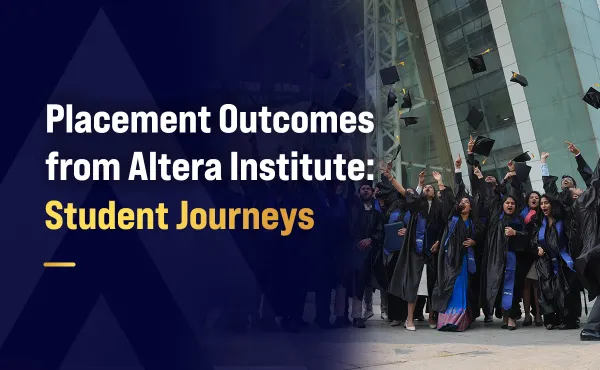
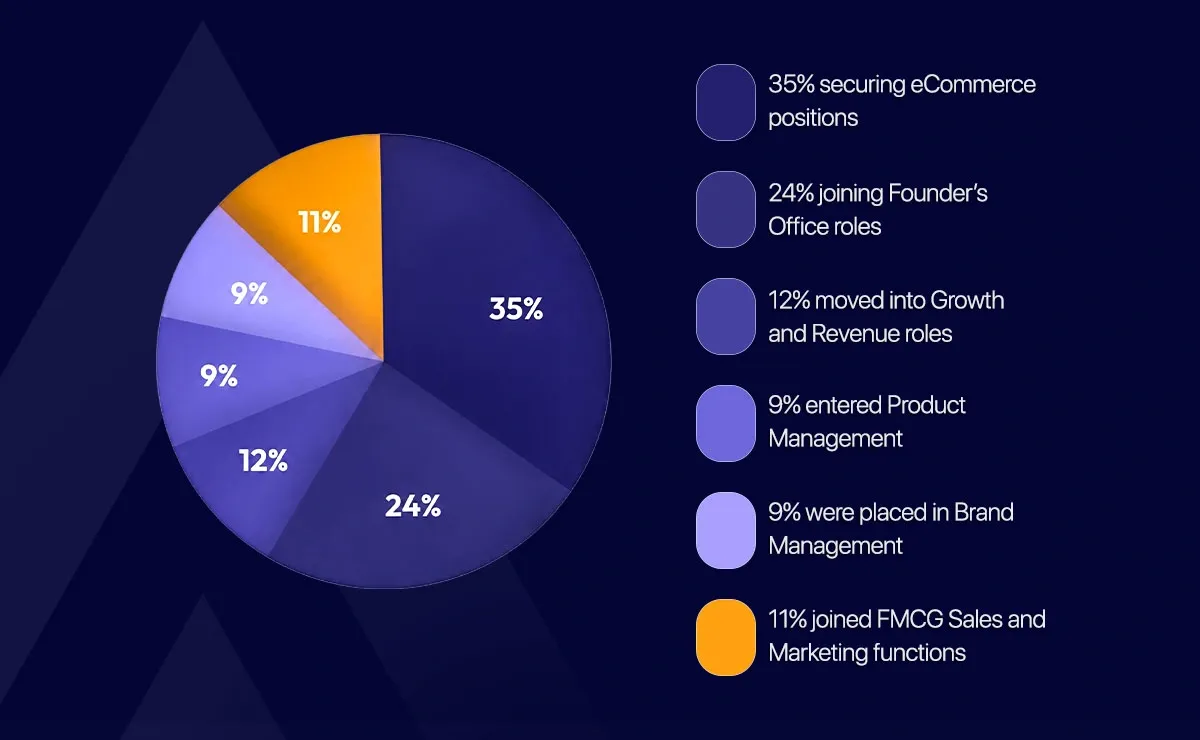
There were 40 students in the Class of 2025. All of them were placed, and 89% went into digital and AI-first jobs.
Role distribution from placements:
- 35% joined eCommerce positions
- 24% entered Founder's Office positions.
- 12% moved into Growth and Revenue roles,
- 9% entered Product Management,
- 9% were placed in Brand Management,
- And 11% joined FMCG Sales and Marketing functions.
These are not traditional MBA placements. Brand Management, Growth Marketing, Product Management, and Business Strategy at companies including HUL, Flipkart, Godrej, Mamaearth, Blinkit, and GroupM are the roles that sit at the intersection of revenue ownership and digital execution. They are the roles that India’s fastest-growing consumer and technology companies are actively struggling to fill because the pipeline of genuinely prepared graduates is insufficient.
There are 135 students in the Class of 2026. 65% have experience from organizations such as Nestlé, Citi, Titan, Deloitte, PepsiCo, and Reliance. This increase from 40 to 135 students in one cohort is not just a reflection of institutional ambition. It is indicative of market recognition, meaning it is recognized by both potential students and industry recruiters because of the specific skills developed in this program.
Summing Up
The issue is not whether frameworks and strategies are important in the changing landscape of education in management. They do. The question is, can graduates make decisions with incomplete data, execute in ambiguous environments, and build in a real business environment where the stakes are real? This ability is not acquired by studying alone. It develops through practice and constructive criticism from advanced players.
Altera Institute's model is an example of how management education can be based on first principles. Relevance is not something that can be added after the curriculum has been developed; it is an integral part of the curriculum designed by the industry. An application-first pedagogy is one in which learning and doing go hand in hand rather than in sequence. Industry-taught faculty means that the distance between the classroom and the workplace is not a gap to be bridged after graduation but one that the program eliminates by design.
The future of work in the Indian digital economy will be for those who can build, rather than simply analyze. The programs that will produce those professionals are not the ones with the longest legacy but the ones with the most honest answer to what building actually requires.