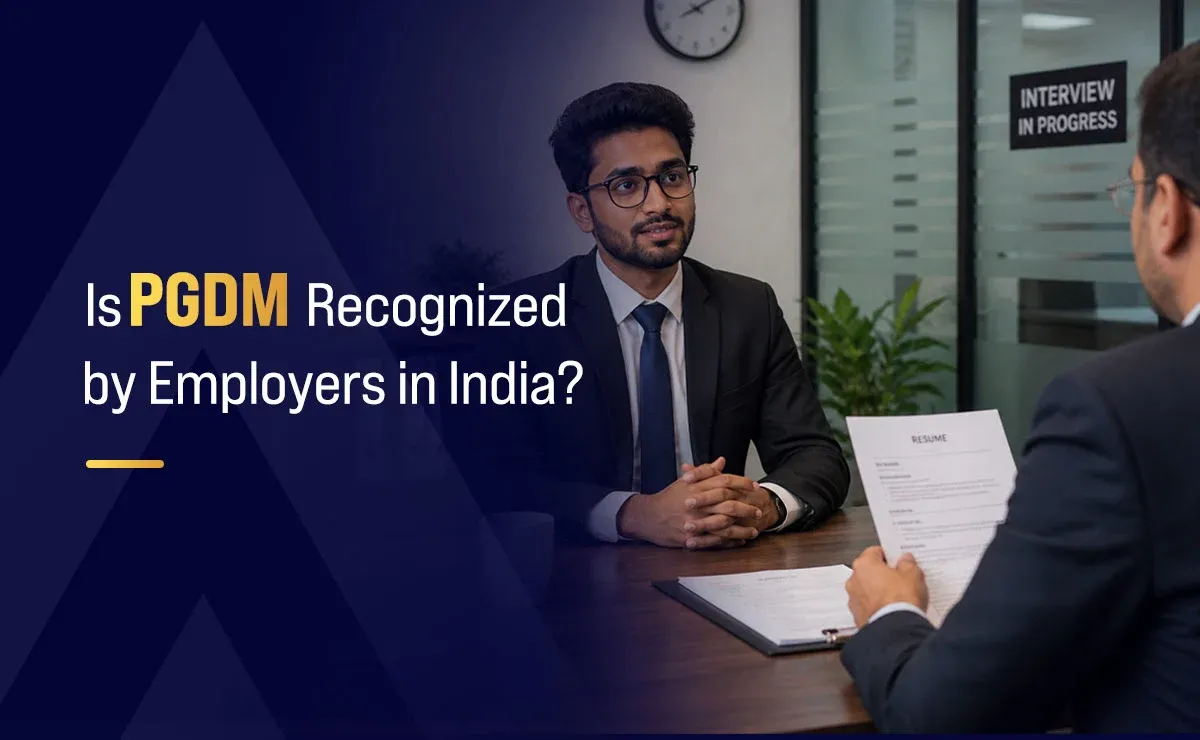
Is PGDM Recognized by Employers in India?
A common anxiety plagues management aspirants in India. If the MBA awards a degree while PGDM awards a diploma, will employers really consider PGDM as being of equal importance to justify the same investment of time and money? At a time when every application cycle counts, this single question freezes decision-making.
The very word "diploma" triggers concerns about recognition, salary, and future career prospects among students. Yet, many reputable management institutes in India offer the PGDM format, such as XLRI, SPJIMR, and MDI. This suggests that the concern is more a matter of misperception than reality. Hence, it is first imperative to gain a basic understanding of these two formats.
An MBA is a postgraduate course offered by universities that are recognized by the University Grants Commission (UGC), whereas a PGDM is a post graduate diploma program offered by autonomous institutes approved by the All India Council of Technical Education (AICTE), which has much more flexibility in designing its courses.
The main message of this article is simple. In the corporate hiring arena, skills and quality outcomes are given much greater importance than MBA or PGDM labels. The following sections explore how PGDM is regulated, the current perception of PGDM in the Indian job market, and how an aspirant can gauge whether a particular program is recognized and useful.
What Exactly Is PGDM and How Is It Recognized?
To understand why labels matter less in practice, let's examine the regulatory framework for both formats. MBAs and PGDMs differ not in quality, but in the way their curricula are governed and approved.
An MBA is offered by UGC-recognized universities and their affiliated colleges, where curriculum changes move through the university system and therefore tend to reflect industry shifts more slowly. A PGDM, on the other hand, is offered by autonomous institutes with AICTE approval, which allows them to make curricular modifications in a timely manner and keep the course content relevant to industry practice. The difference in governance is what really makes the two formats structurally different and explains why many PGDM programs are said to be more responsive to market needs.
A Side-By-Side Comparison of Both Formats
The term "equivalence" is often confused by aspirants. PGDM programs approved by AICTE can be granted equivalence by the Association of Indian Universities (AIU), meaning they are considered equivalent to MBA programs for higher education and corporate roles. But there are also situations where the MBA is indispensable, such as job applications in the public sector, PhD applications, and some bureaucratic checks. However, in the standard recruitment process, this distinction hardly ever makes any difference.
How Do Employers in India Actually View PGDM vs. MBA?

Once the regulatory picture is clear, it is more useful to ask what recruiters actually do rather than what the law says. For years, hiring outcomes in India have been remarkably consistent.
In the private sector, PGDMs from reputable institutions are treated the same as MBAs when it comes to roles, compensation, and career advancement. Candidates with PGDM degrees compete with MBA graduates for the same roles and salary bands, and hiring managers do not view the diploma label as a sign of inferior preparation. There is rarely any negative reaction to the diploma label during the hiring process.
What do Recruiters Actually Evaluate?
When shortlisting candidates, hiring managers concentrate on three dimensions that have very little to do with the credential label.
- Practical skills aligned with current industry needs that allow a candidate to contribute productively from day one rather than requiring long periods of retraining before they become effective.
- Peer group and alumni network strength, which reflects both the quality of the intake and the professional connections a graduate can draw on over an entire career.
- Placement history and role quality, which tell recruiters how earlier cohorts have performed in the market, rather than how the qualification is formally classified on paper.
The market itself reinforces this pattern through the institutions it trusts. Historically, a number of top B-schools for corporate placements, such as XLRI, SPJIMR, MDI, and IMT, have operated on the PGDM model, and their alumni are working in top-level positions in banks, consulting firms, and consumer goods and technology firms. If the diploma label really did prevent employment, these institutions would not have developed the relationships with recruiters that they enjoy.
The same principle also holds true for related programs such as the one-year MBA, the PGP, and the two-year PGDM. At the shortlisting stage, companies don't differentiate between these three formats if the skills and outcomes are good. Consequently, PGDM programs from reputed AICTE-approved institutes are widely regarded as equivalent to MBA programs in India.
Situations in Which the MBA Label Still Matters

There is a general equivalence between MBAs and PGDMs in the private sector, but in certain situations, MBAs are given greater importance than PGDMs. If these scenarios are ignored, aspirants considering a career in government service, academia, or international mobility would be making a big mistake
1. Government and PSU Roles
It is often stated in various public-sector and PSU notifications that candidates must possess an MBA or its equivalent as an eligibility criterion. A PGDM recognized by the AICTE fulfills this criterion without complications. However, many notifications also clearly state that the candidate must possess an MBA degree recognized by the UGC. This can often cause additional documentation issues when verifying a candidate with a PGDM and has the potential to significantly delay or otherwise negatively impact an otherwise successful application to an organization.
2. Higher Studies and PhD Pathways
Most universities with doctoral programs will only accept an MBA degree or a postgraduate diploma from an AIU-accredited B-school. Academic careers such as UGC NET, teaching, and doctoral research also require a recognized master's degree as a minimum qualification. Hence, a PGDM awarded by AIU easily fulfills this requirement, while a non-recognized PGDM might lead to complications during the application process.
3. International Recognition and Credential Evaluation
Foreign universities and global employers consider PGDM an MBA-level qualification as per the AIU equivalency. It helps in assessing credentials for overseas admission to educational institutions and applications to multinationals that have to compare Indian qualifications with theirs. In this sense, the formal approval of the institute is directly connected to the external recognition of the qualification.
The practical response to each of these scenarios is not to avoid the PGDM route altogether but to carefully verify the equivalence status before enrolling. An aspirant who confirms AICTE approval and AIU recognition at the shortlisting stage avoids almost every downstream complication the label might otherwise create.
Conclusion
In India, PGDMs that are selected thoughtfully will be indisputably recognized by employers, especially within the private sector, where the vast majority of management graduates start their careers. In the Indian corporate environment, the title on a certificate has little impact on whether a candidate receives a job offer, is promoted, or is compensated at an appropriate level.
Thus, an aspirant's choice should not be viewed through the classic debate over whether to pursue an MBA or a PGDM; rather, it should be viewed through the lens of skills, acceptance, and expected outcomes. As such, it will be more useful to identify which institute offers the program, whether it meets the requirements for obtaining AICTE approval and AIU equivalency (if applicable), how the program's curriculum was developed, and what placement outcomes reveal about recent cohorts.
MBA and PGDM students should not let the word "diploma" deter them from taking a good look at programs that are relevant to their industry, recognized by the educational system, and have a good placement history. An honest evaluation across these areas will be far more important than the credential's category, and it will signal a change in attitude among serious candidates as compared to those still playing the degree-versus-diploma game.