Marketing Automation Careers in 2026 & How to Get Them


India’s digital advertising comprises 44% of the total ad spend in the country, and it is growing on a 20% year-on-year basis. This number alone represents the incline of the industry and how companies are constantly looking for the right talent to leverage this growth.
However, with the integration of AI into the skill game, employers require professionals who can go beyond designing and setting up campaigns. They actually need marketers who can automate the entire process to fast-track their growth and minimize repetitive manual work. So, in simple words, they don’t just need marketers but marketing automation specialists.
For the unversed, marketing automation is a process of automating repetitive manual tasks required for smooth marketing functions. It’s a system that uses software to ensure the right person receives the right email, ad, or nudge at the right time, without a human having to do it manually for each lead.
If the idea of this excites you, marketing automation could be a great career choice for you. But before you make that decision, here is everything you should know about this niche.
What Does a Marketing Automation Specialist Actually Do?
The primary responsibility of a marketing automation specialist is to build, set up, and run campaigns and then automate repetitive tasks using various software and programs. These automation tasks may include email marketing, social media posting, and sometimes even ad campaigns. To make the process more effective, they also collaborate regularly with sales, design, and project development and management teams.
Core Responsibilities of a Marketing Automation Specialist
Building Automated Email Journeys and Lead Nurture Workflows
Marketing automation specialists design and manage automated customer journeys that guide prospects from initial awareness to conversion. They create email sequences, follow-up campaigns, welcome series, and re-engagement workflows based on user actions, interests, and buying intent. Their goal is to ensure every lead receives relevant communication at the right time without requiring manual intervention.
CRM Management and Lead Scoring
A key responsibility is maintaining an organized and accurate CRM database. They track customer interactions, update contact records, and ensure data quality across systems. They also develop lead scoring models that assign values to prospects based on their behavior, engagement levels, and demographics, helping sales teams focus on the most qualified leads.
Audience Segmentation and Campaign Reporting
Rather than sending the same message to everyone, marketing automation specialists segment audiences based on factors such as behavior, purchase history, industry, location, or stage in the customer journey. They also create campaign reports to measure performance, identify trends, and uncover opportunities for improving engagement and conversions.
Aligning Marketing with Sales Pipelines
Marketing automation works best when marketing and sales teams operate in sync. Specialists collaborate with sales teams to define lead qualification criteria, establish handoff processes, and ensure prospects move smoothly through the pipeline. This helps reduce lead leakage and improves conversion rates.
Monitoring and Analyzing Campaign Performance
They continuously track campaign metrics such as open rates, click-through rates, lead conversion rates, cost per lead, and revenue contribution. By analyzing performance data, they identify what's working, spot bottlenecks in the funnel, and make informed decisions to improve results.
Running Tests and Optimizing CTAs and Landing Pages
Marketing automation specialists regularly conduct A/B tests on email subject lines, calls to action, landing page layouts, forms, and messaging. These experiments help improve engagement, increase conversions, and maximize the return on marketing campaigns.
Managing Marketing Automation Platforms
They work with tools such as HubSpot, Marketo, Pardot, Salesforce Marketing Cloud, ActiveCampaign, or MoEngage to build workflows, manage campaigns, and automate repetitive marketing tasks. Understanding how to configure and optimize these platforms is a core part of the role.
Improving Lead Generation and Conversion Processes
Beyond automation, they analyze the entire customer journey to identify drop-off points and conversion barriers. They recommend improvements to forms, content offers, landing pages, and follow-up sequences to generate higher-quality leads and improve overall marketing efficiency.
Core Tools Used By Marketing Automation Specialists
While each platform has its own interface and features, the underlying concepts remain similar. Most employers expect candidates to be proficient in at least one marketing automation tool. For beginners, HubSpot is generally the best starting point because of its user-friendly interface, strong learning resources, and widespread adoption across industries.
Who Hires Marketing Automation Specialists?
A marketing automation specialist sits at the intersection of creativity, strategy, data analysis, and consumer psychology. It is not just an email marketing or any single-channel marketing role. It requires an understanding of consumer behavior, skills to analyze, interpret, and leverage data, and strong technical knowledge to use various CRM, marketing, and AI tools.
And this is why, in India's growing B2B SaaS and e-commerce ecosystem, this role is increasingly seen as a revenue-generating function rather than just a support role. The industries that primarily seek these professionals are
- SaaS companies
- Ed-tech platforms
- BFSI brands
- e-commerce companies
- Marketing agencies
- Fintech companies
- Healthtech companies
These companies usually have high lead volumes, a complex sales funnel, and large consumer databases. They also largely rely on CRM systems for their everyday marketing initiatives.
Career Path & Salary Ladder in India (2026)
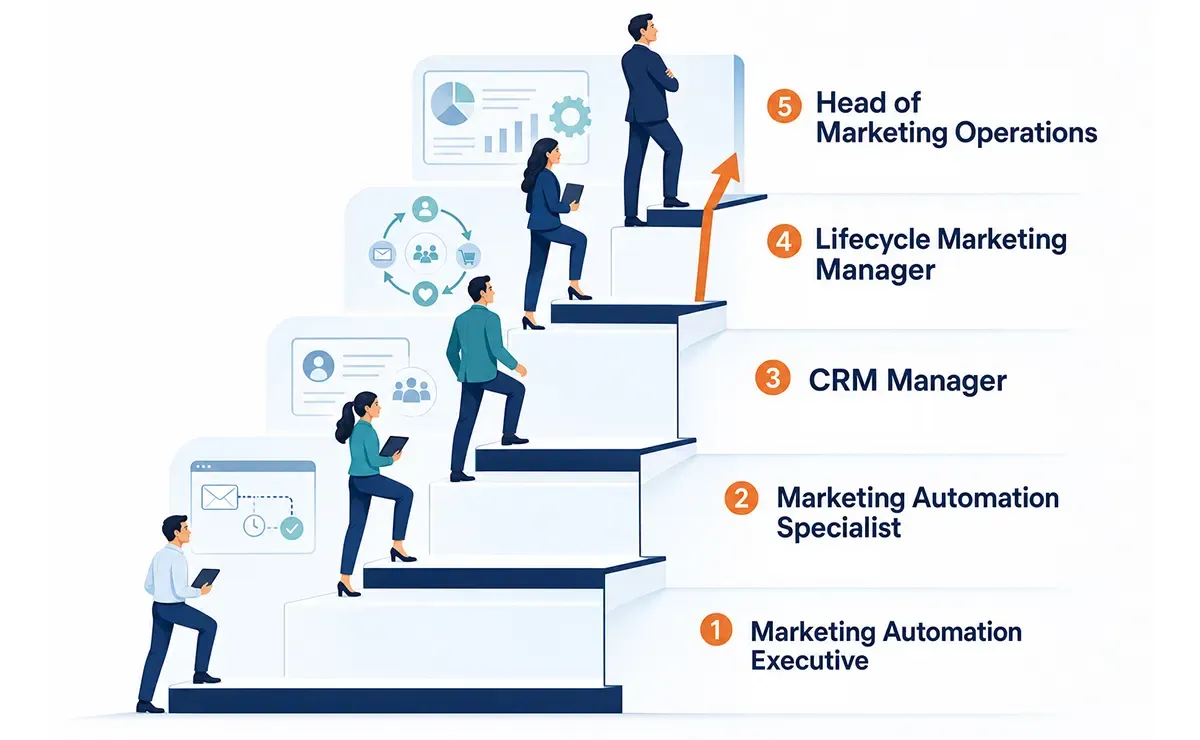
A career in marketing automation typically begins with campaign execution and gradually moves toward strategy, customer lifecycle management, and revenue ownership. Here is a breakdown of what your first decade as a marketing automation professional can look like.
Disclaimer: The given salary range is based on the latest data and can vary at the time you read this article.
What Defines Your Salary Growth and Career Progression?
Salary growth is often faster through strategic job switches than through annual increments. Many professionals see larger jumps when moving into specialized automation roles or larger organizations.
Location also plays a role here. Metro cities such as Bengaluru, Mumbai, Gurgaon, and Hyderabad typically offer 4-9% higher salaries than similar roles in Tier-2 cities. Finally, your experience with different tools, your ability to conduct marketing analytics, and your experience designing and managing campaigns strengthen your profile and earning potential.
Where Are These Jobs? Top Hiring Cities in India
- Bengaluru: Known as the Silicon Valley of India, it is a major hub for tech businesses and startups, which also means a high growth opportunity for marketing ops roles.
- Hyderabad: It is emerging as a key player for the IT and pharmaceutical industries with a growing demand for martech roles.
- Mumbai: It is the financial capital of India and is home to many corporate headquarters and multinational companies, including fintech, FMCG, and media houses. Marketing lies at the core of these businesses.
- Delhi NCR: As a diverse business hub, the NCR region has a range of industries, especially D2C businesses and ed-tech platforms, where there is a huge demand for automation-led marketing roles.
- Remote Hiring: Since this role is primarily platform-based, many professionals in tier-2 cities work with leading brands from the comfort of their homes, earning metro-equivalent salaries.
Skills You Need To Break Into Marketing Automation
As a successful marketing automation specialist, you need to be fluent in both the technical and strategic sides of the role. Technically, it doesn’t necessarily mean coding, but knowing the basics of HTML/CSS can give you a clear salary edge. That means, even if you do not have a technical background, you can still flourish in the role with some upskilling and learning.
On the other hand, strategic skills are essential because this role involves marketing, sales, and customer experience. Remember, it is marketing first and automation secondary. Hence, you also need strategic skills to understand customer behavior, align business goals, and measure impact to be able to create campaigns that can be automated.
Technical Skills
Platform Mastery
Marketing automation specialists spend much of their time building campaigns, automating customer communication, and tracking performance within automation platforms. That is why familiarity with tools such as HubSpot, Marketo, Salesforce Marketing Cloud, Pardot, and Zoho Marketing Automation is essential for your resume.
CRM Architecture and Data Management
Since automation relies on customer data, you must understand how to organize contacts, segment audiences, and track leads throughout the customer journey. Common CRM platforms that you can learn are Salesforce CRM, HubSpot CRM, Zoho CRM, and Microsoft Dynamics.
Basic HTML and CSS
While coding is not a core requirement, basic HTML and CSS skills can help you customize email templates and fix minor formatting issues without relying on developers.
Workflow Design and Automation Logic
Marketing automation specialists need to know how to create automated customer journeys based on customer actions and behavior. This involves working with features such as triggers, decision paths, and A/B testing within platforms like HubSpot, Marketo, and Salesforce Marketing Cloud.
Integration and System Connectivity
Marketing and sales teams often use multiple software tools, so understanding how these systems connect helps you ensure data moves smoothly between platforms. Tools such as Zapier, Make, and native integrations are essential for it.
Strategic Skills
Customer Journey Mapping
To build effective automations, you must understand how customers move from awareness to consideration and ultimately purchase. Mapping these touchpoints helps you deliver the right message at the right stage of the customer journey.
Lead Scoring Strategy
Not every lead is equally likely to convert. You should be able to design lead scoring frameworks that identify high-intent prospects and help sales teams prioritize the most valuable opportunities.
Campaign ROI Analysis
Marketing automation is ultimately a business function, so you need to know how to measure campaign performance and connect automation efforts to revenue, conversions, and customer retention metrics.
Stakeholder Communication
Even the most successful campaigns can lose impact if insights are not communicated effectively. You should be able to present automation data, campaign results, and customer insights in a way that helps leadership and other stakeholders make informed business decisions.
Marketing–Sales Alignment
Successful automation depends on smooth collaboration between marketing and sales teams. Understanding how leads are handed off, followed up on, and nurtured helps ensure that automation efforts contribute to actual business results rather than just generating leads.
While these strategic skills can be developed through hands-on experience, these capabilities often require exposure to real business challenges, customer behavior, and cross-functional decision-making from the very start of your journey as a marketing automation specialist.
At Altera Institute, the curriculum specifically covers consumer behavior analytics, CRM strategy, and performance reporting. Students also get the opportunity to step outside the classroom to speak to real users, real brands, and real businesses. This, paired with live projects & an industry-backed curriculum, gives graduates a head start on the strategic layer that separates mid-level operators from high-value automation professionals.
Is an MBA the Right Path Into Marketing Automation?
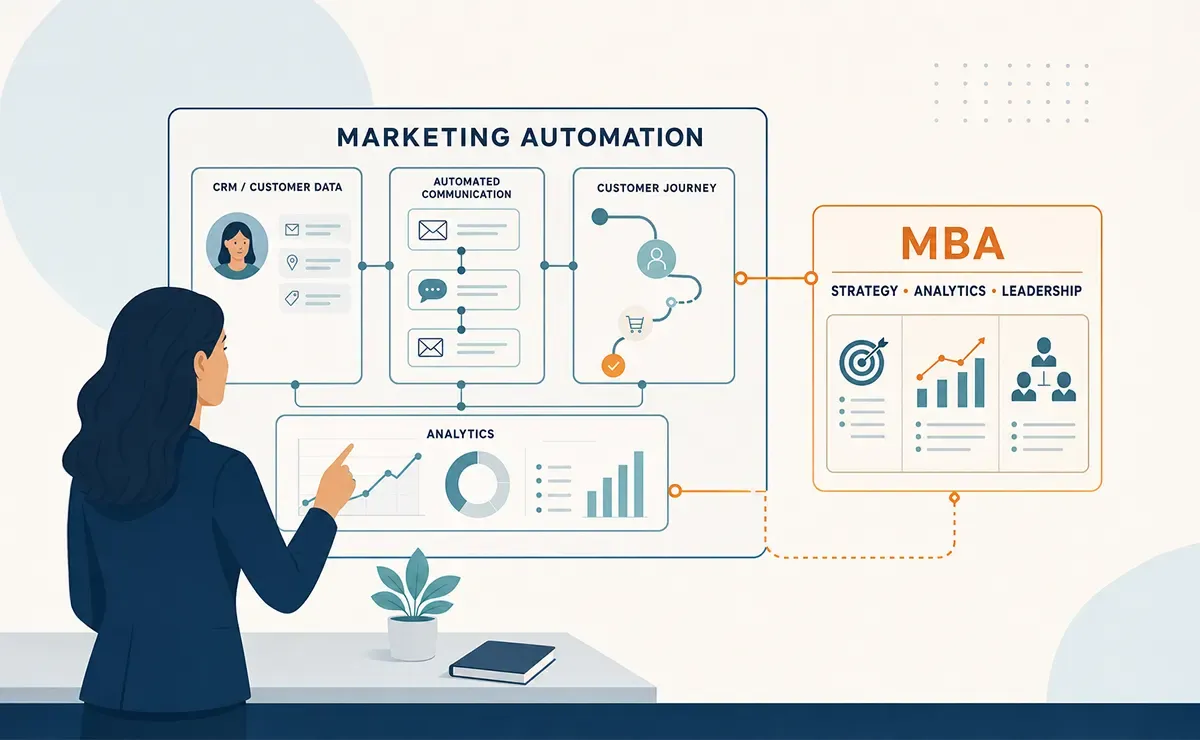
A good thing about entering a marketing career is that it is never purely education-bound. Even without formal education, many professionals are able to crack these roles and gradually progress in their careers. However, one fact that cannot be denied is that it often leads to slower growth compared to someone with an MBA degree.
Why is that so?
Because some of the best marketing MBAs give you the foundation at the very start of your career, which otherwise takes years or even decades for others to learn.
MBA graduates often start with salaries that are significantly higher than their non-MBA peers and tend to move into management roles faster. Over time, skilled non-MBA professionals can catch up. The key difference is that an MBA often accelerates the journey, particularly if your goal is to move into strategy, team leadership, or marketing operations management.
What Certifications Give You (and What They Don't)?
Certifications from platforms like HubSpot, Marketo, and Google are an excellent way to learn the technical side of marketing automation. They help you understand how to build workflows, manage campaigns, segment audiences, and use automation tools effectively.
However, certifications are designed to teach platform skills, not business leadership. They generally do not cover areas such as stakeholder management, budgeting, business strategy, consumer psychology, or how to justify marketing investments to senior leadership. While certifications can help you get hired, they may not be enough on their own when you're competing for senior or strategic roles.
What Can an MBA in Marketing Add?
Strategic Thinking
An MBA goes beyond campaign execution and teaches you how to make marketing decisions based on business goals. You'll learn how consumer behavior influences buying decisions, how businesses evaluate growth opportunities, and how marketing contributes to revenue.
Analytics and Customer Insights
MBA programs typically include subjects such as business analytics, market research, and consumer behavior. These concepts are directly applicable to marketing automation, helping you create better audience segments, lead scoring models, and campaign strategies.
Leadership and Communication Skills
As you move into roles such as marketing operations manager or CRM manager, your responsibilities extend beyond managing campaigns. You'll need to collaborate with sales, product, and leadership teams, making communication and stakeholder management increasingly important.
Networking and Career Opportunities
Another advantage of an MBA is access to alumni networks, industry connections, internships, and placement support. Since many marketing automation roles are filled through referrals and professional networks, these opportunities can provide a significant career advantage.
Higher Starting Salaries
In India, professionals entering marketing automation roles with an MBA often start in the ₹6–12 LPA range, while those entering through certifications and self-learning typically begin closer to ₹3–5 LPA. While both paths can lead to successful careers, an MBA can help you reach higher-paying and more strategic roles sooner.
Which MBA Specialization Is Best for Marketing Careers?
There are multiple MBA programs that offer different specializations, but not all of them serve the same purpose, especially when it comes to roles in marketing. Since this field is now highly influenced by AI and technological advancements, your course should reflect the same. For someone aiming to build a career in marketing automation, CRM, growth marketing, or marketing operations, choosing the right specialization matters just as much as choosing the right institution.
In 2026, the most relevant options are an MBA in Marketing with a strong digital focus, an MBA in Business Analytics, or a program that combines both disciplines. Industry data from NASSCOM and LinkedIn India shows that marketing professionals with digital analytics skills are increasingly in demand, particularly across e-commerce, SaaS, fintech, and D2C brands.
When evaluating an MBA program, look beyond the specialization title and examine the curriculum closely. The strongest programs typically include:
- Digital marketing and performance marketing modules
- Data analytics and business intelligence fundamentals
- CRM systems and customer lifecycle management
- Marketing technology (MarTech) and automation platforms
- Consumer behavior and customer journey mapping
- Performance analytics and marketing measurement
- Generative AI and agentic AI applications in marketing
- Live projects, internships, and industry exposure
On the other hand, be cautious of programs that focus solely on traditional marketing concepts because they often omit the above-mentioned skills.
One of the best marketing MBA programs designed around these evolving industry requirements is Altera Institute's PGP in Applied Marketing. The curriculum combines core marketing strategy with practical training in marketing technology, CRM systems, digital campaign analytics, and consumer data strategy. Students also gain hands-on exposure through live projects and industry-integrated learning experiences.
As a result, graduates are equipped with both the strategic and technical capabilities required for modern marketing roles. They become job-ready for positions in marketing automation, CRM, lifecycle marketing, and marketing operations from the 1st day itself.
Altera Institute—Your Fastest Route to a Marketing Automation Career
If you look at Altera’s placement records, you will notice that most of our graduates are placed across the marketing domain. From brand management to growth marketing, CRM manager, product management, founders’ office, and more. The median package was ₹18.14 LPA, and the average salary of the top 25 percentile was ₹22.14 LPA in 2025.
Now let’s see why Altera is considered to be the best marketing MBA in the industry.
Why Altera's MBA in Marketing Is Built for 2026's Market
Forward-looking Curriculum
If you look at the program curriculum, you will realize it includes everything that a marketing professional should know. From CRM management to product lifecycle, branding, applied analytics, and AI foundations, we build your foundation and then deep dive into the technical side of marketing.
Industry-Integrated Learning
Unlike programs that rely heavily on classroom case studies, we give you the opportunity to work on live projects and solve real problems. This helps you understand how marketing decisions are made and executed in the real world.
Focused Placement Support
Our placement efforts are focused on sectors such as SaaS, ed-tech, BFSI, and D2C, where demand for marketing, CRM, and automation talent continues to grow rapidly. To make sure you get the best out of it, we work individually with every student to brush up on their resume and prepare them for interviews.
Faculty with Real Industry Experience
You learn from professionals who have worked in digital marketing, marketing operations, CRM, and growth roles. This means the insights you gain are practical, current, and directly applicable to the workplace.
Strong Alumni Network
Another perk of pursuing the best marketing MBA programs is their alumni network, which can play a significant role in career growth. Through our alumni network, you gain access to mentorship, industry insights, and professional opportunities. Altera’s network is spread across Delhi, Bengaluru, Mumbai, Pune, and many other major cities of the country.
What Our Graduates Do After Altera
Here are some real-life examples of the kind of roles our graduates have been placed into:
- Krishna Dhankani (PGP Class of ‘26)
Before Altera: B.Com graduate from St. Xavier’s College
After Altera: Growth Marketer at Honasa
- Devraj Dumbre (PGP Class of ‘25)
Before Altera: Performance Marketer at House of X
After Altera: Pricing and Planning at Flipkart
- Vidhi Kalra (PGP Class of ‘26)
Before Altera: Social Media Marketing at Social Symphony
After Altera: Brand Associate at Nykaa
How To Get Your First Marketing Automation Job In India (Step-By-Step)
Whether you're starting from scratch or transitioning from a marketing, sales, or customer engagement role, breaking into marketing automation is more achievable than it may seem. The key is to build platform knowledge, gain practical experience, and demonstrate that you can use automation tools to solve real business problems.
Here is a practical roadmap that you can follow to start your career in this field.
Step 1—Get Certified on a Platform (Free, 2–4 Weeks)
Before applying for jobs, you should develop familiarity with at least one major marketing automation platform.
Start with:
- HubSpot Academy certifications, which are free, comprehensive, and widely recognized by employers
- Google Analytics certifications to strengthen your understanding of marketing performance and reporting
- Salesforce Trailhead modules, if you're interested in CRM and enterprise marketing systems
- Marketo Certified Expert (MCE) if you're targeting larger organizations that use enterprise automation platforms
These certifications won't make you job-ready on their own, but they provide the foundational knowledge needed to start building real-world workflows. They are needed by anyone and everyone who wishes to build a career as a marketing automation specialist. If you already have a marketing background, you may be familiar with HubSpot and Google Analytics, but now you will need to deep-dive into these platforms beyond the basics. Even for freshers, they are not too complicated but may require some extra time to grasp the concept.
Step 2 — Build a Practice Portfolio (4–8 Weeks)
Unlike design or content roles, a marketing automation portfolio isn't a collection of creative work. Instead, it demonstrates your ability to build, manage, and optimize automated customer journeys. It should include real data, measurable outcomes, and proof that the work is done by you.
Using HubSpot's free CRM, create a few sample projects such as
- A welcome email sequence for new subscribers
- A lead nurturing workflow for prospective customers
- A re-engagement campaign for inactive users
- A basic lead scoring model
As you build these projects, document everything:
- Workflow screenshots
- Logic maps showing how customers move through the journey
- Email templates and campaign assets
- Dashboard reports and performance metrics
- Hypothetical results and optimization recommendations
For freshers, if you have a personal blog, side project, family business, or local business willing to experiment, offer to automate a small part of their email marketing. Even a simple implementation can become your first real-world case study with real outcomes.
Small businesses and startups often need help setting up basic email workflows, CRM systems, and customer journeys, allowing you to gain practical experience before landing a full-time role. You can initially take them as beta clients and work with them in exchange for testimonials and screenshots of results before you start charging. This approach usually makes it easier to onboard clients, especially when you don’t have any prior experience in the field.
However, if you are already working in a different domain of marketing, see if your existing workplace has such requirements. If they don’t have an existing system, pitch your ideas to them, show them your skills, and propose that you set this up. If they have an existing setup, discuss whether they are willing to help you transition. Most workplaces are often open to helping their employees upskill and transition to better roles.
Step 3 — Target the Right Job Titles on Job Portals
Despite your skills, targeting the right opportunities on job portals is a very important part of your career progression. Many job seekers often miss opportunities simply because they're searching for the wrong job titles.
If you're entering the field, start with:
- Marketing Automation Specialist
- CRM Executive
- Email Marketing Executive or Manager
- Campaign Operations Executive
- Lifecycle Marketing Executive
As your experience grows, you can target roles such as
- Marketing Operations Manager
- Demand Generation Specialist
- Growth Marketing Manager
- CRM Manager
- Lifecycle Marketing Manager
Focus your applications on industries that actively invest in marketing automation, including:
- B2B SaaS
- Ed-tech
- BFSI
- D2C brands
- Marketing agencies
Cities such as Bengaluru, Hyderabad, Mumbai, Pune, and Gurugram typically offer the highest concentration of marketing automation opportunities.
Step 4 — Use Your MBA Network (If Applicable)
If you're pursuing an MBA or specialized postgraduate program, don't underestimate the value of your professional network.
Many marketing operations, CRM, and automation roles are filled through:
- Campus placement programs
- Alumni referrals
- Faculty and industry mentor networks
- Internship-to-full-time conversion opportunities
This is one area where structured programs can create a meaningful advantage. For example, Altera Institute provides students with placement support, industry exposure, and access to an active alumni network. In practice, this means many graduates gain access to opportunities through referrals and professional connections before applying via traditional job portals.
Frequently Asked Questions
Q1: How long does it typically take to land a first marketing automation job after starting from zero?
Ans. Depending on your pace of learning, it might usually take 8-12 weeks to land your first job as a marketing automation specialist from scratch.
Q2: Can someone from a non-marketing background (engineering, finance, or science) break into marketing automation?
Ans. Yes. Marketing automation is a skills-based field, and professionals from engineering, finance, science, and other backgrounds can transition into it by learning automation platforms, CRM systems, analytics, and customer journey management.
Q3: What's the difference between a marketing automation specialist and a growth marketer?
Ans. A marketing automation specialist focuses on building and optimizing automated campaigns, workflows, and CRM processes. A growth marketer has a broader mandate that includes customer acquisition, experimentation, conversion optimization, and revenue growth across multiple channels.
Q4: What is the salary for a marketing automation specialist in India in 2026?
Ans. Entry-level professionals typically earn between ₹2 and ₹4 LPA, while experienced specialists can earn ₹8–15 LPA or more. Salaries vary based on industry, location, platform expertise, and educational background.
Q5: Which industries in India pay the most for marketing automation roles?
Ans. B2B SaaS, fintech, BFSI, e-commerce, and large D2C brands generally offer the highest salaries because they rely heavily on customer lifecycle marketing, CRM systems, and marketing technology.
Q6: Do marketing automation roles require knowledge of data privacy regulations like India's DPDP Act?
Ans. Yes, as marketing automation professionals regularly work with customer data, understanding regulations such as the Digital Personal Data Protection (DPDP) Act is becoming increasingly important for compliance, consent management, and responsible data usage.
Q7: Are there India-specific marketing automation platforms I should know about?
Ans. Most Indian companies use platforms such as WebEngage, MoEngage, Netcore Cloud, and CleverTap that are specifically designed to handle the unique challenges of the Indian market.


