Marketing as an MBA Specializations

Marketing is a discipline that involves understanding customers and communicating how a product or service will satisfy their needs and provide value so that a mutually satisfying exchange can occur between the customer and the organization. Concepts like Philip Kotler's 4Ps, Product, Price, Place, and Promotion, defined how this discipline was taught for decades. These frameworks were developed in an era when business models focused on production rather than customer preferences.
But that business environment no longer exists today. In 2025, India's advertising industry reached a milestone, surpassing ₹11.41 billion, with 46% of advertising spend dedicated to digital advertising. This reflects the growing dominance of digital channels in marketing and advertising. However, a significant number of MBA marketing specializations are still based on outdated marketing concepts, traditional case studies, and general consumer behavior theories grounded in the past rather than in the present marketing environment.
This is a crucial moment for aspirants, not only to decide whether to specialize in marketing but also whether the program they choose will equip them for the job roles companies are prioritizing and hiring for today.
How Has Marketing Evolved as a Business Function?
Modern marketing looks very little like the mass-media, brand-led discipline that older frameworks describe. Understanding how the function has changed is the first step to understanding what a relevant marketing education must deliver.
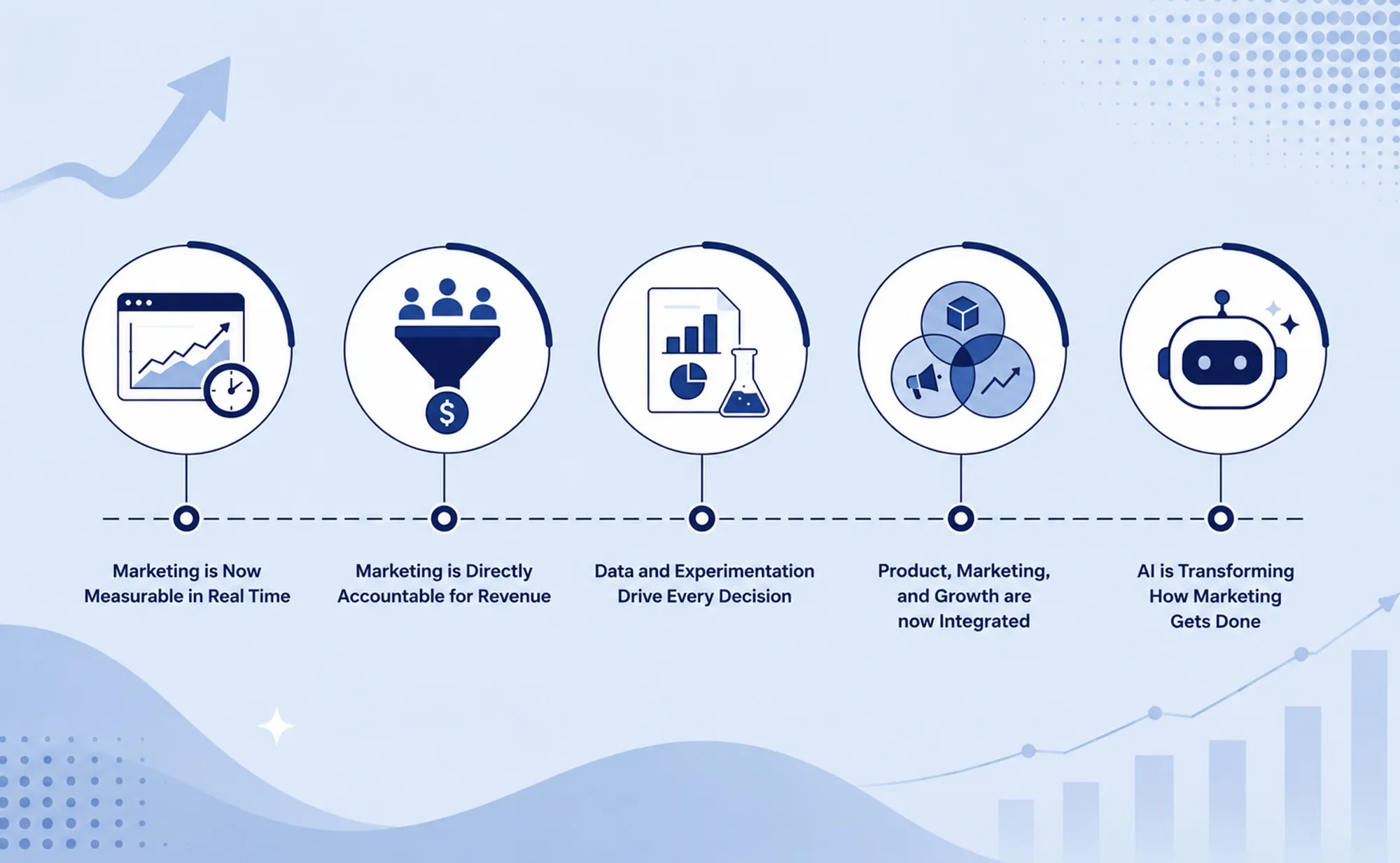
1) Marketing is Now Measurable in Real Time
Every user's action, like clicks, views, add-to-carts, and purchases, is captured in real time and processed instantly by marketing analytics tools. Marketers no longer wait for end-of-quarter reports. Instead, teams track live metrics while campaigns are still running and acting within minutes.
There are several important real-time metrics marketers should track, such as:
- Cost Per Acquisition (CPA) and Return on Ad Spend (ROAS)
- Conversion rates and funnel drop-off points
- Customer Lifetime Value (LTV) and attribution across channels
An important example of this shift from retrospective reporting to continuous, data-driven optimization is in the eCommerce industry, where every interaction is measurable and actionable.
2) Marketing is Directly Accountable for Revenue
The success of marketing teams is no longer based on brand recognition and market share. They now have to show in practical terms how investment translates into revenue and profit. A great example of this is Nykaa, which boosted marketing expenses by 29% to drive quarterly profit up 61% as more users began purchasing higher-value products on its website.
This is revenue-accountable marketing in practice—a direct, quantifiable linkage between investment and business outcome that every modern marketer is expected to demonstrate.
3) Data and Experimentation Drive Every Decision
Modern marketing has replaced gut instinct with a structured experimentation mindset. Decisions are made through controlled tests, not assumptions. This, in practice, looks like:
- A/B testing of landing pages, creatives and messaging by performance teams and then scaling what is working
- Growth groups developing multivariable tests in pricing, recruiting, and promotion
- Product and strategy decisions are directly fed with data from every experiment
The ability to form a hypothesis, run a test, read the results, and iterate is now a core competency, not a specialist skill reserved for analysts.
4) Product, Marketing, and Growth are now Integrated
Marketing no longer operates in silos. Today, marketing, product, and growth teams function as a single, integrated loop in which product changes inform campaigns, which surface product insights, and both are measured against the same revenue and retention metrics. Swiggy's approach is a strong example: it tightly integrates in-app features like loyalty rewards and subscription bundles with its marketing campaigns to drive retention and LTV.
For MBA students, this means that success in marketing today requires understanding product thinking and growth metrics as much as brand strategy and creative execution.
5) AI is Transforming How Marketing Gets Done
AI isn't just a buzzword anymore; it's a reality that's being leveraged every day. Today, AI tools automate content production, optimization, audience targeting, and reporting on performance, which enables lean teams to operate at scale. Survey data shows:
- 21.5% of employees report high levels of AI use in marketing plans; 33.64% report medium levels
- 82% of businesses are prioritizing AI for SEO in 2026, with 25% of marketing budgets allocated to AI tools
- 90% of marketing agencies use generative AI daily
The implication is clear: AI fluency is no longer a differentiator for marketing graduates—it is a baseline expectation.
Where Many MBA Marketing Specializations Fall Short
Despite these shifts in how marketing operates, many MBA marketing specializations have not updated their curricula to reflect these changes. The core problem is structural: traditional MBA programs were designed for a stable, predictable business environment that no longer exists.
The Curriculum Gap
Most traditional marketing courses continue to emphasize classic brand examples, general consumer behavior patterns, and campaign planning based on mass media, while barely touching on marketing technology, performance channels, and digital implementation. Consequently, graduates tend to leave school with gaps in skills:
- Limited understanding of the creator economy and influencer strategy
- No hands-on experience with performance marketing platforms or analytics tools
- Little working knowledge of the AI tools that now power marketing teams
- Ability to articulate a positioning strategy, but an inability to run or interpret a modern digital campaign
The Skills Gap
There has been a significant shift in employer expectations. There is a growing demand for companies to have expertise in performance marketing, data analytics, and digital ecosystem management. It is estimated that there will be more than 1.5 million jobs in digital marketing in India by 2026. Despite this, 45% of employers report difficulty finding skilled digital marketers.
Case studies have their place in building strategic intuition, but they do not teach students how to solve problems they have never encountered before—and in today's environment, novel problems are the norm.
What a Future-Ready MBA Marketing Specialization Should Look Like?
A new generation of industry-aligned programs is emerging—designed specifically around how marketing is practiced today. A genuinely future-ready MBA marketing specialization is built on four non-negotiable principles.
Digital and AI-First Curriculum
The curriculum must be digital and AI-first by design, not an add-on elective taught on top of traditional marketing theory. This involves comprehensive, in-depth coverage of:
- Marketing analytics and performance channels
- Growth loops and conversion optimization
- Marketing technology stacks and AI-powered tools
Specialized Tracks, Not Generic Marketing
The program should feature specialized courses across various functional areas of marketing, such as brand management, product marketing, growth marketing, eCommerce, and AI marketing, as these are the areas where job growth and value creation are occurring at a faster pace. Hence, students who obtain a generalist degree often find it difficult to secure jobs that require specialized knowledge.
Practitioner-Led Faculty
Rather than career academics, faculty members should be industry practitioners. There is a fundamental difference between learning performance marketing from someone who has managed multi-crore advertising budgets at a D2C brand versus reading about it in a textbook. Unlike classroom instruction alone, practitioner-led learning provides real context, current tools, and professional networks.
Live Projects and Revenue-Linked Outcomes
Students should run experiments, read live dashboards, and own measurable results, not just analyze what others did in the past. The shift from passive case analysis to active execution is what separates programs that build job-ready graduates from those that do not.
Altera Institute's PGP in Applied Marketing
The Altera Institute exemplifies this approach. Its 15-month PGP in applied marketing is built around a 100% industry-backed curriculum spanning brand management, product marketing, growth, and AI applications—with faculty who include CXOs and CEOs from leading FMCG, D2C, and consumer tech companies.
Altera Institute's approach has led to the following key outcomes:
- 100% of graduates from the 2025 cohort were placed
- 70% of students placed in roles above ₹15 LPA
- Curriculum designed in collaboration with industry partners for direct relevance to roles
Careers Trajectories in MBA Marketing
The range of careers accessible through marketing and its potential to earn good money are among the most compelling reasons why marketing is a good MBA specialization when the program is a good fit. Contemporary marketing has expanded to encompass a broad spectrum of high-growth roles at the intersection of strategy, data, and technology.
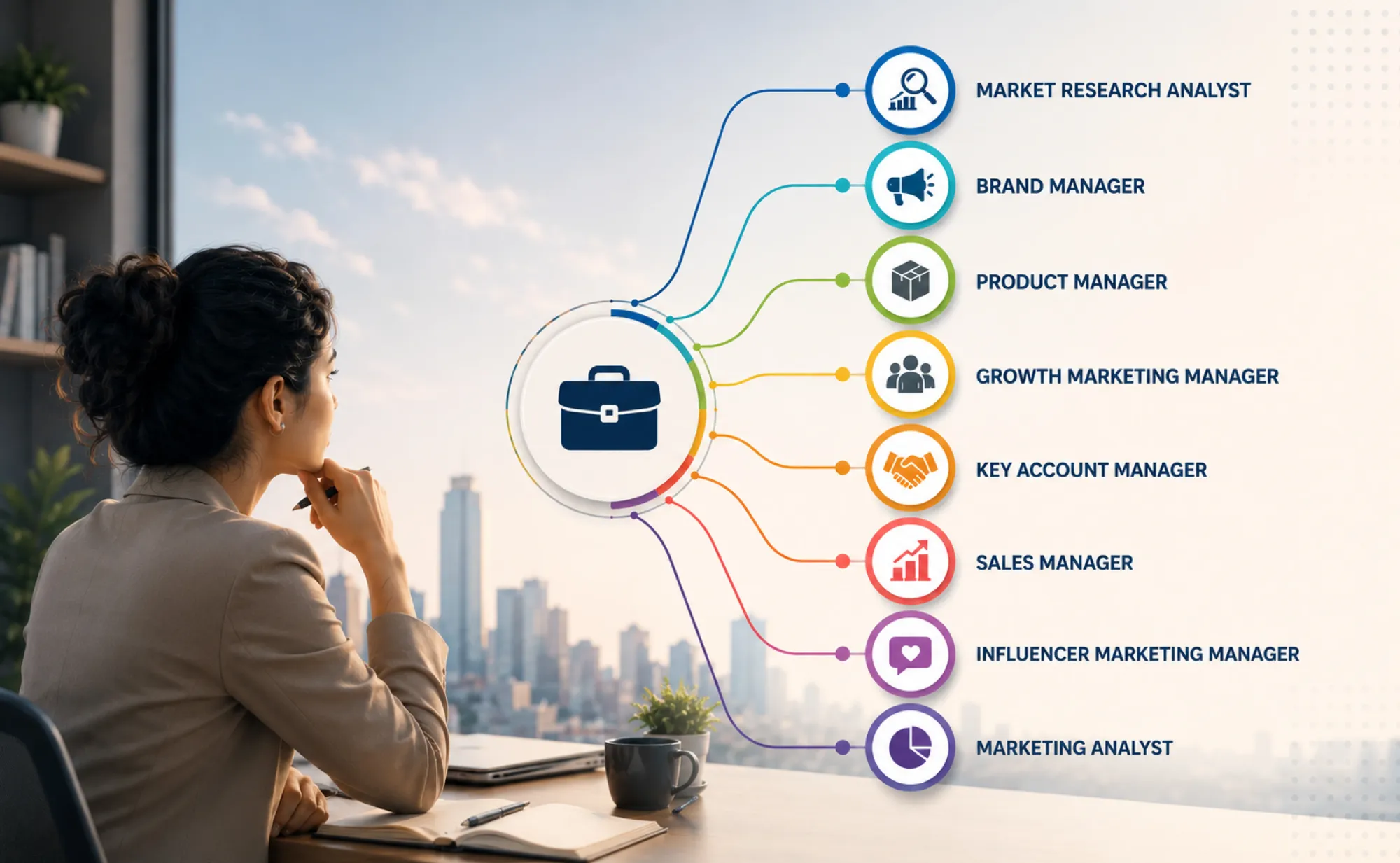
Key Roles Marketing Graduates Can Pursue
- Brand Manager: Responsible for the brand strategy, positioning, and messages on multiple channels.
- Product Marketing Manager: Responsible for product launches, sales enablement, and bridging the gap between product development and go-to-market strategy.
- Growth Marketing Manager: Drives acquisition, activation, and retention through data-led experimentation.
- Performance Marketing Manager: Responsible for paid media, ROAS performance optimization, and campaigns that drive conversions.
- CRM / Lifecycle Manager: Owns customer journeys, retention strategies, and LTV programs.
- Marketing Analyst: Translates data into actionable insights across all marketing functions.
Skills Needed to Succeed
Graduates must possess the following skills to be successful in these jobs:
- Understanding Data and Business: Unit economics, revenue attribution, funnel metrics
- Channel Expertise: SEO, SEM, paid media, content, social, and community management
- Strategic and Analytical Thinking: Linking Marketing with Product, Price and Distribution
- Stakeholder Communication: Transforming data insights to create compelling stories
- AI and Marketing Tech Fluency: Being proficient in using modern marketing tools for campaigns
Conclusion
Marketing is no longer just about broadcast advertising and communication. It is now a growth, product, and revenue function at the core of how businesses acquire, engage, and retain customers.
This transition presents a huge opportunity for the MBA aspirant; however, it also carries risks. The opportunity lies in the vast and ever-growing need for skilled marketers who are equipped for the current digital, AI-driven landscape. Similarly, the danger lies in selecting a program that provides marketing instruction as it existed in the past, not as it has evolved.
Instead of evaluating marketing as a different subject from finance and operations, the real question should be, "Am I receiving marketing education as it is currently being practiced, or is it outdated?" Choose programs that are aligned with industry practice, digital-first, transparent about outcomes, and built by practitioners. An MBA specialization in marketing is one of the most powerful and future-ready options as marketing education catches up with marketing practice.