Careers after Altera Institute


The definition of a “promising MBA career” has changed more in the last six years since the pandemic than in the preceding two decades. Twenty years ago, management school grads often had to settle on a trademarking job with an FMCG giant, an enterprise sales job with a tech firm, a field management job, or a relationship position in banking. They were, and still are, great career avenues established in process, hierarchy, and scale. However, they are no longer the fastest-growing or the best-paying options in India's economy.
Today, the most high-growth, high-paying professions are often at the crossroads of AI, eCommerce, performance marketing, brand and product thinking, and data-driven decision-making. These are positions characterized by the ownership of revenues, real-time measurements, and experimentation. Furthermore, by 2027, AI and automation are set to change 23% of all jobs worldwide. This means the education system, which has been lagging behind market standards, must catch up and accelerate.
The Altera Institute was created to bridge this gap. Designed by senior leaders from companies like Bain & Company, Hindustan Unilever Limited, Goldman Sachs, Haleon, and EY-Parthenon, the 15-month Post Graduate Program (PGP) in Applied Marketing is built around four major career paths: Brand, Product, eCommerce, and Growth, which correspond to Indian digital economy hiring patterns. In this article, we answer the question: What careers can you realistically build if you join the Altera Institute today?
The Job Market Altera Institute Is Built For
Before examining what Altera Institute prepares students for, it helps to understand the structural shifts that have made the job market look so different from the one traditional MBA programs were designed to serve. Four shifts are driving this change simultaneously.
- The value of AI is shifting from execution to judgment. McKinsey says 88% of businesses use AI for at least one function, and generative AI could automate 30% of work by 2030. Tasks that previously consumed entire weeks, such as content creation, campaign optimization, data analysis, and ad-spend management, can now be accomplished in a matter of minutes. Thus, the competitive advantage lies not in performing these tasks but in interpreting results, spotting patterns, and making strategic decisions.
- Business today is measured in real time. All clicks, conversions, and revenue sources are monitored on live dashboards. India's digital workplace maturity stands at 64.6%, which is higher than the global average of 62.3% and most of the developed markets. Professionals in this setting are required not only to interpret metrics on a daily basis but also to make decisions swiftly and confidently.
- Decision cycles have been compressed dramatically. Due to the speed of product development and the use of agile techniques, companies can deploy, test, and switch gears within a few weeks. It places a high value on professionals who can work effectively with hypothesis-driven thinking, A/B tests, and fast failures, rather than those who work best within slow approval processes.
- Functions are converging. There has been a significant disintegration of the silos between marketing, product, growth, and eCommerce roles. Currently, the hottest job titles include growth product managers, brand growth leads, and digital-first category managers. It is no longer enough to possess generic management skills to get into these roles, but employers are now looking for candidates who can work across functions.
Altera Institute's curriculum is specifically tailored to today's market realities, not to the market 10 years ago. These four career tracks are directly aligned with the positions that employers are having trouble filling: eCommerce category heads, performance and growth marketers, product managers with P&L ownership, and brand strategists with a data-driven approach.
How does Altera Institute's Learning Journey Map to Real Roles?
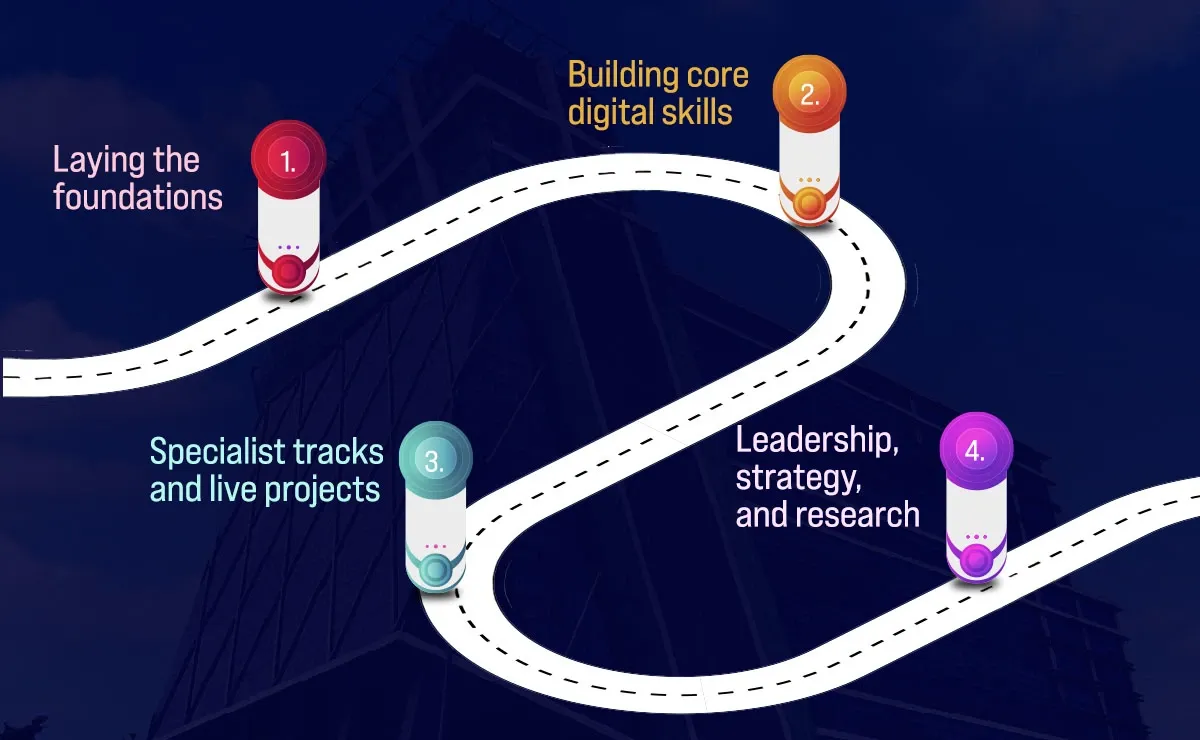
One of Altera Institute's most distinctive features is what might be called career-backwards design: the program starts with the roles graduates need to fill and works backwards to build the curriculum around them. The 15-month PGP is divided into four terms, each ending with a capstone project that mirrors real-world responsibilities—not academic exercises.
- Term 1 – Laying the foundations. Students cover marketing management, go-to-market strategy, media basics, business finance, managerial economics, and applied analytics. The capstone requires students to build a D2C brand from scratch—defining the product, marketing mix, GTM strategy, and communication plan, then executing them. This gives students a practical foundation that most MBA programs spend an entire first year approaching only theoretically.
- Term 2 – Building core digital skills. It focuses on digital commerce, brand building, digital media planning, supply chain, and organized trade, all of which are presented by working practitioners. The final stage is the MVP launch, where students take a product from concept through market research, design, and commercial planning, then present it to industry leaders. At this stage, every student will have created two large portfolio pieces that will reflect a true sense of commercial ability.
- Term 3 – Specialist tracks and live projects. This is when the four career tracks diverge. Students go deep into brand management, growth marketing, eCommerce media planning, category management, generative AI in business, and content marketing. Crucially, placements also begin during this term—students develop their specialist skills while being evaluated by recruiters simultaneously. The Term 3 capstone involves solving a real business problem for an actual CEO or founder, receiving feedback based on genuine stakeholder concerns rather than academic rubrics.
- Term 4 – Leadership, strategy, and research. The final term shifts from functional execution to strategic and behavioral development. Courses cover business strategy, leadership, entrepreneurship, retention marketing, B2B marketing, and business innovation. The capstone is a publishable research report—a professional document that adds to business knowledge, not just academic writing. Placements conclude during this term.
Woven across all four terms are 20+ expert sprints—intensive 4- to 8-hour sessions led by practitioners from Netflix, HUL, EY-Parthenon, Microsoft, Pernod Ricard, Bain & Company, and Whiteboard Capital. Each sprint focuses on a specific high-value skill: consumer insights, product design thinking, negotiation, root cause analysis, or VC investment frameworks. Together, these sprints ensure that the program's learning intensity goes well beyond what any course list suggests.
Skill Clusters That Define Careers After Altera Institute
The program's real-world architecture comprises five clusters of skills, each associated with specific career outcomes. Knowing these clusters can also explain why graduates are of interest to recruiters, not only for their qualifications but also for their ability to make an immediate contribution.
- Revenue and P&L ownership: The majority of MBA students view marketing merely as a cost function; the Altera Institute trains students to view it as a revenue function. Students examine economic categories, operate pricing decisions, and assume ownership of product profitability. These are factors expected from an eCommerce category manager and brand managers with commercial accountability right from day one.
- Digital execution: Students build growth funnels, run media on Amazon and Flipkart, and manage performance campaigns on Google and Meta—not as case studies, but as live exercises. This constitutes a fundamental tenet of growth marketing, performance marketing, and digital commerce functions within companies such as Blinkit, Publicis Groupe, and Wella.
- Product thinking: The D2C brand capstone and the MVP launch help students to identify customer problems, design solutions, build business cases, and take ideas to market. Graduates who come seeking positions in product management or a founder’s office come with actual portfolio pieces, rather than just theoretical frameworks.
- Data and AI proficiency: Applied Analytics from Term 1 and Generative AI in Business from Terms 2 and 3 ensure students can analyze business data, build arguments, and use AI tools for content creation, consumer research, and forecasting. In high-growth roles across brand, product, eCommerce, and growth, this is now a baseline expectation—not a differentiator—and the Altera Institute treats it accordingly.
- Leadership and strategic communication: Term 4 focuses on business strategy, innovation, and volatility management and prepares students to think and communicate beyond their entry-level roles. This is what enables faster progression into lead roles and eventually into CXO-track positions—a capacity most programs leave entirely to on-the-job experience.
What makes this combination rare is that most programs build depth in one or two of these areas while treating others as electives. Altera Institute's design ensures that all five clusters are developed together, which is precisely why recruiters report finding Altera graduates ready to operate cross-functionally from day one.
Career Outcomes and Salaries: Class of 2025
The placement data shows whether a program's claims are proven correct or falsified. The results of the Altera Institute Class of 2025 are both tangible and eye-opening regarding what this type of education actually provides in the market.
On salary metrics, the class reported an average CTC of ₹16.85 LPA, a median of ₹18.14 LPA, and a highest package of ₹26.08 LPA. More significantly, graduates achieved a 3.8x increase in CTC relative to their pre-PGP compensation—one of the strongest returns on investment among comparable programs in India. For early-career professionals who joined the program specifically to bridge a skills gap, this CTC uplift demonstrates that the program is doing exactly what it was designed to do.
The role distribution also relates an equally crucial story about the quality of careers, not just pay:
- 35% of the class entered eCommerce roles
- 24% joined founder’s office or EIR (Entrepreneur-in-Residence) positions
- 12% moved into growth and revenue functions
- 9% entered product management
- 9% were placed in brand management
- 11% joined FMCG sales and marketing
These are not generic management trainee jobs or field sales roles. They are decision-making roles in high-growth organizations, including HUL, Flipkart, Godrej, Mamaearth, Blinkit, Publicis Groupe, and Wella Company. A number of these recruiters revisited campus in consecutive groups, indicating a true, lasting fit rather than just a single placement win.
Who Should Choose Altera Institute?

Altera is not the right program for every aspiring MBA student, and the institute doesn't pretend to be. Understanding where it fits—and where it doesn't—is the most useful decision framework for anyone evaluating their options.
Altera Institute is a strong fit if you:
- You want to own revenue and growth in digital-first roles—brand, product, eCommerce, performance marketing, category management, or a founder's office—rather than occupying a support function.
- You are comfortable in measurable, AI-assisted environments where performance is visible in real time, and the expectation is experimentation, not just execution.
- You value learning by doing, like building a D2C brand, launching an MVP, solving live founder problems, and graduating with a portfolio of real work that speaks louder than a grade sheet.
A generalist MBA may serve you better if:
- Your goal is to have a bigger management influence in finance, operations, consulting, and HR, and you are unsure whether you would like to specialize in the digital-first revenue jobs.
- You are ok with a slower career cycle of FMCG or corporate systems, where brand building is measured in years rather than weeks, and hierarchies are apparent.
For the 35% of Altera Institute's current cohort who are freshers and the 65% who are early-career professionals looking to break into a different kind of role, the program offers something a generalist MBA structurally cannot: direct, verified access to India's fastest-growing career categories, backed by a curriculum built around those roles from the ground up.
Conclusion
The careers you have after Altera Institute are not accidental; they are engineered. To prepare graduates for their first roles as revenue, data, and cross-functional execution experts, the program uses live projects, expert sprints, and capstone deliverables, working backwards from the roles India's digital economy is currently creating.
The numbers reinforce this design logic. In addition to a 3.8x increase in CTC and an average salary of $16.75 LPA, placements were primarily in eCommerce, growth, product, brand, and founders' offices. This reflects a program aligned with where the economy is headed rather than where it has been. Altera Institute prepares students for careers that will make up the mainstream of tomorrow's industry, in a market where artificial intelligence (AI) is expected to reshape global jobs and the Indian digital economy is expected to grow with it.
If your ambition is to build a career at the intersection of brand, product, eCommerce, and growth in India's digital economy—one where you own outcomes, operate with data, and work close to the decisions that actually move businesses forward—Altera Institute is one of the very few programs built ground-up for exactly that path.