
Is a 1-Year MBA Worth it for Fresh Graduates Without Experience?


Here is a question that is not asked enough often: What happens to ambitious graduates who know exactly what they want to achieve but are required to gain some experience before they can access the kind of education that would help accelerate their careers?
For many MBA aspirants in India, this question is a reality. Modern businesses operate at a fast pace, and employers do not expect a new employee to be a novice; they want them to be a valuable asset to the team from the start. This has rendered management education more relevant, focused, and practical than ever before and more focused, accelerated, and practical.
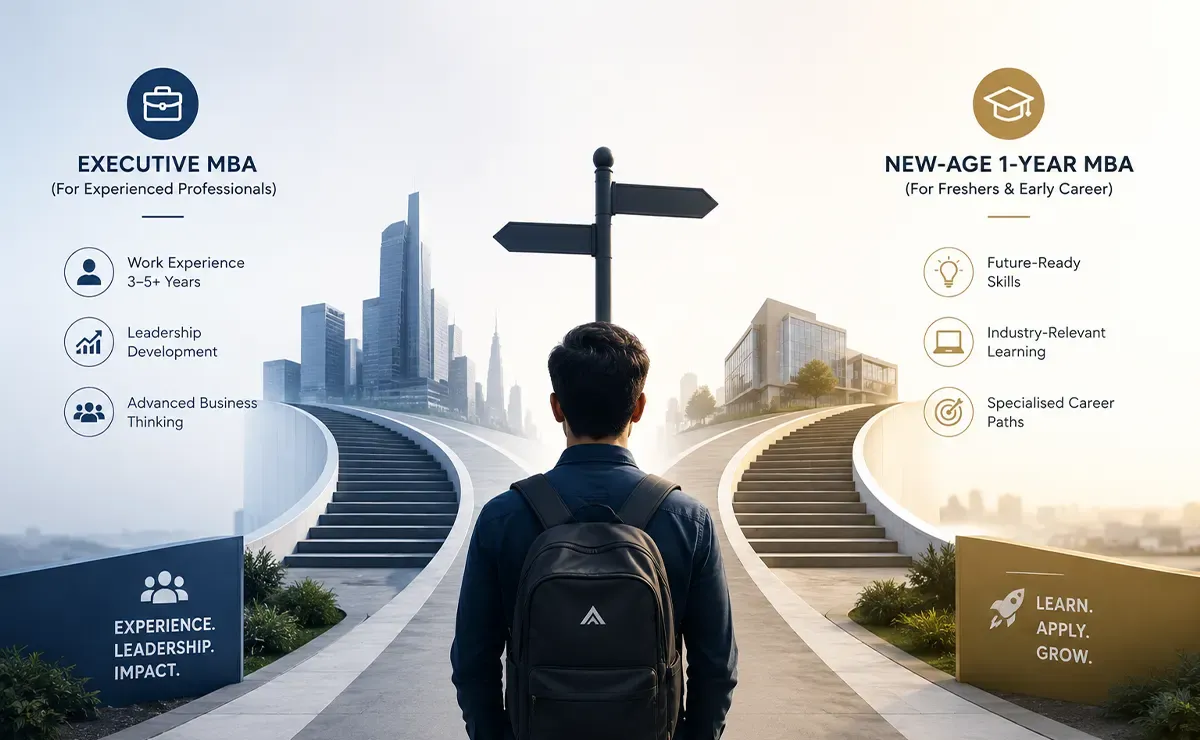
But there's a big difference here. In India, most MBA colleges offer one-year programs for working professionals, not for new college graduates. These programs are organized as Executive MBA, PGPX, or EPGP courses and require prior work experience for eligibility.
But that does not mean fresh graduates are left without options. A growing number of specialist and new-age B-schools today are building one-year programs that are genuinely open to freshers. This article, therefore, answers the question of whether 1-year MBAs are beneficial for freshers and whether the right program exists to help them build meaningful career momentum from the start.
Why Are 1-Year MBAs Becoming More Relevant Today?
One-year MBA programs are rising in popularity, not only because this format caters to student convenience. Rather, it marks a bigger shift happening in the job market over the past decade. Businesses are shifting their focus towards AI integration, faster execution, and data-driven decision-making, which requires them to hire specialists with job-ready skills who can perform beyond theoretical knowledge alone.
This is especially true in high-growth sectors like technology, digital marketing, product management, and consumer brands. Jobs in these domains require candidates to bring a certain level of acquired skills and competencies. And this is now a standard expectation of recruiters, which has pushed business education to prepare students for such market realities. This is why 1-year MBA programs are shorter, more intensive, more targeted, and, most importantly, well-suited to prepare talent for today's hiring landscape.
Here is what makes the one-year format so relevant:
- Targeted Curriculum: 1-year MBA programs provide targeted learning and upskilling in a specific domain, teaching core business principles practically, skipping foundational content that candidates can self-study, and prioritizing applied learning.
- Lower Opportunity Cost: Candidates spend less time away from the professional world and pay lower tuition fees, reducing both financial costs and career interruptions.
- Industry-Aligned Pedagogy: The best 1-year programs reflect the realities of modern business operations and incorporate digital tools, data-driven decision-making, and AI integration directly into their curricula to provide a more holistic preparation for students.
- Better Return on Investment: A shorter duration and faster career entry make the financial investment more compelling, especially for self-financing students.
For fresh graduates, these qualities are especially relevant. Rather than spending two years before entering the workforce, a well-designed one-year program can accelerate the timeline while delivering a focused, industry-relevant learning experience. But a fresher must also realize the importance of having clear career goals before pursuing such a course. Since 1-year MBA programs are known for their relevance to specific domains, freshers must align their career goals with the right program to achieve these outcomes.
Eligibility Criteria for 1-Year MBAs in India

Before going into the details, it's crucial to note that most 1-year MBA courses in India are executive programs that require candidates to have a specified number of years of work experience before applying. For example, ISB's PGP requires at least 24 months of post-graduation work experience. The PGPM from SPJIMR and PGDGM from XLRI usually require at least 3 years of experience, and the average profile of the students ranges from 3 to 5 years.
This is because such programs are designed with a professional context that emphasizes leadership development, advanced business thinking, and cross-functional specialization. It is very intentional and works highly in favor of the student profiles they cater to.
That said, this does not mean fresh graduates have no 1-year MBA options available to them. Today, a parallel segment of 1-year MBA programs that cater to both fresher and early-career professionals is also expanding alongside these executive-style programs.
Many specialist and new-age B-schools, such as Altera Institute, Scaler School of Business, and Master's Union, have begun offering highly structured and industry-relevant 1-year courses. These programs recognize that not every ambitious student wants to wait three to five years before pursuing specialist management education in a targeted domain.
For fresh graduates, these programs typically evaluate candidates on factors beyond work experience, such as:
- Academic consistency and intellectual aptitude
- Clarity of career goals and direction
- Demonstrated interest in modern business areas and functions such as growth, product, AI, or digital marketing
- Willingness to engage seriously with applied and practitioner-led learning
What Do Freshers Gain From a 1-Year MBA?
When a program is well-designed, industry-relevant, and aligned with a candidate's goals, a 1-year MBA can offer genuine and lasting advantages for fresh graduates. The key is to evaluate the program on what it actually delivers, not just on the prestige of its brand name.
1) Faster Career Start
Recent graduates who want to jump straight into postgraduate studies without first dipping their toe into the job market find 1-year MBA programs the right steppingstone to break into high-growth business functions such as product, growth, analytics, and marketing roles much earlier. And this uninterrupted academic progress gives students a head start, enabling them to break into competitive domains such as product management, growth marketing, and business analytics much earlier, with the right skills and competencies.
2) Practical Skill Development
1-year MBA programs are designed to offer a more practical learning environment by leveraging integrated live projects, practitioner-led sessions, and industry-relevant tools. They go beyond theoretical textbook frameworks and can update their curriculum more quickly because they are not subject to UGC's strict rules. This allows fresh graduates to build a practical portfolio of real work they have done with companies and industry practitioners, helping them boost their profile for better outcomes. 1-year programs also help students develop:
- Business fundamentals and decision-making processes based on real-life applications
- Digital and analytical thinking applicable in the current business context.
- Domain-specific expertise in areas such as marketing, product, operations, or business analytics
- Communication, collaboration, and performance skills, which directly relate to job performance
3) Learning How Businesses Actually Operate
Most graduates enter the workplace expecting structured problems, clear instructions, and regular feedback. Business environments rarely work that way. A strong one-year program exposes students to ambiguity, trade-offs, and real-world decision-making much earlier, helping them develop business judgment before they enter the workforce. In fast-moving domains like business analytics, growth marketing, and digital strategy, this matters deeply. These fields demand business judgment, not just technical skill—and a well-designed program builds that judgment before your first day on the job.
How to Choose the Right 1-Year MBA as a Fresh Graduate
Choosing a one-year MBA as a fresh graduate requires a different evaluation lens. The most important factor is not the brand name on the certificate. It is whether the program is genuinely designed to serve the needs of candidates without professional experience.
If you're considering a program, you should ask yourself these questions before applying:
- Is the program eligible for freshers? Ensure that the minimum eligibility criteria do not require work experience
- Does the curriculum reflect modern business realities? Look for programs that address digital strategy, data-driven decision-making, AI-integrated tools, and contemporary business execution
- Who teaches the program? Courses taught by practitioner-led faculty, such as start-up founders, growth leaders, and operators, are often more practical and relevant in providing real-world insights
- What roles do graduates typically enter? Placement data should reflect roles that a fresh graduate can realistically step into, not just titles that require five or more years of prior industry experience
- Does its curriculum include a live project or industry exposure? Real-world experience with real companies during the program is a good indicator that the learning model is designed to be applied, not just theoretical
When a 1-Year MBA Is NOT the Right Choice
Here are some scenarios where pursuing a 1-year MBA right away might not be the best choice:
- You are still exploring different career options
- You are unsure whether you want marketing, finance, consulting, or analytics
- You value internships and campus experiences
- You want a broader management foundation before specializing
Is It Worth It? The Honest Answer
A 1-year MBA can be absolutely worth it for fresh graduates in India, provided the program is genuinely designed with freshers in mind and closely aligned with the career they intend to build. It is true that most traditional 1-year MBAs remain executive-style formats built around work experience. That has always been their design intention, and it works well for the audience they serve.
But today, the market is expanding, with many new-age B-schools offering structured 1-year programs for fresh graduates. They offer practical and industry-relevant business education to candidates who may not yet have professional experience but do have clear ambition and direction.
For freshers, the real value of the right one-year MBA lies in:
- Building early career momentum instead of waiting years to access targeted management education
- Gaining practical, portfolio-building exposure to real business problems from the very beginning
- Acquiring job-specific abilities in fields with a high demand for employment
- Entering the workforce with a clear professional identity and demonstrable execution experience
- Achieving a stronger return on time and financial investment compared to longer, less targeted formats
For fresh graduates, the question is not whether a one-year MBA is better than a traditional MBA. The real question is whether you already know where you want your career to go. If you do, a focused one-year program can help you build relevant skills, enter the workforce sooner, and accelerate your progress. If you don't, spending more time exploring different industries and career paths may be the wiser investment.